A crater of fire in the Turkmenistan desert has been burning nonstop since 1971 after a Soviet drilling accident, and now, 54 years on, the so-called Door to Hell is finally going out
In the Karakum desert of Turkmenistan there is the Door to Hell crater, a pit of fire roughly 70 metres wide that has not stopped burning for over half a century. People call it the Door to Hell. After 54 years, the flames are finally dying, and the reason behind it is as revealing as the fire itself.
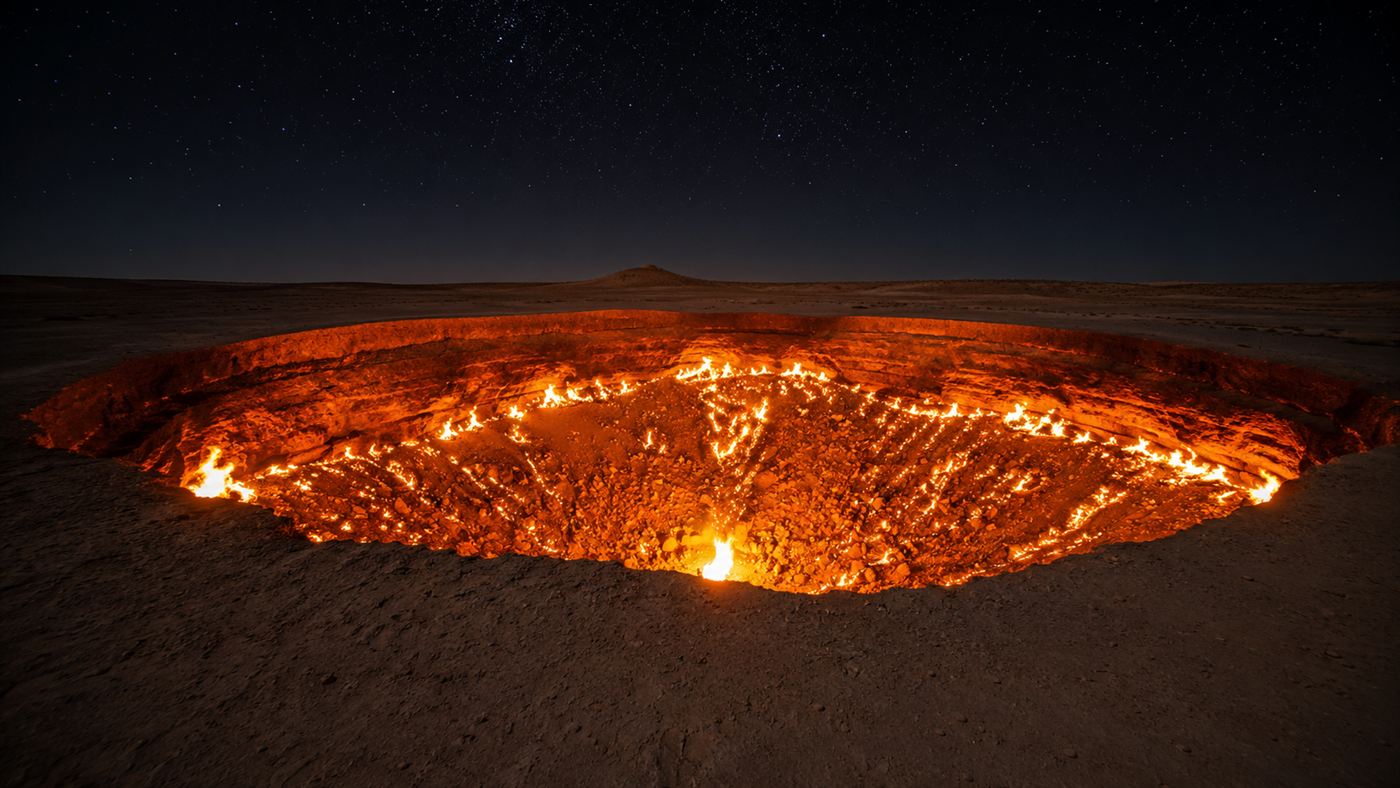
The Darvaza crater has burned in the Karakum desert for more than five decades. Illustration: Watts & Wild.
Out in the flat emptiness of the Karakum desert, a giant hole in the ground glows orange around the clock. The Darvaza gas crater, better known by the nickname tourists gave it, the Door to Hell, is a roughly 70-metre-wide pit that has been on fire continuously for as long as most people alive can remember. For decades it was Turkmenistan's strangest landmark and its top tourist draw.
Now something is changing. Recent satellite and infrared readings show the fire is fading fast, and the secretive government that owns the desert above it says it is deliberately putting the flames out. After more than half a century, the Door to Hell is closing, and how it got lit in the first place is a story of an accident that simply refused to end.
A 54-year accident
The usually told version is that in 1971 a Soviet drilling rig punched into an underground gas pocket in the Karakum, and the ground gave way, swallowing the equipment and opening a crater that began leaking methane. Worried about poisonous gas spreading, engineers reportedly set the crater alight, assuming the fire would burn through the gas in a few days or weeks.
It did not. The crater kept burning for the next five decades, fed by a steady supply of gas seeping up from below. What was meant to be a quick fix turned into one of the longest-running fires on the planet, a permanent bonfire in the middle of one of the emptiest deserts on Earth.
Why it kept burning
The reason the fire never went out is the same reason Turkmenistan exists on the world's energy maps at all: the country sits on some of the largest natural gas reserves on the planet. Beneath the Karakum desert is a vast store of methane, and the Darvaza crater happened to open a small, permanent vent straight into it. As long as gas kept rising, the flames kept feeding.
Over time the fiery pit became a grim sort of attraction. Despite the country being one of the hardest to visit on Earth, travellers made the trek out into the desert to stand at the edge of a glowing hole and feel the heat on their faces. The government even floated plans to extinguish it more than once, without ever following through.
The flames are finally fading
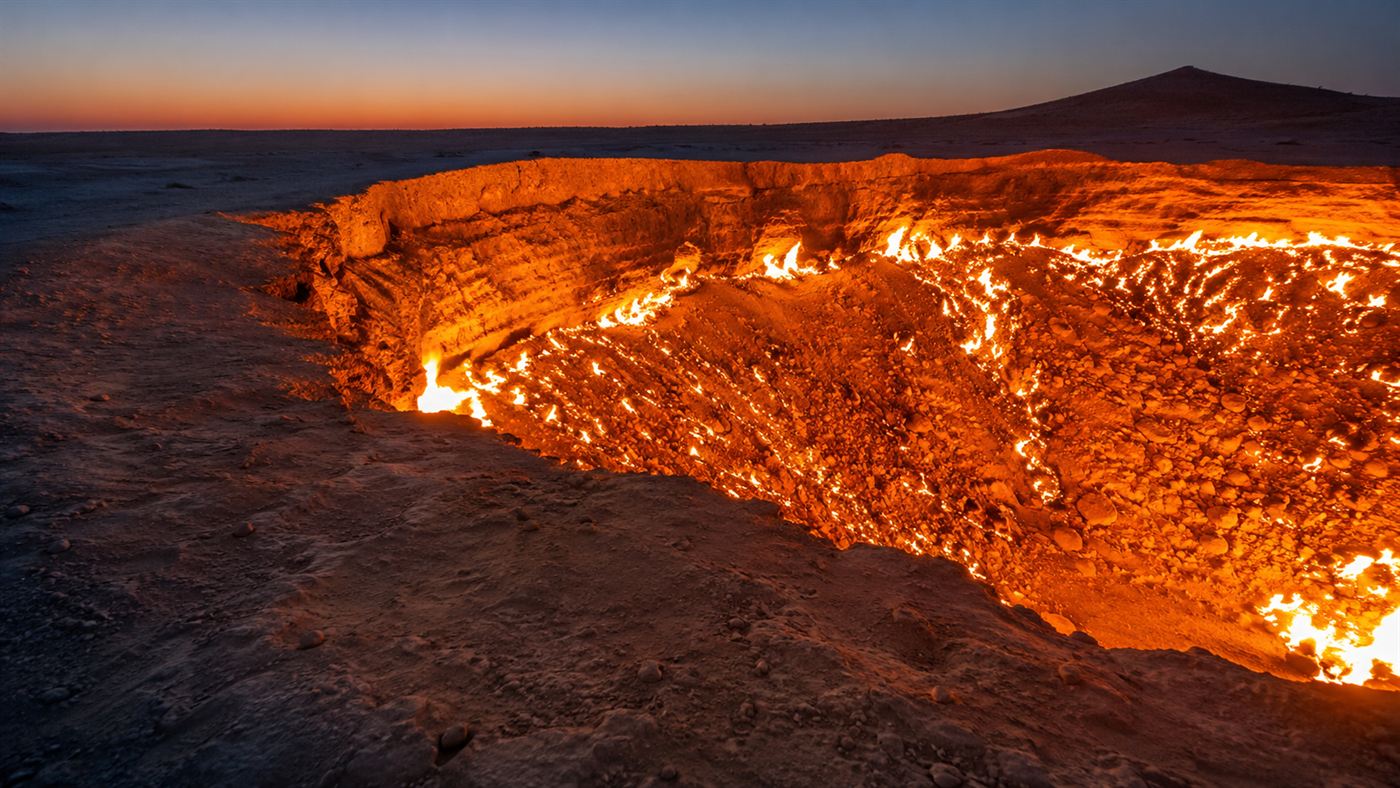
This time the change looks real. According to analysis by the gas-monitoring firm Capterio, the heat coming off the crater has dropped by more than 75 percent over the last three years, leaving only scattered pockets of flame where there was once a roaring inferno. A fire that defined the place for two generations is visibly winding down.
The official explanation is engineering. Turkmen authorities say the blaze has been reduced several times over, helped by new wells drilled around the crater to capture the gas before it reaches the surface. Catch the methane on its way up, the logic goes, and you starve the fire of fuel. By the count of state media, what was once a wall of flame is now down to a few small fires.
Why a government wants its hell closed
There is more than tidiness behind this. Methane is an extremely potent greenhouse gas, and a crater that simply burns it off, or worse, lets it leak, is both an environmental embarrassment and a waste of a valuable resource. Turkmenistan is one of the world's biggest methane emitters, and capturing the gas instead of flaring it lets the country sell it rather than sending it up in smoke.
So the closing of the Door to Hell is really a small chapter in a much larger global story: the scramble to stop methane escaping into the atmosphere. A fire that began as a careless way to deal with leaking gas is now being snuffed out for the opposite reason, because that same gas has become too valuable, and too climate-damaging, to let burn.
The honest catch
It is worth being sceptical about the neat official version. Independent experts at Capterio have noted that the flames appeared to start fading before the new wells were drilled, which raises the possibility that the underground gas was running low on its own, and that the government is taking credit for a fire that was already dying.
And there is a darker catch. Extinguishing the visible flames is not automatically good news for the climate. A burning crater at least converts methane into less harmful carbon dioxide. If the fire goes out but the gas keeps seeping up unburned, the result could actually be worse, because raw methane traps far more heat than the CO2 the flames were producing. Closing the Door to Hell only truly helps if the gas underneath is genuinely captured, not just quietly leaking in the dark.
Why the Door to Hell crater matters
The Darvaza crater was always more than a tourist curiosity. It was a 54-year monument to how casually the fossil-fuel age treated the gas under our feet, lighting a leak on fire and walking away for half a century. Watching it close is a strange kind of milestone, the end of an accidental landmark that should probably never have existed. It shares its underworld nickname with another Soviet drilling site, the Kola Superdeep Borehole that a hoax turned into a well to hell.
Whether its closing is a real climate win or just a fire running out of fuel is the question that actually matters, and it is still not fully answered. Would you have wanted to see the Door to Hell before its flames went out, or is the world better off with it closed? Tell us in the comments.
Related reading: China is building a 400 km solar great wall across a desert it once called the Sea of Death, aiming for 100 GW by 2030 to help power Beijing. See also the Danakil Depression, one of the hottest, most alien places on Earth.
More from Watts & Wild
 The 700 oil wells set ablaze in 1991
 Lake Kivu killer lake powers Rwanda's grid
 Catatumbo lightning, the beacon of Maracaibo
 Boiling river of the Amazon science denied
 Grindavik fights volcano lava with walls
 Eternal flame burns behind a New York waterfall
 The town burning underground since 1962
 Yanar Dag, the hillside that never stops burning