China is building a 400 km solar great wall across a desert it once called the Sea of Death, aiming for 100 GW by 2030 to help power Beijing
In a desert long nicknamed the Sea of Death, China's Solar Great Wall is stringing a 400 km belt of solar panels that is meant to do two jobs at once: feed power toward Beijing and physically stop the sand from spreading. NASA's own satellites say the ground is already turning green.
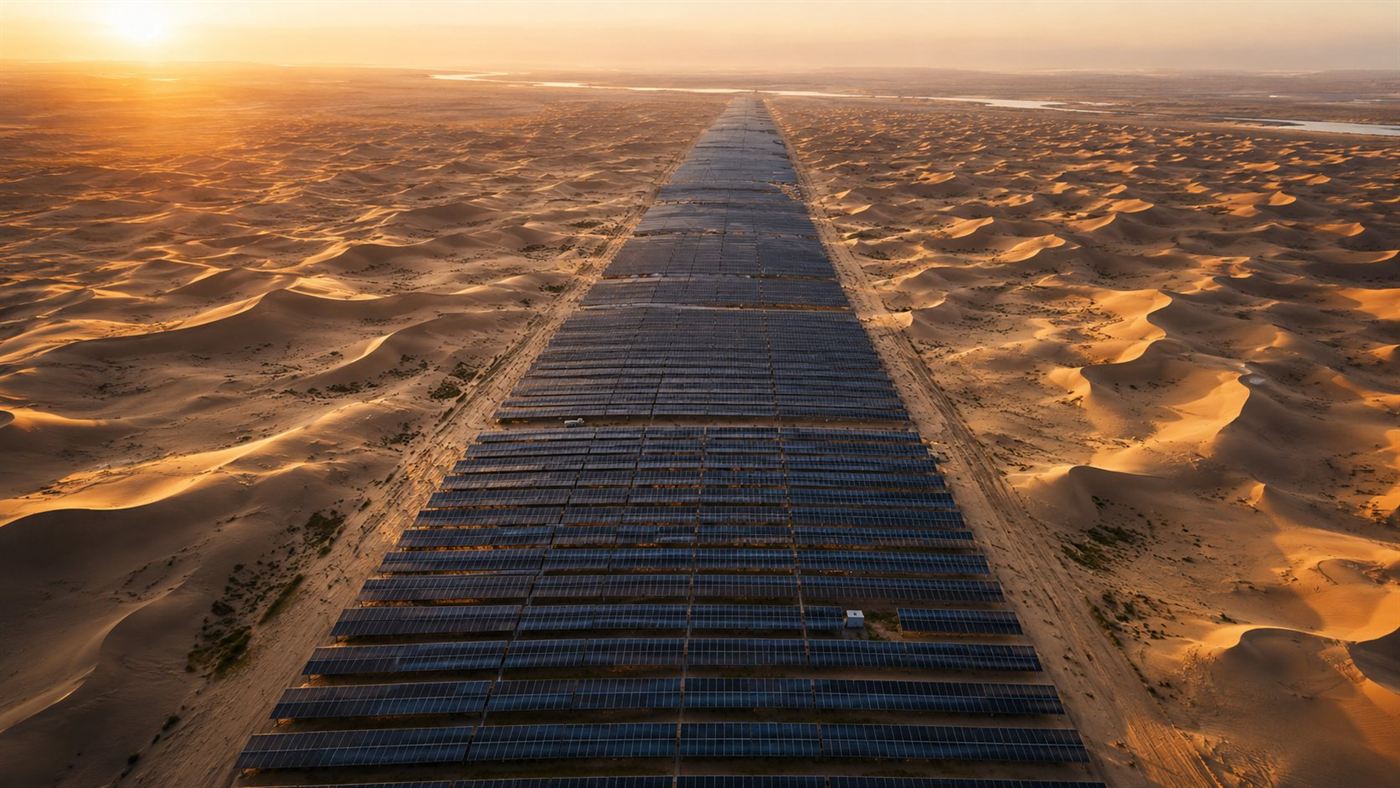
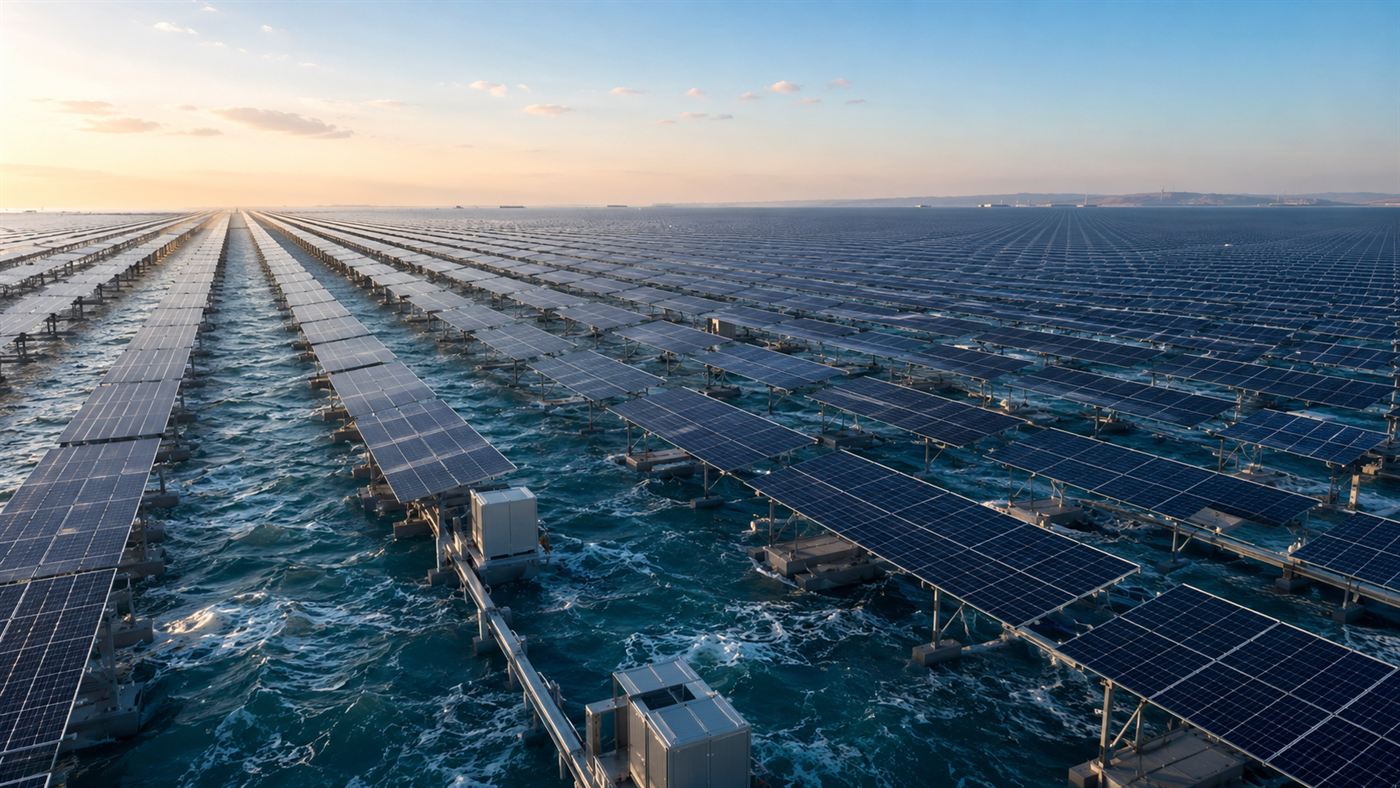
A corridor of solar farms runs for hundreds of kilometres across the Kubuqi dunes in Inner Mongolia. Illustration: Watts & Wild.
For most of recorded history, the Kubuqi Desert was a place you crossed quickly or not at all. Sitting in Inner Mongolia just south of the Yellow River, between the cities of Baotou and Bayannur, its barren, life-poor dunes earned it a grim local nickname, the Sea of Death. But now that same dead sand is being wired into one of the largest single energy projects on the planet, and you can see it from orbit.
The wave of attention arrived in the last days of December 2024, when NASA's Earth Observatory published satellite imagery of what it called a Great Solar Wall, in an article dated December 30, 2024, and trade press followed within days. What the images show is a belt of solar farms running roughly 400 km (about 250 miles) long and up to 5 km (about 3 miles) wide, an ongoing multiyear build that China is aiming to finish in 2030.
China's Solar Great Wall, seen from space
The headline numbers are deliberately enormous. The solar belt is planned at roughly 400 km long and an average 5 km wide, with a maximum generating capacity of 100 GW targeted for completion by 2030. As of late 2024, pv magazine reported that about 5.4 GW had already been installed as of late August 2024, which is a serious project in its own right but only a sliver of the full ambition.
One framing correction matters here, because the name is a little misleading. This is not a single continuous wall of glass marching across the horizon. It is a corridor, a belt of many separate solar farms strung across the Kubuqi, each run by different operators. The biggest single facility belongs to China Three Gorges, the same state giant behind the world's largest hydropower dam, and it runs at about 2 GW on its own.
The purpose, NASA states plainly, is power. The agency says the installation is designed to generate enough energy to power Beijing. Reporting points to a planned annual generation of roughly 180 billion kWh by 2030, with a large share sent eastward to the dense Beijing-Tianjin-Hebei region, the megacity cluster that anchors China's north.
The twist: a power plant that fights a desert
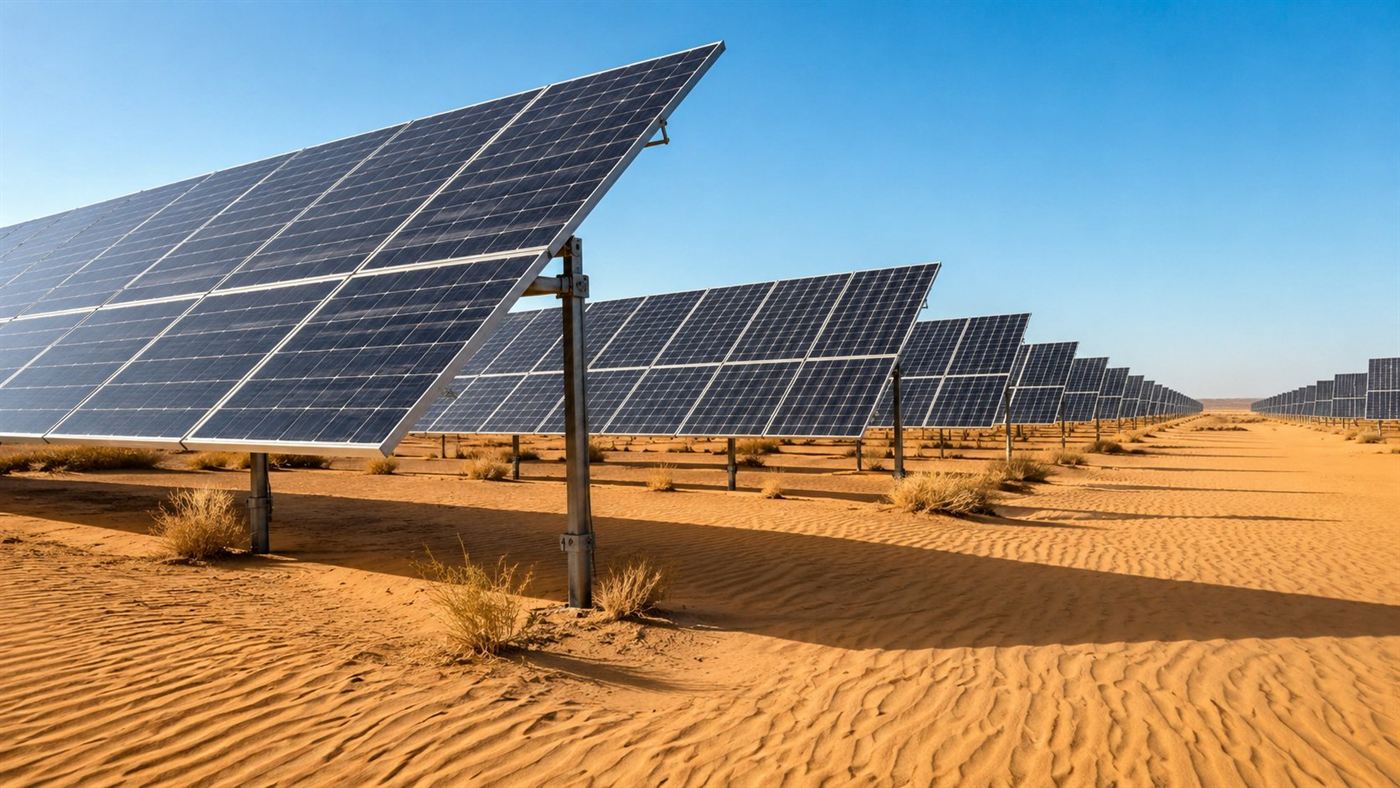
Here is what makes the Solar Great Wall more than just another big number. The panels are meant to pull double duty. Beyond electricity, planners expect the rows of glass to curb desertification by physically blocking the movement of dunes and slowing the wind that pushes sand into farmland and cities downwind.
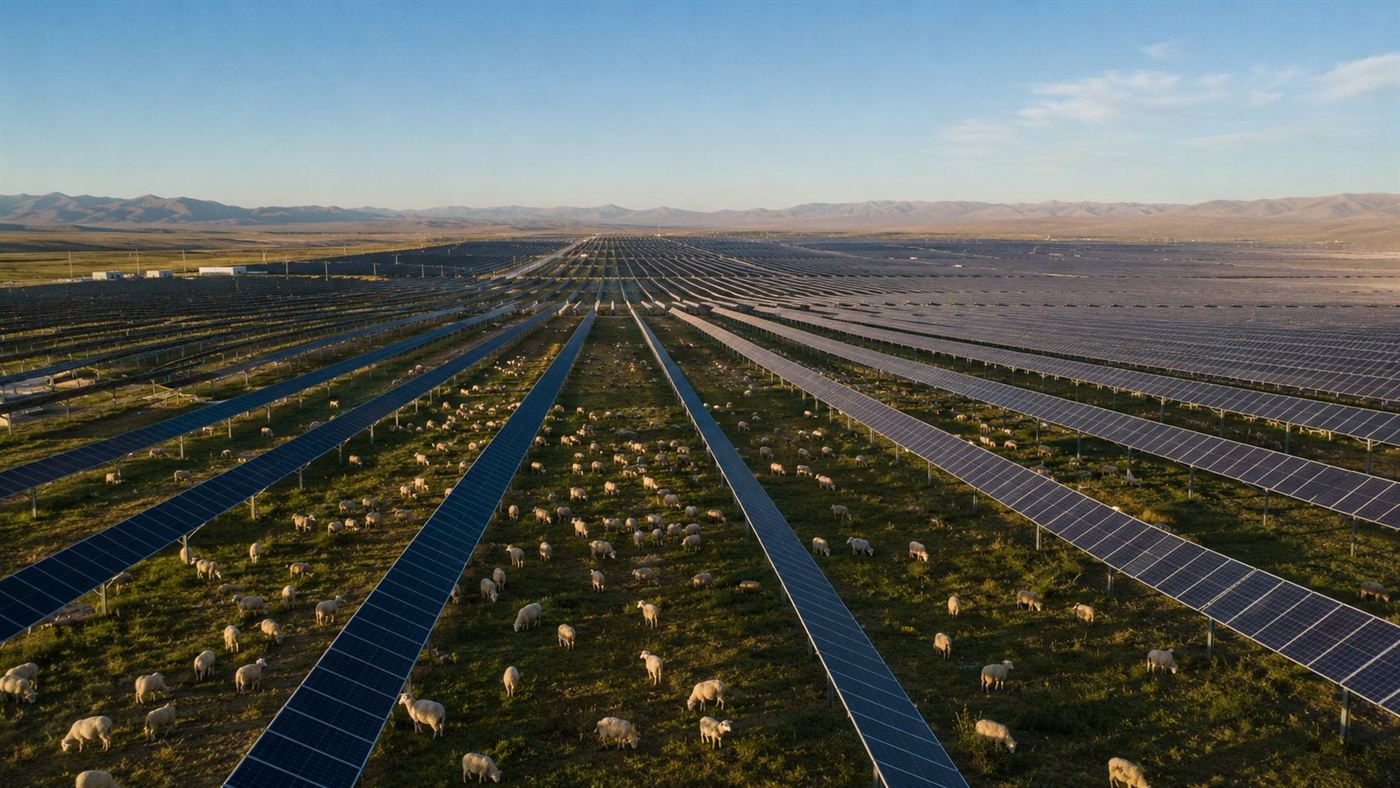
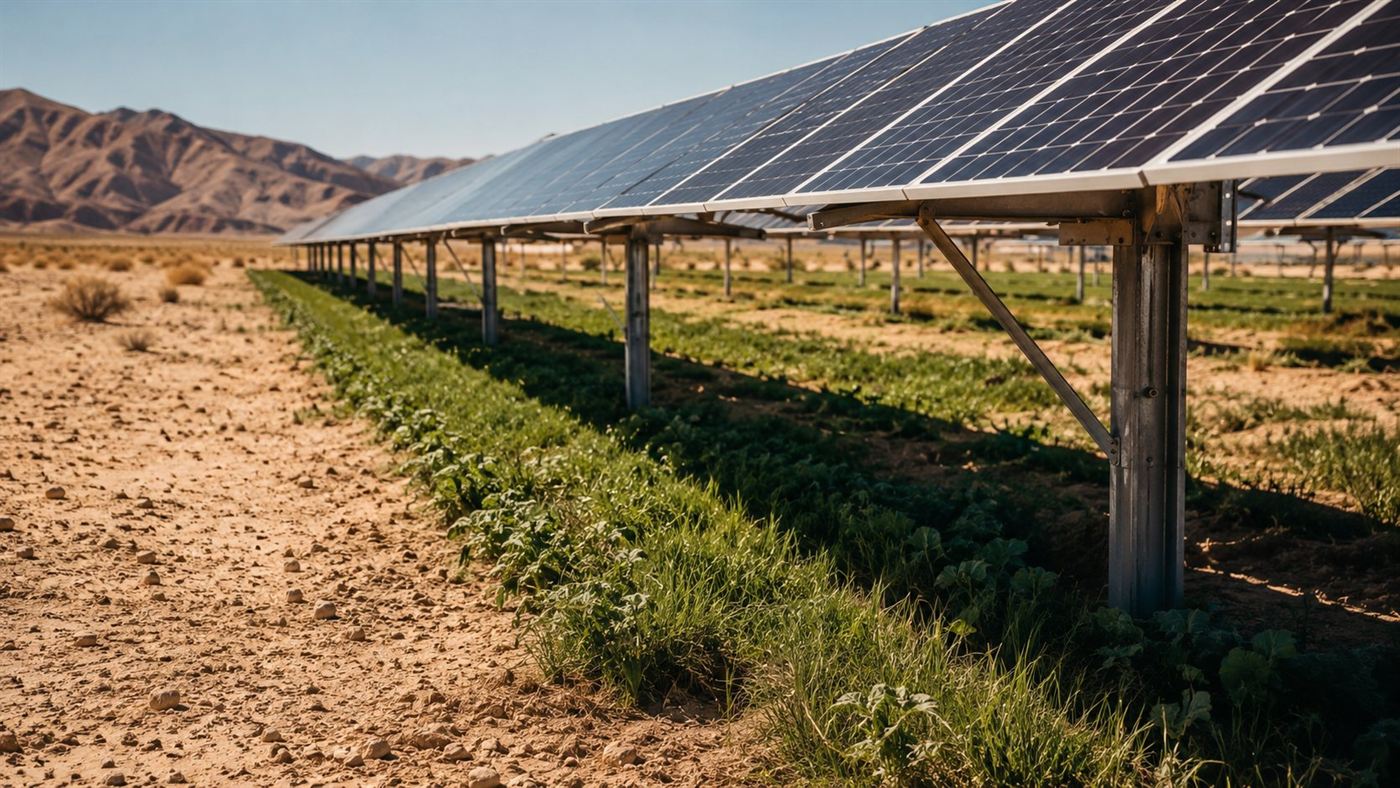
The same structures do a second quiet job. Raised on steel frames, the elevated panels cast shade across the ground beneath them, and that shade slows evaporation in a place where water vanishes almost the moment it arrives. In the cooler, shadier strips under the rows, pasture grasses and crops can take hold. It is a textbook agrivoltaics model, energy on top and agriculture underneath, applied at a scale almost no one has tried in true desert.
So the reversal is the whole point. A wall of panels built to help light up Beijing is, at the same time, pinning down the shifting dunes that gave the Sea of Death its name. The thing that generates the power is also the thing that reclaims the land.
Satellites say the sand is going green
The desertification claim could easily be marketing, except for one thing: the evidence is coming from orbit, not from a press release. NASA and Landsat imagery show measurable greening in parts of the Kubuqi and other Chinese deserts where solar projects have been built, which lends independent visual weight to the dune-control argument.
That is the detail the coverage seized on. Newsweek reported that NASA satellite imagery reveals the Solar Great Wall buildout across the Kubuqi and framed it squarely as a climate and desert-greening story, not just a generation milestone. When the people taking the pictures are NASA rather than the project's own owners, the before-and-after carries more credibility.
The ecological logic is straightforward once you see it. Break the wind, fix the dunes in place, throw shade to cut evaporation, and a strip of land that supported almost nothing starts to support something. Space Daily framed the project as aiming to both power Beijing and curb desertification by 2030, the two goals bolted together by design rather than by accident.
The horse you can see from orbit
One piece of the wall was already famous before the rest made headlines. The Junma Solar Power Station, completed in 2019 and run by State Power Investment Corporation, was laid out so that its panels form the shape of a galloping horse across the desert floor, a nod to Inner Mongolia's horse culture.
It is not just a stunt. The Junma station holds a Guinness World Record for the largest image made of solar panels, with a 300 MW capacity and generating roughly 2 billion kWh per year, according to SciTechDaily. That output is enough to serve somewhere between 300,000 and 400,000 people, a small city's worth of electricity drawn from a picture of a horse.
The choice of this desert was practical, not poetic. The Kubuqi offers high solar irradiance, flat open terrain that is cheap to build on, and proximity to industrial hubs like Baotou and Bayannur, which makes installing panels and wiring them into the grid far easier than it would be in more remote sand.
Why China, and why now
The Solar Great Wall does not exist in a vacuum. It is the flagship of a buildout so large it is hard to picture. China operated roughly 387,000 MW of solar capacity as of mid-2024, about half of the entire global total, leaving the United States and India far behind in absolute terms.
Against that backdrop, a 100 GW corridor is the kind of statement project a country builds when it already dominates a technology and wants a single, visible monument to that lead. Powering a capital city, taming a desert, and breaking a world record with a horse made of panels all in one place is exactly the sort of triple headline that fits China's solar story in 2026.
It also solves a real problem. The Beijing-Tianjin-Hebei cluster is power-hungry and pollution-conscious, and desert in the north has space and sun that the crowded east does not. Building the generation where the land is empty and shipping the electricity to where the people are is the whole reason the corridor sits where it sits.
The honest catch
It is worth saying clearly what is built and what is still a plan. The desertification-control and greening benefits, while genuinely supported by NASA's own imagery, are still largely projected and early-stage. Only about 5.4 GW of the 100 GW target is actually installed, which means roughly 95 percent of the wall does not yet exist.
Everything downstream of that gap is a forecast. The full 2030 capacity, the enough-to-power-Beijing claim, and the long-term ecological payoff all depend on China finishing a project that is still in its early years, and big infrastructure timelines slip. The greening, too, is not automatic. Growing grass and crops under panels in an arid zone still requires irrigation and active management, so the green strips in the satellite images represent work and water, not just shade.
One number floating around secondary coverage deserves a flat warning. Some aggregators claim the project will rehabilitate nearly 27 million hectares of desert, which is almost certainly garbled, since the entire Kubuqi Desert covers only about 1.86 million hectares. Treat any hectares-reclaimed figure with skepticism unless it traces back to an official Chinese government release.
A desert once written off as a Sea of Death is being turned, panel by panel, into both a power station and reclaimed grassland, and the satellites watching from above suggest it might actually be working. Would you trust solar panels to bring a dead desert back to life, or does 95 percent of the wall still being unbuilt make you wait and see? Tell us what you think in the comments.
Related reading: inside the world's largest solar farm, where 20,000 sheep keep the grass down.