The stone giant that fooled America, and the fake of the fake
In the autumn of 1869, two men digging a well behind a farm in upstate New York struck something hard and pale in the soil. When they cleared away the earth, a ten-foot man of stone stared back at them. Word spread like fire, crowds came by the thousand, and learned men argued over whether it was an ancient statue or a petrified human being. It was neither. The Cardiff Giant was one of the most successful hoaxes in history.
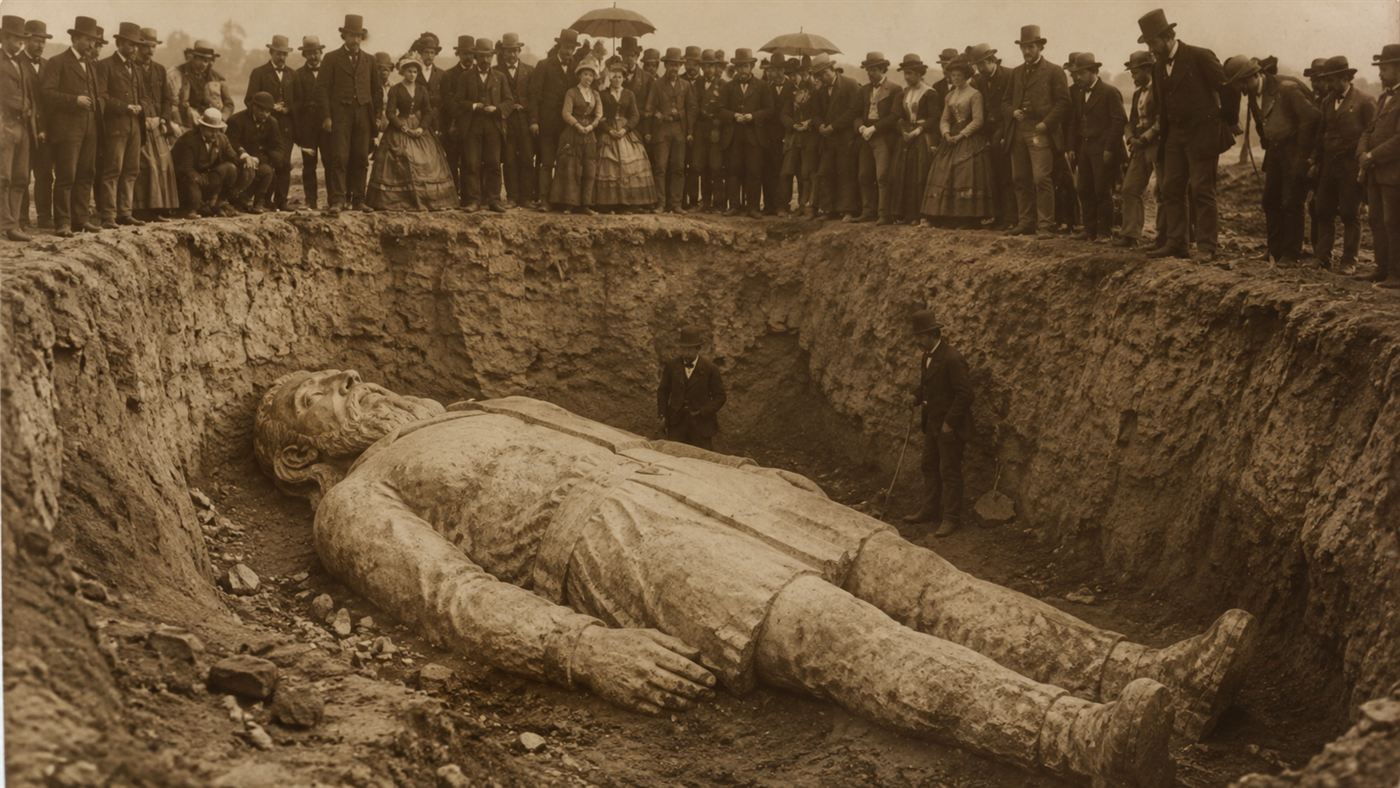
A ten-foot stone man, and a nation that desperately wanted to believe. Illustration: Watts & Wild.
The story of the Cardiff Giant is funny, but it is also sharp. It was built deliberately, by a man who wanted to prove a point about how easily people will believe what they want to be true. And the most delicious twist is that the hoax worked so well it spawned a second hoax, copied from the first.
To see how a lump of carved stone became a national sensation, you have to start with a grudge.
A giant in the well
On 16 October 1869, workers digging a well behind the barn of a farmer named William Newell in Cardiff, New York, unearthed what looked like the body of an enormous man turned to stone. The figure was about ten feet tall and weighed close to a ton and a half, and people flocked to the farm to see it, paying for the privilege.
The country was primed to believe. Many people took the Bible's mention of giants in the earth quite literally, and the idea of a petrified man from a vanished race fit neatly into that hope. Scholars came to inspect it and split into camps, some declaring it an ancient carved statue, others insisting it was a genuine fossilised human. Either way it was a marvel, and Newell's little farm became one of the most visited spots in America almost overnight.
How the Cardiff Giant hoax was built
Behind it all was a man named George Hull, a tobacconist and committed sceptic. Hull had argued with a preacher about whether giants had really once walked the Earth, and decided to prove how gullible believers could be by manufacturing a giant of his own.
He had a large block of gypsum quarried, shipped it secretly to Chicago, and paid stonecutters, sworn to silence, to carve it into the figure of a huge man. To make it look impossibly old, the giant was scrubbed with sand and acid and stippled all over with steel needles to mimic the pores of skin. Then, late in 1868, Hull had it buried on his cousin Newell's farm, where it could quietly wait until the time was right to be discovered. The whole scheme cost him a small fortune, but the payoff, in crowds and money and sheer mischief, was enormous.
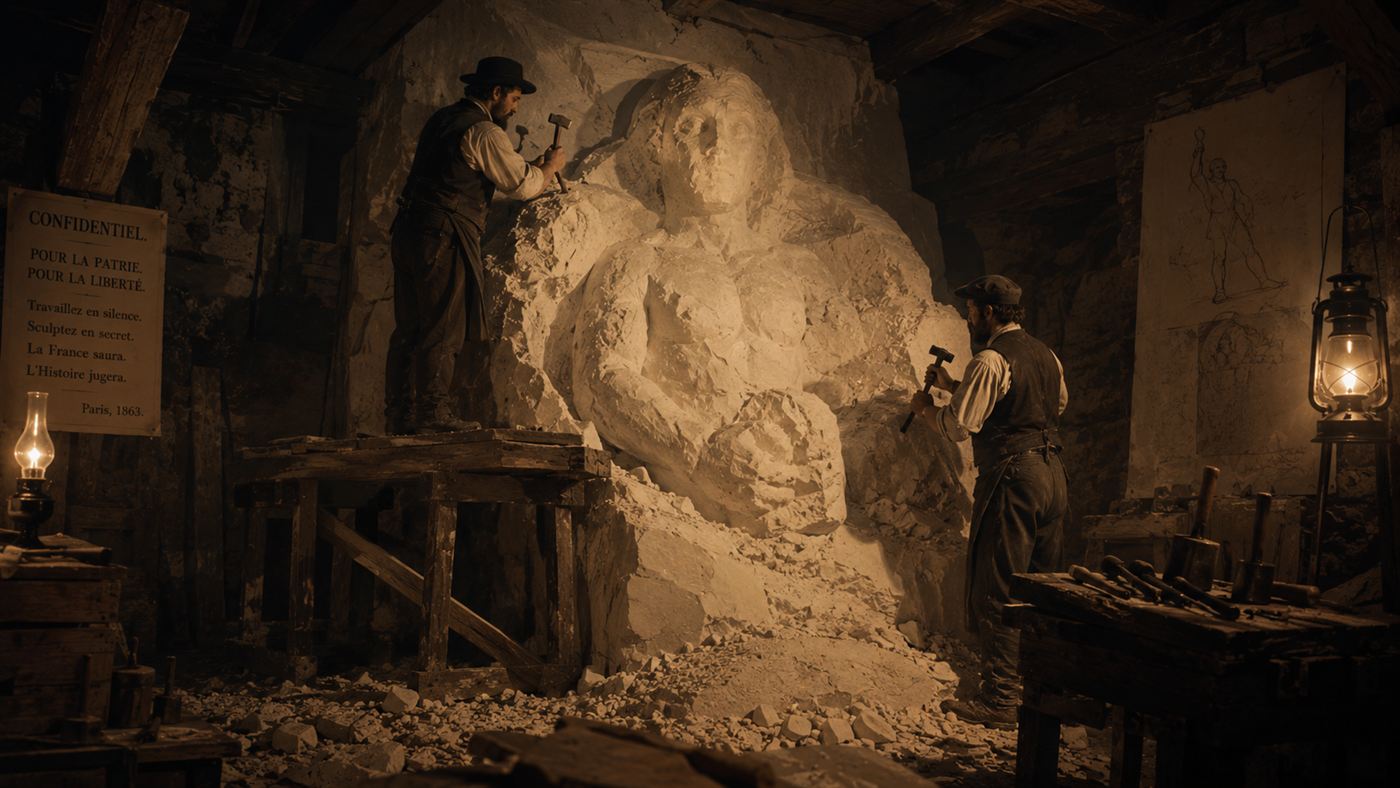
The fake of the fake
The giant made so much money that Hull sold a large share in it to a syndicate of businessmen, who moved it to Syracuse and watched the crowds grow even bigger. The famous showman P. T. Barnum offered a huge sum to buy the giant, and when the owners refused, he simply had his own plaster copy made and displayed it as the real Cardiff Giant.
This led to the perfect absurdity of two stone giants, each side accusing the other of being the fake. It was during this rivalry that the line "there's a sucker born every minute" entered the story, usually said to have been aimed at Barnum's customers, though it was reportedly spoken by one of the giant's owners rather than Barnum himself. When the owners tried to sue Barnum for calling their giant a fake, the case collapsed on a beautifully simple point: their giant was a fake, so he had told the truth.
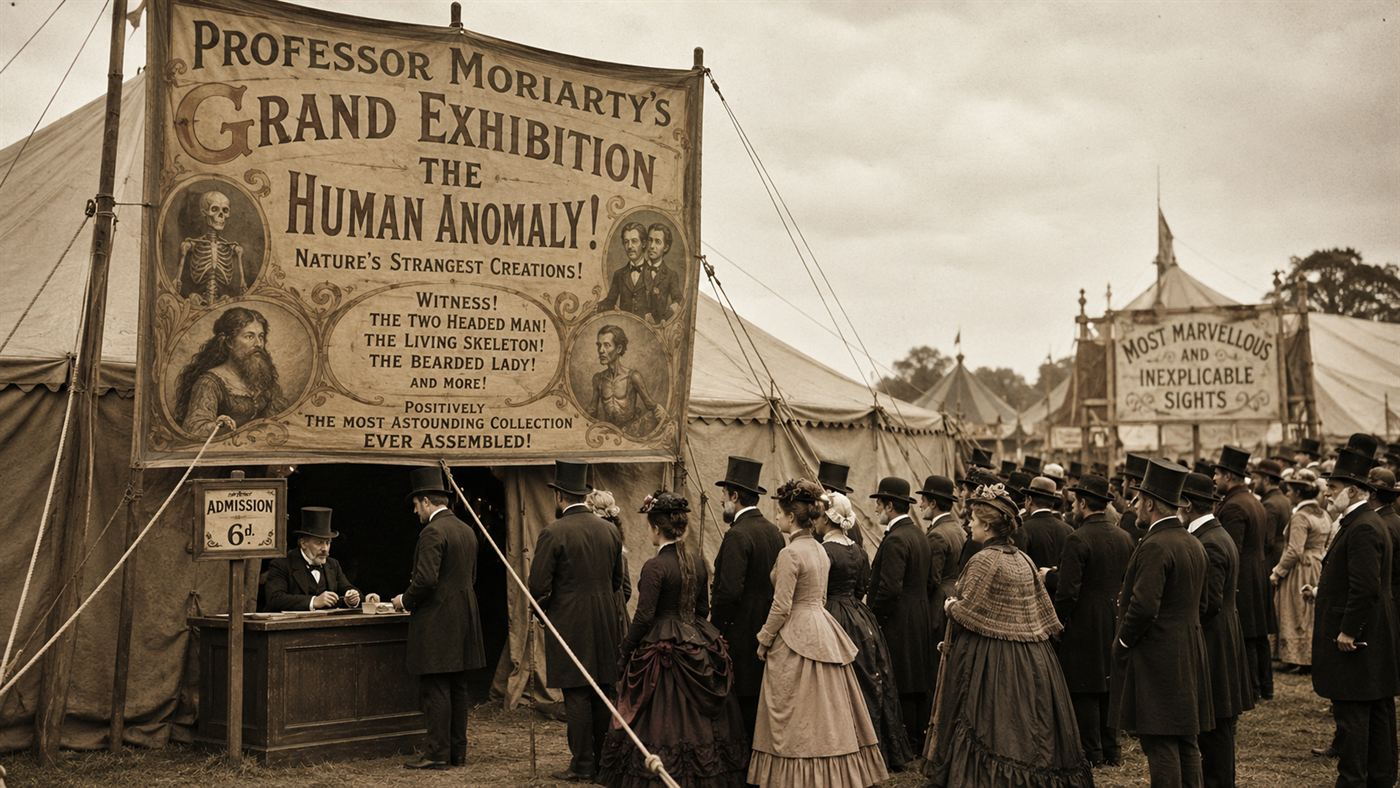
Unmasked
The giant could not survive close scientific scrutiny for long. Experts pointed out that no genuine fossil would look like this, and one leading scientist bluntly declared it a humbug, a recently carved figure rather than any ancient man.
By December 1869, with the evidence piling up, George Hull confessed the whole scheme to the press, and not long after, the courts formally recognised the giant for the manufactured fake it was. It is worth being fair that plenty of people had doubted it from the start; the Cardiff Giant did not fool everyone, and the scientists got it right. But it fooled enough people, and made enough money, to become a legend, a monument less to ancient giants than to our endless willingness to pay to believe in them.
Was the Cardiff Giant real?
Not in the slightest. The Cardiff Giant was a carved block of gypsum, deliberately aged and buried so it could be triumphantly dug up, with no connection to any real petrified man or ancient civilisation.
What was real was the appetite for it. The giant succeeded not because it was convincing under close inspection, but because so many people wanted a stone colossus to be true, whether for religious reasons or simply for the thrill of a wonder. That hunger, more than any clever carving, is what the hoax actually exposed.
Who made the Cardiff Giant?
A sceptic with a point to prove. George Hull conceived and funded the Cardiff Giant to demonstrate how readily people would believe in giants, and P. T. Barnum later compounded the joke by exhibiting a copy as the genuine article.
Between them, the two men turned a private grudge into a national circus, and left behind a story that still gets told whenever a too-good-to-be-true wonder makes the headlines. The Cardiff Giant is long since exposed, but the lesson it was built to teach has never really gone out of date.
A lump of carved stone became a national sensation, and then bred a copy of itself. Why are we so often willing to pay good money for a wonder we half suspect is a trick? Tell us what you think in the comments.
Related reading: the Mechanical Turk, the chess machine that fooled the world with a man hidden inside, and the Collyer brothers, the Harlem recluses killed by the mountain of junk they hoarded. See also the Great Moon Hoax, when a newspaper convinced 1830s New York of bat-men on the Moon, and the Fox sisters, whose faked ghost knocks founded a religion of millions. See also the Hope Diamond, whose deadly curse was largely invented to sell it, and the Kensington Runestone, a likely fake Viking message a town still treasures.