The chess robot that beat Napoleon, and the man hidden inside it
More than two centuries before anyone spoke of artificial intelligence, a wooden figure in a turban sat down at a chessboard in a Vienna palace and began to win. It beat noblemen, then emperors, then much of Europe, and for a lifetime nobody could explain how a machine could think. The Mechanical Turk was the most famous thinking machine that never was.
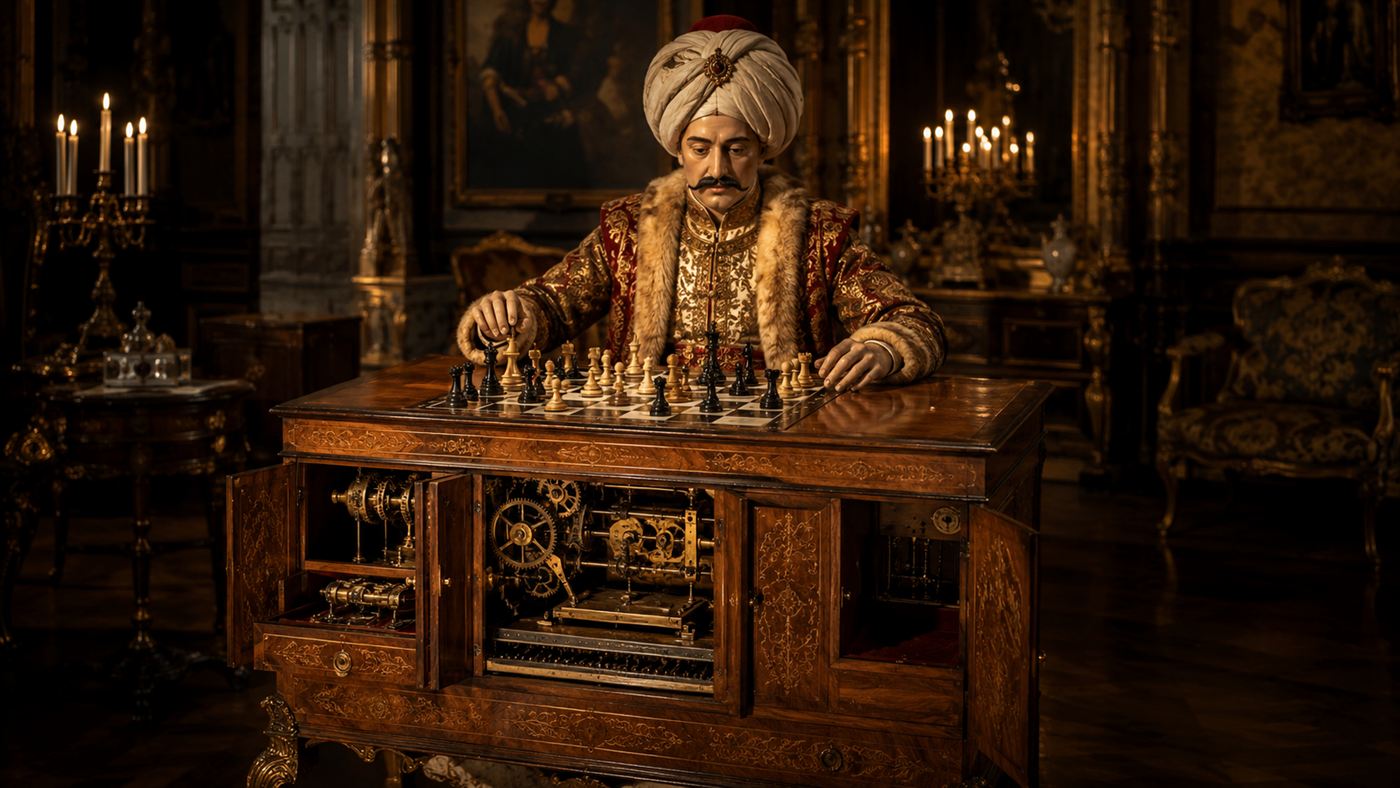
A turbaned figure, a cabinet of gears, and a secret that lasted decades. Illustration: Watts & Wild.
It is a story that feels strangely modern. A clever-looking machine appears to do something only a human mind should be able to do, crowds are dazzled, and very few stop to ask what is really going on inside the box. The Mechanical Turk fooled some of the sharpest people of its age for the simple reason that they wanted to be fooled.
And the answer to the trick was hiding in plain sight, behind the little wooden doors the showman kept opening one at a time.
A machine that could think
The Turk was built in 1770 by Wolfgang von Kempelen, a Hungarian inventor in the service of the Austrian court, to impress the Empress Maria Theresa. It was a large wooden cabinet packed with gears, topped by a chessboard, with a life-size figure dressed in Ottoman robes and a turban seated behind it, ready to play.
Before each game, Kempelen would theatrically open the cabinet's doors to show the audience the dense clockwork inside, apparently leaving nowhere for a person to hide. Then the Turk would come to life, lifting its wooden arm to move the pieces and nodding when it put an opponent in check. To people who had never seen anything like it, the only explanation seemed to be that the machine itself was somehow reasoning its way through the game.
How the Mechanical Turk fooled the world
The Turk did not just look clever; it actually won. With strong players at the controls, it beat challenger after challenger across the courts and theatres of Europe and, later, America. In 1809 the Mechanical Turk played and defeated Napoleon Bonaparte, who is said to have tried a few illegal moves just to see what the machine would do, only for the Turk to sweep the pieces off the board.
It played Benjamin Franklin in Paris, and toured for decades under a new owner, the showman Johann Maelzel, who took it across the Atlantic in 1826. Over roughly 84 years the Turk built a legend as an unbeatable mechanical mind, even as a quiet question followed it everywhere: surely, somehow, there had to be a trick.
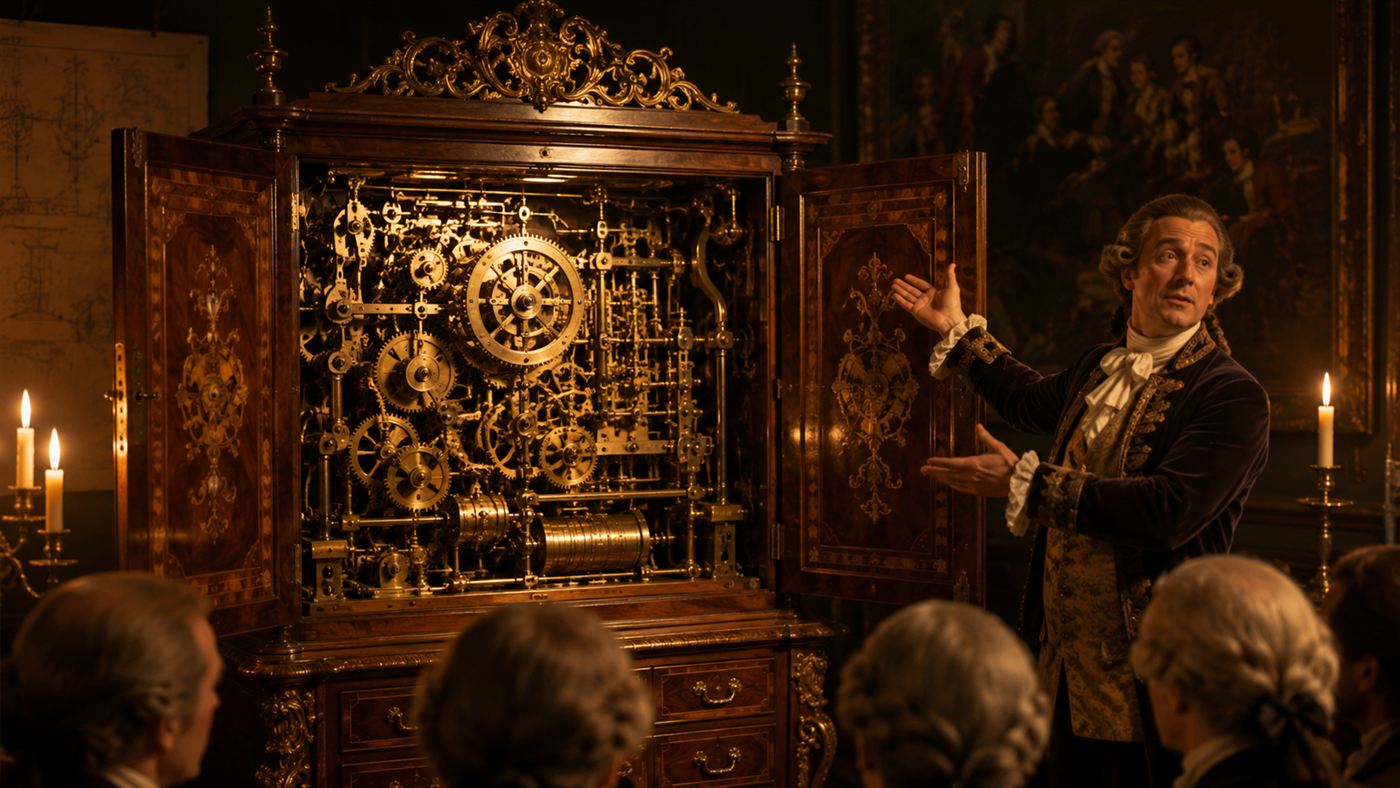
The man in the box
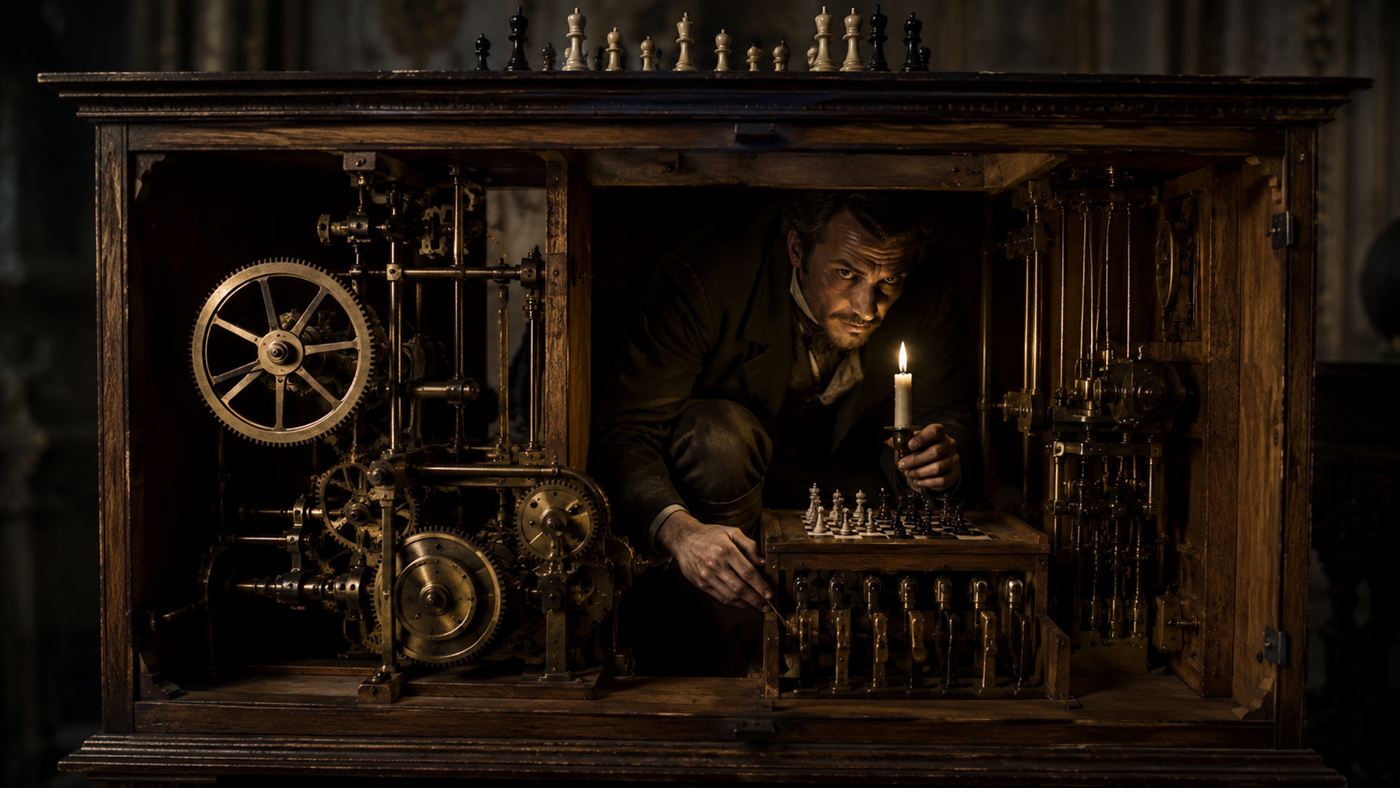
There was, of course, a trick, and it was a person. A skilled human chess master was folded into the cabinet, sitting on a sliding seat and following the game on a small internal board, moving the Turk's arm with a system of levers.
Magnets hanging under the chessboard told the hidden player which pieces the opponent had moved, and a candle lit the cramped workspace, its smoke vented through the turban. When Kempelen opened one door to reveal machinery, the operator simply slid to the other side as dummy gears shifted into place. A series of Europe's best players took turns inside over the years, including names like Johann Allgaier and William Schlumberger, which is exactly why the Turk played so well. The genius was never mechanical. It was the real chess master crouched in the dark.
Why we wanted to believe
Plenty of people suspected a human was involved, but few could prove it. The young writer Edgar Allan Poe published a sharp essay in 1836 arguing that no true machine could play chess, and that a person had to be making every move.
The secret was finally laid out in public in 1837, and the Turk itself was destroyed by a fire in Philadelphia in 1854, ending its long career. Yet the idea behind it never died. The Turk had thrilled audiences with the dream of a machine that could think, a dream we are still chasing, and it lent its name to the modern world too: when a company today hides human workers behind a slick digital front, people still call it a mechanical turk.
How did the Mechanical Turk work?
By hiding a person where the gears seemed to be. The Mechanical Turk concealed a real chess master on a sliding seat inside the cabinet, who tracked the game on a small board and worked levers to move the figure's arm, while the visible clockwork did nothing but impress the crowd.
It was, in the end, a beautifully engineered piece of theatre rather than a calculating engine. Kempelen was a serious inventor, who also built an early speaking machine, but the Turk was always a magic trick dressed as science. Its real cleverness lay in the showmanship that kept the audience looking at the wrong thing.
Was the Mechanical Turk real?
The object was real; the intelligence was borrowed. The Turk was a genuine cabinet and figure that truly played and won at chess, but every move came from a hidden human, not from the machine, so as a thinking automaton it was pure illusion.
That is what keeps the story alive. Long before real computers learned to play chess and finally beat the world's champions for real, people had already met a machine that seemed to think, fallen for it completely, and learned the oldest lesson in technology: when something looks too clever to be true, it is worth asking who is really in the box.
A wooden figure beat an emperor at chess, and the secret was a person breathing quietly in the dark. The next time a machine seems to think, are you sure you know who is really in the box? Tell us what you think in the comments.
Related reading: the Voynich manuscript, a book in an unknown script that no one has ever managed to read, and Clever Hans, the horse that seemed to do math but was secretly reading human faces. Two centuries on, real humanoid robots are finally rolling off a factory line.