Three Gorges Dam slowed Earth's rotation, shifted its axis by two centimetres and flattened the poles, all by lifting 39 trillion litres of river into a single lake
In 2006 the last floodgates of the Three Gorges Dam closed on China's Yangtze River, completing the most powerful hydropower plant ever built. NASA had not been in the project brief, but its geophysicists ran the numbers anyway and found that the Three Gorges Dam had measurably altered Earth's rotation, the planet's axis and the shape of the globe itself.
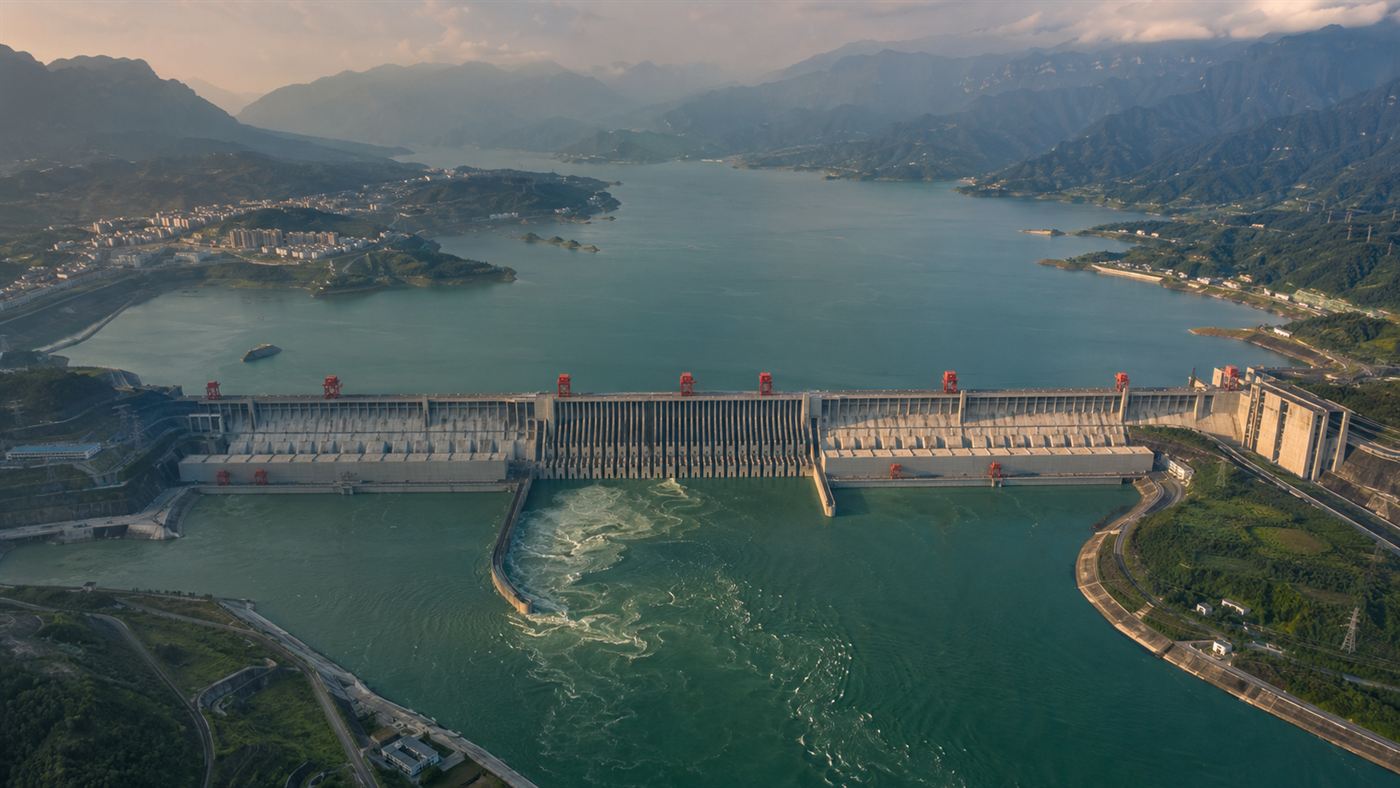
The Three Gorges Dam spans 2.3 kilometres across the Yangtze and rises 185 metres. The reservoir behind it is 600 kilometres long. Illustration: Watts & Wild.
The Three Gorges Dam sits across the Yangtze River at Sandouping, in Hubei Province. The wall is 2.3 kilometres wide and 185 metres tall, and behind it a reservoir stretches back 600 kilometres into the mountain gorges that give the hydropower plant its name. When the lake reached its full operating level of 175 metres, it held 39.3 cubic kilometres of water, enough that moving it from its natural home in the river system to a single, elevated lake would do something no engineer had factored into the project documents.
It would change the planet. As the Three Gorges Dam entry on Wikipedia summarises, drawing on peer-reviewed geophysical research, the redistribution of that mass measurably affected Earth's rotation, its axis and its shape, effects calculated by NASA's Goddard Space Flight Center before the reservoir had even finished filling. The dam was built to stop floods and generate electricity. Nobody had put "alter the moment of inertia of Earth" in the contract.
The Three Gorges Dam on China's Yangtze River holds 39.3 cubic kilometres of water above its original riverbed. When NASA geophysicist Benjamin Fong Chao ran the physics, he found the redistributed mass increased Earth's day by 0.06 microseconds, shifted the planet's axis by about two centimetres and slightly flattened the poles by moving mass toward lower latitudes. The effect is real and measurable, produced entirely by a structure built by human hands.
Why lifting water changes a planet's spin
A spinning object slows down when mass moves away from its rotational axis and speeds up when mass moves toward it.
Physicists call this the moment of inertia, and it governs everything from a spinning top to a collapsing star.
Picture a figure skater: arms pulled in, spinning fast; arms spread wide, spinning slow.
Earth's moment of inertia depends on how its mass is distributed relative to the planet's rotational axis, which runs through the poles.
Mass near the equator, far from that axis, increases the moment of inertia and slows the spin.
Mass near the poles, close to the axis, does the opposite.
The Yangtze River sits at roughly 30 degrees north latitude, a mid-latitude position where any mass redistribution has a measurable effect on Earth's rotational dynamics.
When the Three Gorges Dam reservoir filled, it moved 39.3 cubic kilometres of water from a sprawling, distributed river catchment into a single concentrated mass at elevation.
That shift changed the moment of inertia of the entire planet, by a tiny but calculable amount.
The physics here is not theoretical: it is the same mechanism that makes even a Soviet drilling accident in the Karakum Desert leave a measurable trace on the atmosphere around it.
Large enough concentrations of mass, moved far enough from where they were, always leave a signature.
What NASA calculated about the Three Gorges Dam and Earth's rotation
Benjamin Fong Chao, a geophysicist at NASA's Goddard Space Flight Center in Maryland, published calculations showing the Three Gorges reservoir would have three distinct effects on Earth's rotation.
The first is the day length.
The Three Gorges Dam increases Earth's rotation period by approximately 0.06 microseconds, meaning every day on Earth is very slightly longer than it would be without the dam.
The second is the axis.
The moment of inertia change pulls Earth's rotational axis by roughly two centimetres toward the direction of 79 degrees west longitude, which points roughly toward Hudson Bay in Canada.
The third is the planet's shape.
Moving mass to a latitude of 30 degrees north causes Earth to bulge microscopically at that latitude and flatten fractionally at the poles, the same way any spinning body responds to redistributed mass.
NASA's Earth Observatory has documented the Three Gorges reservoir and its geophysical footprint since the dam entered operation, and Chao's calculations on rotational effects have been widely reproduced and confirmed in the geophysical literature.
These are not projections or models.
They are measurements, derived from satellite geodesy, of what actually happened to Earth's rotation when the water rose.
How does a dam compare to an earthquake?
The numbers for the Three Gorges Dam sound dramatic, but context helps.
The magnitude 9.1 earthquake off Sumatra on December 26, 2004, released energy on a completely different scale.
That event shortened Earth's day by 2.68 microseconds and shifted the axis by about seven centimetres, more than three times the dam's effect on the axis and 45 times its effect on day length.
A single large subduction earthquake outweighs the Three Gorges reservoir by an enormous margin.
But the earthquake took seconds; the reservoir filled over years.
And earthquakes happen without human decision.
The Three Gorges Dam's effect on Earth's rotation is the product of deliberate engineering, which is a different kind of fact.
It also illustrates something important about moment of inertia: it is not just about size but about where mass moves.
Redistributing 39 trillion litres of water from many points across a watershed to one concentrated point at 175 metres of elevation is enough, at the right latitude, to leave a measurable mark on a planet.
The Kola Superdeep Borehole in Russia showed that the mass and heat inside the Earth are far from what we expected even 12 kilometres down; the Three Gorges reservoir is a reminder that the surface itself is not as passive as it looks.
The 1.24 million people the water swallowed
The geophysical numbers are remarkable, but the human numbers are heavier.
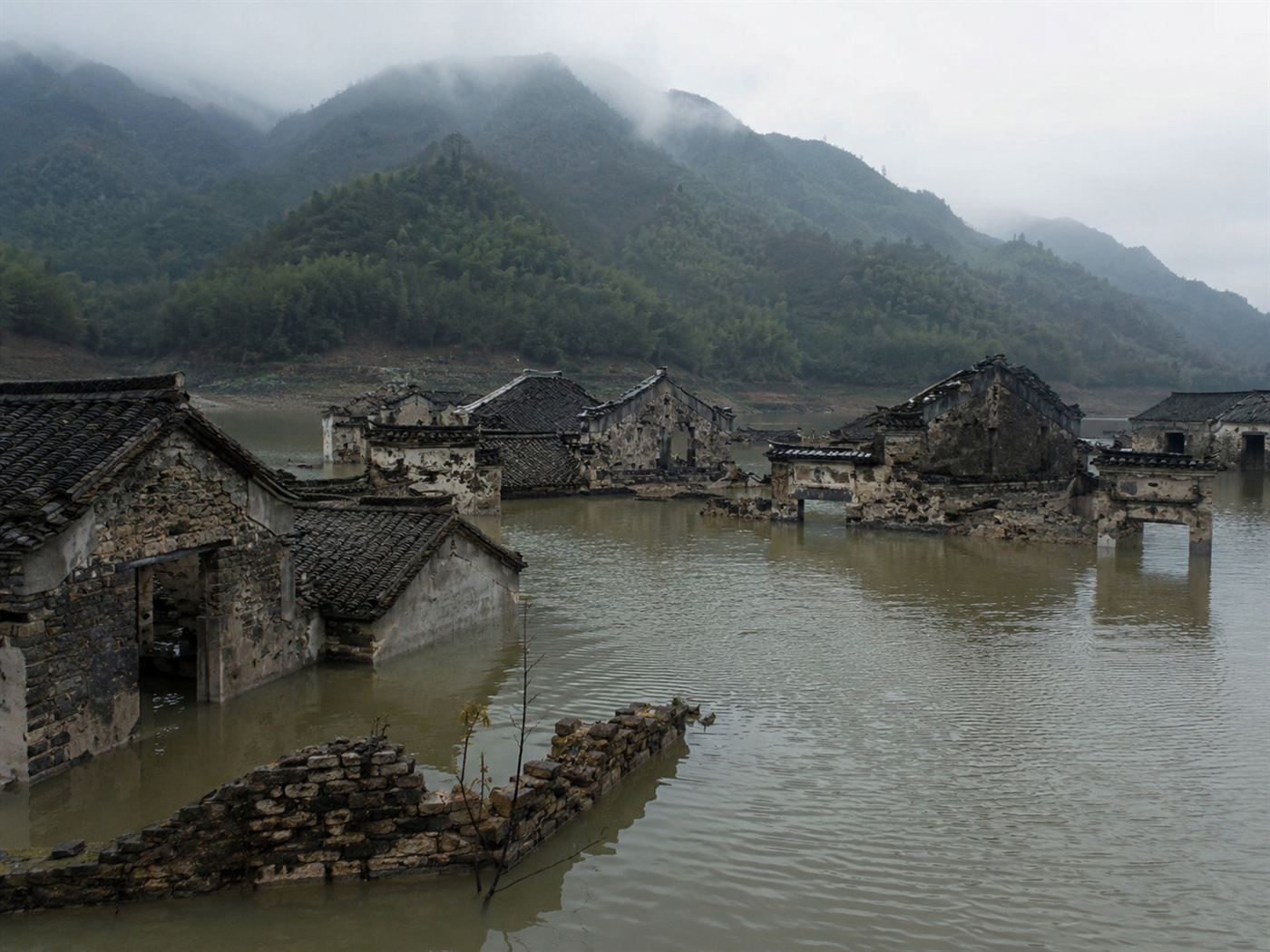
When the Three Gorges Dam reservoir rose between 1994 and the mid-2000s, it submerged 13 cities, 140 towns and more than 1,300 villages along the Yangtze River valley.
According to International Rivers, which documented the displacement in detail throughout the construction period, approximately 1.24 million people were relocated from the reservoir zone, one of the largest forced relocations in history.
Many were moved to resettlement communities on hillsides above the waterline, sometimes to land that was already crowded or that could not support farming.
The ancient city of Fengdu, known for its temples of the afterlife, was dismantled and moved stone by stone to higher ground.
The historic town of Zigui, birthplace of the poet Qu Yuan who lived 2,300 years ago, vanished beneath the rising Yangtze River.
When the reservoir drops in dry years, the ghost outlines of submerged streets and foundations reappear in the mud, a watermark of everything that was traded for the hydropower plant.
Some residents who were relocated found better housing and services in the new towns.
Others lost farmland they could not replace, livelihoods built around river fisheries that no longer functioned the same way, and connections to ancestral land that had been in their families for generations.
The Chinese government has acknowledged resettlement difficulties and released additional support funds multiple times since the dam began operating.
Did the dam do what China built it for?
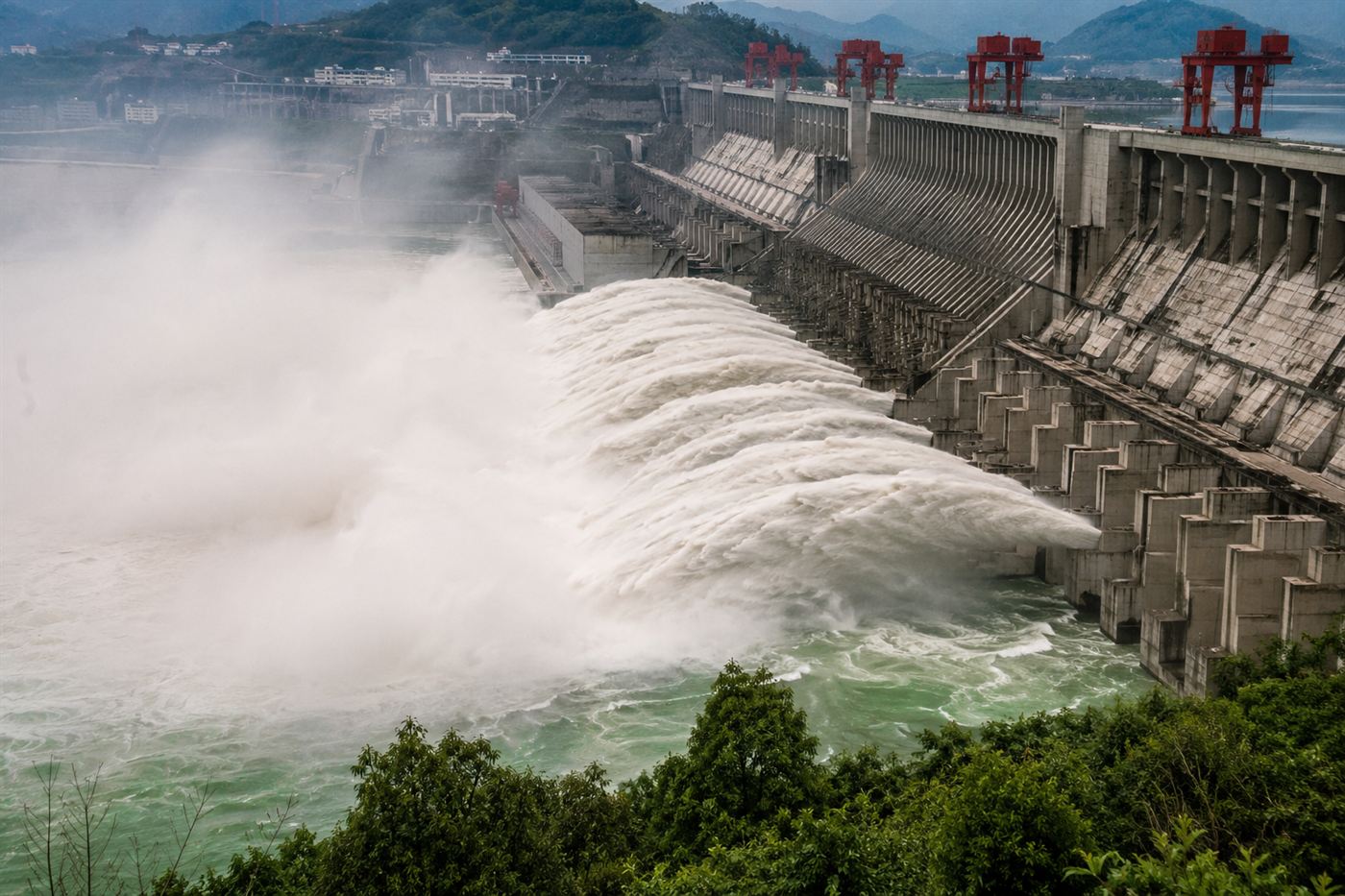
The Three Gorges Dam was built for three purposes: flood control, electricity generation and improved navigation on the upper Yangtze River.
On the first count, it has worked.
Floods that previously killed tens of thousands of people and destroyed millions of homes along the lower Yangtze have been reduced in severity by the dam's ability to hold back peak flows and release water in a controlled sequence.
The 1998 Yangtze floods killed more than 4,000 people and caused losses of 250 billion yuan; subsequent floods of similar scale have been contained by the dam operating as designed.
On electricity, the hydropower plant reached its full installed capacity of 22,500 megawatts in 2012, making it the world's largest electricity-generating facility by capacity.
It generates roughly 100 terawatt-hours of clean electricity per year, equivalent to burning more than 50 million tonnes of coal, which matters in a country that was one of the world's heaviest coal users at the time the dam was conceived.
Navigation improved substantially.
Shipping capacity on the upper Yangtze River increased tenfold after the reservoir raised water levels in the famously shallow and hazardous gorges upstream.
On the metrics it was designed to hit, the dam hit them.
The honest catch
The Three Gorges Dam works, and the costs were real.
The Yangtze River dolphin, the baiji, was already critically endangered by the time construction began, but the dam's disruption of the river ecosystem almost certainly accelerated its decline.
A 2006 survey found no baiji at all, and the species is now considered functionally extinct, the first large aquatic mammal to disappear in modern times due to human activity.
The Chinese sturgeon, one of the oldest fish species on Earth, can no longer reach its spawning grounds above the Three Gorges Dam and its wild population has collapsed.
Sedimentation is a structural problem.
The Yangtze River carries a huge load of silt, and the reservoir traps it instead of carrying it to the sea.
The downstream delta is eroding, coastal fisheries have declined, and the silt that once renewed floodplain farmland is no longer arriving.
There are also geological concerns.
The weight of 39.3 cubic kilometres of water pressing on the reservoir floor has been linked to increased seismic activity in the surrounding rock, a known risk with very large reservoirs anywhere in the world.
And the moment of inertia effect cuts in a useful direction for climate science: redistributing water from ice sheets melting in Greenland and Antarctica into the ocean also changes Earth's rotation, and by far more than any dam.
The Three Gorges Dam is a rounding error in that story, but it proved the principle in the most concrete way possible.
Humans can move enough mass to change how the planet spins.
We did it with concrete and the Yangtze River, and we have been doing it with carbon and ice for much longer.
A hydropower plant built to harness a river ended up writing its signature into the rotation of the planet itself, by exactly 0.06 microseconds per day. Does knowing that a piece of infrastructure changed how Earth spins make you think differently about what we build next? Tell us what you think in the comments.
Related reading: Africa's largest dam switched on in 2025, after Egypt called it an existential threat.
More from Watts & Wild
 The Great Wall and the myths around it
 The dam whose concrete needed ice to set
 The temple sawn apart to escape a dam's lake
 Soviet scientists drilled the deepest hole on Earth and found water 12 km down
 The Door to Hell crater in Turkmenistan is finally going out
 Eight people sealed themselves in a glass world and the oxygen began to vanish
 Lake Kivu could suffocate two million people, so Rwanda is burning it for power