In 1977 a telescope caught a 72-second signal from space so strong an astronomer wrote Wow! beside it, and we have never heard it again
For seventy-two seconds one summer night, a radio telescope in Ohio heard something out of the dark that looked exactly like a message from another world. The astronomer who spotted it on the printout days later was so startled he circled the reading and scrawled a single word in the margin. The Wow signal is still, decades on, the best candidate for an alien transmission we have ever found, and we will probably never know what it was.
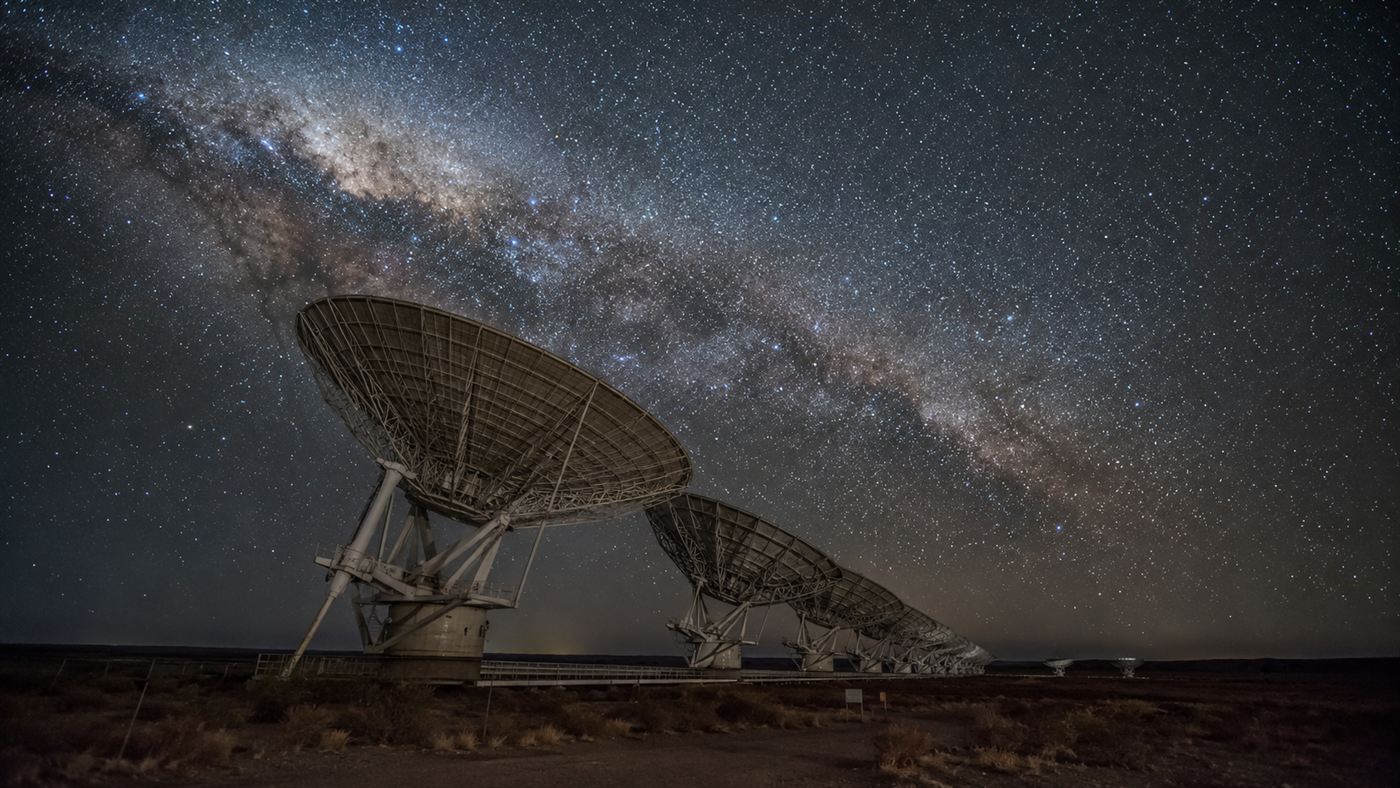
The Big Ear radio telescope listened to the sky for signs of distant civilisations. Illustration: Watts & Wild.
It was the night of 15 August 1977, and the listening was being done by a telescope nicknamed the Big Ear at Ohio State University, part of a long-running project scanning the heavens for signs of extraterrestrial intelligence. The telescope did not have a person watching it; it simply swept the sky as the Earth turned and printed out the strength of whatever radio waves it heard, line after line of letters and numbers.
A few days later a volunteer astronomer named Jerry Ehman sat down to read through the stack of printout. Most of it was the usual quiet hiss of the cosmos. Then his eye caught a short sequence, "6EQUJ5," that leapt off the page, a signal rising and falling far above the background. He drew a ring around it in red pen and, next to it, wrote "Wow!" The name stuck, and so did the mystery.
Why the Wow signal looked like aliens
What made it so exciting was not just that it was strong, but that it had all the right fingerprints. It lasted exactly seventy-two seconds, which is precisely how long the telescope's beam would linger on a single fixed point in the sky as the planet rotated. In other words, it behaved like something out there in space, not like interference from a passing car or a faulty wire down on Earth.
It was also a narrow signal, concentrated at one sharp frequency rather than smeared across many, the way a deliberate broadcast would be and natural objects usually are not. And that frequency sat right at 1,420 megahertz, the natural note of hydrogen, the most common stuff in the universe, which scientists had long argued any thoughtful civilisation might choose as a quiet, obvious channel to call on. As Space.com has reported, it came from the direction of the constellation Sagittarius and ticked nearly every box on the SETI wish list.

The silence that followed
And then nothing. The whole point of a beacon, if that is what it was, is that it should come round again, and astronomers pointed telescopes back at that patch of Sagittarius again and again over the following years and decades. They heard only static. The Wow signal had arrived once, blazed for seventy-two seconds, and fallen silent forever. The same year it was heard, we sent our own message the other way, on the Voyager Golden Record now drifting through interstellar space.
That single fact is what keeps it a curiosity rather than a discovery. A signal you cannot find a second time can never really be confirmed or studied; you are left forever with one ambiguous reading on a roll of paper. It is the most tantalising "maybe" in the history of the search for life beyond Earth.

Was the Wow signal from aliens?
Almost certainly we will never be able to say. The honest position is that it remains unexplained, and that "unexplained" is not the same as "extraterrestrial." It had the hallmarks of an artificial signal, but a one-off event with no follow-up cannot be pinned down, and over the years scientists have leaned increasingly toward some rare natural cause rather than a call from the stars.
The honest catch
It is worth being clear-eyed, because the Wow signal attracts a lot of wishful thinking. Jerry Ehman himself, the man who wrote the famous "Wow!", spent the rest of his life cautioning people not to jump to aliens, and he was right to. One popular idea, that a passing comet's cloud of hydrogen had made the noise, was floated and then largely knocked down. As BBC Sky at Night Magazine has reported, more recent work suggests the likeliest explanation is something stranger but still natural: a sudden flaring of an interstellar cloud of hydrogen, briefly lit up by a passing burst of radiation. That would make the Wow signal a rare astrophysical event rather than a hello from another species. None of which fully closes the case, and perhaps nothing ever will. What we are left with is one of the purest curiosities in science: seventy-two seconds of "maybe," a red circle on a printout, and a question we may simply have to live with unanswered.
Seventy-two seconds of radio from the direction of Sagittarius, and then half a century of silence. Do you think the Wow signal was a natural fluke, or the one time something out there said hello and we missed our chance to answer? Tell us what you think in the comments.
Related reading: Another message from the sky we are still reckoning with, the 1859 solar storm that set telegraphs on fire. See also the Oh-My-God particle, a single cosmic ray over Utah whose source has never been found.