When Krakatoa exploded in 1883 it made the loudest sound in history, ruptured the eardrums of sailors 40 miles away, and was heard 3,000 miles across the sea
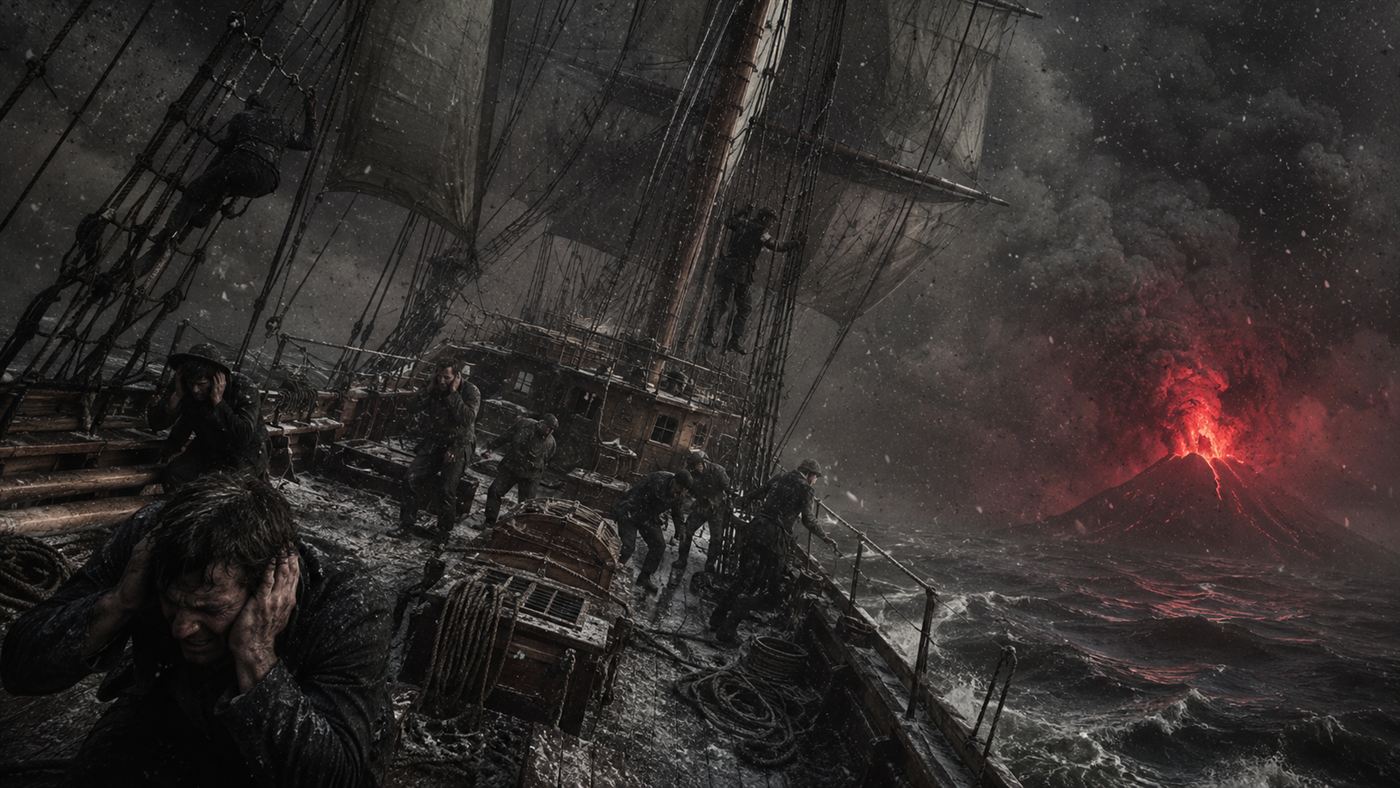
Forty miles from the volcano, the captain of the British ship Norham Castle wrote in his log that he was sure the Day of Judgement had come. Half his crew had burst eardrums. He was not exaggerating, and he was not even close to the worst of it: the Krakatoa eruption made a noise so loud that people heard it a thirteenth of the way around the planet.
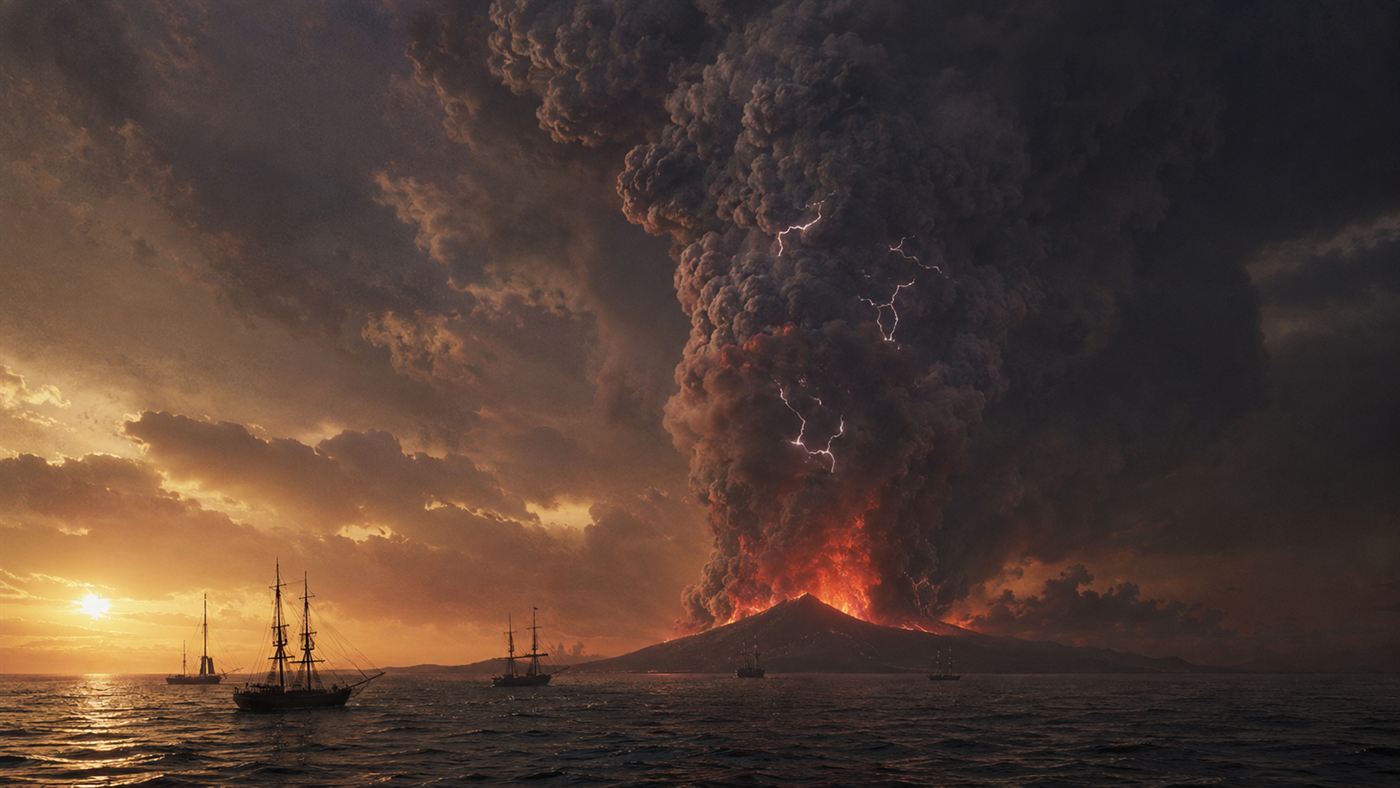
The 1883 eruption blew most of the island into the sky and the sea. Illustration: Watts & Wild.
At about two minutes past ten on the morning of August 27, 1883, the small volcanic island of Krakatoa in the Sunda Strait, between Java and Sumatra, tore itself apart. The final blast of the Krakatoa eruption is the loudest sound humans have ever measured, estimated at around 310 decibels at the source, a number so far past the threshold of pain that it stops behaving like ordinary sound at all.
To put that in human terms: a jet engine up close sits near 150 decibels and will damage your hearing in seconds. Krakatoa was not a sound you heard so much as a wall of pressure that hit you. Sailors on ships in the strait, dozens of miles off, had their eardrums punched out by the shockwave.
How far the Krakatoa eruption was heard
The truly strange part is how far the noise travelled. On Rodrigues Island, near Mauritius and some 4,800 kilometres away across open ocean, the chief of police logged what he took to be the distant roar of heavy guns, a ship in distress firing for help. There was no ship. As Classic FM has recounted, he was listening to a volcano nearly 3,000 miles away.
It was heard in Perth, Australia, about 3,110 kilometres off, and at dozens of points in between. No sound before or since has been documented carrying so far. For comparison, that distance is roughly a thirteenth of the way around the Earth, as if a bomb in London were heard in New York.
The wave that circled the planet three and a half times
The blast also sent out a pulse of air pressure, a single giant ripple racing through the atmosphere. Barometers in cities all over the world, from London to Washington, twitched as it passed. Then it kept going, swept past the far side of the Earth, and came back.
As Discover Magazine has detailed, scientists at the time counted the wave going by seven separate times over five days, which means it lapped the entire planet three and a half times before it finally faded. A volcano had, in effect, rung the whole atmosphere like a bell, and the ringing took the better part of a week to die down.
What actually killed 36,000 people
Here is the twist that gets lost behind the noise. For all the fury of the sound, the blast itself killed almost no one directly. When two-thirds of the island collapsed into the emptied magma chamber, it shoved the sea aside, and the sea came back as a series of tsunamis more than 30 metres high.
Those walls of water, not the explosion, did the killing. They swept over the low coasts of Java and Sumatra and erased whole towns. Of the roughly 36,000 people who died, almost all drowned. The Dutch controller Willem Beyerinck and his family survived only by scrambling uphill ahead of the water, and spent days half-buried in hot ash waiting for rescue.
The red skies that may have painted The Scream
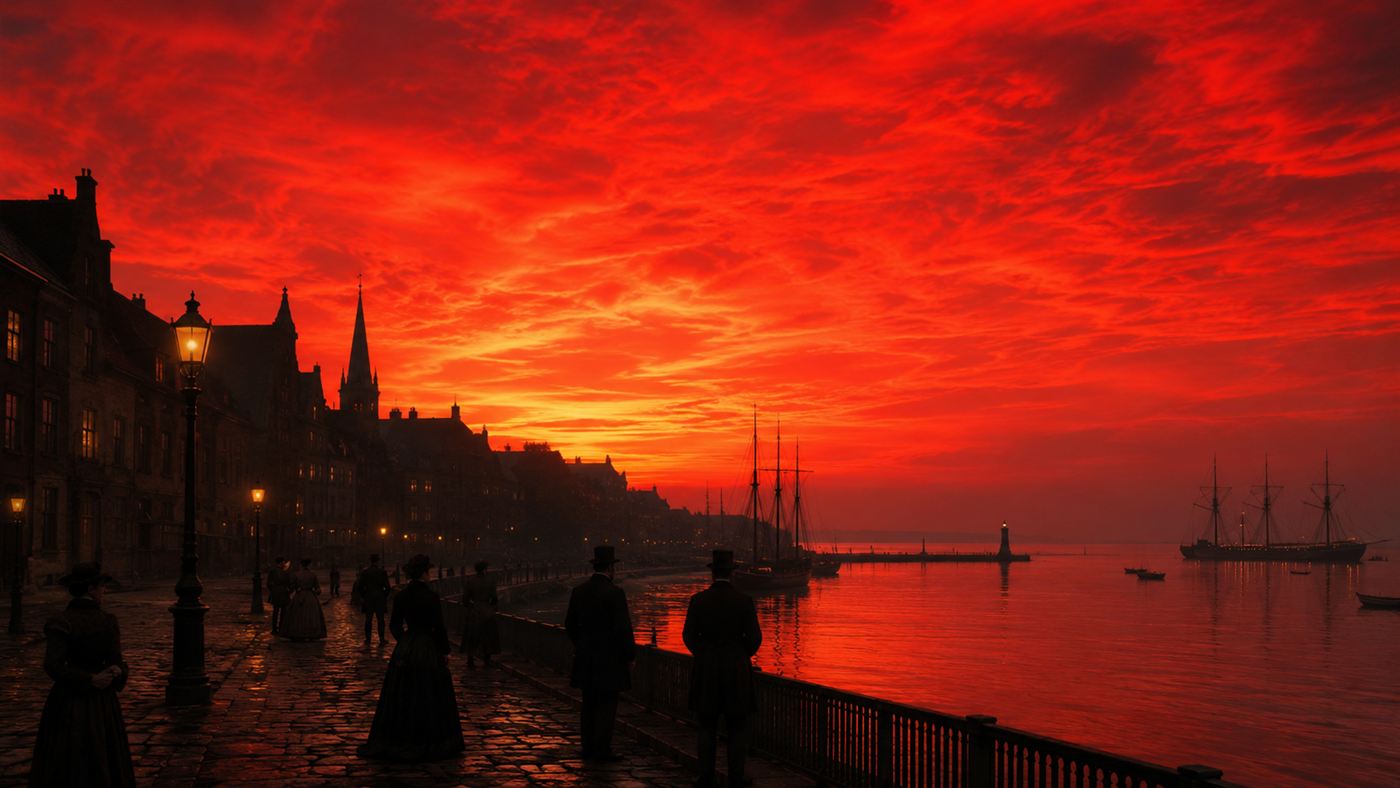
Krakatoa flung so much dust and sulphur into the upper atmosphere that the whole planet cooled by around half a degree, and for months the sky put on a show. Across Europe and North America, sunsets turned a lurid, smoky red and orange, so intense that in some towns fire brigades were called out to put out blazes that were not there.
Ten years later and a continent away, Edvard Munch described walking under a sky that turned "blood red," a memory many researchers link to those lingering Krakatoa sunsets, and painted The Scream. As the account at All That's Interesting lays out, it is one of those quiet threads in history: a volcano in Indonesia may have helped shape the most famous image of dread ever made.
The honest catch
A few caveats keep this honest. The 310-decibel figure is an informed reconstruction, not a microphone reading, because no instrument of the day could capture a pressure pulse that violent, and at that intensity the "sound" is really a shockwave. The link between Krakatoa and The Scream is a strong hypothesis, not a settled fact, since Munch's red sky might instead show rare high-altitude clouds. And the death toll is an estimate that different sources push higher or lower. What is not in doubt is the core of it: in 1883 an island made the loudest noise in human history, and the water it raised is what did the dying.
A single morning's eruption was heard across an ocean, rang the whole atmosphere like a bell, and may have tinted one of the world's most famous paintings. Which part stuns you more, the sound that crossed 3,000 miles or the wave that did the real damage? Tell us in the comments.
Related reading: A bigger Indonesian eruption in 1815 erased an entire summer and helped inspire Frankenstein.