Eben Byers drank roughly 1,400 bottles of Radithor because his doctor prescribed the radioactive patent medicine as a health tonic, and over three years it dissolved his bones
In the late 1920s, a Pittsburgh socialite and amateur golf champion started drinking Radithor, a patent medicine containing dissolved radium, because a physician told him it would fix his injured arm. He kept drinking it for three years, ordered it by the case, and recommended it to friends. The Wall Street Journal later described what happened with a line that is hard to improve on: his jaw fell off.
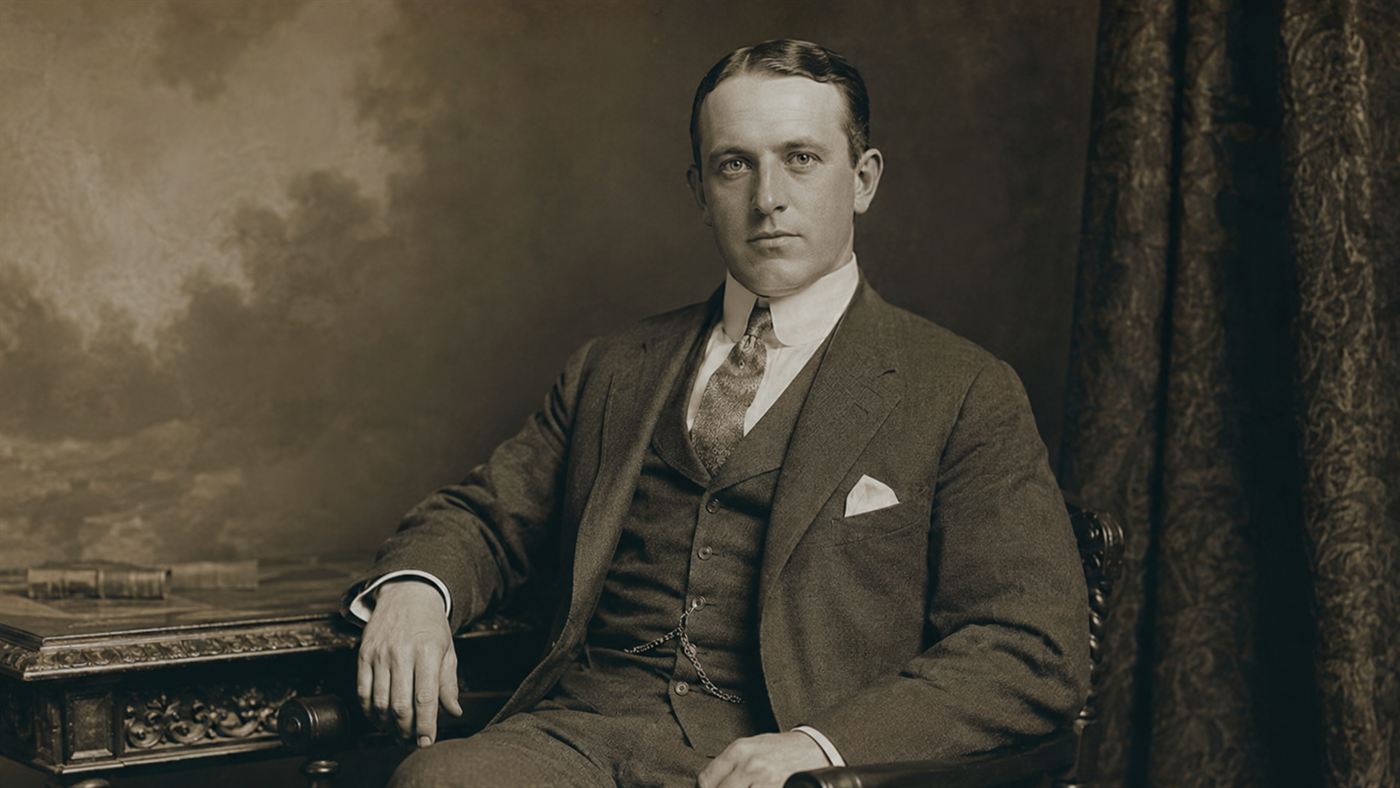
Eben Byers in the early 1920s, years before three bottles of Radithor a day dissolved his jaw and reduced him to 92 pounds. He had won the U.S. Amateur Golf Championship in 1906 and was one of Pittsburgh's most visible socialites. Illustration: Watts & Wild.
Radithor was a small bottle of distilled water containing two microcuries each of radium-226 and radium-228, sold legally across the United States from the mid-1920s at roughly one dollar per bottle. Its maker, William J.A. Bailey, had no medical degree and had previously been convicted of mail fraud, but none of that disqualified him from selling a radioactive patent medicine in an era when radiation was considered an invigorating tonic rather than a hazard. Physicians prescribed Radithor freely, and in the autumn of 1927 one of them recommended it to Eben Byers, a wealthy Pittsburgh socialite who had won the U.S. Amateur Golf Championship in 1906 and had injured his arm falling from a sleeping berth on a train after the Yale-Harvard football game.
Eben Byers did not try Radithor tentatively. Within months he was drinking three bottles a day, ordering cases directly from Bailey's New Jersey facility, and writing testimonials praising its effects on his energy and vitality. He recommended radium water to friends and reportedly gave bottles to his racehorses. Over approximately three years, Eben Byers consumed around 1,400 bottles of Radithor. In 1930, his jaw began to come apart.
The socialite who became Radithor's best advertisement
Eben Byers was born in 1880 into Pittsburgh's industrial wealth, the son of an iron magnate.
He was athletic, socially prominent, and genuinely accomplished: his 1906 U.S. Amateur Golf Championship win was a rigorous national competition, not a ceremonial honor.
In 1927, at age 47, he was still vigorous enough to be at the Yale-Harvard game when the accident that eventually led him to Radithor occurred.
The physician who recommended Radithor to him was following a logic that seemed defensible at the time: radium had been the subject of intense scientific attention since the Curie discoveries, radioactive springs were fashionable health resorts across Europe, and the idea that radioactivity stimulated cellular energy appeared in medical literature as a credible hypothesis, not a fringe claim.
Bailey's marketing described Radithor as permanently beneficial radium water, something the body could absorb and benefit from indefinitely.
What Bailey omitted was that radium is chemically similar to calcium.
The body treats it accordingly.
Radium deposited in bones stays there, and radium-226 has a half-life of 1,600 years, which means the dose Eben Byers accumulated in three years of drinking radioactive patent medicine would be emitting radiation inside his skeleton long after any physician who prescribed it was dead.
What Radithor put inside a person
The mechanism of radium damage is straightforward but was not fully understood in the 1920s.
When radioactive material is ingested, the alpha particles it emits travel only a short distance, but at close range they are energetic enough to break the chemical bonds in DNA and destroy surrounding tissue.
Radium deposited in bone marrow irradiates the cells responsible for producing blood, leading over time to anemia, immune suppression, and failure of bone structure.
In Eben Byers, the damage manifested first in his jaw, which had absorbed the highest concentration of radium as the soft tissue broke down under continuous low-level irradiation.
By 1930 his jaw had deteriorated enough to require surgical removal of most of the bone.
Holes appeared in his skull.
A man who had weighed around 170 pounds at his peak fell to approximately 92 pounds.
His arm, the original reason he had started drinking Radithor, had long since stopped being a consideration.
The radioactive decay of the radium he had accumulated continued regardless of whether he kept taking it.
Eben Byers died on April 5, 1932, at the age of 51.
The radium craze that made Radithor possible
Radithor did not emerge from nowhere.
The 1920s radioactive patent medicine market was a genuine commercial ecosystem with dozens of products, from radioactive face creams to radioactive suppositories, all trading on a public understanding of radiation that associated it with energy, vitality, and the cutting edge of science.
The discovery of radium by Marie Curie and Pierre Curie in 1898 had created a cultural fascination with radioactivity that took decades to cool.
Radium glowed in the dark, which made it visually spectacular and associated with something almost magical.
radioactive spas attracted wealthy European visitors throughout the early twentieth century on the premise that naturally occurring radon in the water was therapeutic.
Bailey was not the only entrepreneur who saw an opportunity in selling radium water, but he was among the more successful: Radithor was sold in at least fifteen states and stocked by physicians as a legitimate treatment.
Thomas Midgley Jr., whose leaded gasoline was being promoted and sold widely during the same decade, represents a parallel pattern: dangerous chemistry normalized through commercial infrastructure before anyone measured the accumulation effect on the human body.
The difference with Radithor was that radium's damage to bones and blood was slow enough that early users often attributed the brief period of mild stimulation that some radiation exposure can produce to the product actually working.
A man who felt better in his first weeks of drinking radium water had no way to know that the dose was silently accumulating in his skeleton.
Eben Byers was not the only person harmed by Radithor, but he was the highest-profile victim, and the one who wrote the most testimonial letters.
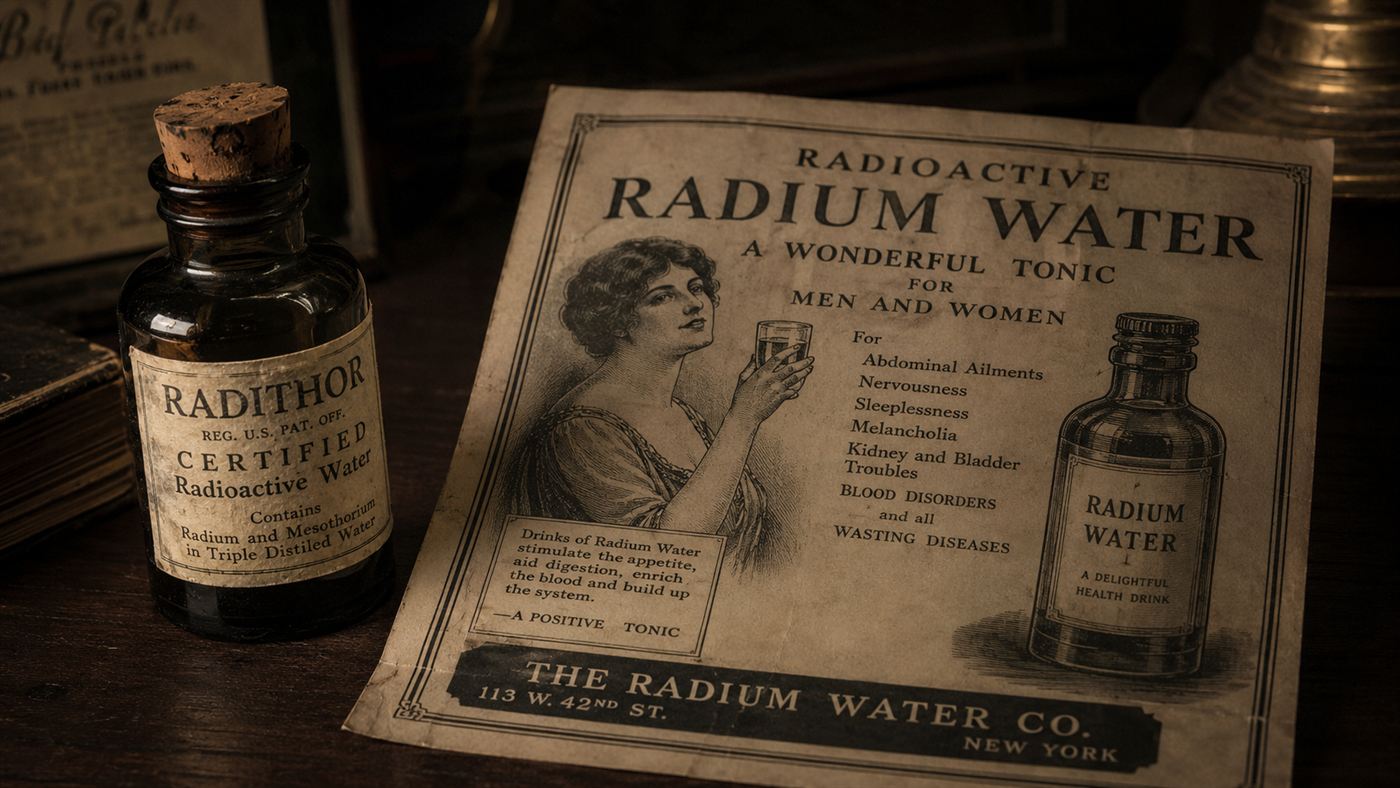
The Radithor investigation
By 1931, Eben Byers had deteriorated enough that Federal Trade Commission investigators became involved.
A journalist named William L. Laurence, working on assignment for the Wall Street Journal, was given access to Byers in what turned out to be his final months.
Laurence found a man barely recognizable as the socialite from the Pittsburgh society pages: the same pattern the Radium Girls had already established in New Jersey dial-painting factories, where workers who licked their radium-paint brushes daily watched their jaws disintegrate, was replaying in a Manhattan townhouse with someone who had bought his own radioactive patent medicine by choice.
The Wall Street Journal ran a piece on Byers with what became the most repeated line in the history of the Radithor case: "The Radium Water Worked Fine Until His Jaw Fell Off."
That phrase appeared as a 1990 retrospective subhead rather than a 1932 original headline, but it captured the story well enough that the distinction rarely survives retelling.
Bailey, the Radithor maker, was investigated but never criminally charged in connection with Eben Byers's death.
He continued selling other products, relocated his business, and died in 1949.
His own bones, when later exhumed, were still measurably radioactive from the radium he had apparently ingested while handling or testing his own radium water product.
The Food and Drug Administration used the Radithor case as the central exhibit in its push for stronger federal oversight of patent medicines, which culminated in the Federal Food, Drug, and Cosmetic Act of 1938.
Marie Curie's notebooks are still radioactive in Paris
Marie Curie, who with Pierre Curie discovered radium in 1898, died on July 4, 1934, two years after Eben Byers.
Her cause of death was aplastic anemia, almost certainly caused by decades of handling radioactive materials without protective equipment in an era when no one had yet defined a safe exposure threshold.
Pierre Curie had died in 1906, struck by a horse-drawn cart in Paris, but bones recovered from his body before burial showed significant radiation damage from his laboratory work.
Curie had won two Nobel Prizes, carried test tubes of radioactive isotopes in her coat pockets, and described the faint blue glow of radium compounds in her darkened laboratory as beautiful.
The concept of cumulative radiation dose, of damage that accumulates invisibly over years and manifests long after the exposure, was not established clearly enough for her to understand what she was experiencing.
Researchers who wish to examine them must sign a legal waiver acknowledging the radioactive hazard.
The notebooks are still radioactive because radium-226's 1,600-year half-life means they will remain so for longer than recorded human civilization has existed.
Eben Byers drank his Radithor in a world where the woman who discovered the element it contained was still alive and still did not fully understand the danger.

The honest catch
Radium-223, a different isotope of the same element that dissolved Eben Byers, is today an approved cancer therapy.
Sold under the brand name Xofigo, radium-223 dichloride is administered to patients with bone metastases from prostate cancer because radium's calcium-mimicking chemistry concentrates it precisely at sites of active bone formation, where tumors tend to cluster.
At carefully controlled doses, the alpha radiation it emits destroys cancer cells within a radius of a few cell widths, with far less systemic damage than conventional chemotherapy.
The difference between Xofigo and Radithor is not the element: it is precision, dose control, a defined treatment window, and roughly a century of understanding what radium does inside the human body.
Radithor was not a complete fiction in 1927: the hypothesis that radiation could stimulate cellular activity had a basis in real biology, and the effects of low-dose exposure are still debated in some research literature today.
What Radithor lacked was any way to measure accumulation, any understanding of how much radium a bone could hold before structural damage became irreversible, and any honest accounting of what daily doses of radioactive patent medicine added up to over three years.
The Great Smog of London in 1952 followed a similar trajectory: a hazard that had been building for decades killed thousands of people before anyone measured what had already accumulated in the air above the city.
Eben Byers's death was neither a murder nor a freak accident: it was the visible consequence of a regulatory gap, a period when a product with "radium" in its name was not required to prove safety before going to market.
Byers recommended Radithor to friends in 1929 because a product with radium in its name and a physician's endorsement felt safer than anything sold at a drugstore today. Would you have trusted it?
Related reading: The Radium Girls were already establishing the same jaw-deterioration pattern in New Jersey factories before Eben Byers started ordering Radithor by the case. See also Elixir Sulfanilamide, the poisoned medicine that finally forced drug-safety testing into law.