Thomas Midgley invented leaded gasoline and the aerosols that made the ozone hole, won the chemistry medal twice for it, and was strangled by his own rope-and-pulley after polio
In 1921, Thomas Midgley solved the engine-knocking problem by adding lead to leaded gasoline and invented the additive that would slowly poison children in every city in the world. In 1928, he invented Freon and the class of chlorofluorocarbons that would eventually tear a hole in the ozone layer. Chemistry's highest body honored him for both. He died in 1944 tangled in a system of ropes he had built to help himself out of bed.
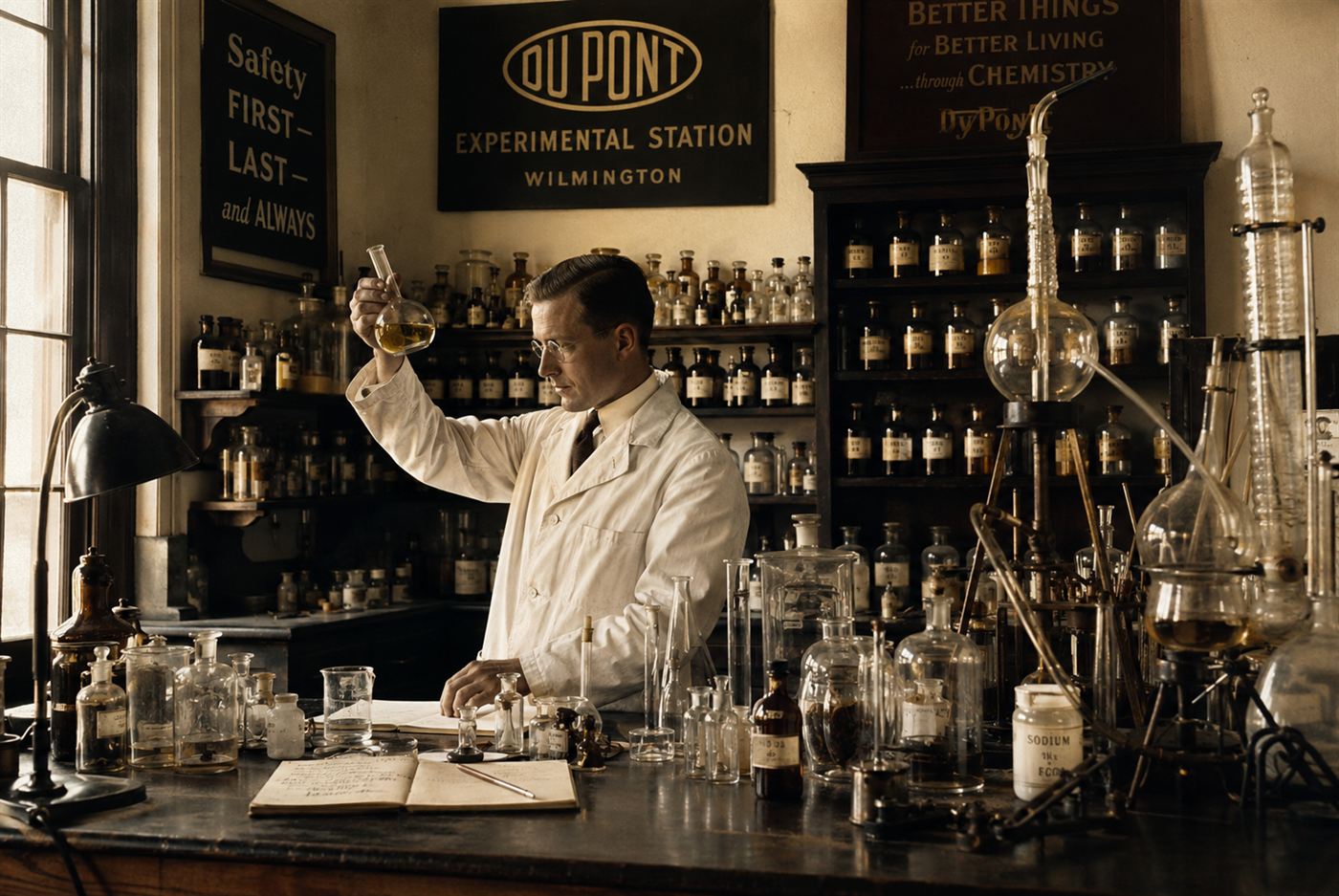
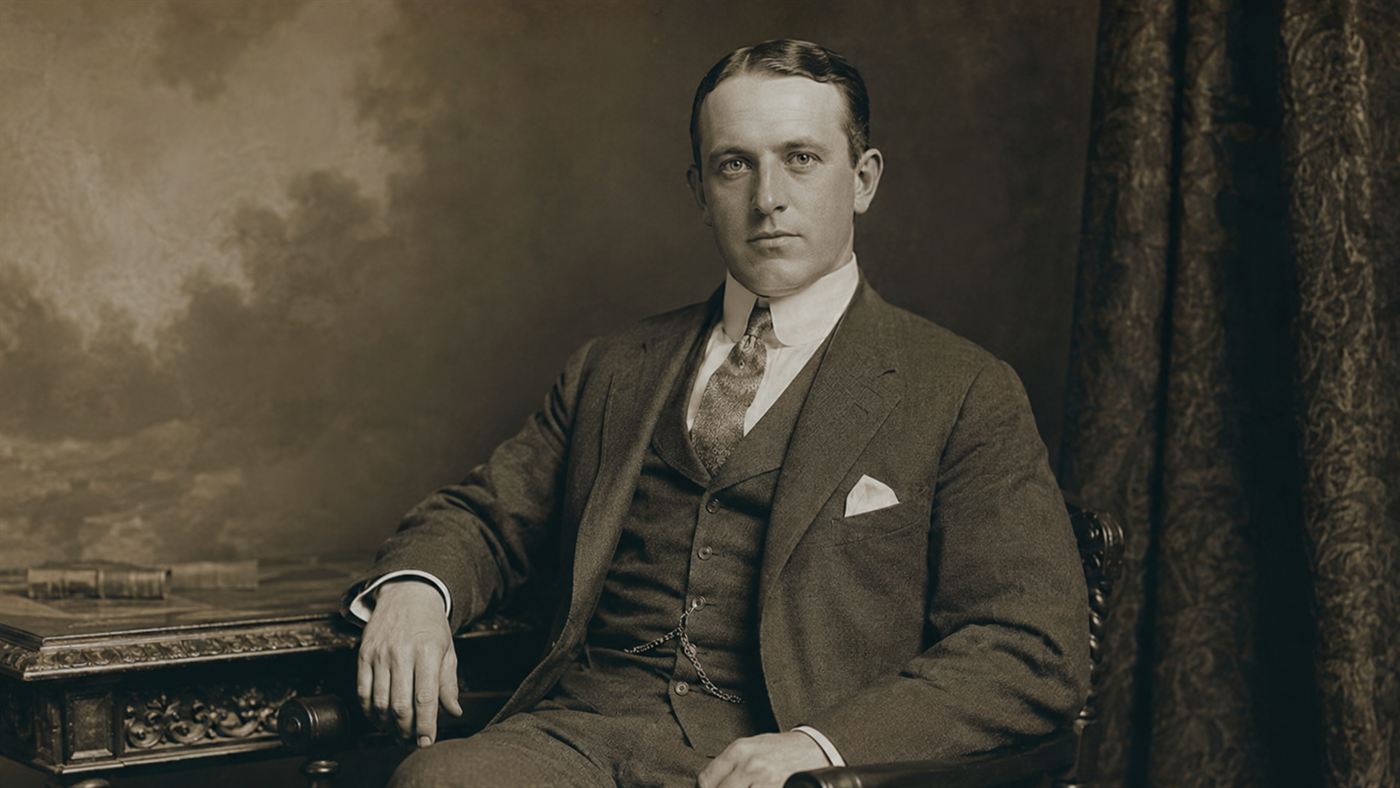
Thomas Midgley Jr. worked in General Motors' research division under Charles Kettering when he discovered that adding tetraethyl lead to gasoline eliminated engine knocking. He held a press conference in 1924 to prove the additive was safe by pouring it over his hands. He was already suffering from lead poisoning. Illustration: Watts & Wild.
In 1921, an American mechanical engineer named Thomas Midgley was trying to fix a problem with internal combustion engines. Engines knocked, a rattling combustion failure that wasted power and damaged machinery. Midgley, working under the inventor Charles Kettering at General Motors Research, found that adding tetraethyl lead to the fuel eliminated the knocking. He called the result leaded gasoline, General Motors and Standard Oil rushed it to market, and by the mid-1920s it was pouring through millions of engines across the United States and eventually the world.
Seven years later, Midgley turned his attention to refrigeration. The refrigerants in use in 1928, compounds like sulfur dioxide and ammonia, were toxic and flammable. Within five days of searching for a safer alternative, Midgley and his team synthesised dichlorodifluoromethane, a compound so stable, non-toxic, and non-flammable that Midgley demonstrated it at a chemistry conference by inhaling from a sample and using his exhaled breath to extinguish a candle. He called it Freon. The class of compounds he had discovered were chlorofluorocarbons. Freon became the dominant refrigerant in the world. And eventually, those chlorofluorocarbons tore a hole in the ozone layer above Antarctica.
Thomas Midgley Jr. was an American chemist who invented tetraethyl lead, the additive that made leaded gasoline commercially viable in 1921, and the chlorofluorocarbon refrigerants marketed as Freon in 1928. Leaded gasoline contaminated a generation through automotive exhaust. Freon eventually caused the ozone layer hole over Antarctica. Chemistry honored him for both.
How did Thomas Midgley's leaded gasoline stop engine knocking?
Engine knocking, also called engine ping, happens when fuel ignites prematurely in a combustion chamber before the piston reaches the correct position.
The result is a sharp metallic rattle, wasted power, and, over time, serious engine damage.
In the 1910s and early 1920s, as automobile use expanded rapidly, knocking was one of the main engineering obstacles limiting engine performance and efficiency.
Charles Kettering at GM Research set Thomas Midgley to work on the problem around 1916.
Midgley worked through hundreds of potential fuel additives over several years before finding that tetraethyl lead eliminated knocking entirely.
Tetraethyl lead, a compound that bonds lead atoms to carbon-based chains, was not new.
It had been synthesised in the 1850s.
What Midgley discovered was that adding a very small quantity to gasoline was enough to stop the knock, dramatically improving engine performance without visible alteration to the fuel.
General Motors, Standard Oil, and DuPont formed a joint venture called the Ethyl Gasoline Corporation to manufacture and market the additive.
By 1923, leaded gasoline was on sale at pumps across the United States.
By the mid-1930s, it was the standard automotive fuel across most of the industrialised world.
Thomas Midgley received the Society of Chemical Industry's Perkin Medal in 1937 and the American Chemical Society's Priestley Medal, the highest honor in American chemistry, in 1941 partly for this discovery.
What happened when workers at the leaded gasoline plant started dying?
The toxicity of lead was not unknown in 1923.
Lead poisoning had been documented in industrial workers for decades.
Alice Hamilton, an American physician and pioneer of occupational medicine, had been warning about industrial lead exposure since the early 1900s.
When production of tetraethyl lead began at a Standard Oil plant in Bayway, New Jersey, in 1924, workers began dying within months.
Five died.
Dozens more suffered hallucinations, tremors, and mental illness before recovering or losing the ability to recover.
Workers called the plant the House of Butterflies because hallucinating workers would swat at insects that were not there.
The response from the Ethyl Corporation and from General Motors was to question the link between lead poisoning and tetraethyl lead, to lobby against regulation, and to argue that there was no safe alternative antiknock additive.
Thomas Midgley held a press conference in October 1924 to demonstrate the safety of tetraethyl lead.
He poured the compound over his hands and held it beneath his nose for sixty seconds, telling reporters he could do this every day without injury.
He could not do this every day without injury.
Midgley had already been hospitalised for lead poisoning the previous year and went to Florida to recover.
In a private letter written around the same time, he acknowledged to a colleague that he had been deliberately avoiding further exposure to protect his own health.
The lead poisoning that killed and disabled workers at Bayway was real.
The insistence that the public risk from automotive leaded gasoline was not real, or not provable, or not worth acting on, was the position that corporations and regulatory bodies held for the next fifty years.
Leaded gasoline continued in widespread use in the United States until 1996, when it was finally banned for on-road vehicles.
The effects on blood lead levels in American children, which peaked in the 1970s, are documented in public health literature as one of the largest mass exposures to a developmental neurotoxin in history.
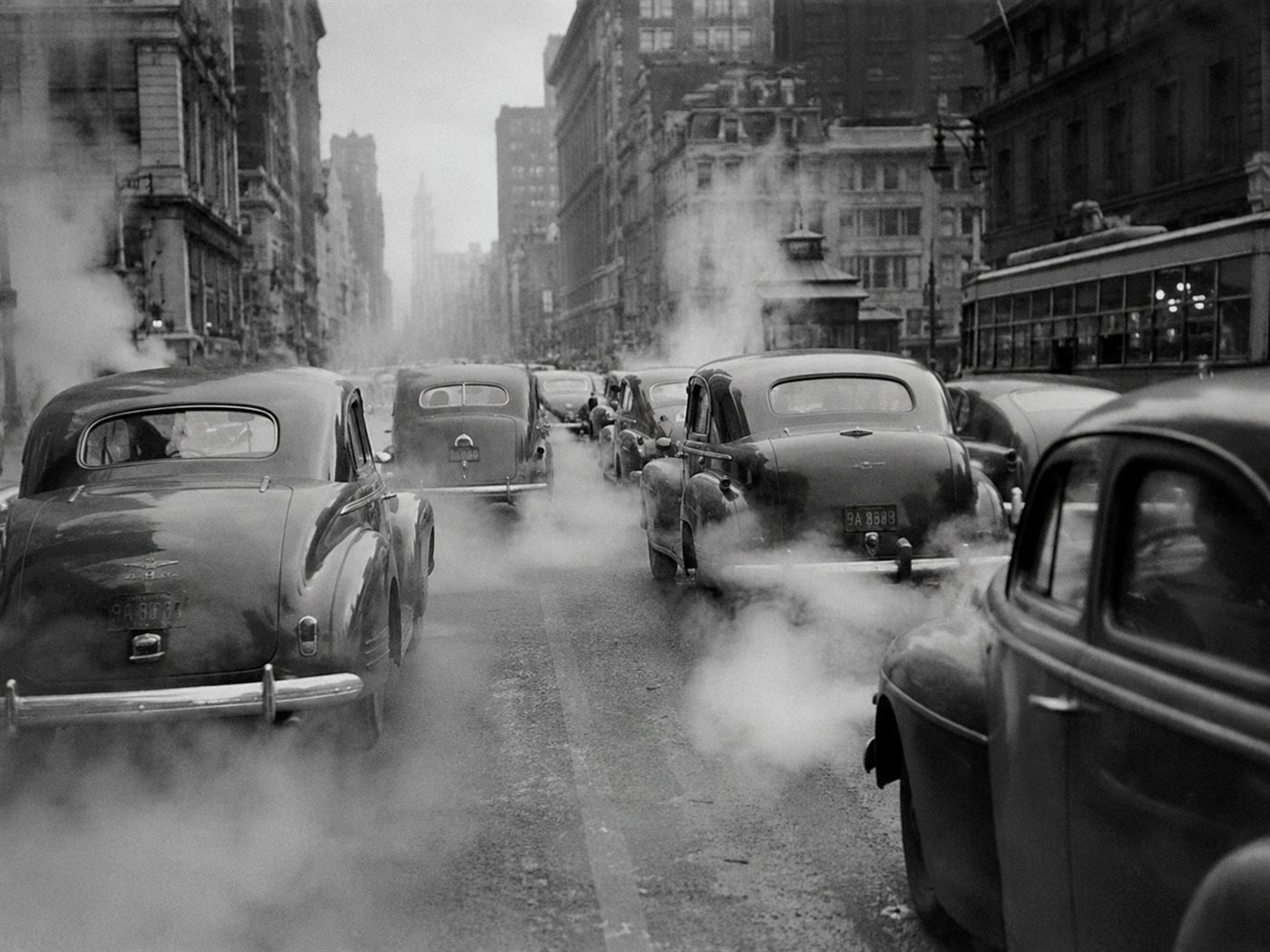
How did Thomas Midgley invent Freon and the chlorofluorocarbons?
By the late 1920s, Thomas Midgley had moved from fuel additives to refrigeration.
The refrigerants in commercial use were a practical problem: sulfur dioxide was toxic, ammonia was toxic and flammable, methyl chloride was toxic and had caused deaths in home refrigerators.
The brief Midgley received from General Motors and Frigidaire was to find a compound that was non-toxic, non-flammable, and stable enough to be used safely in domestic appliances.
Working with chemist Albert Henne and later Charles Midgley at the laboratories, Thomas Midgley's team searched systematically through the periodic table for candidate compounds.
Within five days, they had synthesised dichlorodifluoromethane, a chlorofluorocarbon that met all the requirements.
It did not burn.
It did not react with most other chemicals.
It was not acutely toxic at the concentrations people would encounter in a leaking refrigerator.
Midgley named the compound Freon and presented it to the American Chemical Society in 1930 by inhaling from a flask and blowing out a candle, demonstrating that the compound neither supported combustion nor posed any immediate respiratory danger.
Freon and the broader class of chlorofluorocarbon compounds became the dominant refrigerants in the world.
They were used in air conditioners, refrigerators, fire extinguishers, aerosol spray cans, and foam insulation.
In 1974, chemists Sherwood Rowland and Mario Molina published research showing that chlorofluorocarbon molecules, when they eventually drifted to the stratosphere, were broken apart by ultraviolet radiation and the resulting chlorine atoms were destroying ozone layer molecules at a rate that would eventually cause a catastrophic thinning of the ozone layer over the poles.
Rowland and Molina received the Nobel Prize in Chemistry in 1995 for this discovery.
Thomas Midgley had been dead for fifty years by then, and so he could not receive the honors or the blame.

Why was the Freon discovery celebrated, and when did the truth emerge about the ozone layer?
From the perspective of 1930, the invention of Freon looked like an unambiguous improvement on what had come before.
Home refrigerators in the 1920s and 1930s used sulfur dioxide or methyl chloride as refrigerants, and refrigerator leaks had killed people.
Freon was genuinely safer in the context in which people were thinking about safety in 1930: acute toxicity in confined spaces.
Nobody in 1930 was thinking about stratospheric chemistry.
Nobody in 1930 had identified the ozone layer as something that could be depleted by human industrial activity.
The research that eventually identified the problem came from a completely different direction: the discovery in the 1970s that the ozone layer was thinning and that chlorofluorocarbon compounds were responsible.
The British Antarctic Survey confirmed the existence of the ozone layer hole in 1985.
The Montreal Protocol, signed in 1987, began the international phase-out of ozone-depleting substances.
By 2024, the ozone layer hole had significantly reduced in size, though full recovery is not expected until the mid-21st century.
The same pattern of industrial harm not revealed by conventional testing, followed by decades of use, followed by eventual evidence of catastrophic global effect, had played out with both of Thomas Midgley's major inventions.
It is a pattern that has recurred in other industrial contexts too, from the factory workers who were told that licking radium-coated paintbrushes was safe to the public told that the coal smoke killing thousands of Londoners in 1952 was just influenza.
For more stories about how industrial decisions shape the world people live in, see our Curiosities section.
What happened to Thomas Midgley after he contracted polio in 1940?
In 1940, Thomas Midgley contracted poliomyelitis.
The disease left him significantly paralysed.
He could no longer get in and out of bed without assistance.
Thomas Midgley was an engineer by training, and he responded to his paralysis the way he responded to most problems: he designed a mechanical solution.
He built a system of ropes, pulleys, and motorised lifts that could raise and reposition him in bed and help him transfer to a wheelchair without needing another person in the room.
The system worked, at least for a while.
On November 2, 1944, Thomas Midgley was found dead.
He had become entangled in the ropes of his own device.
He was 55 years old.
The coroner's ruling was accidental strangulation.
The author Bill Bryson, writing in his 2003 book "A Short History of Nearly Everything," described Midgley as a man who "had more impact on the atmosphere than any other single organism in Earth's history."
It was not intended as a compliment.
The honest catch
The framing of Thomas Midgley as the worst inventor in history, or as uniquely villainous, requires some qualification.
Midgley was working within the industrial logic of his time, which treated chemical safety as equivalent to acute toxicity in short exposures rather than cumulative environmental effect over decades.
The long-term harm from leaded gasoline and from chlorofluorocarbons was not detectable by the science available in 1921 or 1928.
Many scientists, regulators, and corporate officials made decisions based on the same incomplete picture.
The particular critique that applies to Midgley is not that he invented something bad by accident, but that when evidence of harm emerged, particularly around lead poisoning at the Bayway plant in 1924, the response from the industry he worked for was to suppress, delay, and lobby rather than to stop.
Midgley himself was privately aware that tetraethyl lead was dangerous to workers in manufacturing.
His public demonstration of its safety in 1924 was theatre, not honest testimony.
There is also the question of alternatives.
Ethanol was a workable antiknock additive in 1921 and did not require adding lead to gasoline at all.
It was not chosen, in part because ethanol could not be patented the way tetraethyl lead could.
The leaded gasoline industry was built on a compound that could generate royalties.
The ozone layer hole from chlorofluorocarbons, by contrast, was genuinely unforeseeable with 1928 science.
The harm from Freon represents what regulators now call a systemic failure of precaution rather than individual culpability in the way that the lead poisoning cover-up was.
Both harms were immense.
Their causes are more tangled than a single name makes them seem.
If the same compound had been invented with the full knowledge of what it would do over the following decades, would we still call it one of the worst inventions in history, or does the responsibility lie with the systems that kept it on the market after the harm became clear?
Tell us in the comments.
More from Watts & Wild
 The factory told the Radium Girls their paintbrushes were safe while the men upstairs wore lead aprons
 The Great Smog of 1952 killed 12,000 Londoners and the government blamed flu for three years
 The coal tip above Aberfan had been reported as dangerous for years before it buried a school
 Jimmy Carter crawled into a melted nuclear reactor in 1952 and was president when Three Mile Island happened
 The socialite who drank 1,400 bottles of radium water and dissolved from the inside