In July 1518 in Strasbourg, a woman named Frau Troffea began dancing in a street and could not stop, and within a month four hundred people had joined her
On July 14, 1518, a woman named Frau Troffea walked out of her house in Strasbourg and began to dance. She had not stopped days later. By August, four hundred of her neighbours had joined her in what became known as the dancing plague of 1518. The city hired musicians to keep them going. Some of the dancers died.
 By Bruno Teles · 27 June 2026
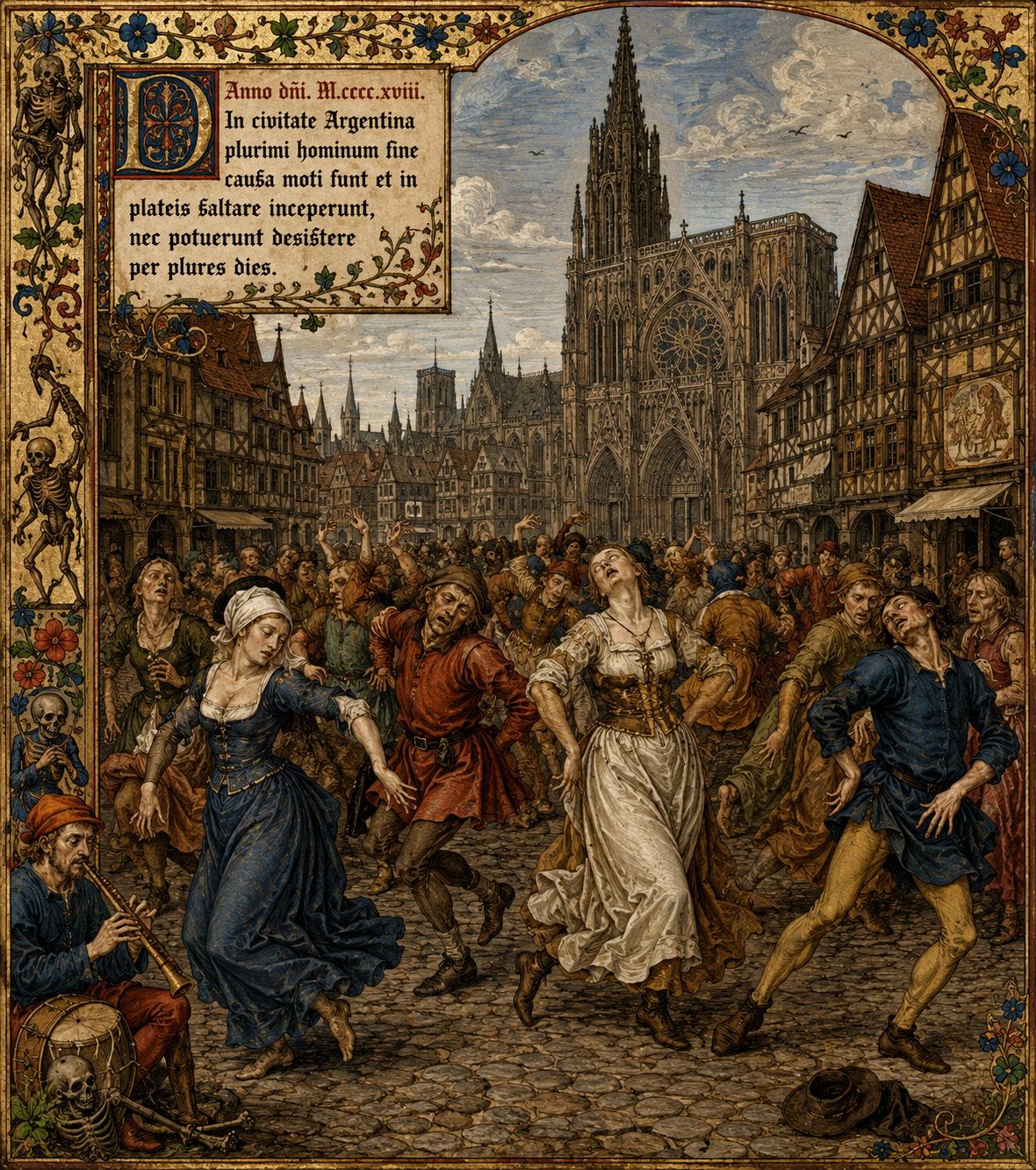
The dancing plague of 1518 is one of the strangest events recorded in European history. In a city already devastated by famine, disease, and poverty, hundreds of people danced uncontrollably for weeks on end, and the city's response was to provide a stage and an orchestra.
Frau Troffea, the woman whose name appears in the Strasbourg city council's records as the first to be affected, was among the initial group of dancers. Nothing in the historical record suggests she chose to start. The dancing came upon her involuntarily, and it would not stop until the Strasbourg authorities sent the worst-affected cases to a shrine of St Vitus in the Vosges mountains, weeks later.
The dancing plague of 1518 began in Strasbourg in July when a woman named Frau Troffea started dancing in a street and could not stop. Four hundred people eventually joined her. The Strasbourg city council's response was to hire professional musicians and clear a stage for the dancers to continue, believing the cure was to dance until the body gave out.
Who was Frau Troffea, and how did the dancing plague of 1518 begin?
The Strasbourg records of July 1518 are unusually specific on one point: a woman named Frau Troffea began dancing in a street of the city around July 14, and she did not stop for days.
She danced through the day and into the night.
By the fourth or fifth day, she had collapsed repeatedly from exhaustion, only to rise and begin again.
Contemporary accounts describe her feet as bleeding.
By the end of the first week, thirty-four more people in Strasbourg had joined the dancing plague.
They had not chosen to dance.
The contemporary word used in the Strasbourg records was the German equivalent of "afflicted" or "struck" by dancing.
This was 1518 Strasbourg, a city inside the Holy Roman Empire with a population of perhaps twenty thousand people.
It had been suffering for years: crops had failed repeatedly, a severe famine was underway, a plague epidemic had killed thousands in recent memory, syphilis was spreading through the population, and taxes levied to fund distant wars had pushed many families to near-starvation.
The city's residents were living at the edge of what people can bear.
Frau Troffea's name appears in city records but almost nothing else about her is known.
Whether she was married, what her occupation was, where exactly she lived in Strasbourg, whether she recovered: none of this is in the surviving documents.
She is the face of a disaster that has no proper face.
How did Strasbourg respond when four hundred people could not stop dancing?
The Strasbourg city council's initial response was to try to stop the dancing.
They banned music in the streets around the affected areas.
It did not work.
By August, the number of people caught in the dancing plague had grown to approximately four hundred.
The council then consulted the city's physicians and the local medical guild.
Their diagnosis was "hot blood" (in the Galenic medical tradition, an excess of the blood humour, associated with fever and irrational behaviour).
Their prescription: more dancing.
The council accepted this advice.
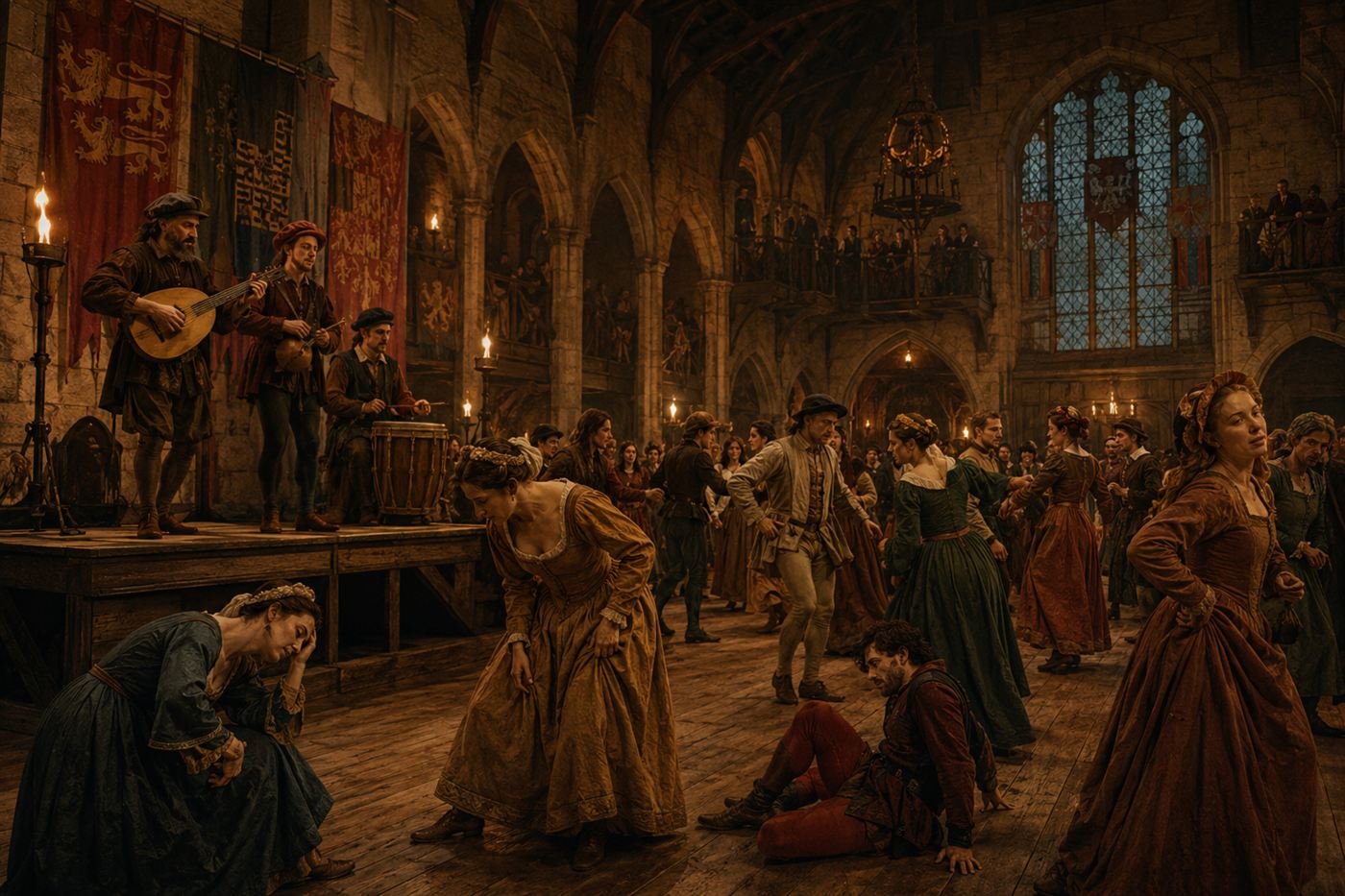
They cleared the market and the corn exchange of Strasbourg and turned them into dance floors.
They hired professional musicians to play continuously, so that the afflicted could dance without breaking rhythm.
They hired professional dancers and brought them in to dance alongside the victims, to demonstrate how the body should move.
The musicians played day and night.
The idea behind this treatment was straightforward: the hot blood causing the dancing plague would exhaust itself if the body danced long enough, and recovery would follow the point of complete collapse.
This is also the moment where the Strasbourg response almost certainly made everything worse.
The music legitimised the dancing as a public performance rather than a private affliction.
The stages turned the dancing plague into a spectacle that attracted crowds.
The crowds transmitted the behaviour to new participants.
Scholar John Waller of the University of Michigan, whose 2008 study of the Strasbourg dancing plague is the most thorough modern academic treatment, argues that the council's response transformed a localised outbreak of mass hysteria into a city-wide epidemic.
They were trying to cure something they did not understand, and the cure spread the disease.
Who died in the dancing plague, and how did it eventually end?
Contemporary Strasbourg records and documents from neighbouring cities and monasteries describe people dying during the dancing plague of 1518.
The deaths are attributed to heart failure, stroke, and exhaustion.
Some contemporary accounts put the number of deaths at fifteen per day at the peak.
Historians are cautious about this figure.
The records of individual deaths, with names and circumstances, do not survive in the way that the general accounts of the event do.
We know that people died; we do not know how many with any confidence.
The dancing plague in Strasbourg eventually subsided after the city authorities changed strategy.
They stopped the music.
They closed the dance halls.
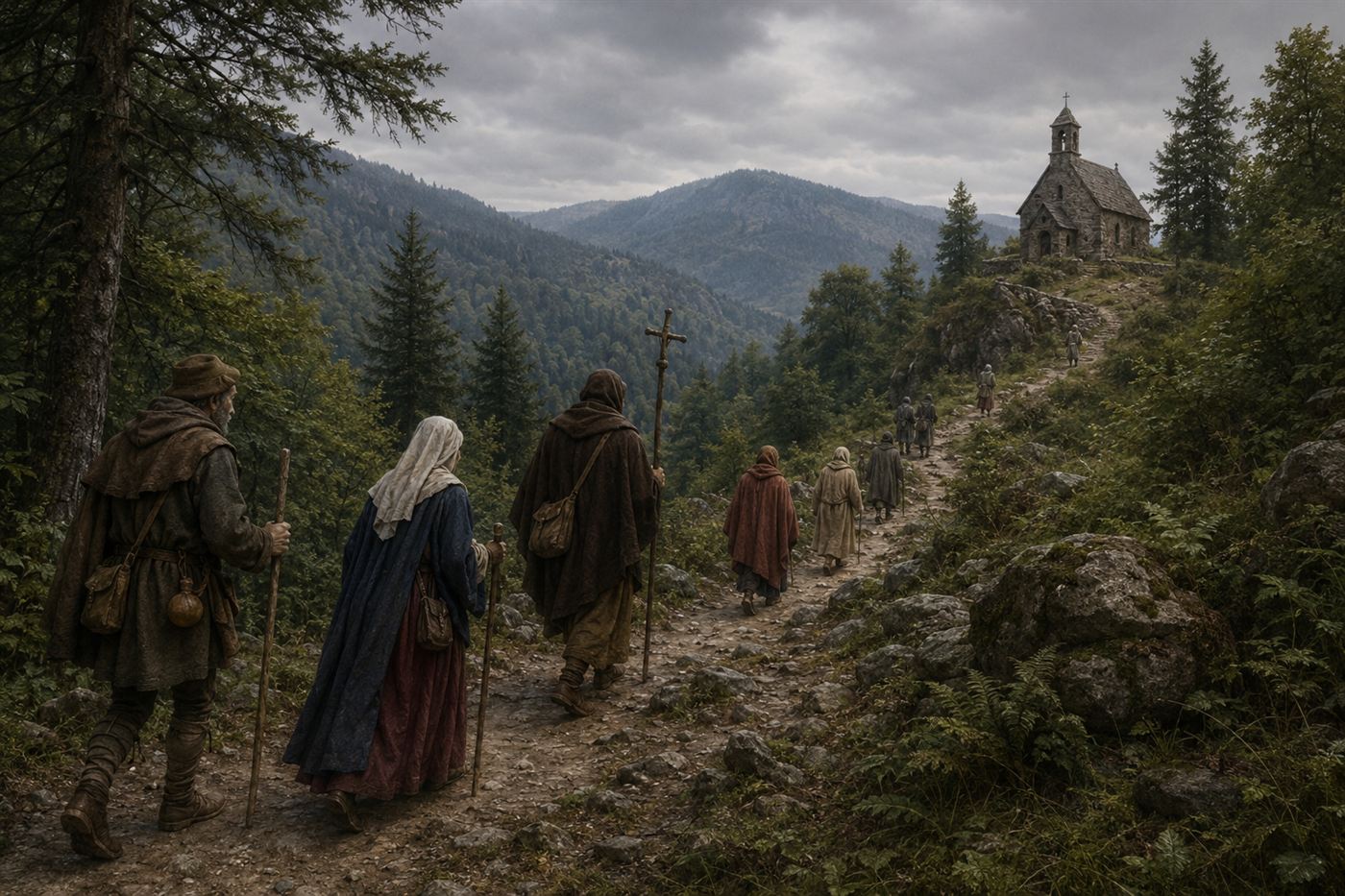
They organized processions of the most severely afflicted to the shrine of St Vitus at Saverne, in the Vosges mountains some distance from Strasbourg.
St Vitus was the patron saint of dancers and epilepsy, and in the religious belief of the time, he could both cause and cure uncontrollable movement in those who offended or appealed to him.
The dancers were given red shoes, associated with St Vitus in the religious folklore of the region.
The pilgrimage and the religious ritual of the shrine appear to have worked: the dancing subsided there.
The exact date on which the dancing plague of 1518 ended is not recorded.
At some point in September or October 1518, the accounts stop, and life in Strasbourg appears to have returned to normal.
What caused the dancing plague of 1518, and was it mass hysteria?
Mass hysteria, now more properly called mass psychogenic illness, is the leading explanation for the dancing plague of 1518.
Mass psychogenic illness is a documented and recurrent phenomenon in which physical symptoms, including uncontrollable movement, spread through a group without any organic (biological) cause.
It tends to occur in populations under severe psychological stress, in groups with shared beliefs about the nature of the symptoms, and in settings where the behaviour is observed or somehow validated by the community around it.
Strasbourg in 1518 met all three conditions precisely.
The population was under extreme stress from famine, disease, and poverty.
The regional folk belief about St Vitus gave the dancing a recognised religious meaning: to be struck by the dancing plague was understood as St Vitus punishing or testing the afflicted.
And once the city council built stages and hired musicians, the behaviour was publicly validated at the highest civic level.
The ergot theory, which attributes the dancing plague to poisoning by Claviceps purpurea, the fungus that grows on wet rye bread, has been popular with non-specialists for decades.
Ergot poisoning, historically known as St Anthony's Fire, causes burning sensations in the limbs, hallucinations, and convulsive spasms.
But the symptoms of ergotism do not include sustained, coordinated dancing.
Ergot poisoning also affects all people who eat contaminated bread, not a selective subgroup of a city's population.
And the ergotism theory cannot account for the way the dancing plague spread through Strasbourg over weeks in a pattern consistent with social transmission rather than food contamination.
Most historians and medical scholars reject the ergot explanation for these reasons.
Were there other dancing plagues, and was 1518 the most severe?
The Strasbourg dancing plague of 1518 was not the first, and it was probably not the last.
The most extensive earlier outbreak occurred in 1374, along the Rhine valley and spreading into parts of what are now Belgium, Germany, and the Netherlands.
Thousands of people danced compulsively through the streets of multiple cities, invoking St Vitus and being taken to his shrines.
A smaller outbreak struck Strasbourg itself in 1418, a century before the 1518 dancing plague.
Other recorded episodes of mass compulsive behaviour in medieval and early modern Europe suggest that dancing plagues were a recognisable pattern, not a unique event.
What made 1518 unusual was the extent of documentation and the specific nature of the city council's response.
The Strasbourg records are unusually detailed for the period, which is why the 1518 dancing plague is the best-studied episode of the phenomenon.
John Waller's analysis also identifies a specific factor that made Strasbourg in 1518 particularly vulnerable: a local cult of St Vitus with a strong regional presence meant that the cognitive framework for interpreting uncontrollable movement as a divinely inflicted dancing plague was especially available to Strasbourg residents.
In cities without this specific cultural template, the same social stressors might have produced different symptoms, or none at all.
The link between the inexplicable and the cultural framework available to explain it is a pattern that appears in many chapters of history where collective behaviour defies easy analysis.
The honest catch
The death toll of the dancing plague of 1518 is genuinely uncertain.
The figure of fifteen deaths per day comes from a single contemporary account, a letter from a monastery near Strasbourg, and historians are not confident it is accurate.
No individual names of those who died are recorded.
The mass hysteria explanation is the best available, but it is also still an incomplete one.
Mass psychogenic illness explains the mechanism by which symptoms spread socially through a group.
It does not fully explain why some individuals begin the behaviour and others do not, or why it begins in a particular person on a particular day.
Frau Troffea remains, five hundred years later, an unexplained starting point.
The dancing plague of 1518 also raises a question about how we describe the event itself.
"Dancing" implies something joyful or voluntary, but contemporary descriptions of the afflicted make clear they were not dancing for pleasure.
They were suffering.
Some begged to be stopped and could not stop themselves.
Some wept while their bodies continued to move.
The Strasbourg council, the physicians, the musicians they hired: all of them were trying to help, with the best understanding available to them in 1518.
The idea that dancing through the crisis was the cure turns out to have been wrong, possibly making things worse.
But it was not negligence.
It was the limit of what a city knew, doing the best it could for people who were completely beyond what the medicine of the time could explain, in the middle of a famine, in a city that was already close to breaking. Medieval Europe is full of such half-explained episodes, from this to the two green-skinned children who walked out of a Suffolk harvest field.
The city of Strasbourg did the only thing it knew how to do for four hundred people who could not stop dancing. It turned on the music and built a stage. The cure made it worse. We have better tools now than they had in 1518, but we still regularly see situations where the institutional response to a crisis feeds the crisis in ways nobody anticipated. Does the dancing plague of 1518 feel like the distant past, or like something that could still happen? Leave a comment below.
More from Watts & Wild
More in Curiosities →


Bruno writes about the moments when history produced something that nobody could explain and everyone had to live through anyway. He writes for Watts & Wild from Lisbon.