On Christmas Eve 2024 a NASA probe flew right through the Sun's atmosphere and lived, the fastest object ever built passing 6 million kilometres from the surface at 690,000 km/h
On Christmas Eve 2024, while most people were wrapping presents, NASA's Parker Solar Probe did something no machine had done before: it flew straight through the outer atmosphere of the Sun at 690,000 km/h, the fastest any human-made object has ever travelled, and came out the other side intact.
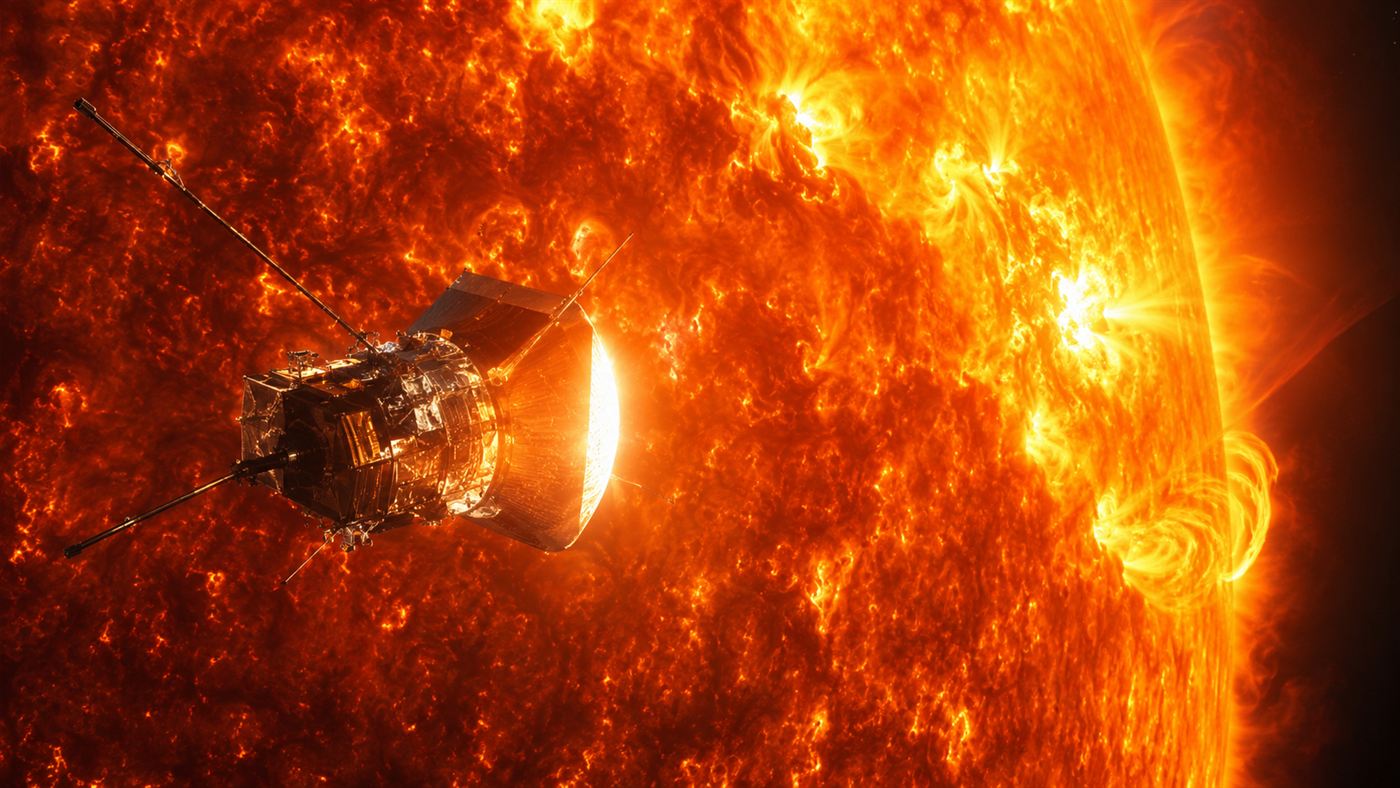
The Parker Solar Probe shields its instruments behind a carbon heat shield as it skims the Sun. Illustration: Watts & Wild.
We talk about spacecraft going to the Moon or Mars, far out into the cold and dark. The Parker Solar Probe does the opposite. It dives inward, toward the one object in the solar system actively trying to destroy it, and on 24 December 2024 it got closer to the Sun than anything humanity has ever built.
At its closest, the probe was about 6.1 million kilometres from the solar surface. That sounds like a lot, but on the scale of the solar system it is a hair's breadth, close enough to be flying inside the Sun's own atmosphere. For a few hours, a machine from Earth was effectively swimming through the edge of a star.
The Parker Solar Probe inside the Sun's atmosphere
The Sun does not have a hard surface, but it does have an outer atmosphere called the corona, the faint halo you can see during a total eclipse. As NASA described it, on that pass the Parker Solar Probe flew through the corona itself, the closest any spacecraft has ever come to the Sun. In the loose language everyone used, it touched the Sun.
This is the whole point of the mission. To understand a star, you eventually have to go and fly through the outer layers of one, taking measurements from inside rather than squinting at it from 150 million kilometres away. No probe had ever been built tough enough to try until now.
The fastest thing we have ever built
Getting that close means falling an enormous distance into the Sun's gravity, and that makes the probe astonishingly fast. At closest approach it was moving at about 690,000 km/h, roughly 430,000 mph, which works out to a staggering 191 kilometres every second. Nothing humans have ever made has moved faster.
It is hard to picture that speed. At 690,000 km/h you could cross from London to New York in about half a minute, or circle the entire Earth in just over three minutes. The probe is not so much flying as being slingshotted around the Sun, picking up velocity from the same gravity that is trying to pull it in.
How it survives the heat
The thing that should kill it is, of course, the heat, and the answer is one beautifully simple piece of engineering: a shield. According to the Johns Hopkins Applied Physics Laboratory, which built and operates the probe, a carbon-composite heat shield is designed to endure around 1,400 degrees Celsius, while keeping the instruments tucked behind it at close to room temperature.
There is a counter-intuitive trick that helps. The corona is incredibly hot, in the millions of degrees, but it is also extremely thin, so few particles actually touch the spacecraft. It is the difference between putting your hand in a hot oven and putting it in boiling water, the same temperature feels very different. The shield still faced furnace-like heat near 1,000 degrees, but it held, and the probe phoned home a couple of days later to say it was fine.
Why fly into the Sun at all
This is not a stunt, even if it sounds like one. The probe is hunting answers to questions that matter down here. One is the long-standing mystery of why the corona is hundreds of times hotter than the surface beneath it, which makes no obvious sense and has puzzled physicists for decades. The other is the solar wind, the stream of charged particles the Sun blasts out in all directions.
That solar wind, and the violent storms that ride on it, are what threaten satellites, power grids and communications back on Earth. By flying into the place where this weather is born, the probe, named after the physicist Eugene Parker who predicted the solar wind, is trying to help us forecast space storms before they hit. It is, in a real sense, a mission about protecting modern life.
The honest catch
It is worth puncturing the romance a little. The probe did not photograph the Sun from just above its surface, and it certainly did not land on anything; touching the Sun means flying through a wisp of thin outer atmosphere millions of kilometres up, not skimming a fiery ground. The actual surface would vaporise the spacecraft in an instant.
The science is also slow and incremental, not a single eureka. Data trickles back over months and has to be carefully untangled, and no one expects the corona's mysteries to be solved by one daring pass. The mission will eventually end when the shield degrades or the fuel runs out. What the probe delivers is hard, patient measurement from a place we could never reach before, which is less dramatic than the headline but arguably more valuable.
Why touching the Sun matters
Strip away the superlatives and what remains is genuinely staggering: we built a machine that can fly into the atmosphere of a star, at a speed that would take it around the planet in minutes, and survive. A century ago we were barely flying across oceans. Now we are threading hardware through the edge of the Sun and getting it back.
It also quietly underlines how tangled our modern world is with the Sun's moods, and how much we want to predict them. Does flying a probe into the Sun's atmosphere feel like one of humanity's great feats to you, or a terrifying place to send anything at all? Tell us in the comments.
Related reading: The world's largest camera, a 3,200-megapixel machine the size of a car, has started filming the entire southern sky over and over for ten years to build the first true time-lapse of the universe. For another audacious leap into space, see Project Orion, the spaceship designed to ride nuclear bombs to the planets. See also how a planet-sized telescope captured the first image of a black hole.