For 230 years people have dug into a hole on a Canadian island chasing buried treasure, and it has cost them millions of dollars, six lives, and possibly nothing real at all
On a small wooded island off the coast of Nova Scotia there is a hole in the ground that has obsessed treasure hunters for more than two centuries. It floods whenever anyone digs too deep. It has swallowed fortunes and six lives. And after 230 years of frantic excavation, the single most likely explanation is that there was never any treasure there to find.
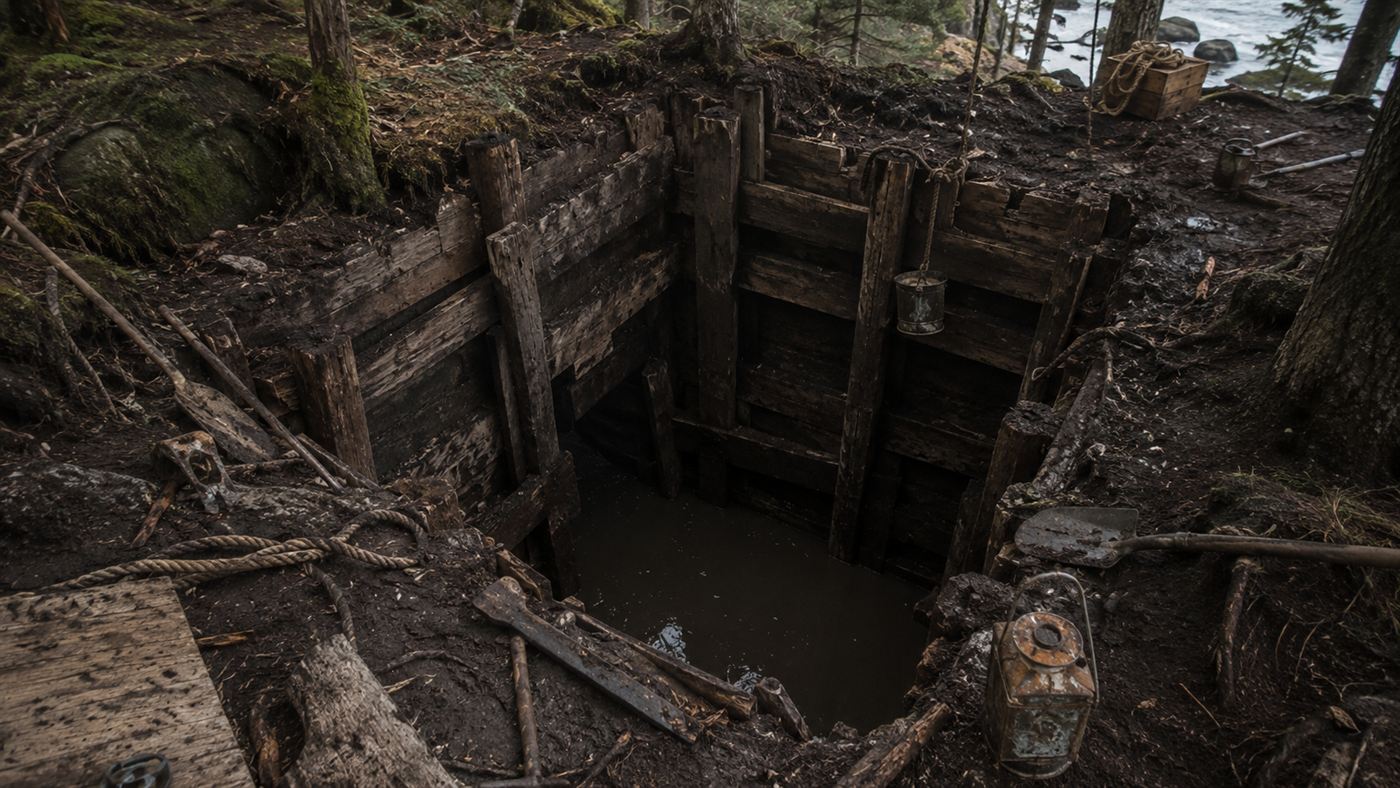
For 230 years, diggers have poured money and lives into this flooded hole. Illustration: Watts & Wild.
The Oak Island money pit is one of the longest-running treasure hunts in the world, a story so irresistible that it has drawn in everyone from teenage farmhands to a future president of the United States, and most recently a long-running television series. It has all the ingredients of a perfect mystery: buried gold, cryptic clues, an apparently booby-trapped shaft, and a body count. The only thing it lacks, awkwardly, is the treasure.
The whole saga began with a curious teenager and a hole in the ground.
What is the Oak Island money pit?
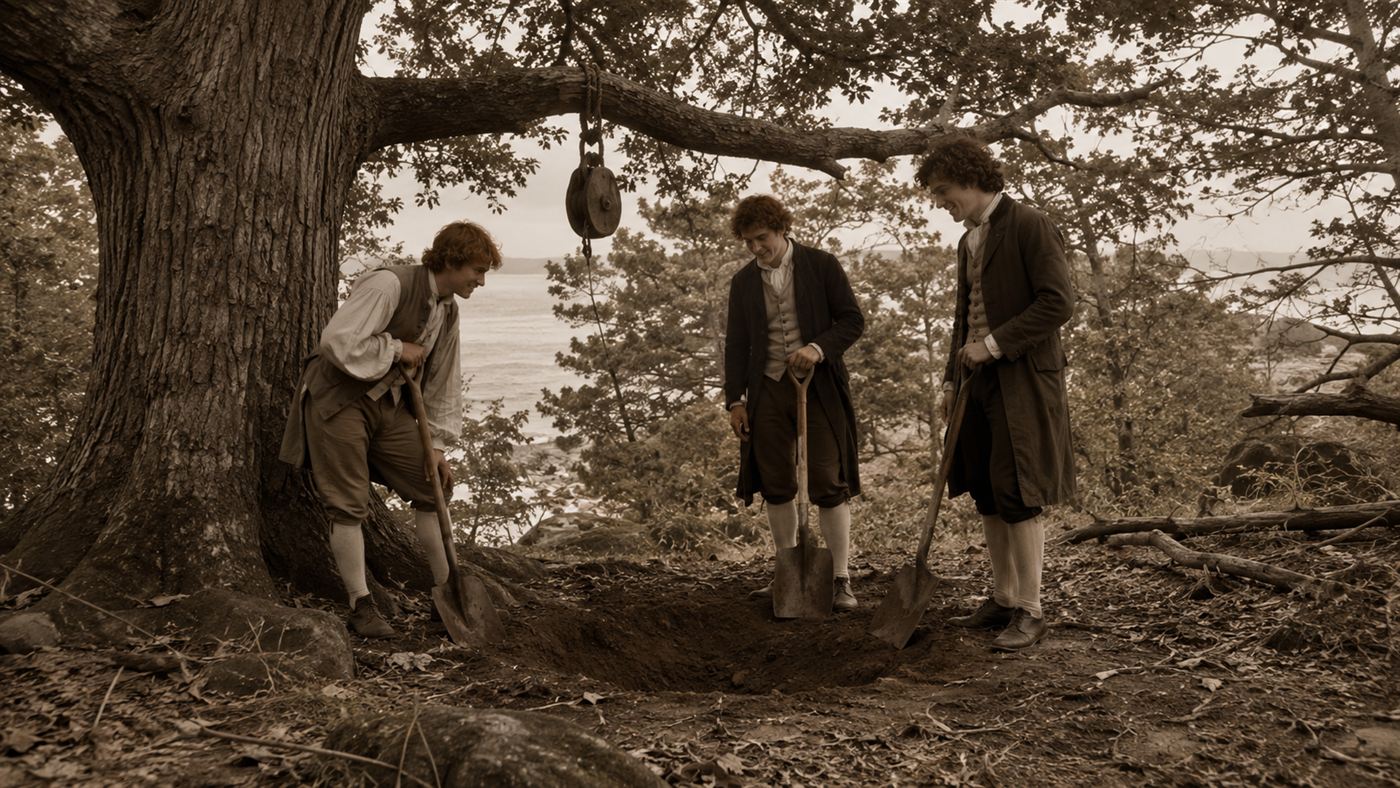
In 1795, a young man named Daniel McGinnis is said to have spotted a circular depression in the ground on Oak Island, beneath an old oak tree from which, the story goes, hung an old ship's tackle block. Convinced it marked buried pirate loot, he and two friends started to dig. A few feet down they hit a layer of flagstones, and then something stranger: a platform of oak logs.
As they kept going, the pattern repeated. Roughly every ten feet, the diggers reported hitting another deliberately placed oak platform, along with layers of charcoal, putty and, oddly, coconut fibre, a material from thousands of miles away. It looked, for all the world, like someone had gone to enormous effort to bury something very deep and very securely. And then, at around ninety feet, the pit beat them in the most dramatic way possible.
The booby-trapped hole that floods
The defining feature of the money pit, the thing that has defeated every expedition, is the water. When diggers reach a certain depth, the shaft suddenly floods with seawater faster than any pump can clear it, sometimes filling with sixty feet of water almost overnight. To treasure hunters, this looked like genius: a deliberate booby trap.
The legend that grew up is elaborate. Searchers became convinced that whoever buried the treasure had also dug hidden flood tunnels running 500 feet to the sea at a spot called Smith's Cove, where they found an artificial beach and stone drains designed to channel seawater into the pit the moment it was disturbed. In this telling, the money pit is not just a hole but an ingenious ancient security system, engineered to drown anyone who got close to the prize.
The curse and the six deaths
Over the following two centuries, wave after wave of treasure-hunting companies attacked the pit, sinking new shafts, drilling boreholes, and pouring in money that would today run into the millions. None of them got the treasure, and the island began to take a darker toll. Since 1861, when a boiler burst during one expedition, six people have died on Oak Island in accidents, collapses and gas leaks tied to the hunt.
From those deaths grew the most famous piece of Oak Island folklore: the curse. According to legend, the treasure will only be found once seven people have died searching for it, which means, chillingly, that the island is said to be just one death short. It is exactly the kind of detail that keeps a mystery alive, and keeps people digging. The hunt has even snared famous names; a young Franklin D. Roosevelt invested in and visited an Oak Island dig in 1909.
Has anything actually been found?
This is the deflating part. For all the centuries of effort, the haul from the money pit is almost comically thin. The single most cited "treasure" is a fragment of gold chain, just three small links, brought up by a drill in 1849. Beyond that there are various ambiguous scraps, an inscribed stone whose translation is disputed and which has since been lost, and a great deal of wood and mud.
No chest, no hoard, no pirate gold, nothing remotely matching the fortunes that have been spent looking for it has ever been recovered. The most valuable thing ever taken out of the Oak Island money pit, by a wide margin, is the story itself, which has sold books, funded expeditions and run for many seasons on television. The treasure that pays out, ironically, is the legend.
The honest catch
Here is where a sceptic has to spoil the party, because the most boring explanation is also the most likely. Many geologists and investigators argue that there is no treasure and no ingenious booby trap at all. In this view, the "money pit" is simply a natural sinkhole in the island's soluble limestone bedrock, and the famous flooding is the entirely ordinary result of the island's freshwater lens meeting tidal seawater pressure through natural underground channels.
The eerie oak platforms and coconut fibre, the argument goes, have been exaggerated, misremembered or muddled across 230 years of retelling, and some of the "structures" found later were the remains of earlier searchers' own diggings. The real engineering marvel of Oak Island may not be an ancient vault, but the human imagination, which took a wet hole in the ground and built around it one of the most durable treasure legends on Earth. The mystery, in other words, is mostly us.
Why the Oak Island money pit still grips us
Even knowing all that, it is almost impossible not to be charmed by it. The Oak Island money pit endures because it sits exactly on the line between the rational and the romantic, daring you to believe that just a few more feet of digging will finally reveal the chest. It is the perfect engine for the most powerful force in treasure hunting: the sunk cost, the conviction that having spent so much, you cannot possibly stop now.
That, perhaps, is the real lesson buried on Oak Island. A good enough mystery does not need to be true to be powerful; it only needs to be unfinished, and a hole that always floods just before you reach the bottom is a story that can, quite literally, never be closed. Two and a quarter centuries on, the pumps are still running, and the treasure that was never there is as alluring as ever.
Two centuries, millions of dollars and six lives have gone into a hole that may hold nothing at all. If a treasure can never be proven to exist or to be absent, would you keep digging, or finally walk away? Tell us what you think in the comments.
Related reading: Another mystery that has defeated the cleverest minds for centuries is the Voynich manuscript, a 600-year-old book nobody can read. See also the Lost Dutchman mine, a fortune that has drawn searchers to their deaths in Arizona. See also the Beale ciphers, a coded Virginia treasure that may not exist.