Congress accused Howard Hughes of defrauding the government on a wooden flying boat that never fought in the war it was built for, so on November 2, 1947 he climbed in the Spruce Goose, flew it once for twenty-six seconds at seventy feet, and put it back in its hangar forever
The Spruce Goose, officially the H-4 Hercules, was the largest aircraft ever built when it rolled out in 1947. It had cost $18 million in US government money, was made almost entirely of laminated birch wood, and had not flown a single mission of the war it existed to fight. Howard Hughes was about to explain that.
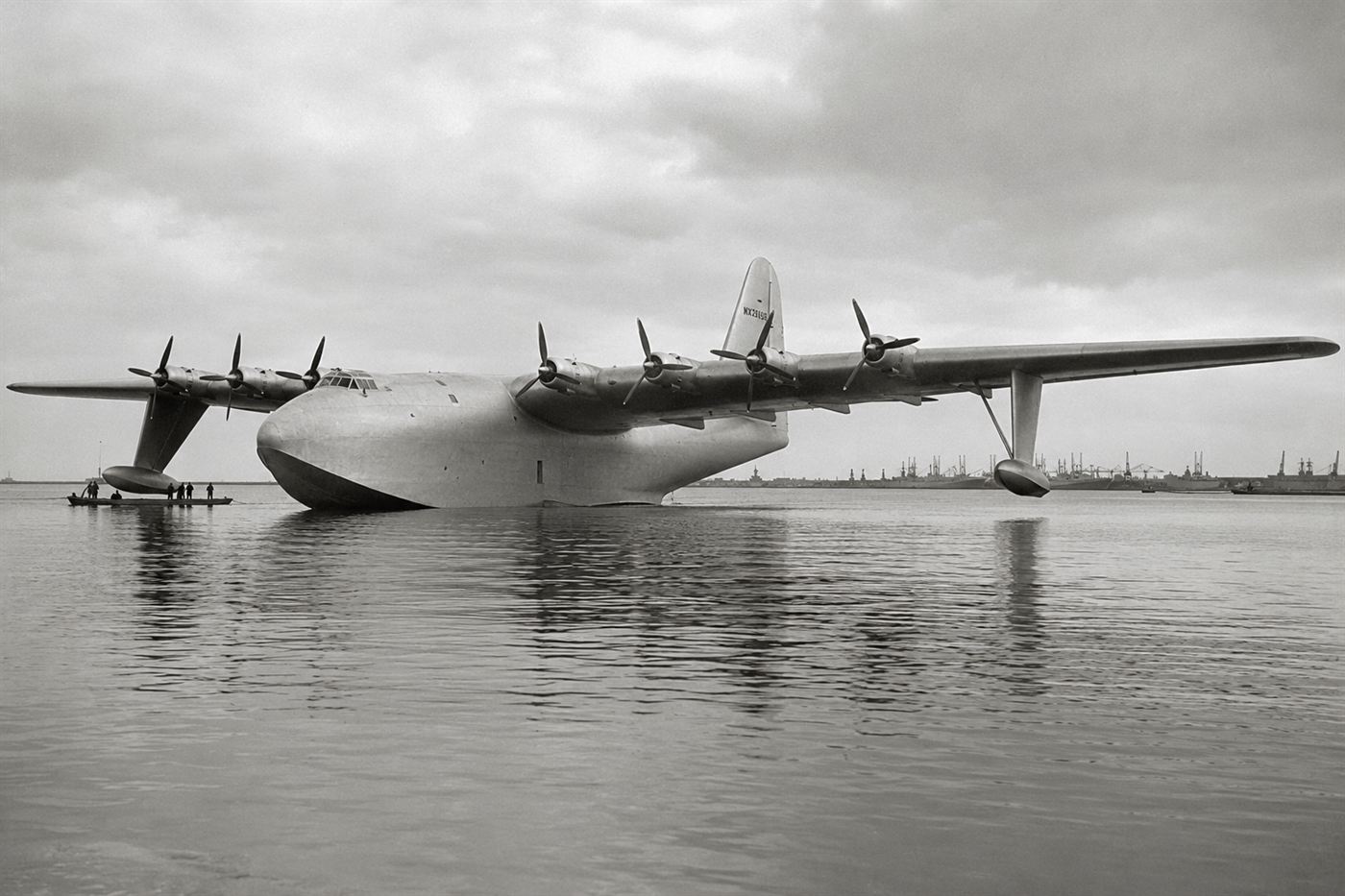
The Spruce Goose on Long Beach harbor, November 1947. The H-4 Hercules had a wingspan of 97.5 meters, the largest of any aircraft built to that point. It carried eight Pratt & Whitney R-4360 engines and was capable of lifting 750 soldiers or two Sherman tanks. It flew once. Illustration: Watts & Wild.
The United States Senate had reason to be suspicious of Howard Hughes. In 1942, the government awarded a contract worth $18 million to the Hughes Aircraft Company and the Kaiser Cargo Company to build three enormous flying boat transport planes, officially designated the H-4 Hercules and quickly nicknamed the Spruce Goose by the press. The planes were designed to carry troops and war materiel across the Atlantic, bypassing the German U-boat threat that was devastating Allied shipping. They were to be built of laminated wood because aluminum was rationed for the war effort. Construction began in 1942. By August 1945, when Japan surrendered and the war ended, exactly none of the three aircraft had flown. Only one had been completed. The $18 million was spent. A Senate subcommittee, led by Senator Owen Brewster of Maine, opened hearings in the summer of 1947 to find out what had happened to the money and whether Howard Hughes had committed fraud.
Howard Hughes answered the committee's questions in August 1947 and turned the hearings into the most dramatic public performance of his career. He attacked Brewster personally, accused him of conspiring with a rival airline to destroy Hughes's commercial aviation business, and generated days of sympathetic front-page coverage that shifted public opinion decisively in his favor. The investigation concluded without charges. Three months later, on November 2, 1947, Hughes climbed into the cockpit of the Spruce Goose during what were supposed to be routine taxi tests on Long Beach harbor, and flew it. The H-4 Hercules rose seventy feet above the water, traveled about 1.6 kilometers along the harbor, stayed airborne for approximately twenty-six seconds, and came back down. Hughes got out. The plane went back in its hangar and never flew again.
The flying boat that missed its war
German U-boats were killing Allied shipping at a rate the war could not sustain.
In 1942, U-boats sank more than 1,600 Allied ships, and the loss of fuel, food, and weapons crossing the Atlantic was threatening to strangle the war effort before it properly began.
The conventional solution was to build more ships and sink more submarines, but Henry Kaiser, the industrialist behind some of the fastest wartime shipbuilding programs in American history, had a different idea.
A very large flying boat could carry cargo and troops across the ocean above the submarines.
Kaiser approached Howard Hughes, who had already set multiple air speed records and was building a reputation as one of the most daring aviators alive.
The government contract was signed in 1942: three H-4 Hercules aircraft, each capable of carrying 750 fully equipped troops or two Sherman tanks, each powered by eight engines, each with a wingspan larger than any aircraft ever built.
Kaiser withdrew from the project in 1944, frustrated with the slow progress.
Howard Hughes continued alone, at his own expense after the government funding ran out.
The war ended before the plane was ready.
The two additional aircraft that were to have been built were cancelled.
The single completed H-4 Hercules sat in a Long Beach hangar, unflown, while Congress took a very close look at the bill.
Why the Spruce Goose was built of wood
The nickname Spruce Goose was misleading from the start.
The aircraft was built almost entirely of laminated birch, not spruce.
Howard Hughes reportedly hated the nickname precisely because of this inaccuracy, though it stuck permanently.
The choice of wood was not eccentric: it was mandated.
Aluminum was strictly rationed during the war years, allocated first to fighter planes and bombers that were already in production.
A new and unproven aircraft program could not compete for aluminum supply against established military needs.
Wood offered an alternative with some genuine engineering advantages: it was light, workable, available, and did not require the same precision metalworking as aircraft-grade aluminum.
Hughes developed a proprietary technique for laminating and forming the birch into structural panels and curves, which he called Duramold.
The resulting structure was strong enough to support the weight of eight Pratt & Whitney R-4360 Wasp Major radial engines, each producing 3,000 horsepower.
The wingspan of the H-4 Hercules measured 97.5 meters, nearly 320 feet, larger than any aircraft that had existed to that point, and a span that even the Antonov An-225, the heaviest plane ever built, never quite matched.
Howard Hughes and the Senate investigation
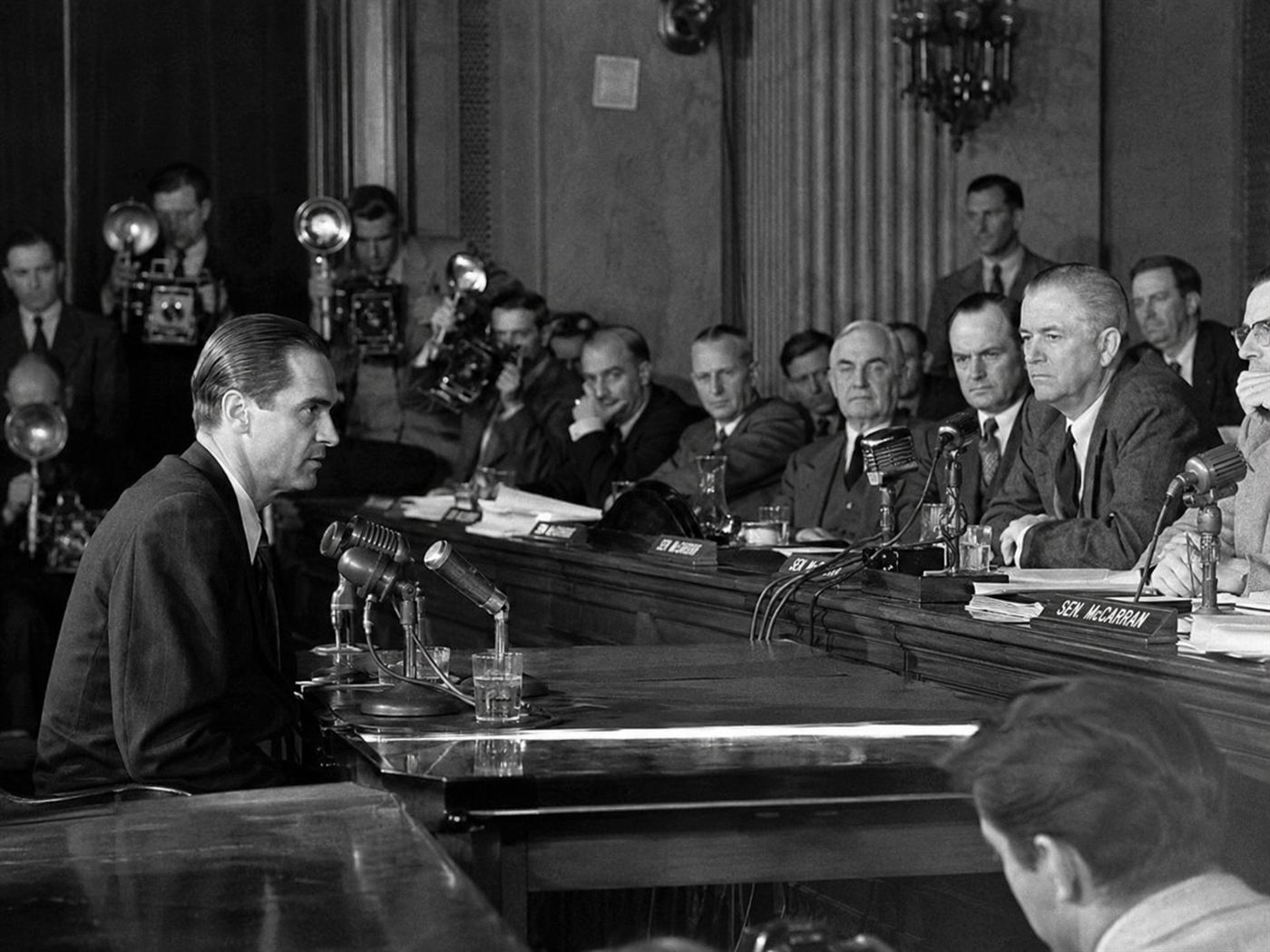
Senator Owen Brewster had personal reasons to dislike Howard Hughes.
Hughes had accused Brewster of pressuring him to merge his Trans World Airlines with Pan American Airways, which Brewster allegedly supported, in exchange for making the fraud investigation go away.
This charge, which Hughes made publicly and in testimony, made Brewster the target and Hughes the victim.
The committee hearings in July and August 1947 were front-page news across America.
Howard Hughes arrived without counsel, sat before the committee, and methodically attacked Brewster's credibility rather than defending the Spruce Goose program.
He presented hotel records showing meetings between Brewster and Pan American executives that suggested a conflict of interest.
Public opinion shifted.
The investigation, which had been framed as Congress holding a war profiteer accountable, began to look like a political vendetta against a popular American hero.
The subcommittee adjourned in August 1947 without recommending charges against Howard Hughes.
But the H-4 Hercules still had not flown.
The Spruce Goose flight of November 2, 1947
In the first days of November 1947, Howard Hughes announced that he would be conducting taxi tests of the H-4 Hercules on Long Beach harbor.
Journalists and press photographers came to watch.
On November 1, Hughes ran the aircraft across the water twice, engines at partial power, without leaving the surface.
On November 2, during the third taxi run, he pushed the throttles forward.
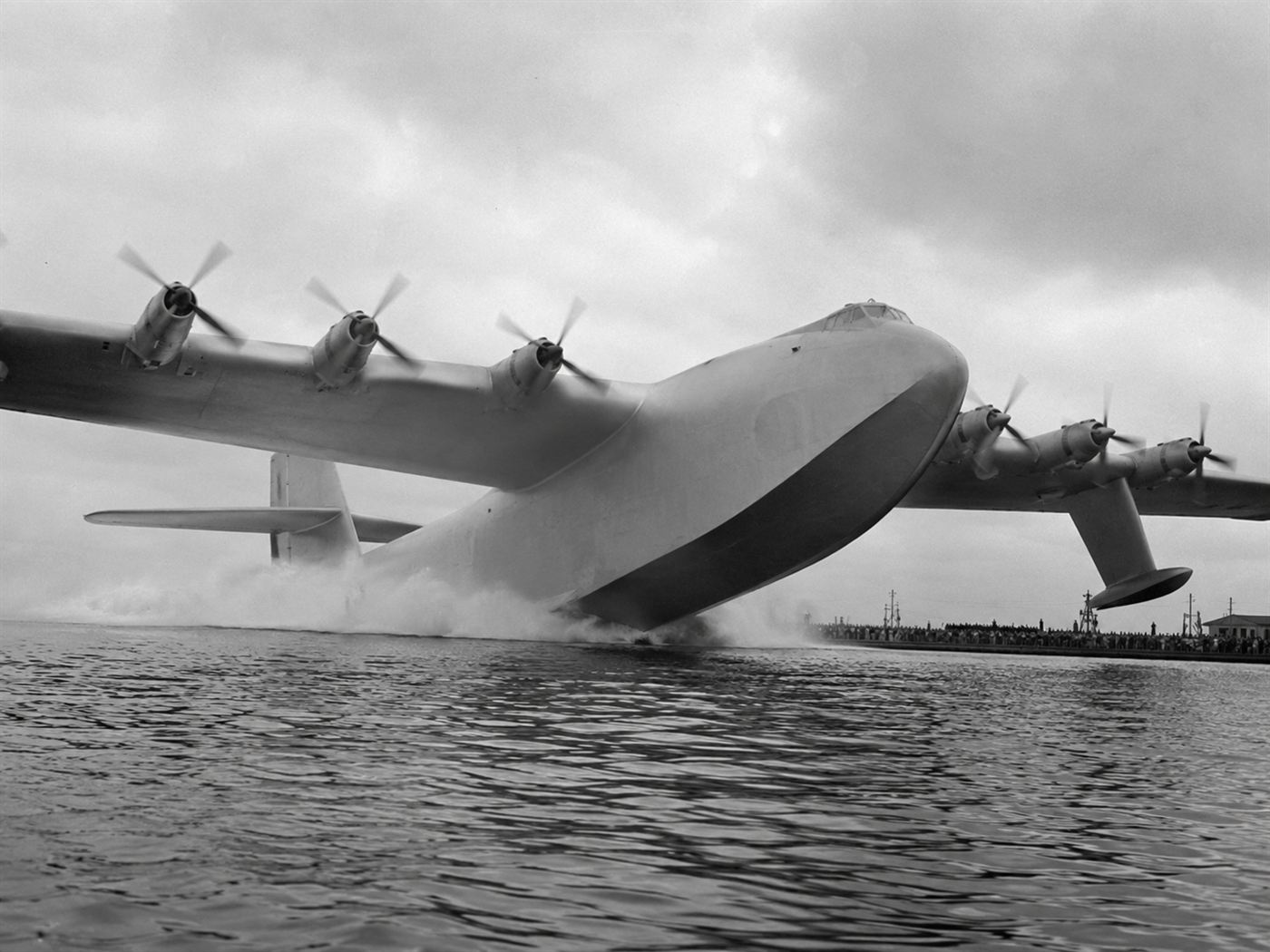
The Spruce Goose lifted off the water.
It reached a maximum altitude of approximately seventy feet, roughly twenty-one meters.
It traveled about 1.6 kilometers along the harbor at around 200 kilometers per hour.
It was airborne for approximately twenty-six seconds.
Hughes brought it back down onto the water without incident.
The WWII aircraft that had been called a fraud had flown.
Hughes gave no public explanation for why he had done it during what was supposed to be a taxi test.
He later said only that the controls had felt right and he had decided to go.
What happened to the Spruce Goose after one flight
After November 2, 1947, the Spruce Goose was moved back into its hangar. It belongs to the same family of wartime grand swings as Project Habakkuk, Britain's plan for an aircraft carrier made of ice.
Howard Hughes never stated publicly that he would not fly it again, but he never did.
He kept the H-4 Hercules in a climate-controlled hangar in Long Beach, maintained by a full-time crew, at his personal expense for the rest of his life.
The cost of maintaining the hangar and crew is estimated to have reached several million dollars by the time of his death.
Hughes died in April 1976 aboard a private aircraft, reportedly in a condition of extreme physical deterioration after years of profound obsessive-compulsive disorder and near-total isolation.
After his death, the Spruce Goose was transferred to the Aero Club of Southern California and eventually to the Evergreen Aviation Museum in McMinnville, Oregon, where it remains on permanent display, the only flying boat of its kind ever built.
The honest catch
The Spruce Goose proved it could fly, which is what Howard Hughes set out to prove in November 1947.
What it never proved is that it could have done what it was built to do.
A seventy-foot altitude and twenty-six seconds of flight in calm harbor conditions is not a demonstration of transoceanic military transport capability.
The H-4 Hercules had never been tested in ocean swells, in rough weather, at full military payload, or on the kind of open-water takeoff it would have needed to operate as designed.
Aviation historians have generally concluded that the design was genuinely innovative but that the WWII aircraft program was fatally compromised from the start: the war was moving too fast, aluminum eventually became available and made the wood construction unnecessary, and the U-boat threat had been significantly reduced by 1944, removing the strategic logic that had motivated the project.
The Spruce Goose was not exactly a fraud.
It was not exactly a success either.
It was the largest flying boat ever built, it flew once, and for one extraordinary minute on a November afternoon, it proved something to a watching crowd that had written it off.
Whether that was worth $18 million of government money is a question Howard Hughes chose never to answer directly.
Was the Spruce Goose the most expensive proof of concept in American aviation history, or was it something more? Leave a comment below.
Related reading: the SR-71 Blackbird, an aircraft as audacious as this one but built for speed.