The Hindenburg was built to fly on American helium, but Harold Ickes blocked the sale to Germany, so on May 6, 1937, it burned on hydrogen over New Jersey
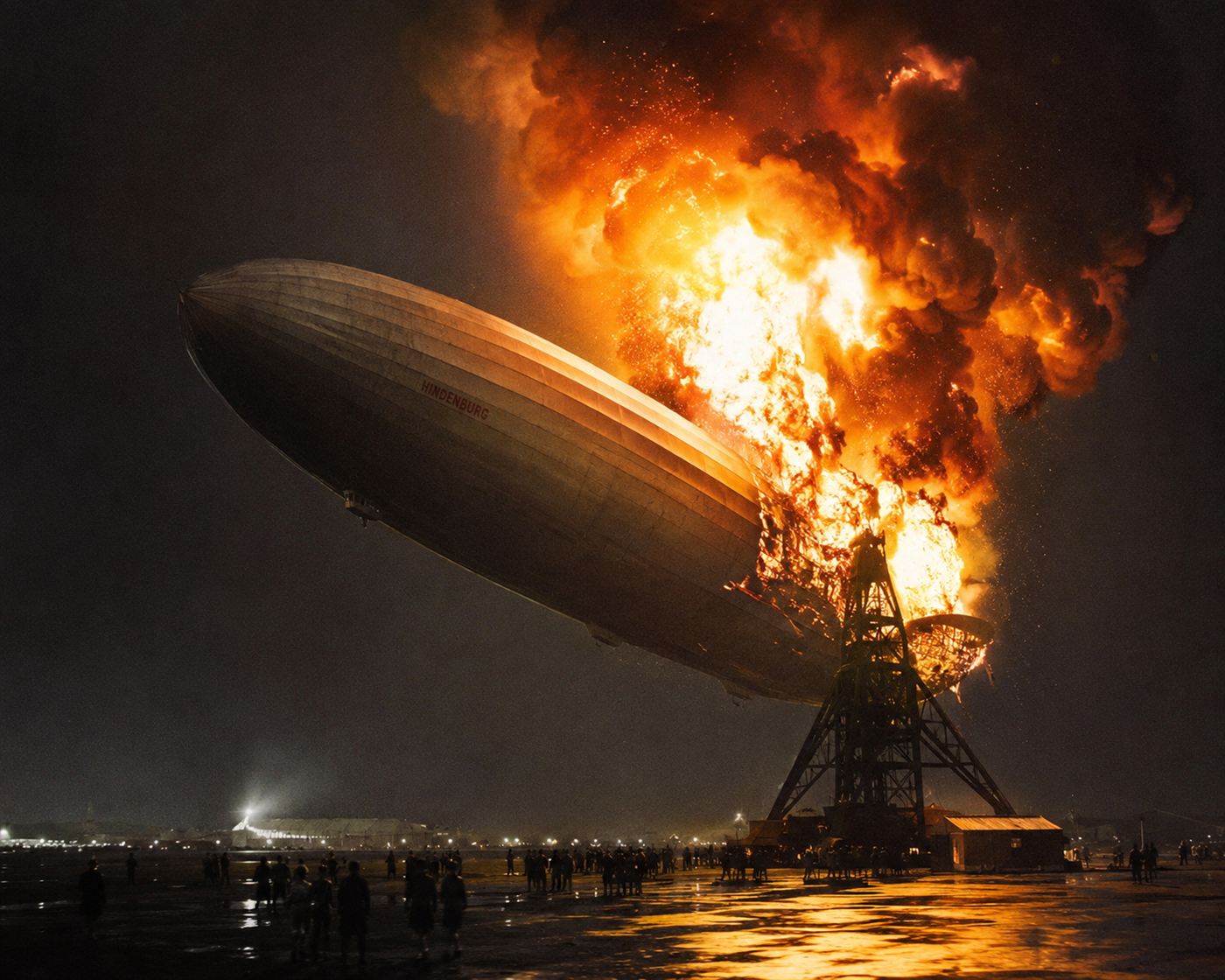
On the evening of May 6, 1937, the Hindenburg arrived over Lakehurst, New Jersey, after crossing the Atlantic from Frankfurt. While docking, hydrogen near its stern ignited. The largest aircraft ever built burned to the ground in thirty-four seconds. The Hindenburg disaster killed thirty-six of its ninety-seven people.
 By Bruno Teles · 27 June 2026
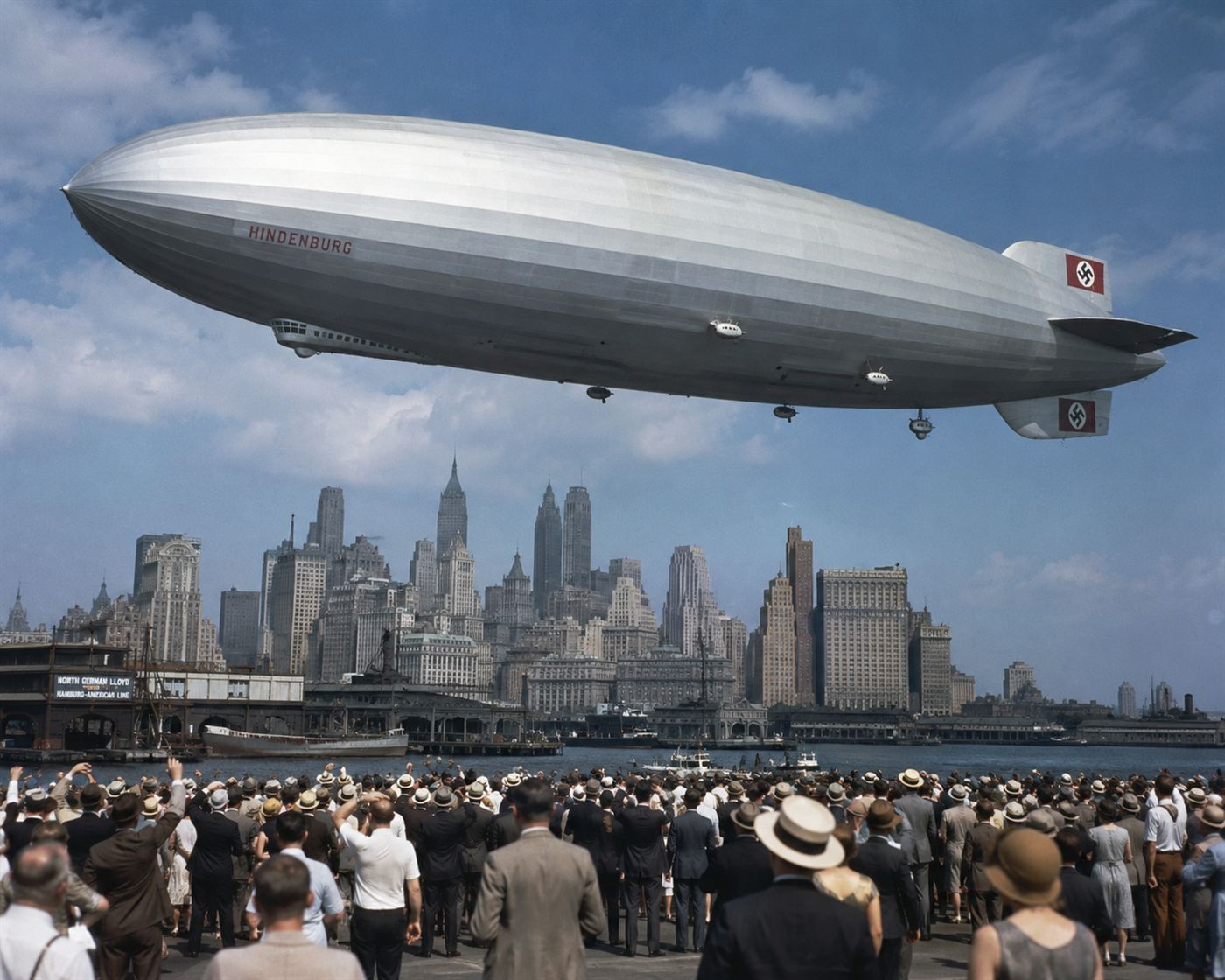
The Hindenburg was the largest aircraft ever built, 245 metres long, filled with 200,000 cubic metres of hydrogen and capable of crossing the Atlantic in sixty hours. Germany built it because the United States controlled the world's supply of helium, the non-flammable alternative, and the US had refused to export it.
Herbert Morrison, a radio reporter for WLS Chicago, was at Lakehurst to cover what was supposed to be a routine docking. He was recording when the fire started. "It's crashing, terrible," he said, and then his voice broke. "Oh, the humanity, and all the passengers screaming around here." The recording was broadcast the following day and became one of the defining moments in broadcast history.
The Hindenburg was a German hydrogen airship that caught fire while docking at Lakehurst Naval Air Station in New Jersey on May 6, 1937. Thirty-six of its ninety-seven occupants died. The disaster was shaped by the US government's decision to withhold non-flammable helium from Nazi Germany, leaving the zeppelin to fly on hydrogen instead.
What was the Hindenburg, and why did the world's largest airship fly on hydrogen?
The LZ 129 Hindenburg was completed in March 1936 at the Zeppelin works in Friedrichshafen, Germany.
It was 245 metres long, about the length of three football fields, and had a passenger capacity of 72 travellers in a luxury that no other form of transatlantic transport could offer.
There was a dining room with white tablecloths, a promenade deck with slanted windows overlooking the ocean, and private sleeping cabins.
The crossing from Frankfurt to Lakehurst took about sixty hours, compared to six or seven days by ocean liner.
In 1936, the Hindenburg made ten successful round trips across the Atlantic, carrying 1,002 passengers without incident.
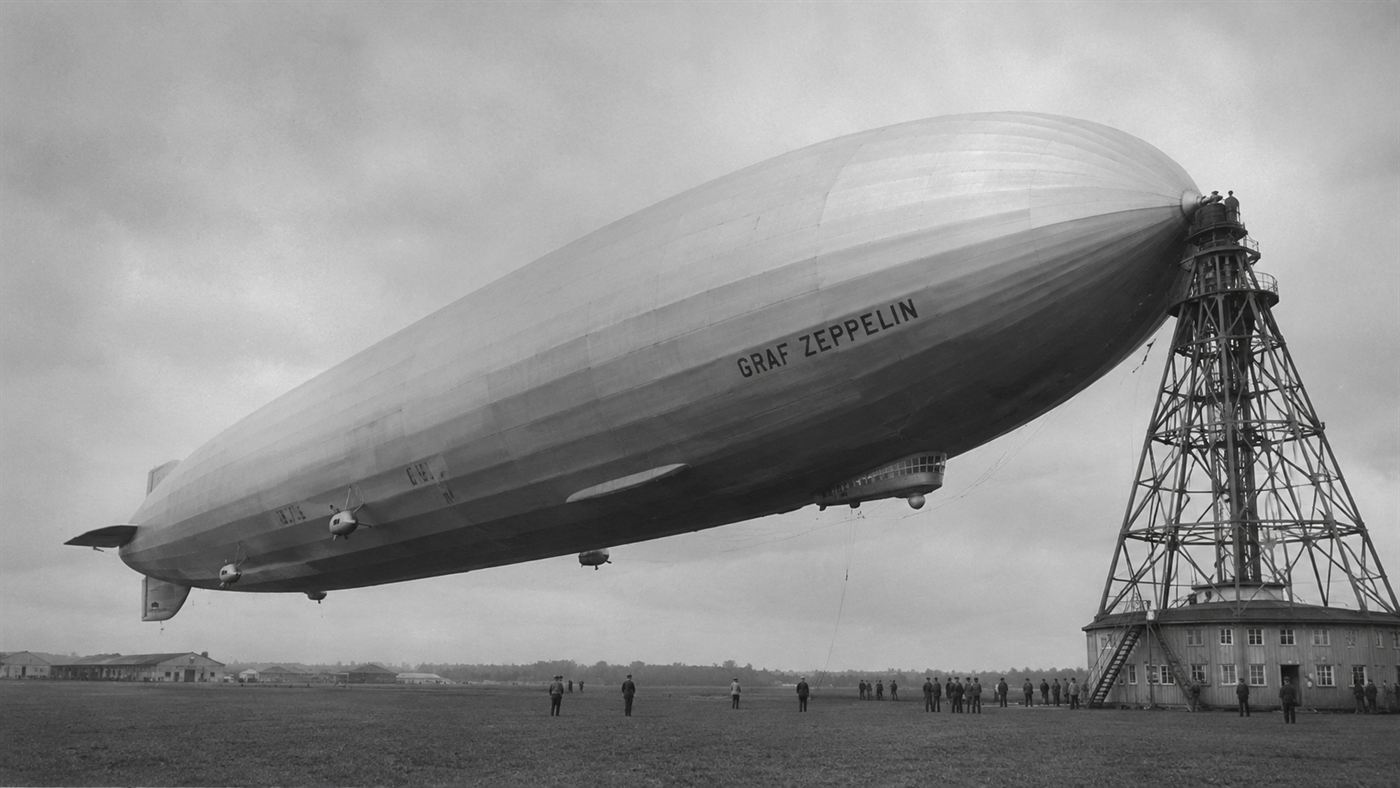
It was operated by Deutsche Zeppelin-Reederei and was one of two active German zeppelins, the other being the LZ 127 Graf Zeppelin.
Both airships were important symbols of German technological ambition and, by 1937, of the Nazi state's prestige.
The Hindenburg had been designed to use helium as its lifting gas.
Helium is non-flammable, inert, and only slightly less effective than hydrogen as a lifting agent.
A helium-filled zeppelin would not burn.
But the United States held a near-complete monopoly on the world's commercial helium supply, extracted from natural gas wells in Texas, Kansas, and New Mexico.
US law banned the export of helium for non-US use, and Germany could not obtain it elsewhere in meaningful quantities.
The Hindenburg flew on hydrogen by default.
Why did the US withhold helium from Germany, and who made that decision?
The United States had been protecting its helium supply since 1925, when Congress passed the Helium Act, declaring it a strategic government reserve.
Helium had been used to fill observation balloons and blimps in World War One, and military planners believed it would be vital again.
In 1927, the Helium Control Act tightened the rules further, prohibiting the export of helium for any offensive military purpose.
By 1936, Germany was negotiating with the United States for the purchase of helium to fill the Hindenburg and the new Graf Zeppelin II, which was under construction.
The Bureau of Mines and the State Department were willing to sell.
Harold Ickes, Franklin Roosevelt's Secretary of the Interior, was not.
Ickes was one of the most consistently anti-Nazi figures in the US government.
He had watched Germany rearm, seen the first concentration camps open, and did not believe German assurances that helium would be used only for civilian airships.
He added conditions to the proposed sale: the United States would retain the right to inspect facilities where the helium was used and to verify that none of it entered military service.
Germany refused these conditions as incompatible with national sovereignty.
Negotiations continued through early 1937.
A provisional agreement was reached in January 1937, but Ickes continued to obstruct the final sale through bureaucratic delay.
On May 6, 1937, while the paperwork was still unresolved, the Hindenburg arrived at Lakehurst on what should have been a routine flight.
After the disaster, there was no German buyer left, and the question of helium sales to Germany became permanently moot.
Ickes never publicly acknowledged that his obstruction had contributed to the conditions that killed thirty-six people.
What happened at Lakehurst on the night of May 6, 1937?
The Hindenburg had been delayed twelve hours by bad weather over New England.
It arrived at Lakehurst Naval Air Station in New Jersey at approximately 7:00 PM, already seven hours behind schedule.
The weather had improved but lightning was still visible in the distance.
The ground crew of more than two hundred people took up their positions to catch the mooring lines that would be dropped from the zeppelin as it descended toward the mooring mast.
At 7:25 PM, the Hindenburg began its final approach.
At 7:25:09 PM, witnesses on the ground saw a small blue flame appear near the tail section.
The hydrogen ignited.
The tail dropped toward the ground first.
The bow rose briefly, as the still-intact forward hydrogen cells provided lift.
Then the bow fell.
The entire process, from the first flame to the collapsed wreck on the ground, took thirty-four seconds.
Of the ninety-seven people on board, sixty-one survived.
Thirteen of the thirty-six passengers died, along with twenty-two crew members and one ground crew member.
Several survivors escaped by jumping from low altitude as the bow descended toward the ground.
Werner Franz, a fourteen-year-old cabin boy, survived when a water ballast tank ruptured and drenched him, extinguishing the flames around him; he ran from the wreckage and lived to the age of ninety-two.
Captain Max Pruss suffered severe burns but survived; he remained convinced for the rest of his life that the disaster was deliberate sabotage.
The leading technical explanation is that static electricity, built up by the thunderstorm and the damp mooring ropes acting as a conductor, ignited a hydrogen leak near Gas Cell 4.
The exact cause has never been conclusively established.
How did Herbert Morrison's radio broadcast change disaster reporting forever?
Herbert Morrison was twenty-six years old and working for WLS, a radio station in Chicago.
He had been sent to Lakehurst to record a feature about the Hindenburg's arrival, a routine assignment for a prestigious new aircraft.
His sound engineer, Charlie Nehlsen, was recording Morrison's narration onto acetate discs.
Morrison was describing the docking procedure in calm, professional tones when the hydrogen ignited.
His voice broke immediately.
"It's burst into flames," he said.
"Get out of the way, please, oh my, this is terrible."
Then: "Oh, the humanity, and all the passengers screaming around here."
He had to stop several times as emotion overcame him.
The recording was transmitted to NBC by phone line and broadcast to national radio audiences the following morning.
It was not, technically, a live broadcast: Morrison was recording onto physical discs, not transmitting in real time.
But the emotional immediacy of the recording, combined with footage shot on film by multiple cameras present at the event, created something new in the history of journalism.
Radio audiences could hear a witness break down in real time as thirty-six people died.
Networks understood for the first time what it meant to have a reporter physically present at the moment a disaster happened, with a microphone running.

Why did the Hindenburg disaster end the entire era of the zeppelin?
More than 30,000 people died on American roads in 1937.
The Hindenburg disaster killed thirty-six.
Nobody proposed banning cars.
But within two years of the disaster, commercial zeppelin travel was finished.
Part of the explanation is the visual record: the Hindenburg was filmed burning by multiple cameras, and the footage showed the largest aircraft ever built destroyed in half a minute in a scene of spectacular violence.
The psychological impact was immediate and total.
The LZ 130 Graf Zeppelin II had been completed and flew successfully thirty times after the Hindenburg disaster, but never once carried a paying passenger.
In May 1940, both surviving German zeppelins were scrapped for aluminium to build Luftwaffe aircraft for the war that had by then begun.
The age of the airship as a passenger vehicle was over.
A technology that had seemed like the future of transatlantic travel, that had offered a luxury no aircraft could match, that had crossed the Atlantic hundreds of times without losing a passenger, ended in thirty-four seconds.
The Vasa warship, which sank on its maiden voyage in 1628, had at least the excuse of being the first of its kind; the Hindenburg had made seventeen transatlantic flights before the last one.
The practical loss was that the hydrogen zeppelin was replaced, not by helium airships, but by flying boats and eventually by the jet plane, which was faster, smaller, and did not require two hundred ground crew to land.
The honest catch
Harold Ickes' decision to obstruct the helium sale was not the only reason the Hindenburg burned on hydrogen.
Germany had alternatives: it could have built helium-production facilities on US soil, under conditions the US found acceptable, and arranged a long-term supply.
It chose not to, partly because the negotiations were slow and the zeppelin programme was already committed to hydrogen operations.
Even with helium, the specific disaster might not have been avoided.
The structural fabric of a zeppelin would burn regardless of what filled the gas cells, and the crash itself could have caused casualties.
What helium would have provided was time: a helium-filled zeppelin hit by fire at its extremity does not fall in thirty-four seconds.
Whether that time would have been enough to save all thirty-six lives is unknowable.
The cause of the fire also remains genuinely uncertain.
Static electricity is the most accepted explanation, but the Hindenburg disaster has also been attributed to sabotage (most often to a crew member named Eric Spehl, who had communist sympathies and died in the fire), to a hydrogen valve malfunction, and to an incendiary paint theory proposed by NASA aeronautics engineer Addison Bain.
Most historians and engineers remain unconvinced by Bain's paint theory.
Herbert Morrison's "Oh, the humanity" line is also frequently misquoted and taken out of context: he was describing the people he could see on the ground around the wreckage, not those inside the burning airship.
And the zeppelin era was already in economic difficulty before the disaster: the Great Depression had dramatically reduced demand for expensive transatlantic passages, and the Hindenburg had never been as profitable as its backers had hoped.
The fire may have accelerated the end; it may not have created it.
What it created, undeniably, was a broadcast moment that Herbert Morrison could not plan for and could not stop: a reporter's voice breaking on a recording that would be played for the next century as the sound of sudden catastrophe.
The Hindenburg had crossed the Atlantic seventeen times without incident. Thirty-six deaths ended an entire era of passenger travel in a way that thirty thousand road deaths the same year never did. Where does that logic come from, and is it rational? Do we shut down technologies when the failure is spectacular and visible, and keep running ones that kill quietly every day? Leave a comment below.
Related reading: the US Navy's flying aircraft carriers, helium airships that launched fighter planes in mid-air and killed more men than the Hindenburg when they crashed.
More from Watts & Wild
More in Industry →
Bruno covers the human cost of industrial decisions, engineering overconfidence, and the moments when a technology meets its limit. He writes for Watts & Wild from Lisbon.