The Emu War of 1932 began in late October in the dry wheat belt of Western Australia, about three hundred kilometres east of Perth. After World War I, the Australian government had given ex-servicemen farming land in the Campion district, part of a settlement scheme meant to revive the agricultural economy. By 1932 those farms were producing wheat at a loss, prices had collapsed in the Depression, and the wheat farmers were struggling. Then, on top of the debt and the drought, came the emus.
Between ten thousand and twenty thousand emus migrated into the Campion district that year, following ancient movement corridors toward water and salt. They broke through fences, trampled crops, and drank from farm dams. The wheat farmers petitioned the government for help. What they got was Major G.P.W. Meredith of the Royal Australian Artillery, two soldiers, and two Lewis guns with ten thousand rounds of ammunition.
The Emu War was a 1932 military operation in Western Australia to cull emus devastating wheat farms in the Campion district. Major Meredith led the operation with Lewis guns and ten thousand rounds. The emus scattered, outmaneuvered every ambush, and the military withdrew after killing fewer than a thousand birds.
Why did Australia declare the Emu War of 1932 on its own birds?
Western Australia had a problem in 1932, and it came on two legs.
The Campion district, east of Perth, had been carved into wheat farms during the postwar soldier-settler schemes of the 1920s.
The wheat farmers there were struggling with global wheat prices that had collapsed during the Depression.
They were also battling a drought that had punished Western Australia for several consecutive years.
Emus were a normal part of the landscape.
What happened in 1932 was not normal.
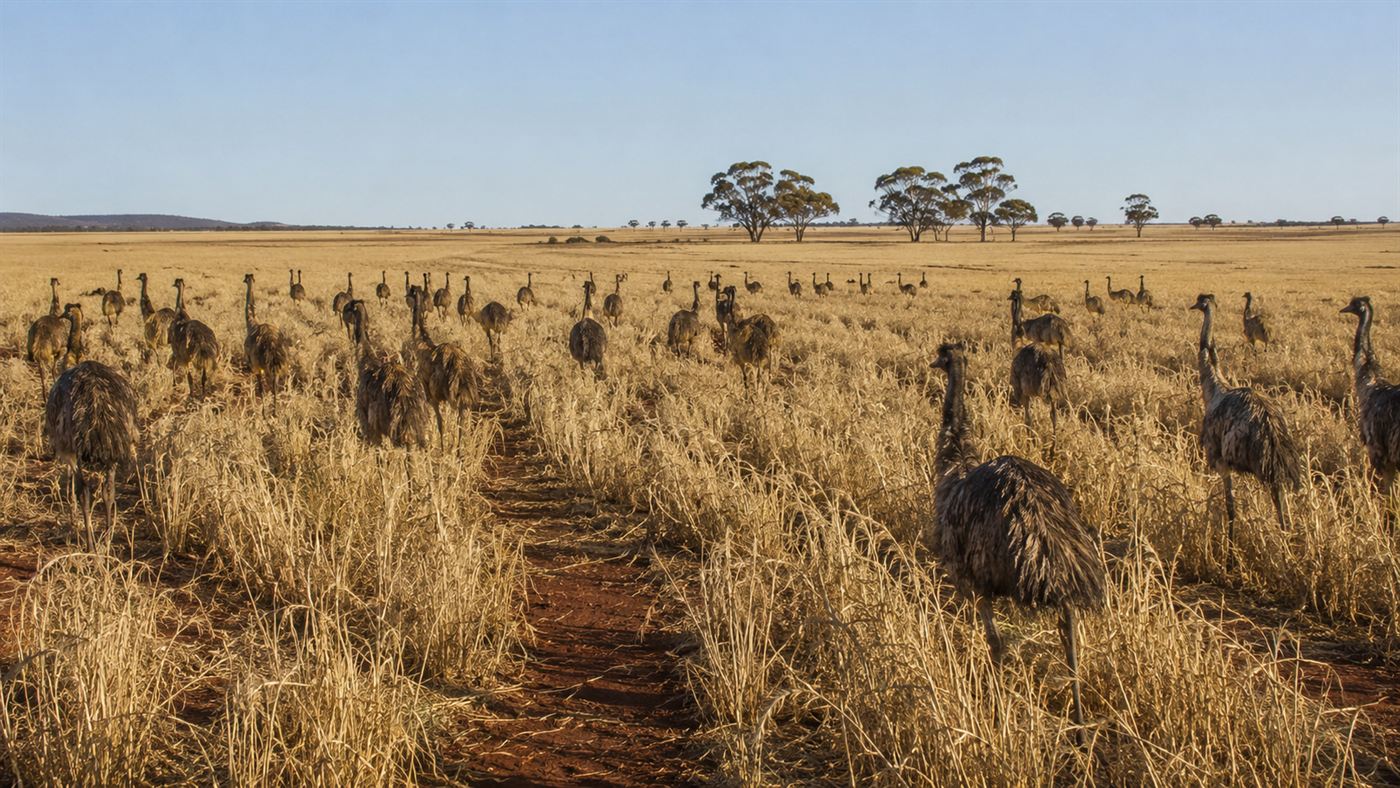
An estimated twenty thousand birds descended on the Campion wheat farms during their annual migration toward the coast, following water sources and old movement corridors.
The emus moved in large mobs.
They flattened young wheat by sitting on it, drank from the stock dams, and broke fencing as they walked through it.
The wheat farmers called on the federal government in Canberra.
They wanted a military cull.
The minister for defence, Sir George Pearce, agreed.
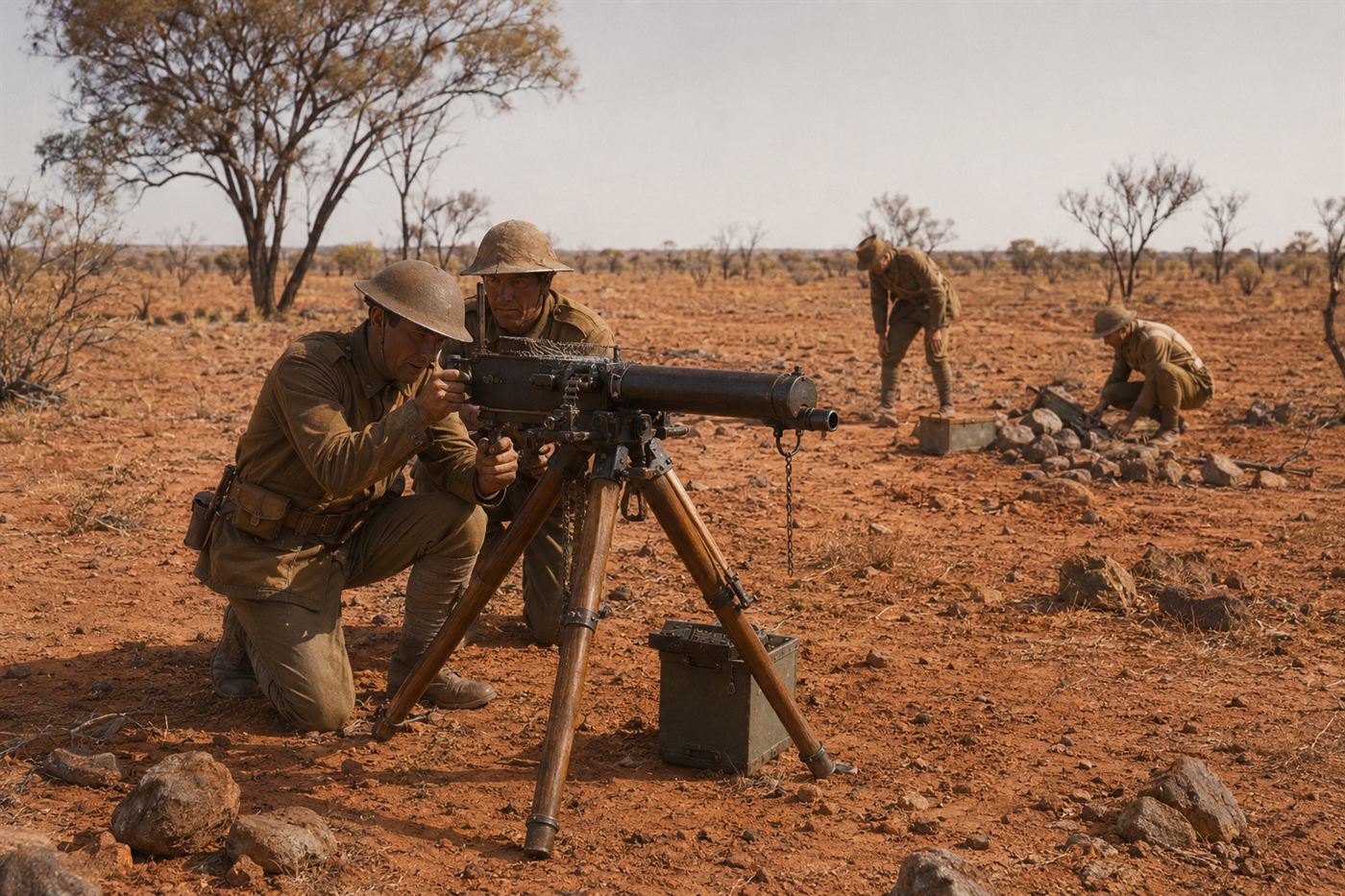
Major Meredith of the Royal Australian Artillery was dispatched from Fremantle with two soldiers, two Lewis guns, and enough ammunition to kill an entire mob twice over.
Pearce would later be nicknamed "Minister for the Emu War" in the press, not entirely as a compliment.
What happened when the Emu War operation began?
The Emu War's first engagement took place on November 2, 1932, at a dam near the town of Campion.
A mob of about fifty emus had gathered at the water.
Major Meredith and his team waited for the birds to cluster so the Lewis guns could sweep the group in a single burst.
The emus did not cluster.
As the soldiers opened fire, the mob scattered into small groups running in different directions, too spread out to track with a fixed-arc tripod gun.
Some birds fell.
Most ran.
One Lewis gun jammed early in the engagement.
A few days later, Major Meredith tried a different approach near Merredin.
He set an ambush at a dam and waited for a large mob to gather.
Close to a thousand emus arrived.
He opened fire at about three hundred yards.
The Lewis gun jammed again after a dozen rounds.
The emus dispersed before the gun could be cleared.
The Western Australian press was watching from the start.
Newspapers began reporting not on the success of the Emu War but on its failures.
One newspaper called the effort "worse than useless."
A member of Parliament suggested that medals should be awarded to the emus, in contrast to the fate of bird species on the other side of the world that humans had not found so resistant.
Why did Major Meredith compare emus to tanks?
Major Meredith made a remark after the first week of the Emu War that has outlasted the operation itself.
"If we had a military division with the bullet-carrying capacity of these birds," he told the press, "it would face any army in the world."
"They could face machine guns with the invulnerability of tanks."
The comparison was not flattery.
It was a technical observation about the biology of emus under fire.
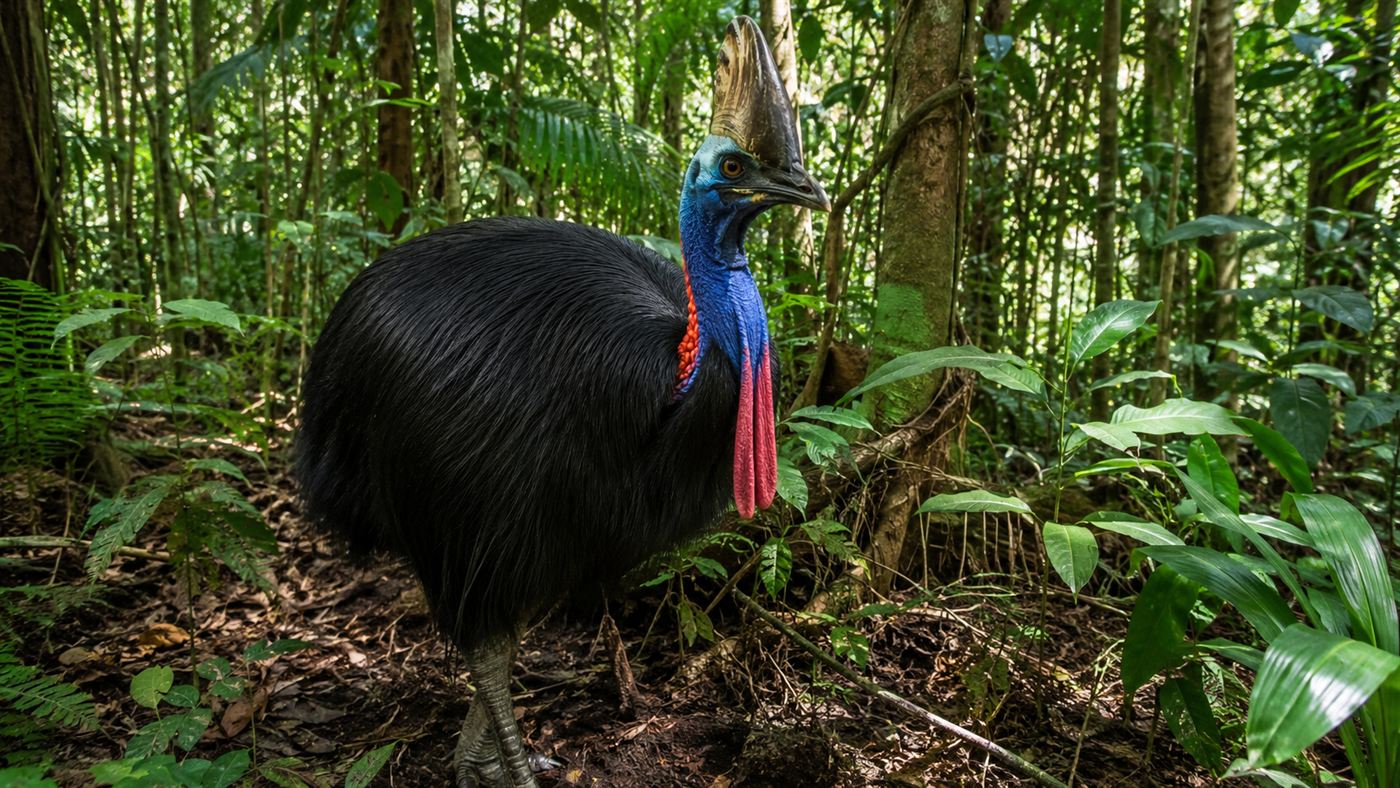
Emus weigh up to sixty kilograms and stand nearly two metres tall.
They are not fast animals on a straight line, but they change direction quickly, they spread when startled, and they do not stop moving.
A Lewis gun on a tripod fires in a fixed arc.
An emu mob, once it scatters across dry scrub, presents dozens of small moving targets that a fixed position cannot track.
Major Meredith also noted that emus took an unusual number of hits before falling.
The density of muscle and bone in a large running bird absorbed rounds that would stop a mammal of similar weight.
The wheat farmers watching from the edges of the Campion district reported the same thing: the birds seemed to absorb punishment without slowing.
Ornithologist Dominic Serventy, asked about the Emu War afterward, said the emus appeared to have "detailed plans worked out" for avoiding the guns.
He was being wry.
But the natural movement patterns of large emu mobs, which split and regroup when disturbed, genuinely defeated the fixed-arc firing positions the soldiers had set up in the flat open country of Western Australia, where there was nowhere to channel the birds.
When did the army withdraw from the Emu War?
By November 8, 1932, Major Meredith had been in the Campion district for less than a week, and the Emu War was already being questioned in Parliament.
The official tally at the time of the first withdrawal was two thousand two hundred and fifty rounds fired and fewer than fifty emus confirmed killed.
The cost per confirmed kill was catastrophic by any military accounting.
The Emu War was temporarily suspended under political pressure.
It resumed in late November, with somewhat better results.
Meredith's team found that Lewis guns mounted on moving vehicles were more effective than the fixed tripod positions.
A mobile gun could follow the mobs rather than waiting for the emus to enter a kill zone.
By the time the Emu War wound down in December 1932, official records claimed nine hundred and eighty-six confirmed kills and approximately two thousand five hundred rounds fired.
Major Meredith himself estimated that another two thousand five hundred birds died later from wounds sustained during the operation.
The wheat farmers of the Campion district were not satisfied.
Their crops were still being damaged.
The emus were still migrating through Western Australia.
They petitioned the government again.
What came after the Great Emu War?
The Great Emu War ended without solving the problem that wheat farmers had raised in the first place.
The emus were still moving through Western Australia.
The wheat farmers petitioned again in 1934, and again in 1943 and 1948.
Each time, small-scale culls resumed with varying results.
By the early 1950s, the approach shifted.
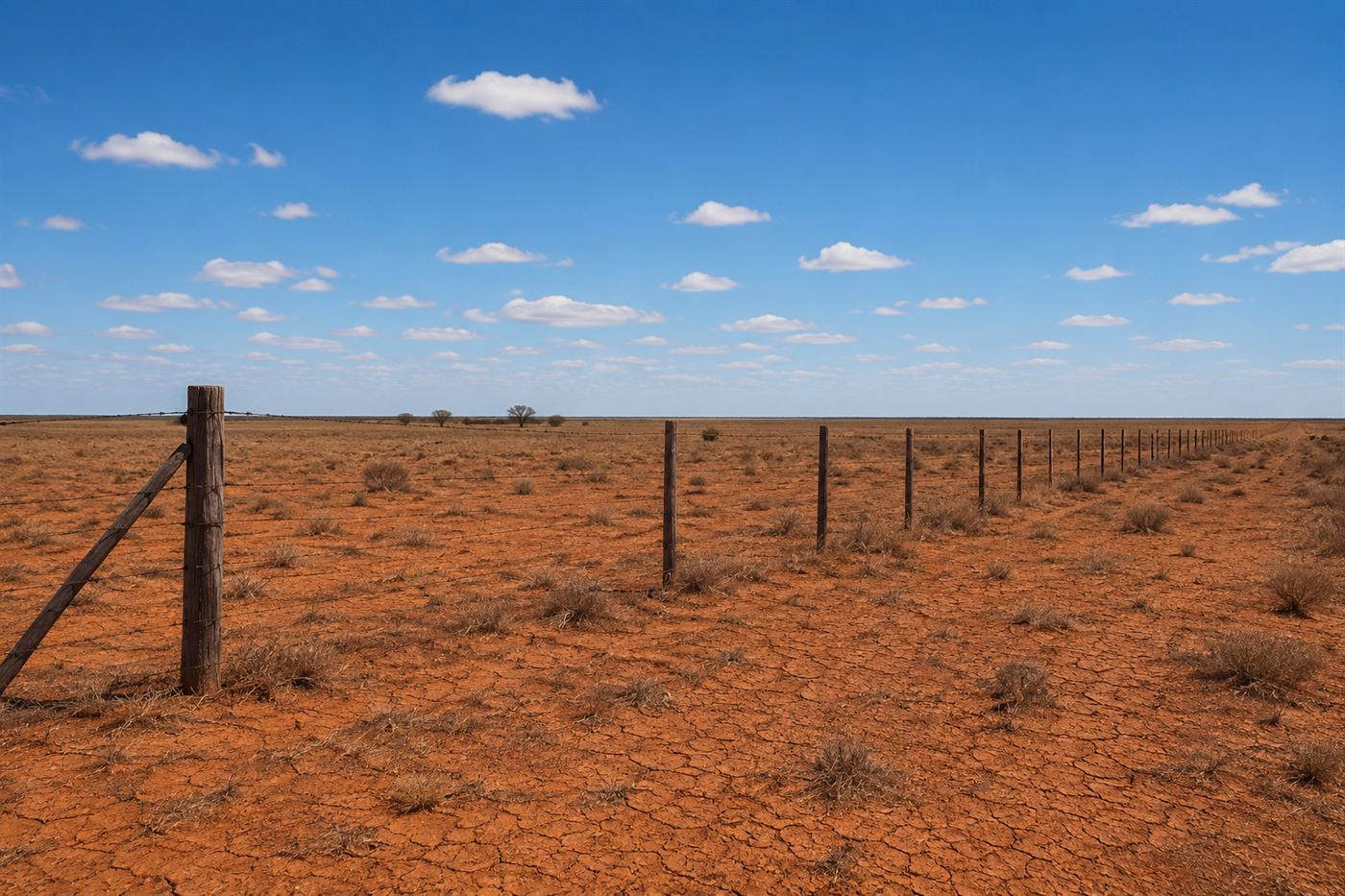
The government began funding extensions of the rabbit-proof fencing that crossed Western Australia, adapting it to exclude emus from wheat-growing areas rather than trying to kill the birds in the open fields.
This worked considerably better than the Lewis guns had.
You cannot stop an emu migration with a machine gun.
You can, with enough wire and posts, redirect one.
The Great Emu War entered Australian culture as a story about the limits of military thinking applied to an agricultural problem, and as a durable joke at the army's expense.
The wheat farmers whose actual problem started the campaign were largely forgotten in the retelling.
Major Meredith served in World War II and left behind no extended written account of his feelings about the Emu War.
The quotes attributed to him in the Perth press in November and December 1932 are the main record of his assessment.
In 2015, military historian Peter Merrington said the operation "bordered on the farcical."
He was not wrong, but it is worth noting that the wheat farmers who called for help received a government response that made their situation no better, much as the city authorities of Strasbourg in 1518 responded to an unexplained crisis by making it considerably worse.
The honest catch
The Emu War is a good story, and like most good stories it has been somewhat improved in the telling.
The figure of fewer than fifty confirmed kills in the first week is the most-quoted number from the Emu War, but it is not the most accurate.
Major Meredith's own estimate for the full operation, including wounded birds that died after scattering into the scrub, was around twelve thousand.
That number is probably high.
It appears in his own official report, and the incentive to justify a costly operation would have pushed the estimate upward.
The likely real total, across all phases of the Emu War, is somewhere between several hundred and a few thousand birds.
The phrase "the emus won" is accurate in a narrow sense: the emus were not eliminated from the Campion district, and the Emu War was withdrawn under political pressure before its stated objectives were met.
In a broader sense, emus are not a species that needed protecting.
They were not endangered then and they are not endangered now.
Their population in Western Australia was never at risk from the operation.
The Emu War failed as a culling effort, not as a conservation intervention.
The wheat farmers, the people whose genuine problem started the whole campaign, received very little from the exercise.
Their crops were still being damaged in 1933 and 1934.
The fence approach that eventually worked should probably have been funded first.
What the Emu War left behind is a remarkably complete record of a military failure that was embarrassing enough to be covered in detail by a Parliament that preferred not to think too hard about it, and memorable enough to survive as a cultural curiosity long after the wheat fields of the Campion district were forgotten, just as another mid-century human attempt to manage an animal population ended in unexpected ways on the other side of the world.
Australia deployed soldiers with machine guns to fight emus and the emus won.
What does that tell you about the limits of force as a solution to problems that are fundamentally about ecology?
Sources