Forty million Christmas Island red crabs close the island's roads every November to reach the sea, and when yellow crazy ants began killing them by the million, rangers spent a decade saving them with a parasitoid wasp
Every year when the first monsoon rains arrive, the Christmas Island red crabs leave the rainforest and take over the roads, all 40 million of them at once. The island closes its streets, builds crab bridges and tunnels, and waits two weeks for the crab migration to finish. When yellow crazy ants arrived and started killing them in the millions, the only fix turned out to be a wasp no larger than a sesame seed.
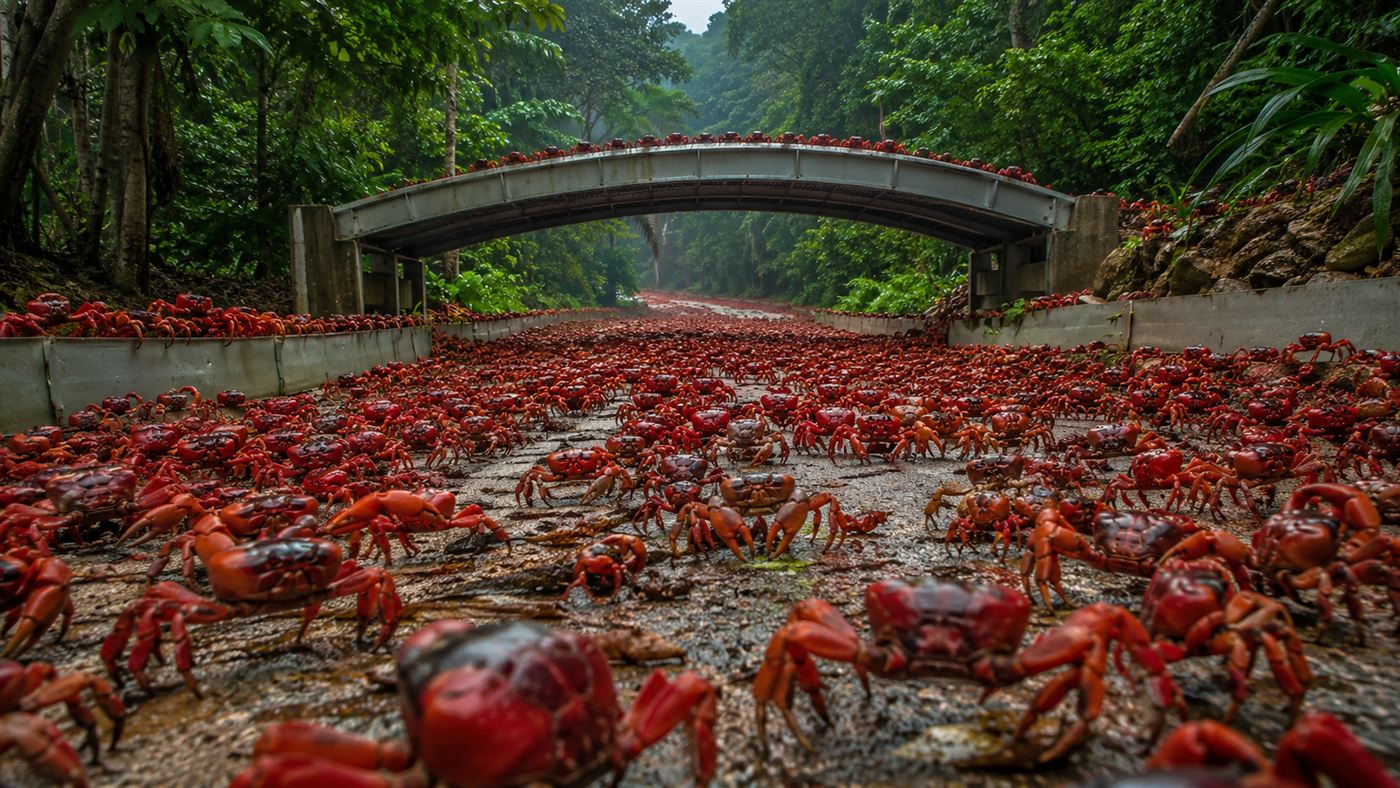
The Christmas Island red crab migration turns the island's roads scarlet every November. Illustration: Watts & Wild.
Christmas Island sits in the Indian Ocean about 135 kilometres south of Java, home to roughly 2,000 people and no particular reason for global fame for most of the year. Then the monsoon rains arrive. The Christmas Island red crabs wake up all at once and start moving. Not a few. Not a notable colony. The entire population, somewhere between 40 and 50 million land crabs, pours out of the forest and heads downhill toward the coast.
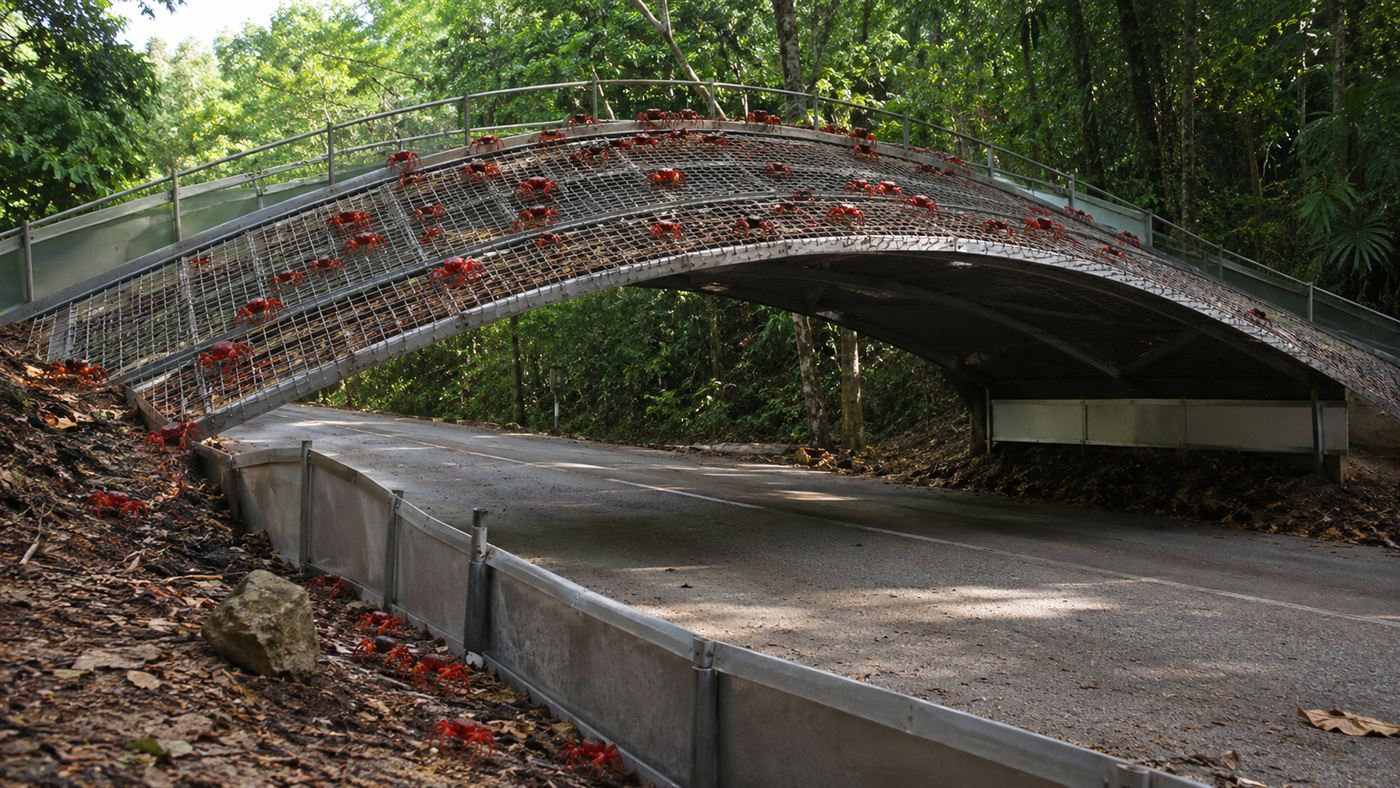
Roads close. Residents plan around them. The island's parks authority deploys barriers, installs crab underpasses, and posts warning signs. According to Parks Australia, which manages the Christmas Island National Park, rangers have built more than 30 dedicated crossing structures to carry the crabs safely over and under the island's road network. For two weeks, every road is a shared space and the land crabs have right of way. No other crab migration on earth operates at anything like this scale.
Why Christmas Island red crabs march every year
The species is Gecarcoidea natalis, a land crab found only on Christmas Island and the nearby Cocos (Keeling) Islands.
It breathes air and spends most of the year in the rainforest, eating fallen leaves, seeds, and the occasional piece of dead animal.
Christmas Island red crabs are the reason the rainforest floor looks the way it does.
Each land crab processes the leaf litter from several square metres of forest floor every year, and across 40 million animals that amounts to a decomposition engine that keeps the whole ecosystem cycling.
Then the first rains of the monsoon season trigger a hormonal cascade, and the entire crab migration begins at once.
Males set off first, marching as far as 18 kilometres to reach the coastal cliffs.
They dig burrows and wait for the females to arrive.
After mating, the females move to the water's edge and release their eggs directly into the ocean, timing each batch to the last quarter moon and the turning tide before dawn.
Each female carries up to 100,000 eggs.
The larvae spend about four weeks at sea before returning as juveniles the size of a fingernail.
The crab migration cannot be rescheduled.
It runs on lunar timing and millions of years of instinct, and the island has learned to work around it.
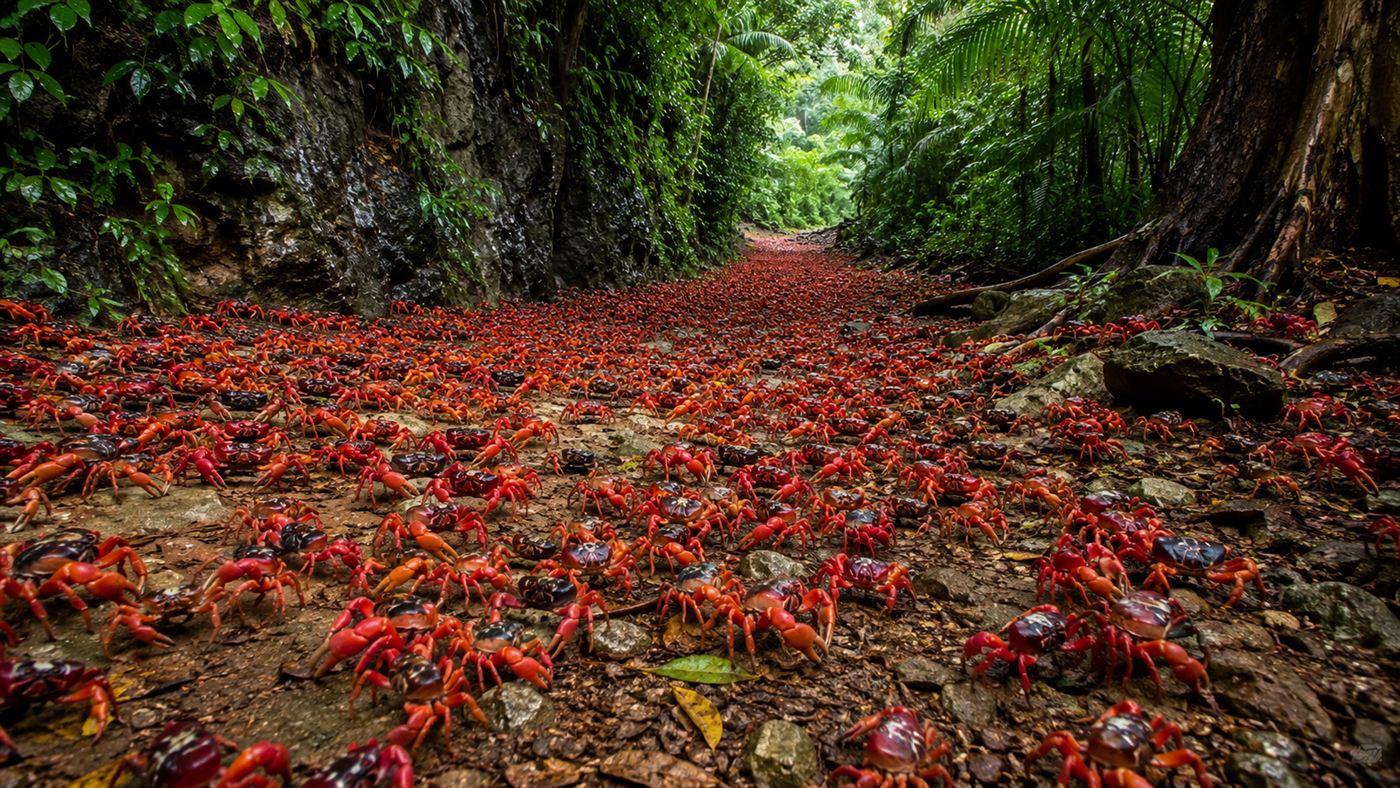
Crab bridges, tunnels, and road closures
Parks Australia has built more than 30 crab underpasses and elevated crab bridges to carry the Christmas Island red crabs safely across the island's roads.
Temporary plastic barriers funnel the land crabs toward crossing points rather than onto tarmac.
The island's trunk road closes in sections during peak migration.
Warning signs go up weeks in advance, and residents report sightings to help rangers predict where the wave of red crabs will hit next.
The motivation is not sentimental.
The Christmas Island red crabs are what ecologists call a keystone species, the same category as wolves in Yellowstone: remove them and everything downstream in the ecosystem changes.
Without the land crabs, leaf litter accumulates, seedling competition shifts, and the forest structure that took millions of years to evolve begins to change in ways that are hard to reverse.
The bridges and road closures are not just spectacle.
They are infrastructure that keeps an entire island functioning, a cousin of the wildlife crossings now being built for mountain lions in Los Angeles.
When yellow crazy ants began killing them by the million
Sometime in the late 1990s, a vessel unloading at Flying Fish Cove brought something that Christmas Island had no defences against: Anoplolepis gracilipes, the yellow crazy ant.
The name comes from their erratic, darting movement when disturbed.
On their native range, yellow crazy ants are held in check by predators and competing insects.
On Christmas Island, they found neither, and by the early 2000s supercolonies had spread across more than a quarter of the island's forest floor.
Yellow crazy ants have one weapon that a land crab cannot counter: formic acid.
When hunting or defending territory, they spray it in concentrated jets.
A Christmas Island red crab hit in the eyes stumbles, disoriented, and within minutes the ants swarm and kill it.
By 2001 Parks Australia estimated that yellow crazy ants had killed between ten and fifteen million red crabs.
Not disease, not predation, not habitat loss: an invasive species systematically poisoning a keystone land crab with acid, one million crabs at a time.
The forest responded immediately.
Unprocessed leaf litter built up where the crabs had gone.
Seedling competition began to shift.
The kind of trophic cascade that usually takes ecologists years to document was visible to the naked eye within a few seasons, a reminder of how quickly a forest changes when its engineers disappear.
Broad-spectrum insecticide across the national park was not an option: it would kill the crabs alongside the ants.
The yellow crazy ants needed a more surgical solution.
How a tiny wasp saved the crab migration
Yellow crazy ants are not independent creatures.
They farm scale insects, tiny sap-suckers that cling to tree roots and branches, harvesting the honeydew the insects excrete as their main energy source.
Without that honeydew the supercolonies cannot sustain their enormous populations.
Without the supercolonies, the formic acid attacks stop, and the Christmas Island red crabs survive.
Combined with targeted aerial bait drops using a low-toxicity insecticide, the program attacked the ants' food supply from both directions.
It took most of a decade.
By the late 2010s, invasive species supercolony coverage had dropped from more than 27 percent of the island to roughly one percent.
The crab migration continues.
The Christmas Island red crabs are recovering.
The honest catch
Yellow crazy ants are still present on Christmas Island.
The supercolonies are suppressed, not gone, and conditions that allow them to re-expand can return quickly.
The monitoring and baiting program must continue indefinitely.
Climate change is shifting the timing of the monsoon, and the crab migration is locked to seasonal and lunar cues that may not track a changing climate reliably.
Other invasive species remain: giant African land snails, feral cats, wolf snakes, and wolf spiders all eat juvenile red crabs or compete with them for food, and none are under the same level of control as the yellow crazy ants.
The 40 million figure is an estimate; nobody has counted every crab, and the true population before the invasive species crisis was likely considerably higher.
The bridges and road closures protect land crabs on tarmac but do nothing for the crabs in the forest, which is where the real threats live.
What saved the Christmas Island red crabs was not a fence or a crossing but a decade of precise biological control aimed at a single link in the yellow crazy ant's food supply.
That link is still being held.
The work is not finished.
Forty million land crabs closing an island's roads every year is one of the strangest spectacles on earth. The fact that it came within a decade of ending, and was saved by a wasp attacking an ant's food supply, makes it stranger still. Have you ever been stopped by wildlife on a road? Tell us in the comments.