At the start of the nineteenth century there were five billion passenger pigeons in North America, and when the last one died in a Cincinnati zoo in 1914 it had happened within a single human lifetime
The passenger pigeon was once the most abundant bird species in North America. Flocks of billions darkened the sky for days. Within fifty years of the industrial market hunting era, the species was gone. The last passenger pigeon, a female named Martha, died at Cincinnati Zoo on September 1, 1914.
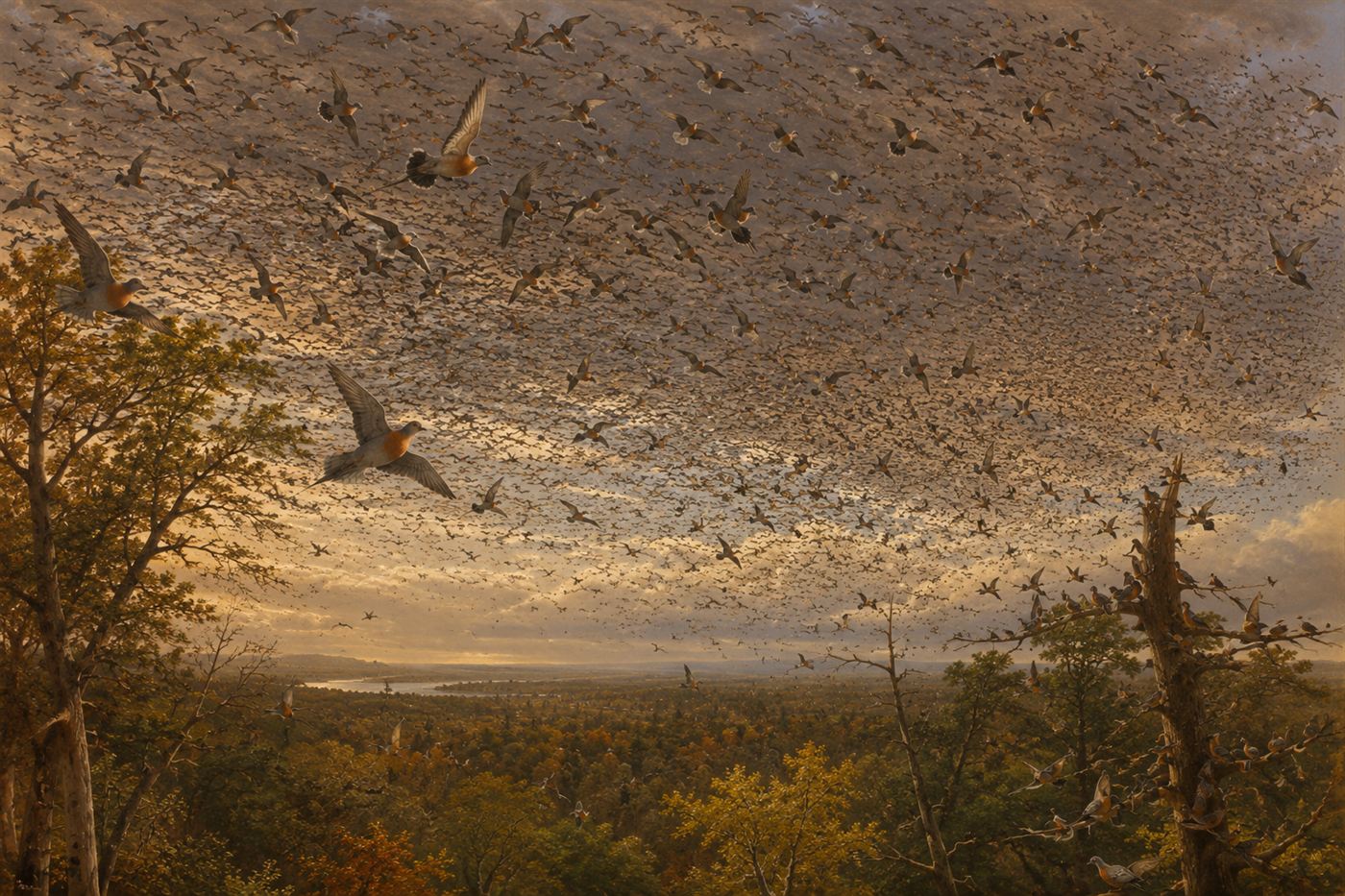
John James Audubon described a flock of passenger pigeons in Kentucky in 1813 as lasting three days, the birds so dense they blocked the midday sun. By 1914 the species was gone. Illustration: Watts & Wild.
In October 1813, the naturalist John James Audubon was travelling from his home in Henderson, Kentucky, toward Louisville when he noticed the sky beginning to darken. The darkness was not clouds. It was birds, passenger pigeons, arriving in numbers he had never imagined possible. He stopped counting after a while and estimated that a billion birds may have passed over in a single hour. The flock continued for three days. He wrote that the noon sun became as dim as during a total eclipse. Within a single human lifetime, that abundance would vanish completely, in what became the most rapid documented case of passenger pigeon extinction.
One hundred and one years later, on September 1, 1914, a female passenger pigeon named Martha died alone in her enclosure at Cincinnati Zoo. She was approximately twenty-nine years old. A keeper found her dead on the floor. Her body was packed in 300 pounds of ice and sent to the Smithsonian Institution in Washington, where she remains in the collection to this day. Between Audubon's flock and Martha's death, the entire species had been eliminated. The passenger pigeon extinction is the fastest documented collapse of an abundant vertebrate species in recorded history.
The passenger pigeon was the most numerous bird species on the North American continent, with an estimated population of 3 to 5 billion at its peak. Organized market hunting beginning in the 1850s reduced that population to a few hundred captive birds by the 1890s. The last confirmed wild bird was shot in Ohio in 1900. The last passenger pigeon, Martha, died at Cincinnati Zoo on September 1, 1914. The passenger pigeon extinction took less than fifty years.
How abundant were passenger pigeons before their extinction?
Descriptions of the passenger pigeon in the eighteenth and early nineteenth centuries read like fantasy.
Audubon's 1813 account is the most famous, but it was not unique.
Alexander Wilson, another early American ornithologist, described a flock near Frankfurt, Kentucky, in 1806 that he estimated at 2,230,272,000 individual birds.
Whether his arithmetic was exact is beside the point.
The passenger pigeon was not a rare or marginal species.
It was the dominant bird of the eastern North American deciduous forest ecosystem, consuming enormous quantities of the mast crops of oak, beech, and chestnut, and in turn feeding wolves, foxes, cougars, raptors, and human communities across an entire continent.
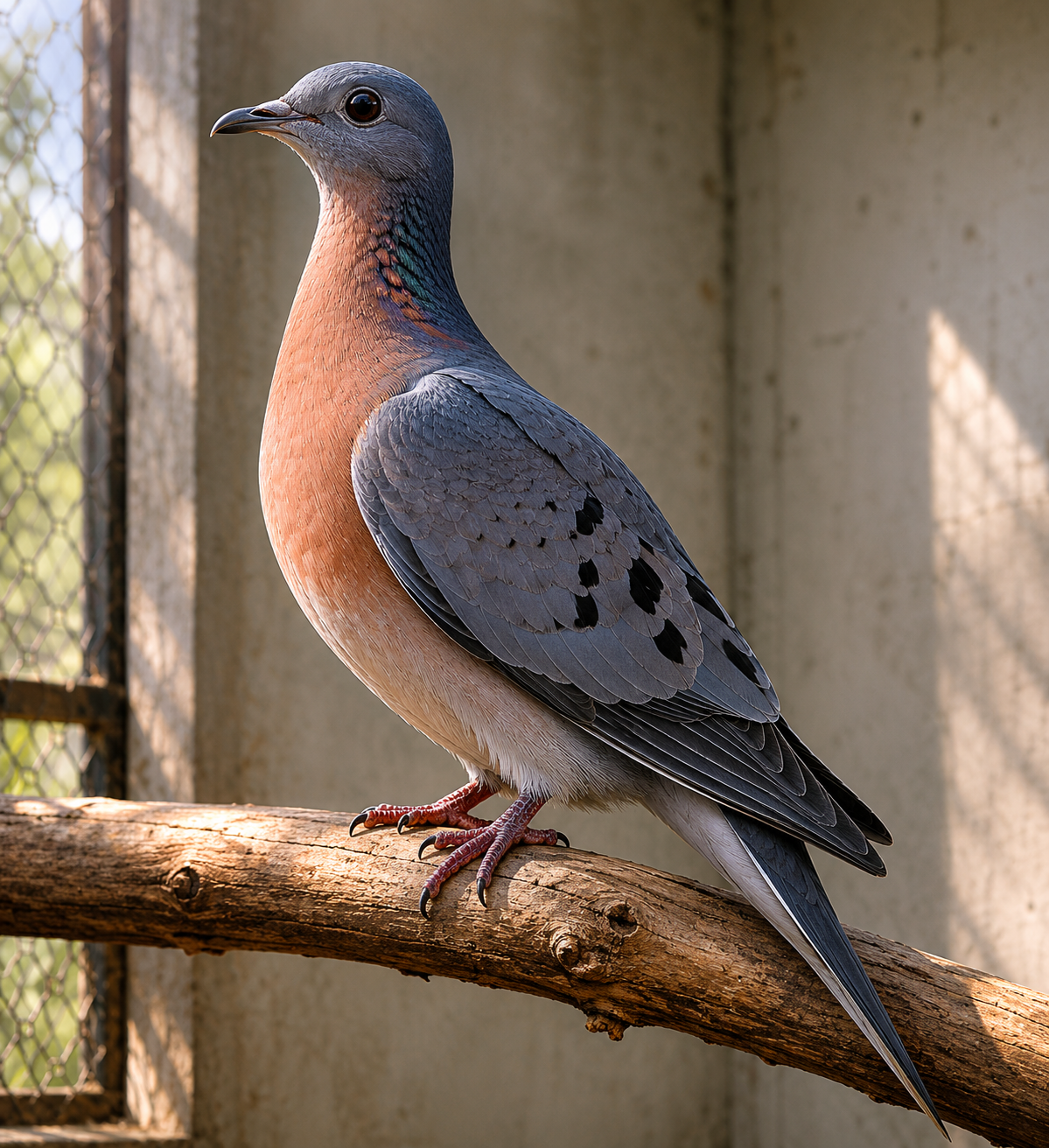
It was a pigeon the size of a small dove, blue-grey above with a russet-pink breast, fast in flight and able to travel hundreds of miles a day.
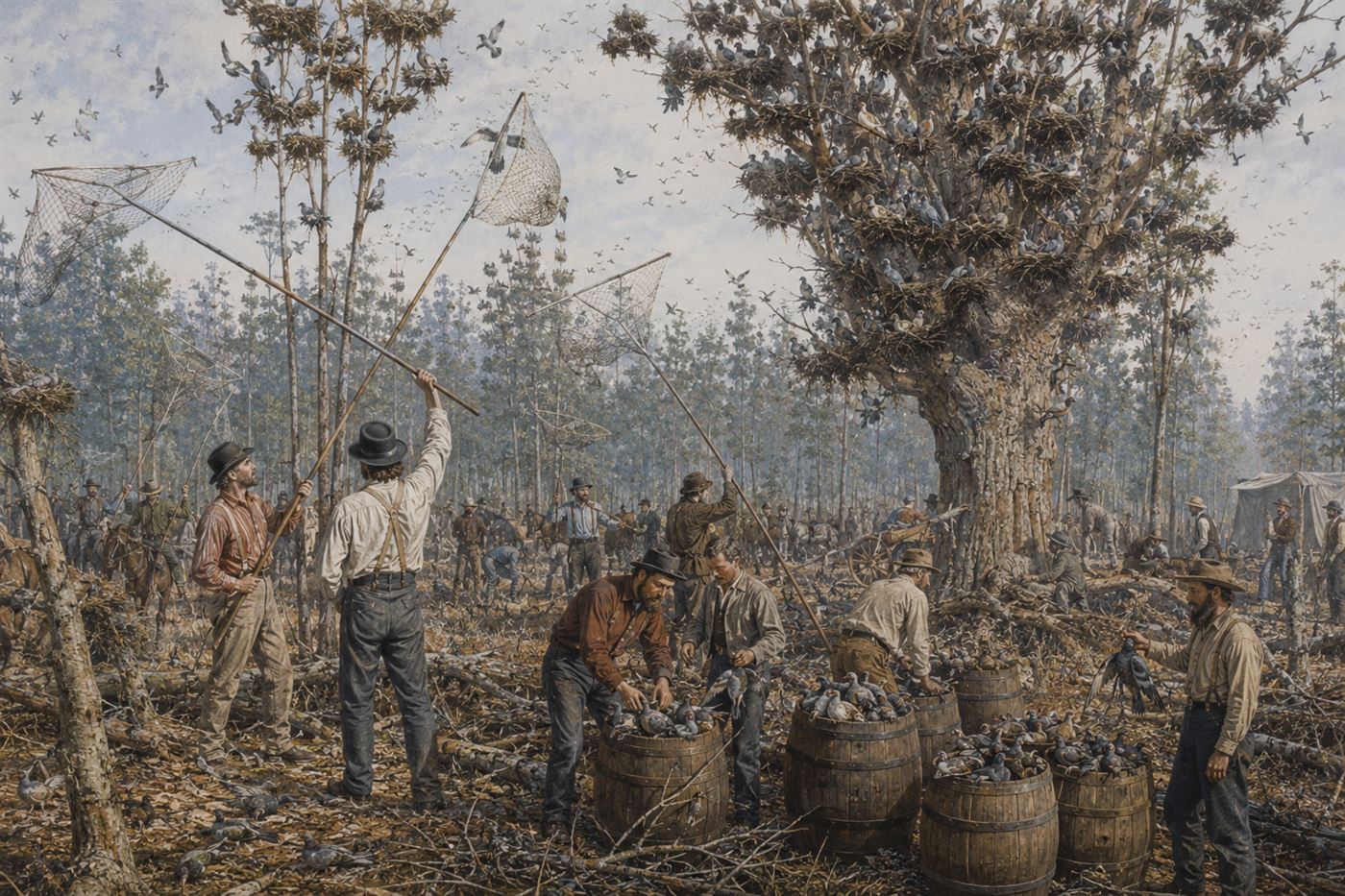
It nested in enormous colonies, sometimes covering hundreds of square miles of forest, with hundreds of nests packed into a single tree.
The colonies were so large and the birds so numerous that many observers assumed they could never be threatened, that the supply was simply beyond the possibility of exhaustion.
This assumption turned out to be the species' death sentence.
How did market hunting drive the passenger pigeon to extinction?
Market hunting for the passenger pigeon was not casual or subsistence.
It was industrial.
By the 1850s, telegraph lines and expanding railways had made it possible for professional hunters to receive news of a nesting colony, travel to it within days, and ship the birds to urban markets in New York, Boston, and Philadelphia by the millions.
The techniques used at nesting sites were efficient to the point of being almost impossible to describe calmly.
At Petoskey, Michigan, in 1878, the last great nesting colony of the passenger pigeon was hunted for weeks by professional hunters who killed an estimated 50,000 birds per day.
Barrels of salted pigeons were shipped by rail south and east.
The young birds, the squabs, were considered a delicacy.
They were also extraordinarily cheap.
At the peak of market hunting in the 1860s and 1870s, live pigeons were shipped to cities in such volume that they sold for pennies each.
The speed of the collapse shocked even some of those who had participated in it.
Why did attempts to save the passenger pigeon fail?
The collapse of the passenger pigeon population was noticed before it became irreversible.
The ornithologist Elliott Coues wrote in 1878 that the species was declining at an alarming rate.
Several states passed laws in the 1870s and 1880s attempting to restrict market hunting near nesting colonies.
Michigan passed a law in 1897 prohibiting the killing of passenger pigeons within two miles of a nesting site.
The problem was that there were no nesting sites left.
The last confirmed wild passenger pigeon was a young male shot on March 24, 1900, in Pike County, Ohio, by a fourteen-year-old boy named Press Clay Southworth, who did not know what it was.
He thought it was an unusual bird and kept the skin.
The skin is now at the Ohio State Museum.
The birds remaining in captivity were concentrated at a few zoos.
Cincinnati Zoo made repeated attempts to breed the passenger pigeon from its remaining birds.
The attempts failed.
Researchers later concluded that the passenger pigeon may have been what is called an obligate colonial breeder: a species that requires the stimulation of large numbers of its own kind to reproduce successfully.
A small captive group, however well fed and cared for, could not replicate the social conditions of a colony of millions.
The species had evolved in a world where it was always surrounded by billions of its own kind.
By the time the last few hundred existed, they were in a world that no longer resembled the one they had been built for.
For the passenger pigeon, nine was not nearly enough.
Who was Martha, the last passenger pigeon?
Martha was hatched at Cincinnati Zoo around 1885.
She was named, according to zoo tradition, after Martha Washington.
She spent her entire life in the zoo.
As the number of passenger pigeons in captivity declined, she became famous.
By 1910 she was the only living passenger pigeon in the world.
She was elderly and could barely fly.
The zoo offered a prize of $1,000 to anyone who could find a wild passenger pigeon or another captive bird to mate with her.
No one claimed the prize.
September 1, 1914 was also the day that French and British forces were moving to halt the German advance at the Marne.
The death of the last passenger pigeon received some coverage in the American press.
It was not front-page news.
What does the passenger pigeon extinction tell us about species loss?
The passenger pigeon extinction is a case study in what conservation biologists call the "shifting baseline syndrome."
Each generation accepts the abundance of its own time as normal.
The people who hunted passenger pigeons at Petoskey in 1878 had grown up in a world where the birds had always been there in their millions.
The people who watched the last colony collapse in the 1880s had grown up after the peak.
The people who received news of Martha's death in 1914 had likely never seen a wild passenger pigeon.
The lesson that took ecologists a century to articulate clearly is that abundance does not protect a species from extinction if the pressure on it is intensive enough and rapid enough.
The five billion birds were not a buffer.
They were a target.
For the passenger pigeon, recognition came too late and the biology was unforgiving.
The species needed billions.
It got Martha.
For more on wildlife extinction and recovery stories, see our Wild section.
The honest catch
The passenger pigeon extinction has attracted a new kind of attention in recent years through the work of Colossal Biosciences, a de-extinction company that has announced plans to resurrect the species using genetic material from museum specimens combined with the genome of the band-tailed pigeon, the passenger pigeon's closest living relative.
What would emerge from this project, if it succeeds, would not be the passenger pigeon.
It would be a bird engineered to resemble the passenger pigeon in key biological traits, raised in captivity, and potentially released into a landscape that no longer contains the vast deciduous forests that the original species depended on.
The eastern forests have recovered from their nineteenth-century clearance, but the American chestnut, which was one of the passenger pigeon's most important food sources, was functionally destroyed by chestnut blight in the early twentieth century.
The ecological niche no longer exists in the form the species evolved to fill.
The honest question is not just whether de-extinction is technically possible but what the recovered animal would be, where it would live, and what problem its existence would solve.
A species that once numbered five billion and shaped the ecology of an entire continent cannot be replaced by a few hundred engineered birds released into fragmented forest.
The passenger pigeon extinction may teach us more as a lesson than its de-extinction would recover as a bird.
Audubon saw a flock that darkened the sun for three days. Martha died alone on a concrete floor in 1914, and her body was the one they packed in ice. If a species can go from five billion to zero in fifty years, what does abundance actually protect us from, or does it just make us slower to notice?
Tell us in the comments.
Also see: The Arabian oryx was declared extinct in the wild in 1972, and nine zoo animals eventually became the founders of a species that runs free again across the Arabian Peninsula. And read how the Carolina parakeet, America's only native parrot, died in the very same Cincinnati Zoo cage as Martha.
More from Watts & Wild
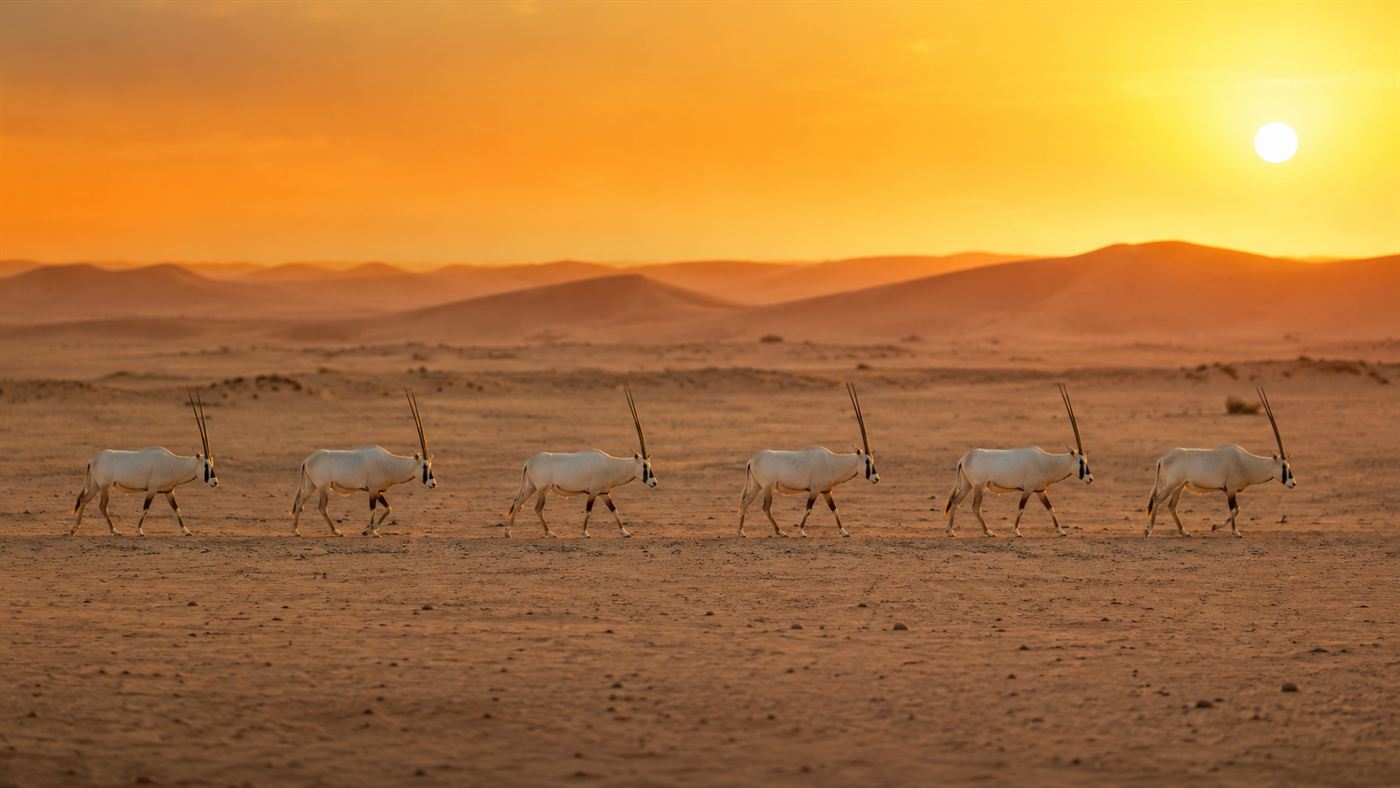 Hunters declared the Arabian oryx extinct in the wild in 1972. Nine zoo animals became the founders of a species that now runs free across the Arabian Peninsula.
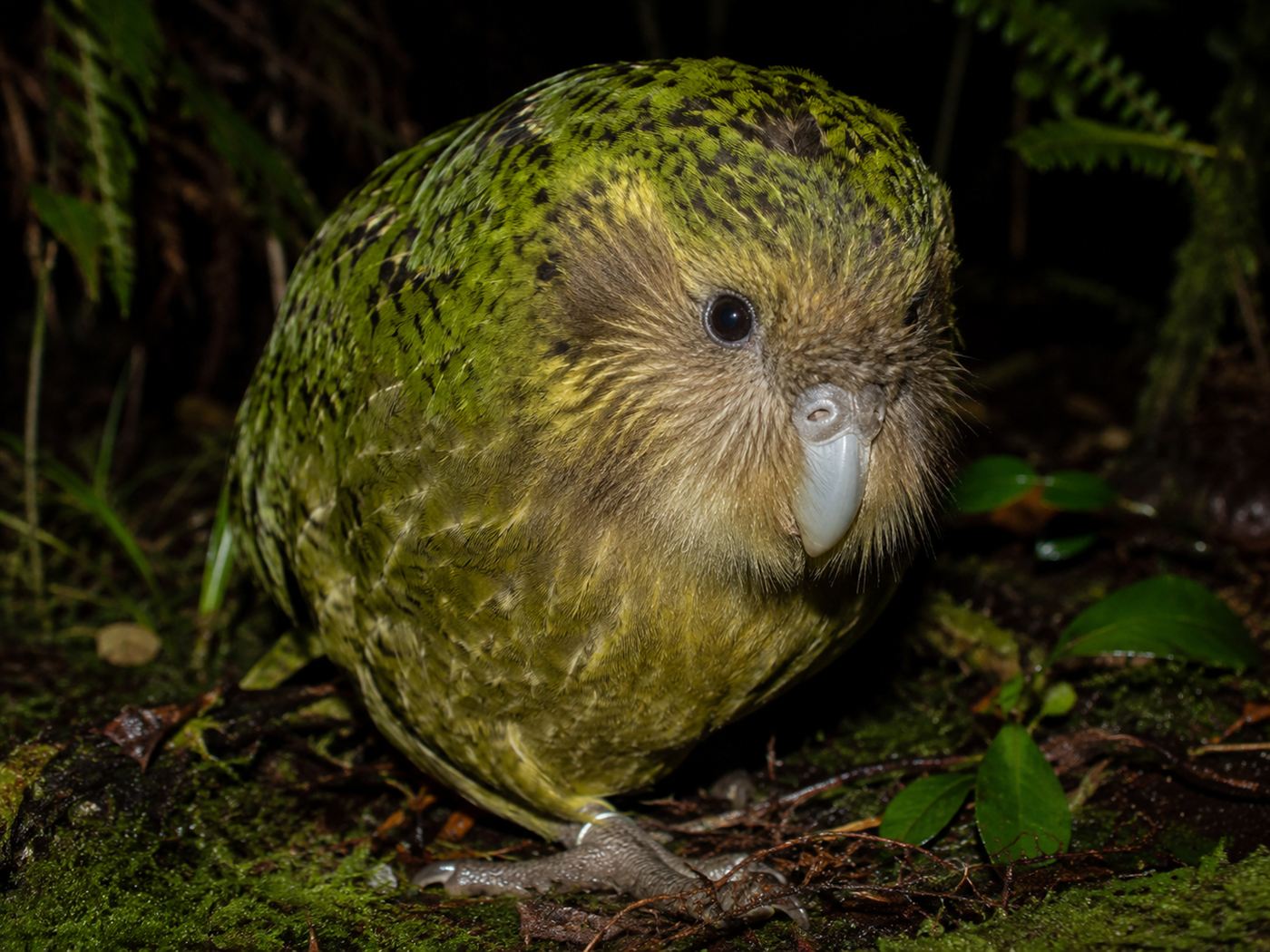 The kakapo is the world's heaviest parrot, critically endangered, and its best breeding season ever just happened because of a bumper crop of native fruit
 A fungus wiped out four billion American chestnut trees in forty years, and scientists have spent decades trying to engineer one that can survive
 De-extinction raised a dire wolf from DNA. What that animal actually is depends on what you think a species means.