An architect in New Mexico lost his license fighting to build houses out of old tires, cans and bottles, and 50 years on his off-grid Earthships have spread around the world
Michael Reynolds builds Earthship homes from what the rest of us throw away, walls of earth-packed tires and bottles that need no power lines, no gas and no water mains. The state of New Mexico took his architecture license over it. It took him 17 years to get it back.
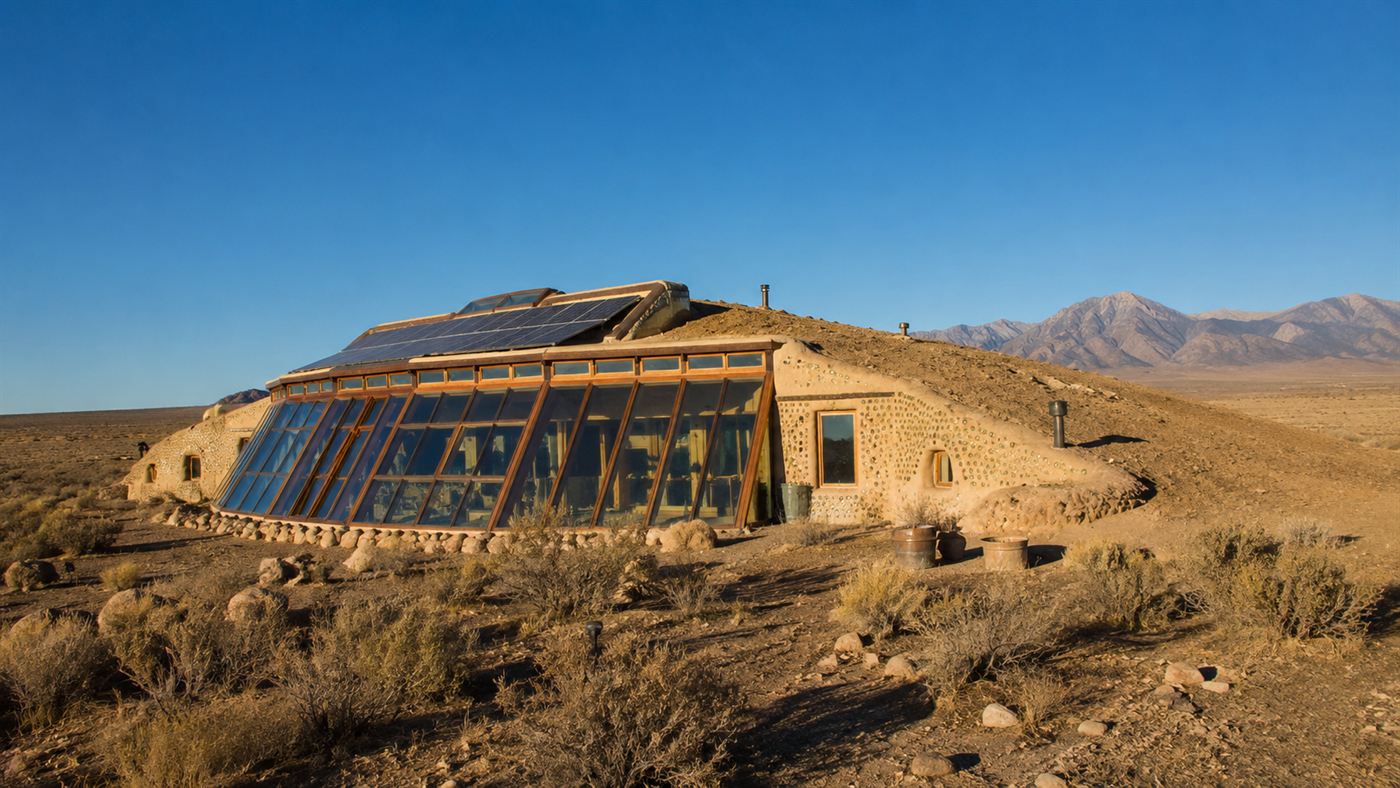
An Earthship in the high desert: a sloping wall of glass, thick walls of earth-packed tires, and no connection to any grid. Illustration: Watts & Wild.
Michael Reynolds builds houses out of the things the rest of us throw away. The walls are old car tires, pounded solid with rammed earth. The gaps are filled with aluminium cans and glass bottles. The finished home needs no connection to a power grid, a gas line or a water main, and he has been making these strange, self-sufficient Earthship homes in the New Mexico desert for more than fifty years. It cost him the right to call himself an architect.
In 1990, after a long battle with the state over building codes, Reynolds surrendered his architecture and construction licenses rather than stop. As the record of his career lays out, the state architects board stripped his credentials, and it took a 17-year fight before his architecture license was finally reinstated in 2007. Today, in his eighties, he is still building. In 2025 his team unveiled a new disaster-resilient model he calls his Model T, and versions of his Earthships now stand on nearly every continent.
Earthship homes run on their own garbage
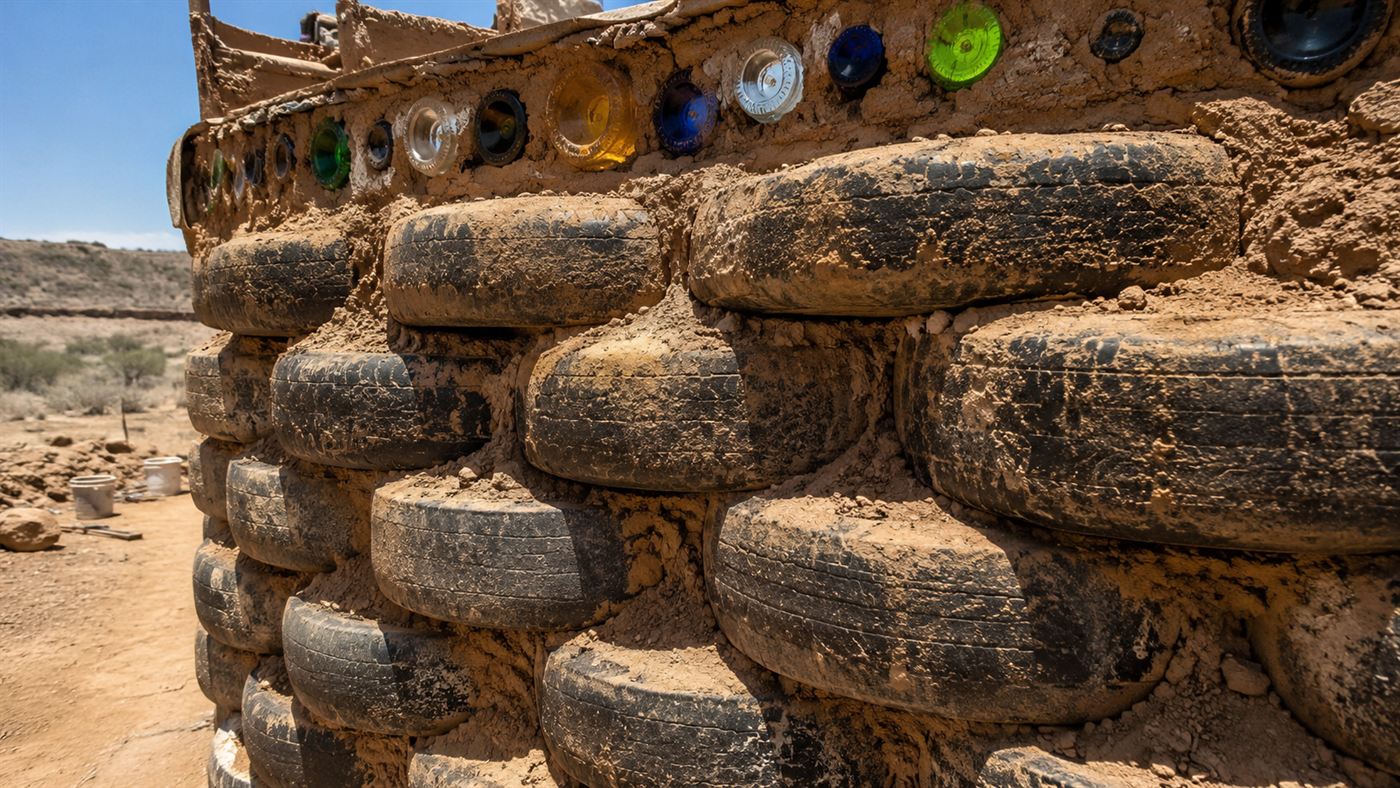
The basic Earthship is a clever piece of physics dressed up as a junkyard. Its thick outer walls are made of used tires, each one rammed full of earth until it weighs as much as a person, and stacked like enormous bricks. A single home swallows roughly 800 to 900 tires, which turns a notorious waste problem into the building's greatest strength: a wall of dense earth that soaks up the sun's heat by day and releases it slowly at night. It is the same thermal-mass trick that lets the Eastgate Centre in Harare cool itself like a termite mound.
The rest follows from there. A long, sloped face of glass points at the sun to warm the interior and grow food inside. Rain and snow are caught off the roof and stored, used, then filtered again to water indoor planters. Solar panels and batteries handle the electricity. As Earthship Biotecture describes its own design, the goal is a home that heats and cools itself, harvests its own water and power, and treats its own waste. Reynolds once summed up the result simply: "There's nothing coming into this house, no power lines, no gas lines."
The beer-can house that started it
The idea is older than the climate panic that made it fashionable. Reynolds graduated from the University of Cincinnati in 1969 and, instead of joining a firm, moved to the high desert around Taos and started experimenting. In 1972 he built a small house using beer cans wired together into bricks, an idea odd enough that he patented it the following year.
From that first can-walled structure, the design grew into the full off-grid Earthship, refined over decades of trial, error and the occasional leaking roof. Taos became his laboratory, a stretch of cheap, harsh, sun-soaked land where he could keep testing what a building could do without any pipes or wires running to it. The point was never just recycling. It was independence.
The garbage warrior against the state
That independence put him on a collision course with the rules. Building codes are written around houses that plug into utilities, and a self-contained home that does not fit neatly into any of those categories. Through the 1980s Reynolds clashed repeatedly with New Mexico over permits and subdivisions, and in 1990 he gave up his licenses rather than abandon the work.
What he did next is the part that turned him from an eccentric into a folk hero. He lobbied the New Mexico legislature for years for the right to set aside land where unconventional, sustainable building could be tested legally, a fight captured in Oliver Hodge's 2007 documentary Garbage Warrior. He eventually won both his license back and the legal room to keep experimenting. The man the system had pushed out had effectively rewritten part of the rulebook to let his idea exist.
From outcast idea to global movement
Earthships long ago stopped being a single oddball compound in the desert. Reynolds and his Earthship Biotecture team now run an academy that trains builders from around the world, and his crews have travelled to disaster zones, from tsunami-hit coastlines to earthquake-struck communities, to put up quick, self-sufficient shelters out of local rubble and tires.
The 2025 model, the one he likens to Henry Ford's Model T, is pitched squarely at a world bracing for more extreme weather and unreliable grids: a home designed to keep its occupants warm, watered and powered when the systems around it fail. After half a century of being treated as a curiosity, the core Earthship promise, a house that does not depend on anything, suddenly sounds less like a hippie fantasy and more like a hedge.
The honest catch
For all the romance, Earthships are not a finished answer, and Reynolds's own decades of leaks and disputes prove it. They were perfected in a specific place, the dry, sunny, high-altitude desert, and they can struggle elsewhere. In cold, damp or cloudy climates the passive heating and indoor humidity can misbehave, and early designs in particular earned a reputation for being hard to keep comfortable year-round.
They are also slow and physical to build. Ramming hundreds of tires by hand is brutal labour, the upfront work is enormous, and getting one permitted can still be a battle in places that never passed a law like New Mexico's. None of that erases what Reynolds proved, that a house can be built from waste and run on sun and rain alone. It just means the Earthship is best understood as a radical, hard-won proof of concept, not a catalogue you can order a city from.
A man who lost his license fighting to build houses out of garbage spent the next thirty years being proved less crazy every year the grid got shakier. Would you live in a home that needs no power, gas or water connection at all, if it meant building it out of tires by hand? Tell us what you think in the comments.
Related reading: In a Himalayan desert where the glaciers melt too early, one engineer stopped waiting and started building his own towers of ice.