In a frozen Himalayan desert where the glaciers are melting too early to water the crops, one engineer stopped waiting and started building his own, growing 30 metre towers of ice that store winter water until spring
High in the Indian region of Ladakh, the land is a paradox: a desert made of ice. It sits above 3,000 metres, gets less than 50 millimetres of rain a year, and its farms have always drunk from one source alone, the meltwater of Himalayan glaciers. Now those glaciers are failing the people who depend on them, so a local engineer decided to stop waiting for nature and grow glaciers of his own, the ice stupa artificial glaciers now keeping these farms alive.
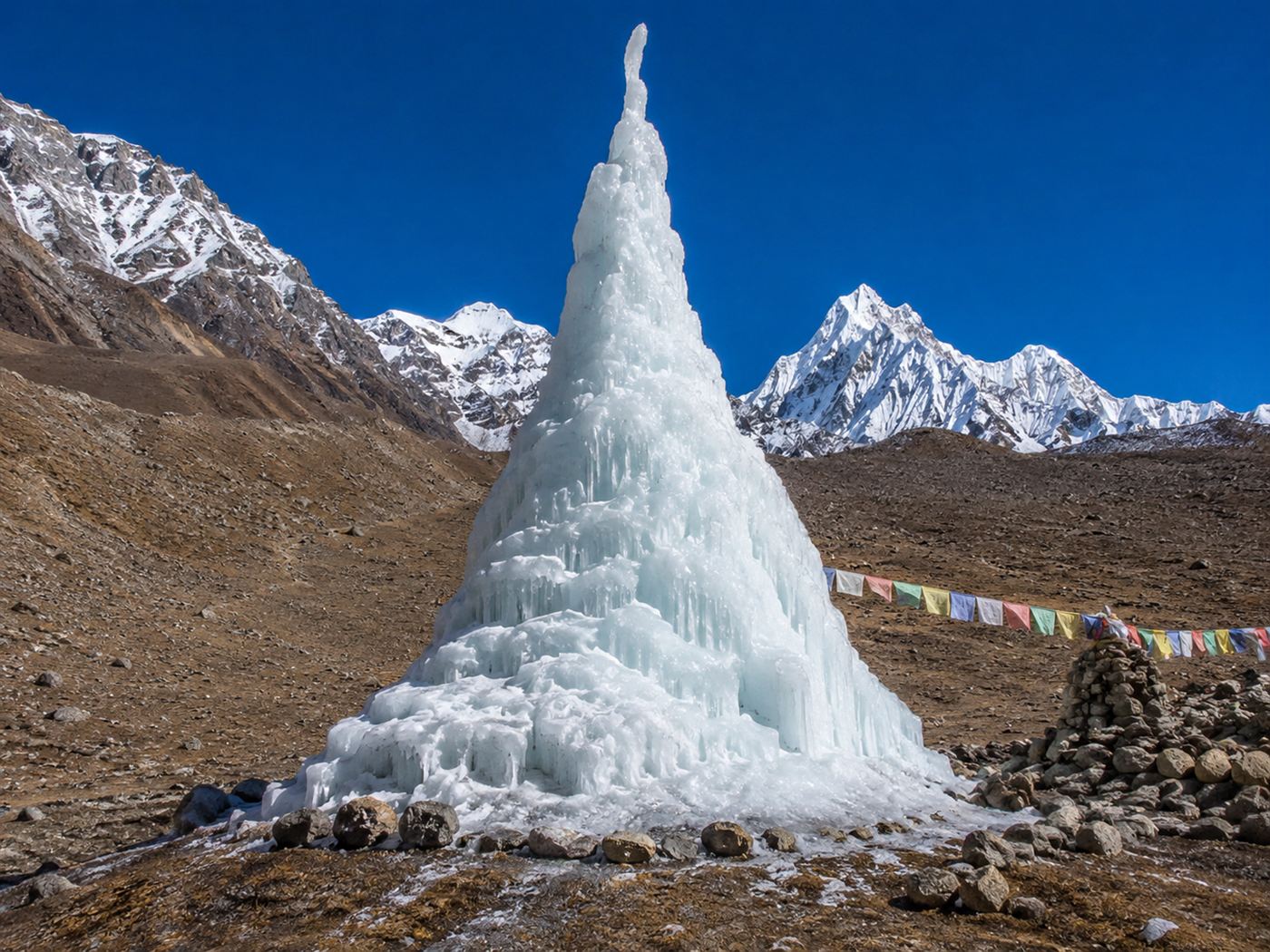
An ice stupa rising from the Ladakhi desert, a man-made glacier built to outlast the spring sun. Illustration: Watts & Wild.
They are called ice stupas, named for the dome-shaped Buddhist shrines that dot the region, and from a distance they look like something between a shrine and a frozen volcano. Each one is a cone of ice, some rising as high as a ten-storey building, parked in a barren valley and quietly waiting for the warmth that will turn it back into water exactly when the fields need it most.
The idea is so simple it feels like a trick, and yet it is rewriting how some of the highest, driest communities on Earth survive a warming climate. It needs no electricity, no fuel and no moving parts. It needs only a pipe, a slope, and a cold enough night.
A desert that happens to be frozen
To understand the invention you have to understand the strangeness of the place. Ladakh is a cold high-altitude desert in the rain shadow of the Himalayas, where the clouds have already dropped their water before they arrive. Almost nothing falls from the sky. For thousands of years the trick to farming here has been timing: catching the meltwater that runs off the mountains as the weather warms, and using it to plant barley, vegetables and fruit trees in the short growing season.
That timing is everything. The villages do not need water in midwinter, when nothing grows, and they do not lack it in high summer, when the glaciers run freely. The dangerous moment is early spring, the planting weeks of April and May, when seeds must go in but the high glaciers have not yet begun to melt in earnest. For generations there was just enough to scrape through. Then the climate started to move the goalposts.
The problem with a melting glacier
It sounds backwards, but warming glaciers can leave a place with less usable water, not more. As temperatures climb, Ladakh's glaciers are retreating up the mountains and melting on a different schedule, often too late to help with the spring planting and then too fast and too much later in the year. The water a village can actually use at the moment it needs it is shrinking, even as the ice overall disappears.
For farmers this is an existential squeeze. Miss the planting window for lack of water in April, and the whole year's harvest is gone, regardless of how much the glacier gushes in July. Across the region, fields were being abandoned and young people were leaving for the cities, driven out by a water shortage that arrived at one specific, unforgiving time of year.
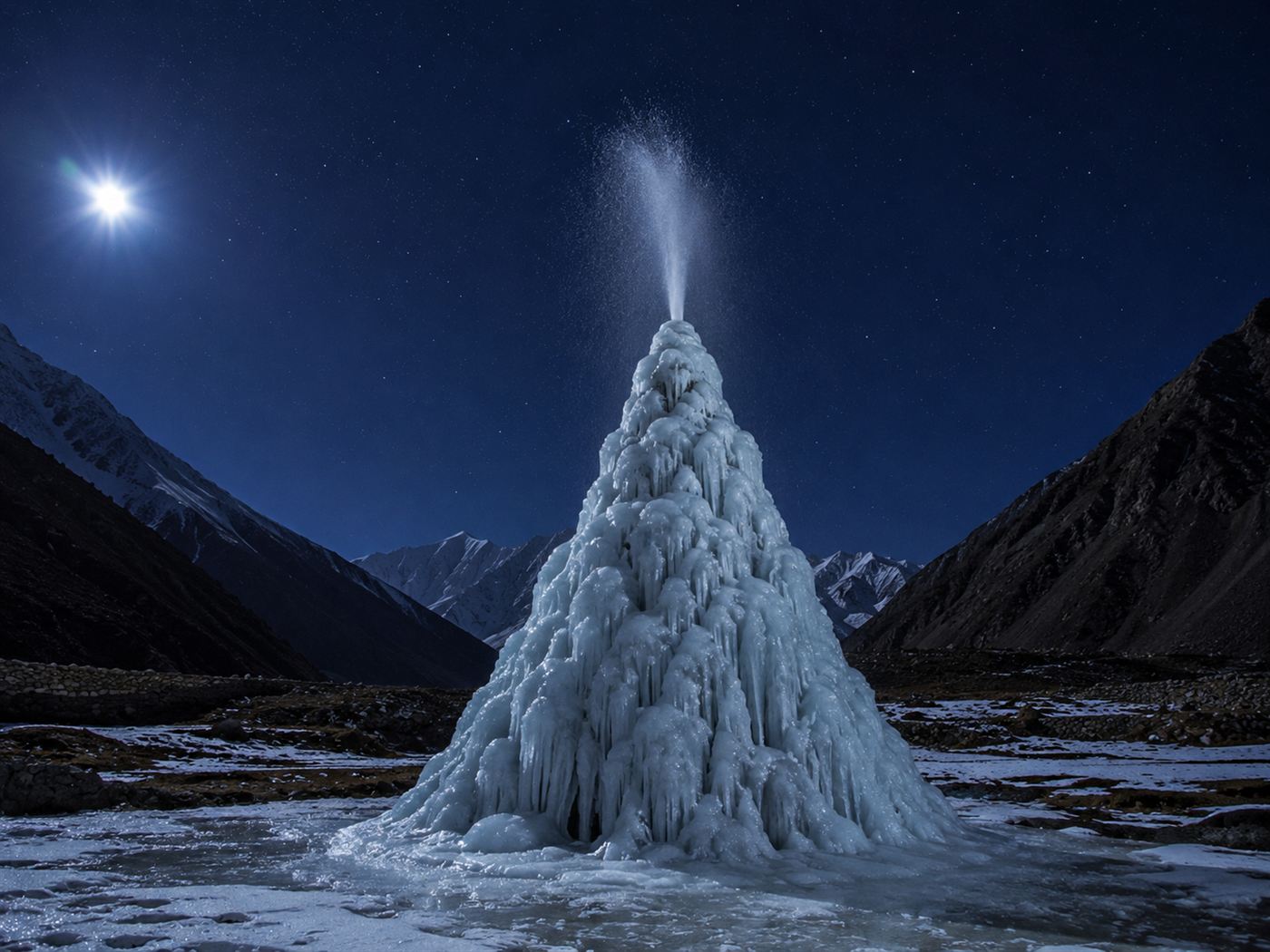
How you build a glacier from a garden hose
The man who cracked it is Sonam Wangchuk, a Ladakhi engineer and educator. His insight came from a small observation: ice sitting in the shade under a bridge in May, refusing to melt long after the sun should have killed it. The enemy of stored ice, he realised, was not warm air so much as direct sunlight. Make ice that hides from the sun, and it would last deep into the dry season.
The method that grew from that idea is beautifully low-tech. In winter, when streams still run but the water goes unused, it is piped downhill from a point higher up the mountain. As BBC Science Focus has explained, the drop in height alone builds up enough pressure to push the water up through a vertical pipe and spray it into the air, with no pump and no power at all. In the brutal cold of the Ladakhi night, often well below minus 20, the spray freezes as it falls and lands as ice, and night after night the droplets pile into a growing cone.
Why ice stupa artificial glaciers take the shape of a cone
The shape is the clever part. A cone is the closest thing to a sphere you can pour from a fountain, and it packs the most volume of ice behind the least surface area facing the sky. As the technique is documented, growing the ice tall and vertical rather than spread flat like a natural glacier means far less of it is exposed to the sun, so it melts slowly from the outside in. A flat sheet of the same ice would be gone in weeks. A tower of it lingers for months.
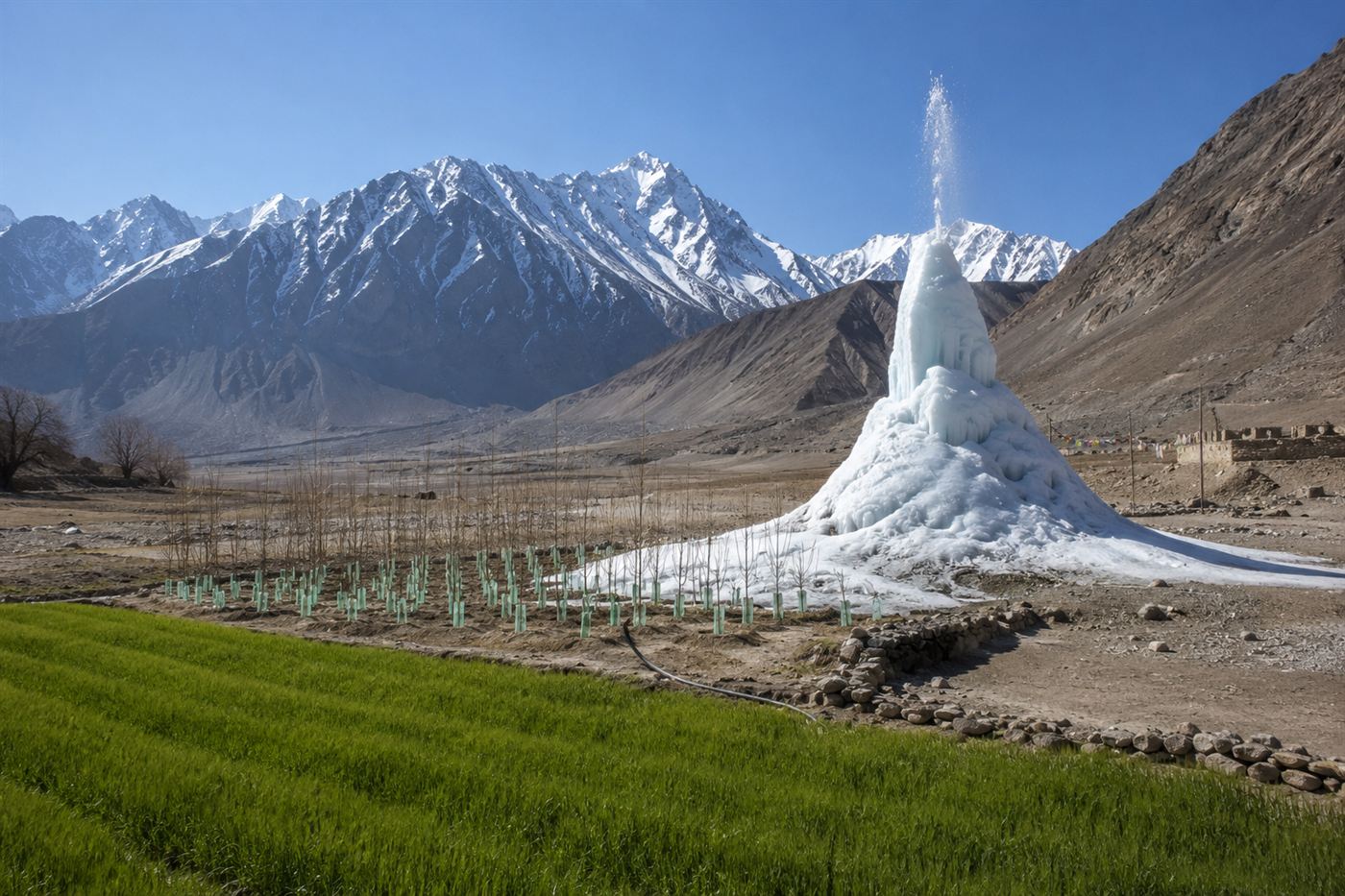
That is the whole magic. The stupa freezes in the dead of winter, when the water is worthless, and stands there like a giant slow-release tablet. As spring arrives and the fields wake up, the cone begins to melt from its surface, trickling out a steady supply of water at precisely the time the glaciers are still asleep. A single large stupa can hold enough to help irrigate thousands of newly planted saplings through those critical early weeks.
The honest catch
It is a wonderful idea, and it is not a miracle, so it deserves an honest accounting. An ice stupa is tiny next to a real glacier. It does not refill the mountains or reverse the retreat of the ice; at best it buys a village a vital few weeks of water in spring. It is a patch over a wound, not a cure, and the wound, a warming planet, keeps getting deeper no matter how many cones get built.
It is also fragile in its own right. The whole trick depends on nights cold enough to freeze a fountain, and as winters warm those nights are getting rarer even in Ladakh. Pipes freeze and burst, the spray has to be managed, and a stupa that should be growing can fail in a mild spell. The ice stupa is best understood not as a fix for climate change but as a clever, humble way of living with its early effects.
Why a tower of ice matters more than its size
Set against the megaprojects this site usually covers, an ice stupa is almost nothing: no concrete, no grid connection, no budget to speak of. And yet it may be one of the most quietly radical pieces of engineering around, because it solves a desperate problem with materials any village already has, water and cold, arranged in a smarter shape.
The idea is already spreading to other high, dry mountain regions facing the same slow crisis, from the rest of the Himalayas toward the Andes and the Alps. In a century obsessed with building bigger, Ladakh offers a different lesson: that sometimes the most powerful response to a changing planet is not to overpower nature but to copy it, borrow its oldest trick, and grow a glacier of your own before the spring runs dry.
A pipe, a slope and a cold night turn wasted winter water into a glacier a village can drink in spring. Is low-tech, local invention like the ice stupa the real future of surviving climate change, or just a moving stopgap while the glaciers vanish for good? Tell us what you think in the comments.
Related reading: California just switched on the first US solar panels built over irrigation canals, and covering all 4,000 miles could save 63 billion gallons of water a year.