Three friends in Amsterdam got tired of watching plastic drift out to sea, so they strung a curtain of air bubbles across a canal that has now caught a million pieces
It began in 2017 with three friends, a glass of beer, and a stubborn refusal to keep watching plastic float past them toward the North Sea. The thing they built is almost invisible: a thin tube on a canal floor, pushing up a wall of bubbles. By August 2025 it had caught its millionth piece of plastic.
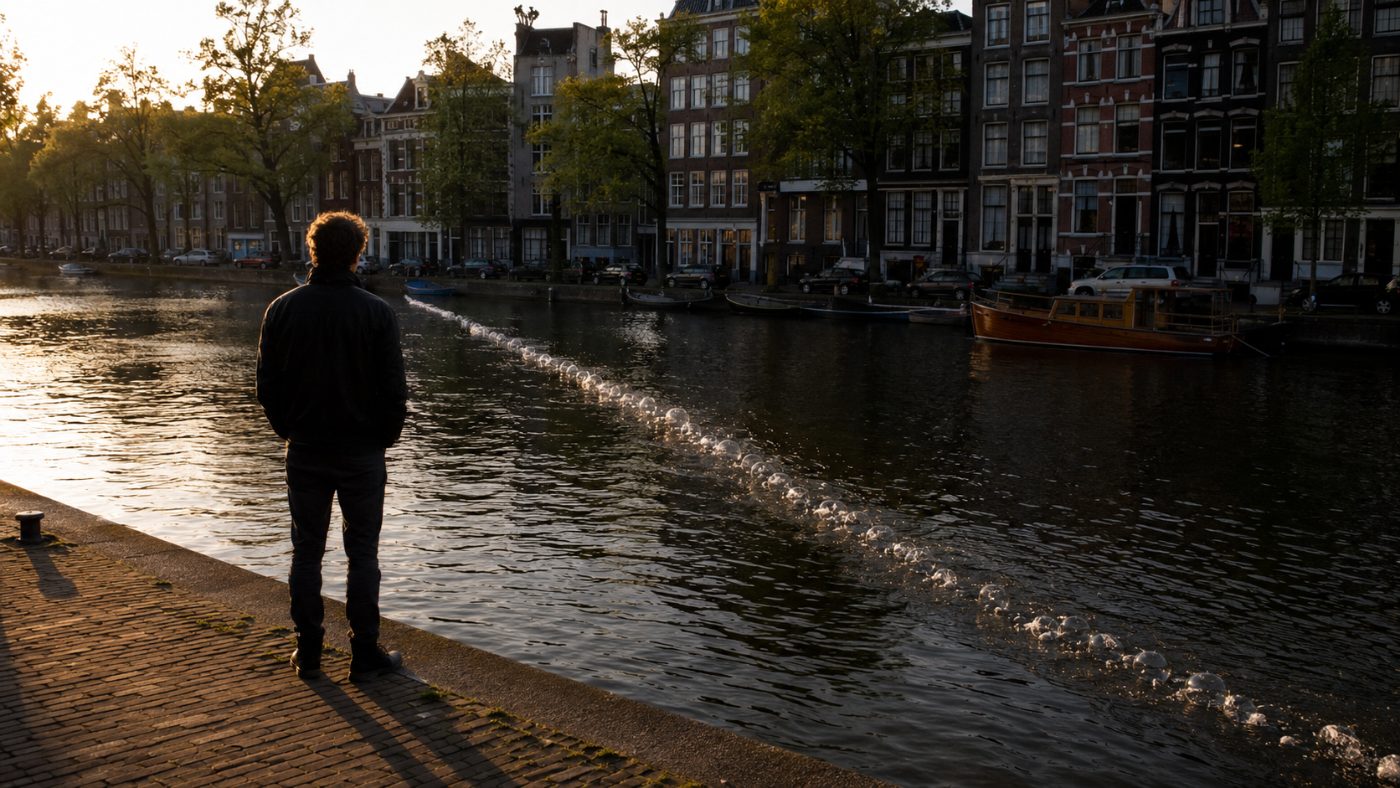
A wall of rising bubbles cuts across an Amsterdam canal, lifting plastic to the surface while boats and fish pass straight through. Illustration: Watts & Wild.
Most of us, faced with a canal full of plastic, do the modern thing: we feel bad about it, maybe we post about it, and then we look away. A small group of friends in Amsterdam refused to look away, and their Great Bubble Barrier Amsterdam project is the result. They had been talking for years about the plastic streaming out of the city's famous canals toward the sea, and instead of waiting for someone official to fix it, they decided to build the fix themselves.
What they built does not look like much. There is no giant machine, no net, no boat scooping at the water. There is just a perforated tube lying on the bottom of a canal, and a compressor pushing air through it. The air rises as a steady screen of bubbles, and that screen does the work. On August 27, 2025, the company behind it announced that this quiet curtain of bubbles had pulled its one millionth piece of plastic out of the water.
A glass of beer and a refusal to look away
The Great Bubble Barrier was founded in 2017 by three Dutch women, Anne Marieke Eveleens, Saskia Studer and Francis Zoet. The origin story has become a little legend in Amsterdam's startup world: over drinks one evening, while they were arguing about how on earth you stop plastic in moving water, someone looked at the bubbles climbing the inside of a beer glass and asked the obvious question. What if you did that to a whole canal?
It turned out they were not the only ones chasing the idea. In Berlin, a young engineering student named Philip Ehrhorn had watched bubbles corral debris at a wastewater treatment plant and started sketching the same concept. He found the women online, realised they were building the thing he had been dreaming about, and joined them. Today he is the company's chief technology officer, and the bubble idea has carried the team from a back-of-the-napkin sketch to an Earthshot Prize finalist in 2022.
How you stop plastic with nothing but air
The cleverness is all in the geometry. The tube is not laid straight across the channel but at a diagonal. The rising bubbles create an upward current that floats plastic to the surface, and because the wall sits at an angle, the natural flow of the water then slides that floating plastic sideways, along the bubble curtain, until it collects in a catchment basket at the bank. The water does the sorting. The bubbles just lift.
The beauty of a wall made of air is what it lets through. Boats sail straight over it. Fish swim straight through it. As the Dutch Water Sector has reported, the rising bubbles even aerate the water, nudging up its oxygen levels, which is the opposite of what most barriers do to a river. A net would snag wildlife and block traffic. A wall of bubbles simply stands there, catching roughly 86 percent of the floating plastic that drifts into it.
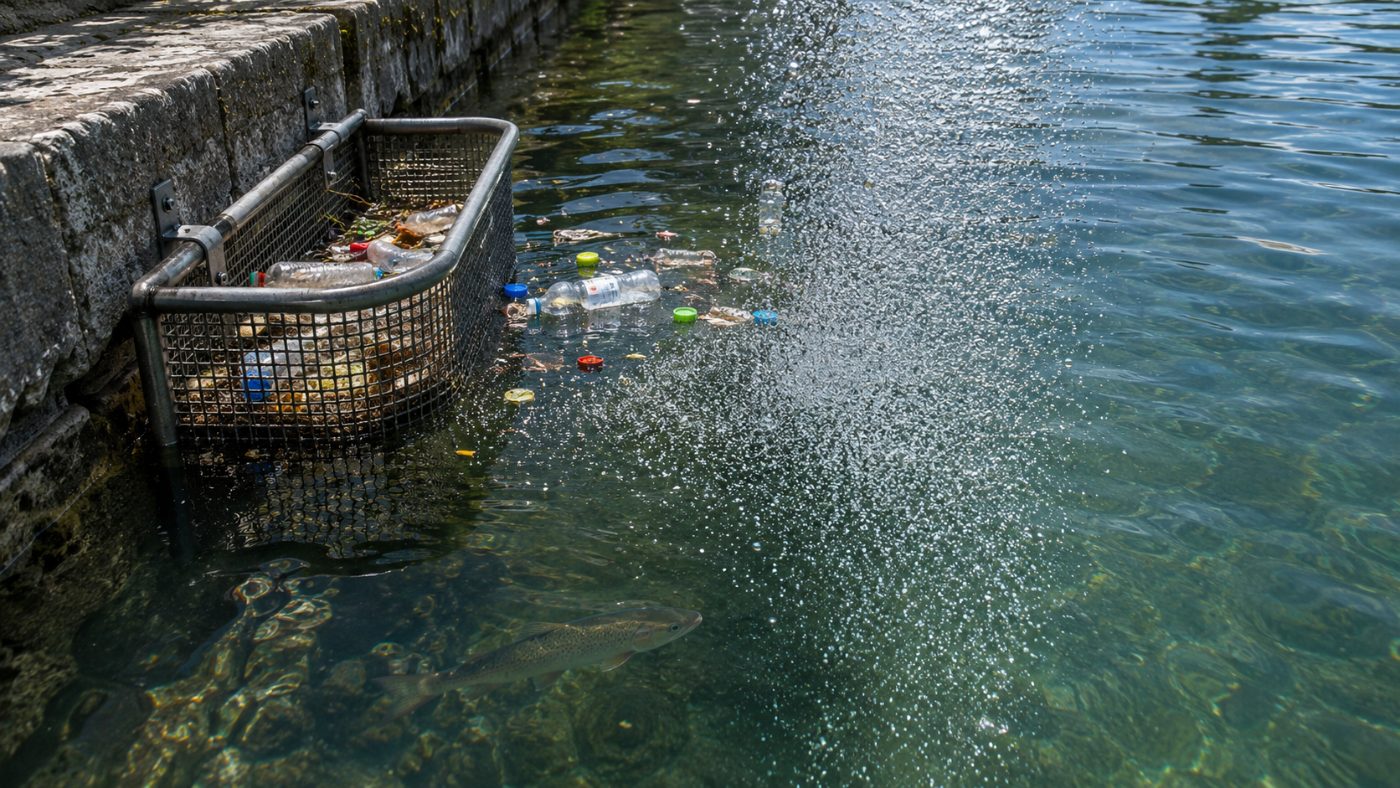
The Amsterdam canal that proved the Great Bubble Barrier
The first long-term Bubble Barrier went into the water at the Westerdok, where Amsterdam's canal network drains toward the open water, in late 2019. As EcoWatch reported at the launch, it was commissioned together with the city and the regional water authority, Waterschap Amstel, Gooi en Vecht, which meant it was never just an art project. It was a piece of public infrastructure being asked to prove itself.
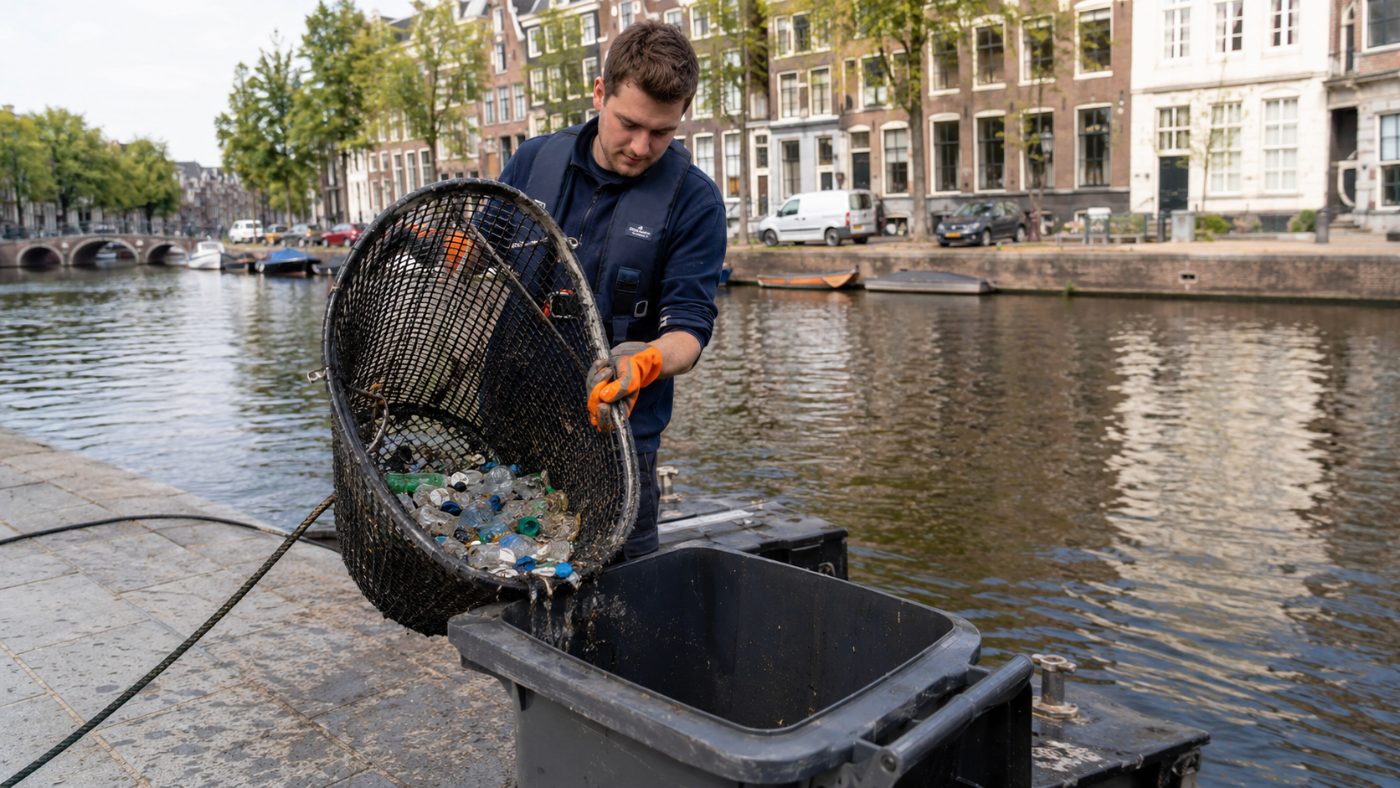
It did. The Westerdok barrier now pulls in around 15,000 pieces of plastic, roughly 80 kilograms, every month, day in and day out, on a stretch of water nobody used to think about. In September 2024 the city made the decision that matters most for any pilot: it approved the barrier as a permanent installation. And then, in August 2025, came the headline number, the millionth piece of plastic stopped before it could reach the sea.
Why the river is the place to fight
There is a strategic logic to all of this that is easy to miss. The plastic choking the world's oceans does not mostly start in the ocean. Most of it washes in from the land, carried down rivers and canals, which means the cheapest place to catch it is long before it ever spreads across open water and breaks into untraceable confetti.
Estimates put the plastic entering the sea each year in the millions of tonnes, the large majority of it arriving through rivers. Catch it in a canal in central Amsterdam and it is a manageable basket of bottles and wrappers. Let it reach the North Sea and it becomes a problem the size of an ocean. The Bubble Barrier is built on that simple, unglamorous bet: stop it at the chokepoint, while it is still easy to grab.
From a city canal to a tidal estuary
The harder test was whether bubbles could work somewhere messier than a calm Dutch canal. In Portugal, the team installed a barrier in the Ave river estuary at Vila do Conde, the project's first in tidal water, where the flow reverses twice a day and refuses to behave. As part of the EU-funded MAELSTROM research project it caught around 2,700 items of plastic, about 17 kilograms, each month, and proved the design could be tuned for shifting, salty, back-and-forth currents rather than one tidy direction.
Other barriers have followed. One went in at Harlingen in 2024 to keep plastic out of the protected Wadden Sea, and the company is now eyeing projects in the United Kingdom, the United States, Germany and Thailand, according to impact loop. The ambition, in Ehrhorn's words, is blunt: the technology "should be available wherever it's needed." A million pieces in one canal is a proof of concept, not a finish line.
The honest catch
For all its charm, a wall of bubbles is not a cure, and the team is fairly honest about that. It catches floating plastic, which leaves out the microplastics already shredded too small to lift and the heavier waste that sinks to the bottom. Eighty-six percent is a remarkable number for an open waterway, but it is not a hundred, and the barrier only works where there is enough current to slide the plastic along the wall. Drop one into still water and it will struggle.
The deeper catch is the one every clean-up technology shares. A Bubble Barrier sits at the end of the pipe, pulling out plastic that should never have been made, sold and dropped in the first place. It treats the symptom beautifully and does nothing about the disease, and scaling it up runs into the usual walls of funding and permits rather than physics. None of that makes it useless. It makes it one honest, working tool, the kind that catches the bottle today while the slower fight over plastic itself drags on.
A curtain of air, an idea sparked by a glass of beer, and a million pieces of plastic stopped before they reached the sea. Would you back simple, end-of-pipe machines like this one, or does catching the plastic let us off the hook for making so much of it in the first place? Tell us what you think in the comments.
Related reading: Experts said cleaning plastic out of the ocean was impossible, so a Dutch teenager quit engineering school to prove them wrong.