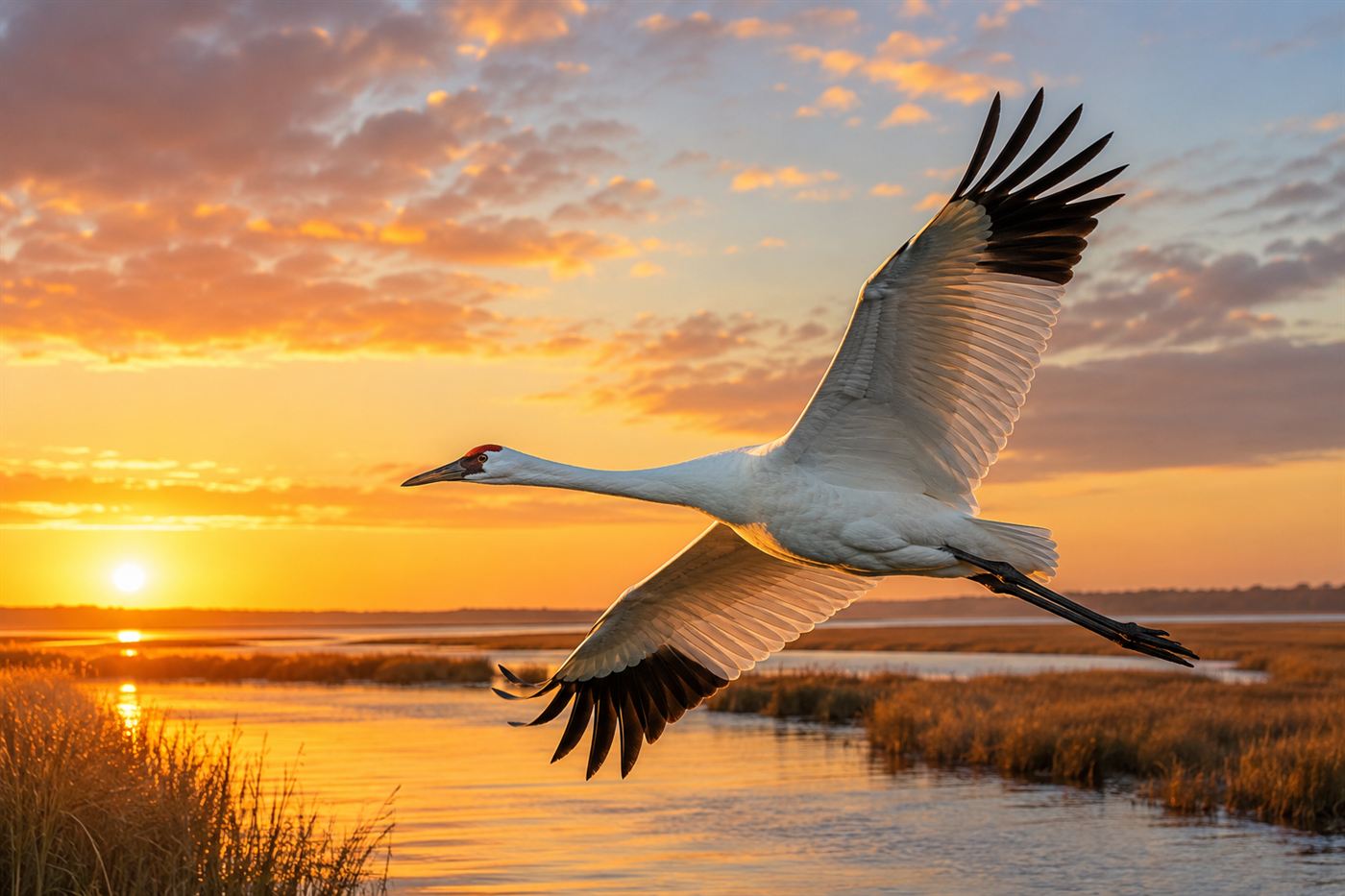
The whooping crane is the tallest bird in North America, standing about 1.5 meters tall with a wingspan of more than two meters, brilliant white except for black wingtips and a patch of bare red skin on its face. In the nineteenth century the whooping crane migration carried flocks across the Great Plains. By 1941, the winter count at its last known stronghold in Texas found exactly 16 birds. Birds can astonish us at the other end of the scale too, like Wisdom the albatross, the oldest wild bird known, still nesting in her seventies.
The story of how the whooping crane came back from 16 individuals to roughly 838 today runs through a Canadian wilderness park that nobody knew the birds nested in, a captive breeding program built on borrowed eggs, and a Canadian sculptor who dressed himself in a crane costume and flew an ultralight aircraft into history.
The whooping crane fell to 16 wild birds by 1941 through hunting and habitat loss. Their nesting grounds in Wood Buffalo National Park, Canada, were unknown to science until 1954. A captive breeding program and the ultralight aircraft-led Operation Migration rebuilt the population to roughly 838 individuals across wild and captive groups, though full recovery remains decades away.
How close did the whooping crane come to extinction?
The whooping crane was never as abundant as the passenger pigeon or the bison.
Historical estimates suggest the peak population was perhaps 10,000 birds, spread thinly across the continent.
Market hunting in the nineteenth century reduced that number dramatically.
The whooping crane, large and conspicuous, was easy to shoot and the feathers were sold for millinery.
Drainage of the tall-grass prairie marshes where the birds stopped to feed on migration removed the rest of the habitat they needed.
By 1938 the known wild population had fallen to 29 birds.
By 1941 it was 16, and ornithologists were genuinely uncertain whether the species would survive the decade.
The last wild whooping crane in Louisiana, part of a separate non-migratory population that had once been distinct, died in 1950.
For a period, the 16 birds wintering at Aransas National Wildlife Refuge on the Texas Gulf Coast were the only wild whooping cranes known to exist on Earth.
Where do whooping cranes nest, and why did it take 13 years to find out?
For more than a decade after 1941, scientists protecting the 16 surviving whooping cranes did not know where those birds went in the summer.
Every autumn the whooping cranes arrived at Aransas, and every spring they departed northward and disappeared.
The nesting grounds, wherever they were, lay somewhere in an era when aerial survey of remote Canada was difficult and expensive.
The mystery ended on June 30, 1954.
A Canadian Wildlife Service helicopter survey pilot named Don Landells, flying with wildlife biologist G. Wilson Allen, spotted two adult whooping cranes and a chick in the remote wetlands of Wood Buffalo National Park, a wilderness preserve spanning the border of Alberta and the Northwest Territories.
Wood Buffalo National Park covers nearly 45,000 square kilometers of boreal forest and muskeg, one of the largest national parks in the world, and the whooping cranes had been nesting there the whole time, hidden by sheer remoteness.
The discovery transformed the conservation effort.
Knowing where the birds nested meant biologists could monitor the breeding season, count eggs, and eventually consider whether to intervene.
Robert Porter Allen of the National Audubon Society had spent years documenting whooping crane behavior and migration, and his fieldwork laid the scientific groundwork that made the subsequent recovery possible.
How did captive breeding save the whooping crane?
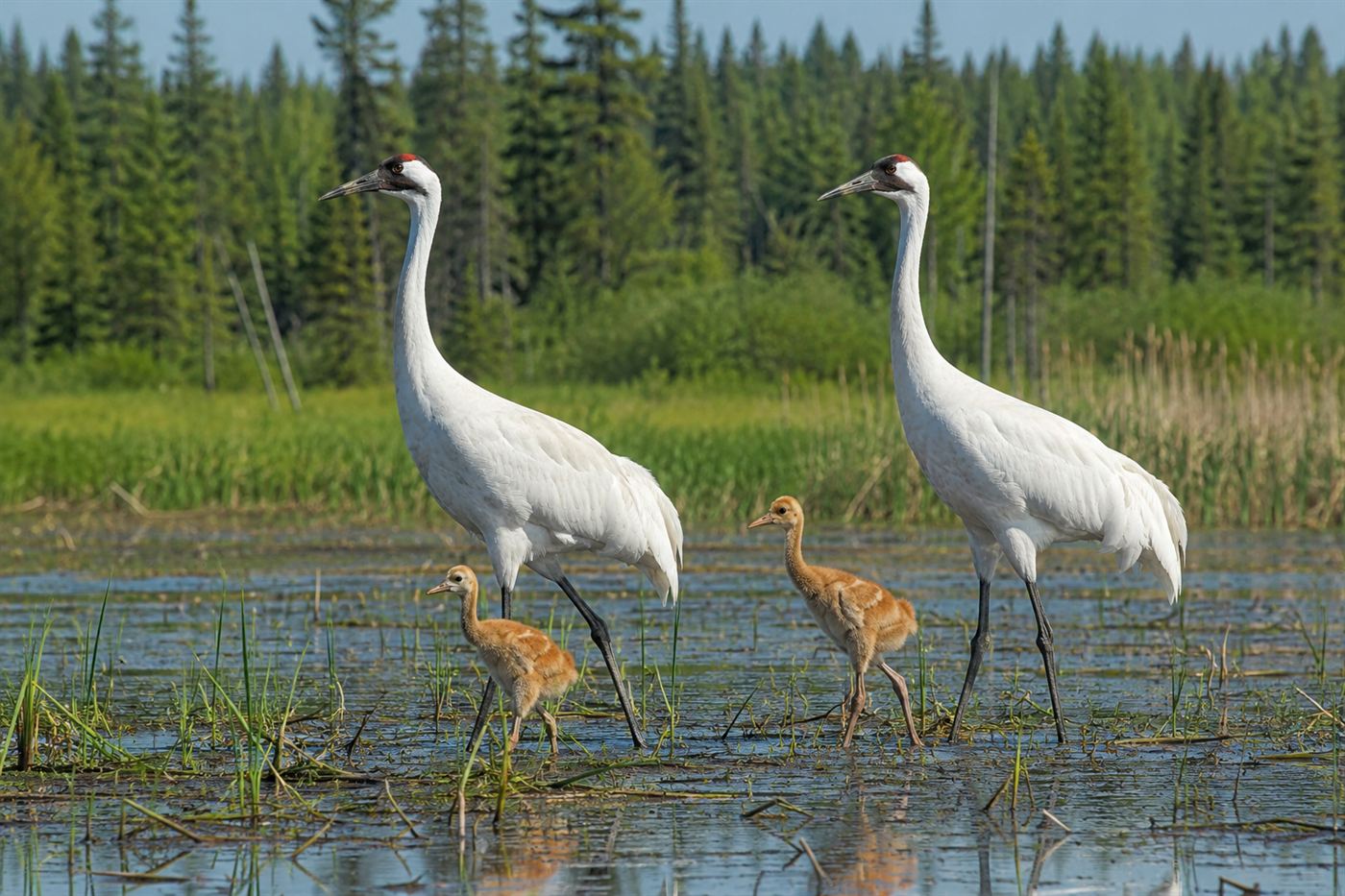
Whooping cranes lay two eggs but almost always raise only one chick.
Biologists realized that if they removed a single egg from a wild nest at Wood Buffalo, the pair would still attempt to raise the remaining chick, and the collected egg could be hatched in captivity to start a captive breeding population.
This technique, called double-clutching, was applied starting in the 1960s and formalized through the 1970s.
Eggs collected at Wood Buffalo were flown to the Patuxent Wildlife Research Center in Maryland, where biologists worked to learn how to hatch whooping cranes in captivity and eventually how to breed them.
The captive breeding program for the whooping crane was one of the longest and most painstaking in conservation history.
Whooping cranes reach sexual maturity slowly, mate for life, and do not breed reliably in captivity without careful management.
The program also partnered with the International Crane Foundation in Baraboo, Wisconsin, which became a central hub for whooping crane captive breeding and research.
By the 1980s the captive population had grown large enough that biologists began to consider the next problem: how do you return a captive-bred whooping crane to the wild when the migration route that wild cranes follow is a piece of learned knowledge, passed from parent to offspring, that the captive birds do not have?
Who was Bill Lishman and how did he prove ultralight aircraft could teach birds to migrate?
Bill Lishman was a Canadian sculptor, not a biologist.
He had been flying ultralight aircraft for years when he began wondering, in the mid-1980s, whether birds could be trained to follow one.
He started with Canada geese and found that goslings raised by hand would imprint on the aircraft and fly with it as naturally as they would follow their parents.
In 1988 and 1993, Lishman led flocks of Canada geese on flights from Ontario to Virginia and back, demonstrating that captive-raised birds could learn a migration route by following an ultralight.
The 1996 film "Fly Away Home," starring Jeff Daniels and Anna Paquin, told a fictionalized version of his work and introduced millions of people to the concept before Operation Migration had led a single whooping crane.
Lishman's key insight was that the birds would follow the aircraft only if they had never learned to fear or recognize humans.
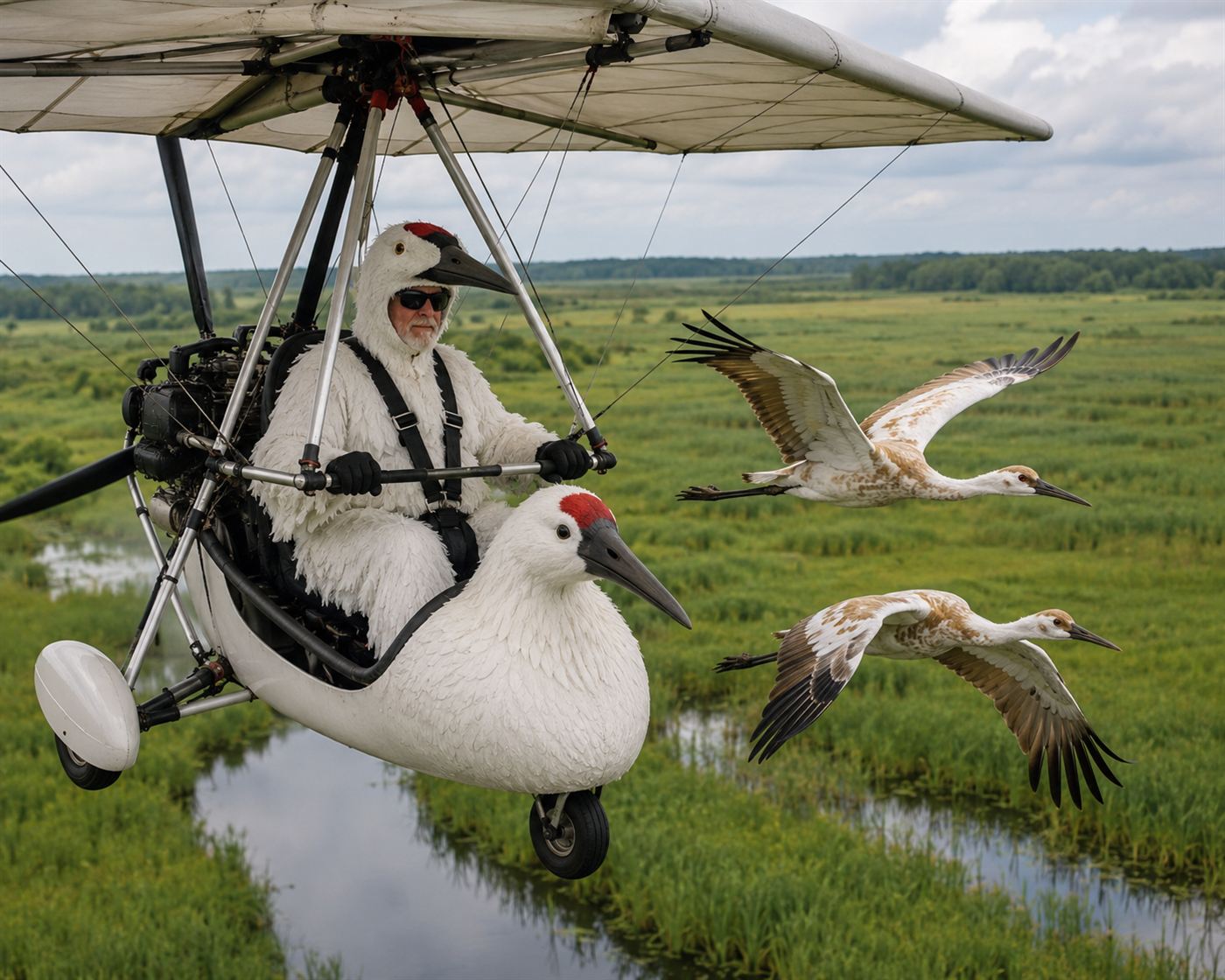
The handlers who raised the chicks wore white costumes designed to resemble whooping cranes, with masks covering their faces and voice boxes to suppress human speech.
They never allowed the birds to associate food or safety with a visible human form.
The ultralight aircraft, painted white, became in the birds' minds a large, competent bird that knew where to go.
How did the whooping crane migration flights work in practice?
Operation Migration launched its first whooping crane-led flight in 2001, guided by pilots Joseph Duff and William Lishman and a team that had spent years developing the protocols.
Each autumn, a cohort of captive-bred whooping crane chicks raised at the Necedah National Wildlife Refuge in Wisconsin was taught to fly alongside the ultralight aircraft.
The pilots wore full crane costumes at all times when near the birds: white suits, crane-head masks, no talking, no direct eye contact with the chicks outside the costume.
The migration south to Chassahowitzka National Wildlife Refuge in Florida covered roughly 1,900 kilometers and took weeks, flying short daily legs in favorable weather, grounding the flock when conditions were bad.
Once the whooping cranes completed the route south, they were left to winter in Florida and migrate north again the following spring on their own.
A crane that completes the journey south with an ultralight aircraft typically returns north independently, guided by landmarks and instinct, without needing to follow the aircraft again.
Over the 14 years Operation Migration operated, from 2001 to 2015, pilots guided 249 whooping cranes south from Wisconsin to Florida.
The program was suspended in 2015 when the US Fish and Wildlife Service determined that the Eastern Migratory Population established by Operation Migration was not sustaining itself through natural reproduction at the rate needed, and that a different approach might be required.
How many whooping cranes are there now?
As of 2023, the total whooping crane population stands at approximately 838 individuals across wild and captive groups.
The Aransas-Wood Buffalo population, the natural migratory flock that has survived continuously since 1941, numbers around 537 birds and is the largest wild group.
The Eastern Migratory Population, established by Operation Migration, numbers around 70 birds and has not grown to the self-sustaining size that managers hoped for.
Additional smaller reintroduced populations exist in Louisiana and Wisconsin, though none yet approach the size needed for long-term viability without management.
The recovery of the whooping crane from 16 individuals to more than 800 is genuine progress.
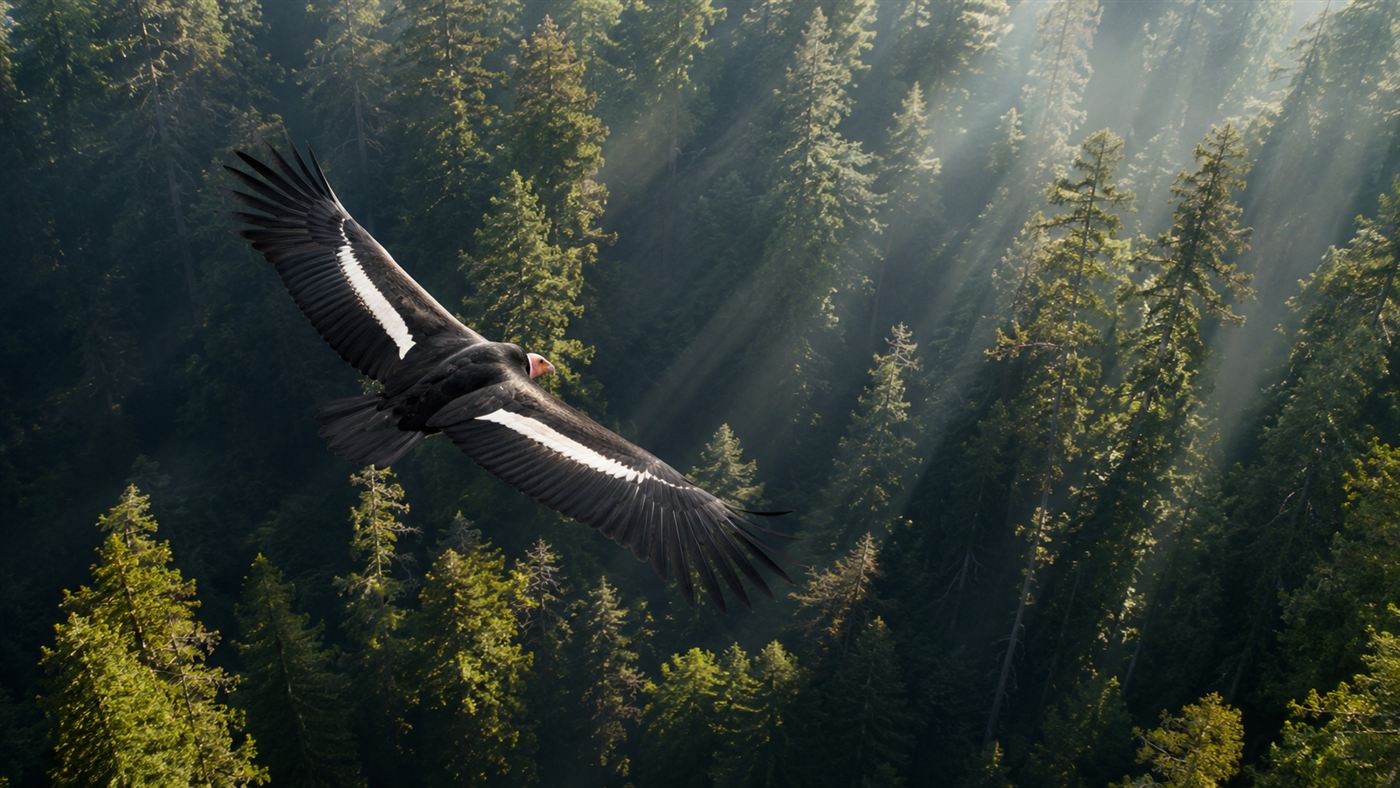
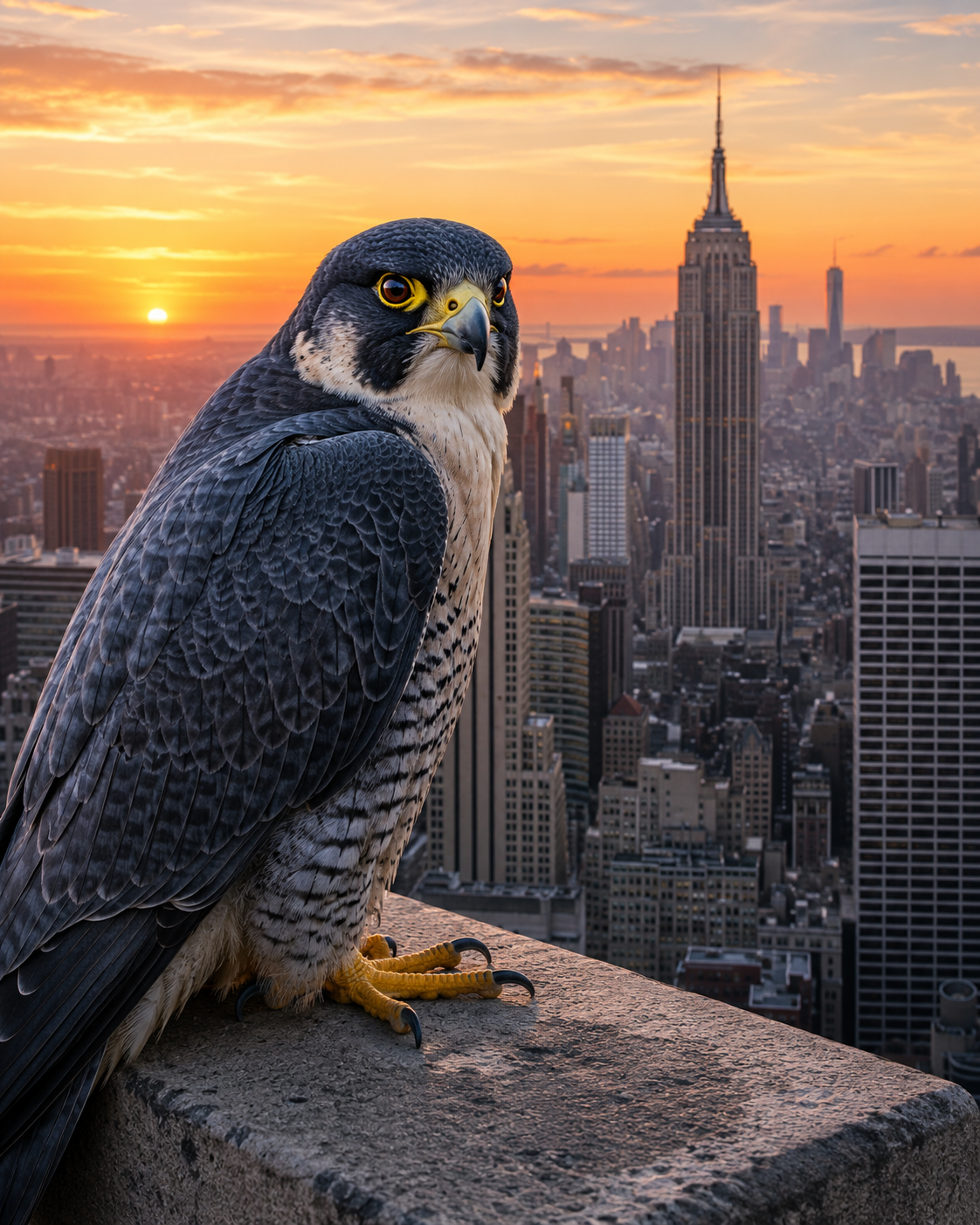
It sits alongside the California condor recovery and the peregrine falcon's return from DDT as examples of what sustained captive breeding programs can accomplish for bird species at the edge.
But a species with 537 wild birds in a single migratory population remains fragile in a way that numbers alone do not capture.
The whooping crane's survival as a wild animal is connected to the health of the tall-grass prairie wetlands along its migration route, the condition of the Aransas estuary in Texas, the stability of the Wood Buffalo wilderness in Canada, and the continued absence of a catastrophic event, a disease, an oil spill, a major storm, at any critical point along a 3,800-kilometer corridor.
The honest catch
Operation Migration was one of the most imaginative conservation programs ever attempted, and watching pilots in crane costumes guide endangered birds south in an ultralight aircraft is genuinely one of the stranger and more moving things the effort to save species has produced.
But the results are sobering.
The Eastern Migratory Population, which Operation Migration spent 14 years building, contains about 70 whooping cranes and is not growing reliably on its own.
The birds taught to migrate by ultralight aircraft are reproducing, but not at the rate needed for the population to sustain itself without continual additions of captive-bred birds.
The Aransas-Wood Buffalo population, the natural flock that survived without human teaching, is the only group large enough to matter at the scale of long-term survival, and it winters in a location where a major hurricane or a sustained drought could do catastrophic damage in a single season.
The whooping crane has come back from 16 individuals, which should have been impossible.
But at 537 wild birds after more than 80 years of the most expensive and intensive bird conservation program in North American history, it still cannot be described as recovered.
The passenger pigeon once darkened North American skies from horizon to horizon, and was gone within one lifetime.
The whooping crane shows how hard it is to pull a species back once it has fallen that far, even with every tool available.
What does the whooping crane's story tell you about how early we need to act before a species reaches the level of 16 survivors? Leave a comment below.
Sources