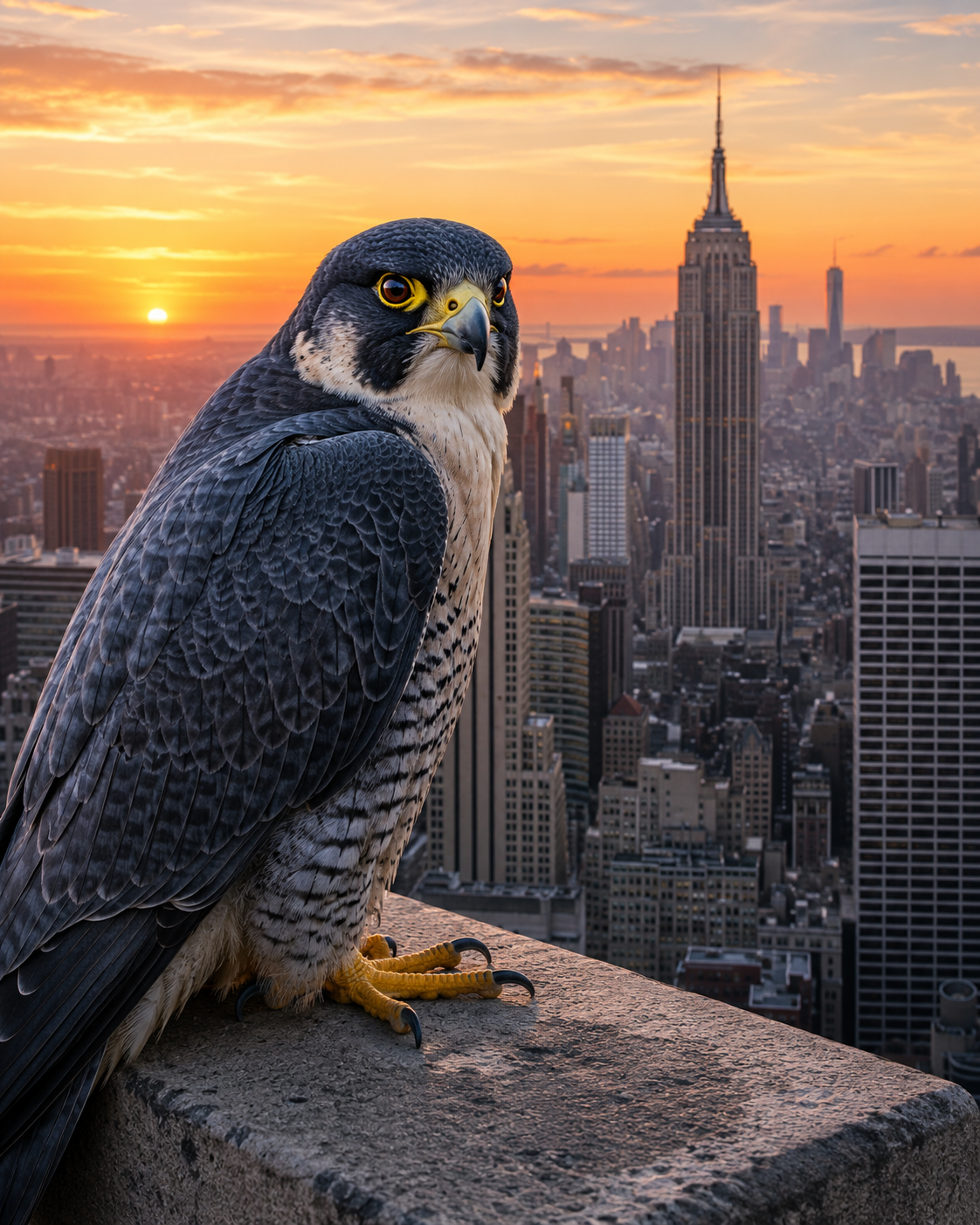
The peregrine falcon is the fastest animal on Earth. In a full stoop dive it can reach 320 kilometers per hour, folding its wings into a teardrop and dropping toward prey that has almost no chance of escape. For most of human history, that speed made it the most prized bird in falconry, trained by kings and emirs and generals. By 1964, the speed meant nothing: the last known nesting pair of peregrine falcons east of the Mississippi River had produced eggs that fell apart. The peregrine falcon DDT recovery that followed would become one of the most complete comebacks in the history of American conservation.
The culprit was DDT, a pesticide first synthesized in 1874 and adopted worldwide after World War Two as a miracle solution to insect-borne disease and agricultural pests. What nobody understood, until it was almost too late, was what happened when DDT moved up the food chain.
DDT's metabolite DDE caused eggshell thinning that collapsed the peregrine falcon population across eastern North America by the mid-1960s. Rachel Carson's 1962 book Silent Spring brought the mechanism to public attention. DDT was banned in the United States in 1972, captive breeding and the hack-box method rebuilt eastern populations from scratch, and the peregrine falcon was delisted as an endangered species in 1999. It now nests on skyscrapers in more than a dozen American cities.
How did DDT cause eggshell thinning in the peregrine falcon?
DDT does not kill raptors directly.
It accumulates through a process called biomagnification: insects absorb small amounts from treated crops, birds eat thousands of insects, raptors eat hundreds of birds, and by the time the chemical reaches the top of the food chain the concentration is millions of times higher than it was at the bottom.
In the peregrine falcon's body, DDT is converted into a metabolite called DDE.
DDE interferes with the enzyme that deposits calcium into eggshells during formation.
The result is eggshell thinning: shells so fragile that the weight of the incubating adult crushes them.
Peregrine falcon nests that had produced healthy clutches for generations began failing every year.
The birds were still laying, still incubating, still behaving normally in every observable way.
The eggs simply collapsed.
Eggshell thinning was eventually documented in more than 50 species of birds across North America and Europe, from pelicans and ospreys to bald eagles.
But no species was hit harder than the peregrine falcon, whose position at the very top of the avian food chain meant it concentrated DDE to levels that produced near-total reproductive failure.
Why was Rachel Carson's Silent Spring so important?
Rachel Carson was a marine biologist and nature writer at the US Fish and Wildlife Service who spent four years documenting the effects of pesticides on wildlife before publishing Silent Spring in September 1962.
The book traced the mechanism of DDT's spread through ecosystems with the precision of a scientific paper and the clarity of a nature essay.
It described towns where the robin population had crashed after DDT was sprayed on elm trees, streams where fish had died, fields where meadowlarks had disappeared.
Rachel Carson did not call for an outright ban on all pesticides.
She called for restraint, for understanding, for acknowledging that a chemical designed to kill insects did not stop killing once the target insect was dead.
The chemical industry attacked her immediately.
Velsicol Chemical Corporation threatened to sue her publisher.
Industry-funded scientists called her hysterical, unscientific, a communist sympathizer.
President Kennedy read the book and ordered a review by the President's Science Advisory Committee.
The committee's 1963 report supported Rachel Carson's findings.
She died of breast cancer in April 1964, eight months after Silent Spring was published, before she could see DDT banned.
The Environmental Protection Agency, created in 1970 in part as a response to the alarm her book had raised, banned DDT in the United States on December 31, 1972.
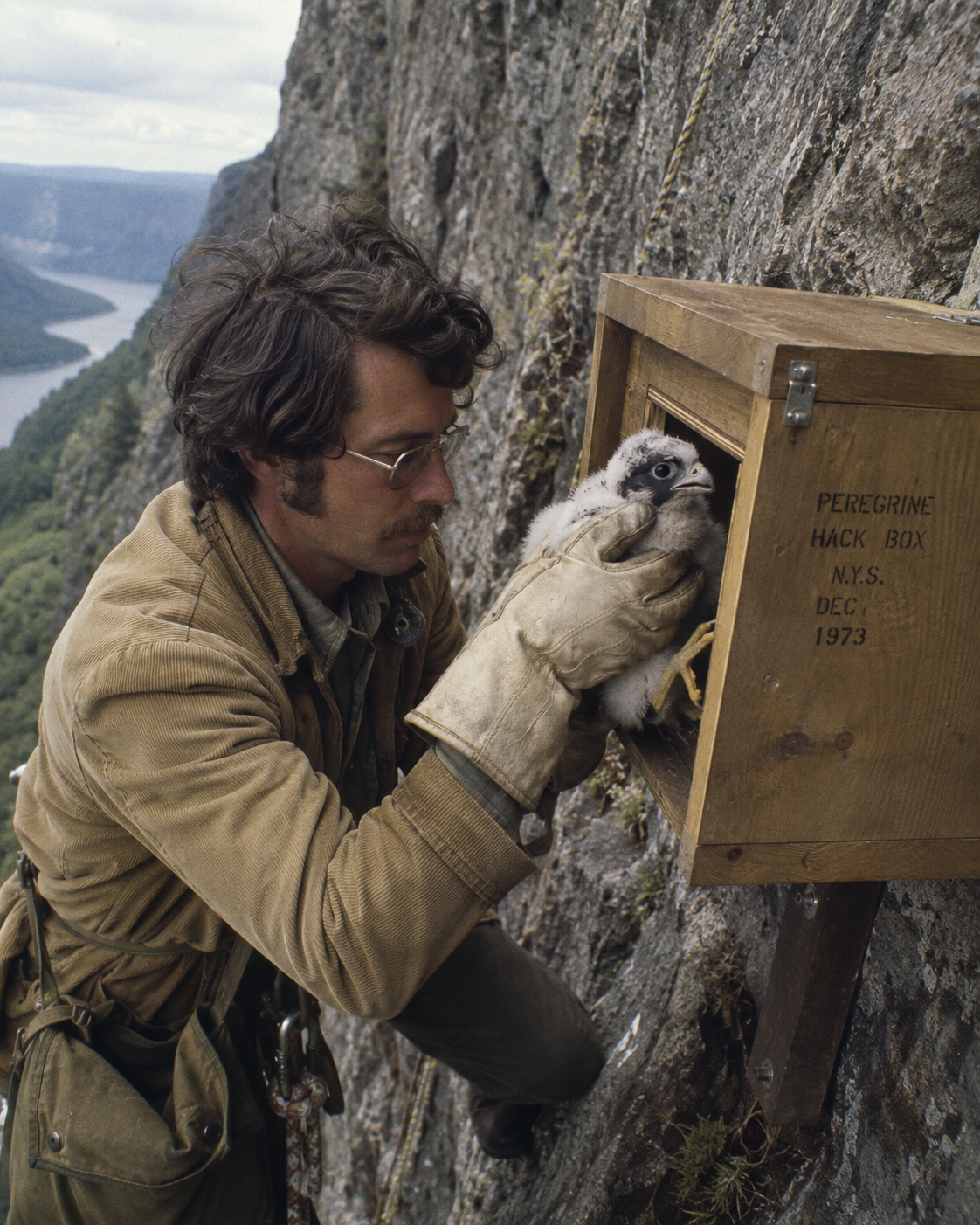
How Tom Cade drove the peregrine falcon DDT recovery from a Cornell rooftop
Tom Cade was an ornithologist at Cornell University who had spent years studying peregrine falcons and had watched the eastern population collapse through the 1960s.
He did not wait for the DDT ban to start rebuilding.
In 1970, two years before DDT was prohibited, Cade founded the Peregrine Fund at Cornell's Laboratory of Ornithology and began the first serious captive breeding program for a bird of prey.
Nobody had reliably bred peregrine falcons in captivity before.
Cade's team discovered that if you removed the first clutch of eggs and incubated them artificially, the female would lay a second and sometimes a third clutch, multiplying the number of chicks produced per breeding pair.
Between 1974 and 1999, the Peregrine Fund and partner organizations released approximately 6,000 captive-bred peregrine falcons across North America.
The recovery of the peregrine falcon was one of the first large-scale demonstrations that captive breeding could actually restore a raptor to the wild, something that had seemed implausible before Cade's program proved it.
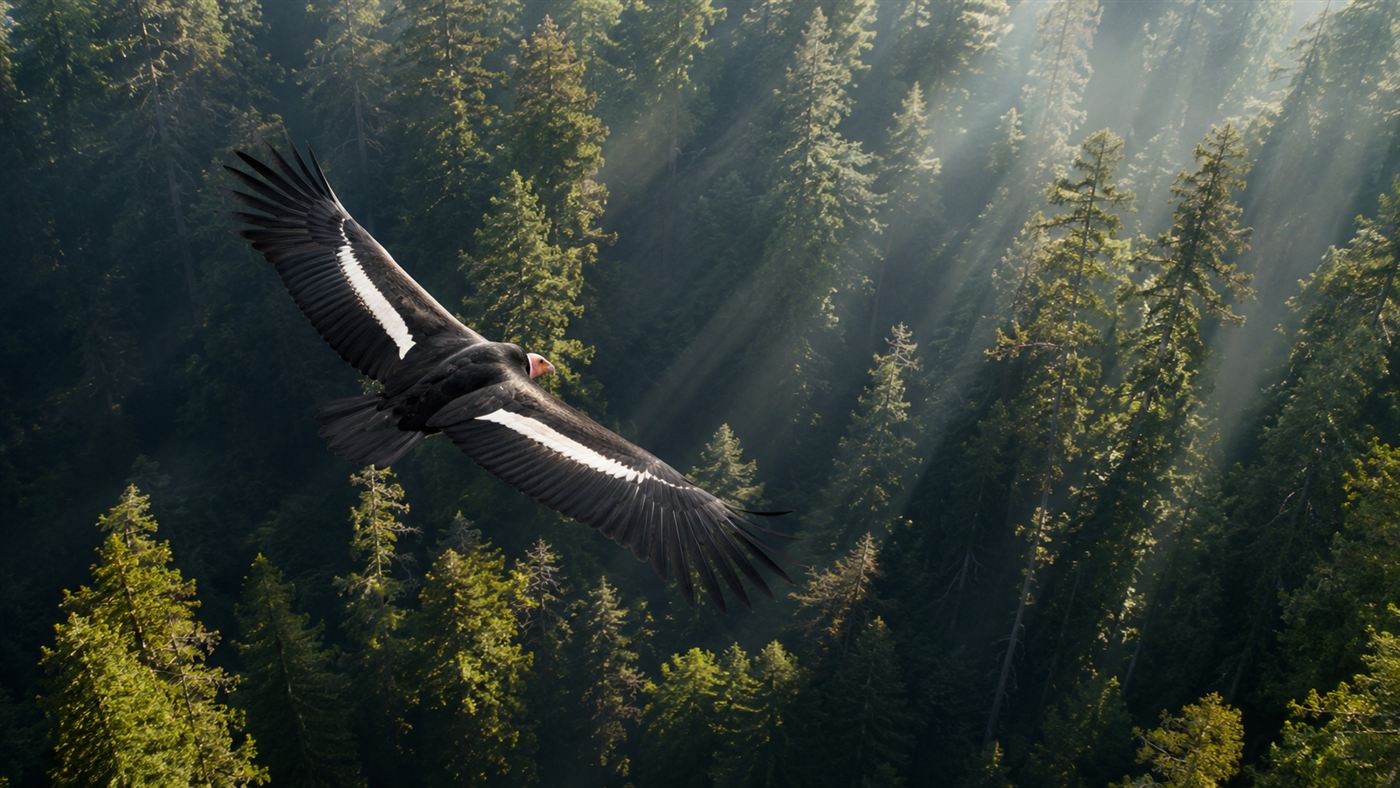
The California condor recovery that followed used techniques directly descended from what the Peregrine Fund pioneered in the 1970s.
What is the hack-box method and how does it work?
The hack box is a wooden box mounted at a traditional peregrine nest site, typically on a cliff face, a bridge, or a tall building.
Young peregrine falcons at about 28 days old, too young to fly but old enough to eat solid food, are placed inside.
Food is provided through a slot so the birds never see a human hand.
The chicks fledge from the box as they would from a natural nest, learning to fly and hunt in the area around the release site.
Peregrine falcons return to breed near where they fledged, so hacking at a traditional cliff site programs the released bird to treat that cliff as home.
The technique meant that the recovered population was not just surviving in new places but re-colonizing the exact ledges and gorges where peregrine falcons had nested before DDT wiped them out.
For a bird that had used the same cliff faces for thousands of generations, this continuity of place turned out to matter enormously to the speed and stability of the recovery.
How many peregrine falcons are there now?
When the US Endangered Species Act listed the peregrine falcon in 1970, there were an estimated 324 nesting pairs left in North America.
By the time the species was delisted in 1999, the population had recovered to more than 1,600 pairs.
Today estimates place the North American population at more than 3,000 breeding pairs, with a global population of roughly 140,000 individuals.
The peregrine falcon is no longer considered globally threatened by the International Union for Conservation of Nature.
It is one of the most complete recoveries in the history of the Endangered Species Act, accomplished within a single human generation.
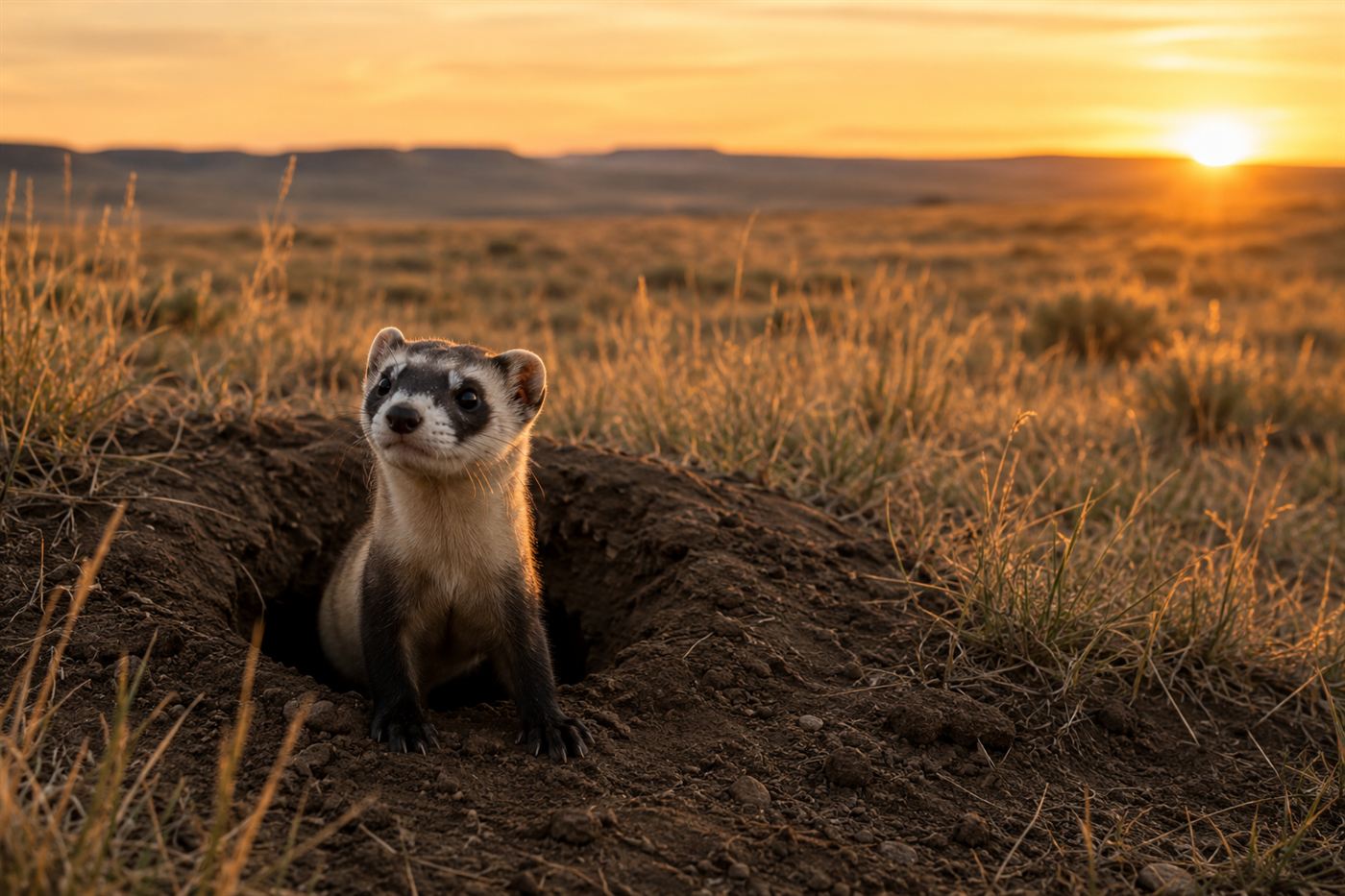
For comparison, the Arabian oryx took nearly 50 years to move from Extinct in the Wild to Vulnerable, and the black-footed ferret, brought back from 18 individuals, still hasn't crossed the threshold to leave the Endangered category after 35 years of intensive management.
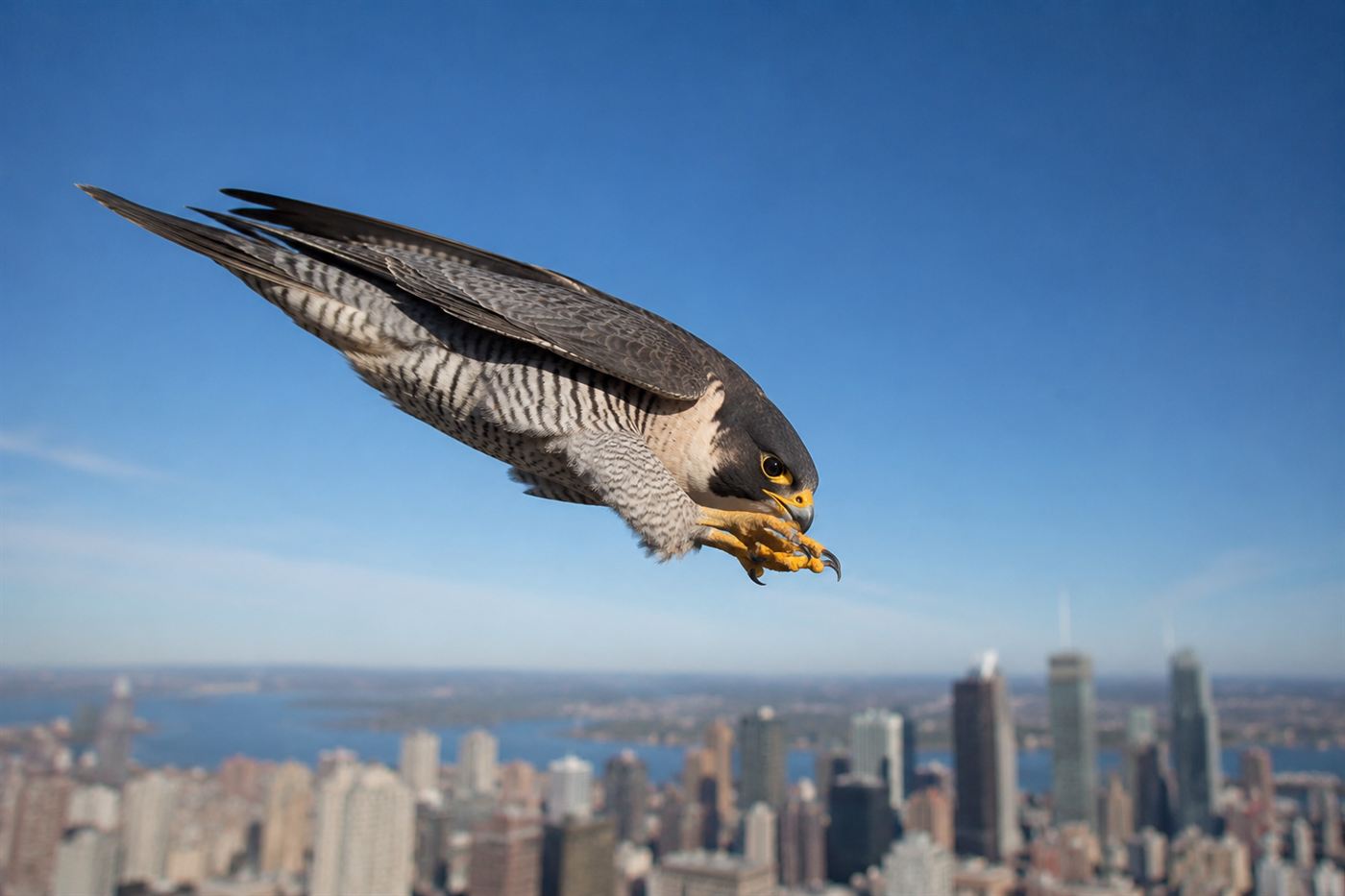
Why does the peregrine falcon nest in cities now?
The first urban peregrine falcon nest in North America was recorded on a building in Baltimore in 1977, one of the early hack-box releases, a bird that had been raised on a city ledge and returned to breed on one.
The pattern has grown into something nobody predicted: a raptor that evolved hunting over cliffs and open country has become one of the most successful urban predators in the world.
City skyscrapers, with their ledges and air currents, replicate the cliff faces where peregrine falcons naturally nest.
Cities are full of feral pigeons, introduced from European rock doves, which are almost exactly the size prey the peregrine falcon evolved to hunt.
Starlings, house sparrows, and European starlings all thrive in cities and all fall within the peregrine's preferred prey range.
The same industrial food system that created the agricultural surplus feeding feral pigeons in every city also created the demand for DDT that nearly destroyed the peregrine falcon.
The bird that almost disappeared because of how humans reshaped the landscape now thrives because of how humans reshaped the landscape, just differently.
Peregrine falcons now nest in New York, Chicago, London, Sydney, Toronto, Berlin, and dozens of other cities.
Webcams pointed at their nests attract millions of viewers every breeding season.
The connection between DDT's cascading effects on ecosystems and the near-loss of raptors across the Northern Hemisphere is now taught in every introductory ecology course, a cautionary chapter that Rachel Carson made possible.
The honest catch
The peregrine falcon recovery is genuinely one of the best conservation outcomes of the twentieth century.
But the story has an asterisk, and the asterisk matters.
Urban peregrine falcons eat city pigeons, and city pigeons eat grain that has often been treated with rodenticides: anticoagulant poisons like brodifacoum used to control rats and mice.
Secondary rodenticide poisoning is now documented in peregrine falcons, red-tailed hawks, and barn owls across North American cities.
The same pesticide logic that made DDT and eggshell thinning so devastating in the 1950s and 1960s is operating again with a different chemical class, and the birds most at risk are the urban raptors that recovered from DDT by learning to live in cities.
The peregrine falcon was delisted because the DDT ban worked.
That ban did not remove the underlying pattern: a chemical enters the food chain, concentrates at the top, and the animals at the top suffer last and worst.
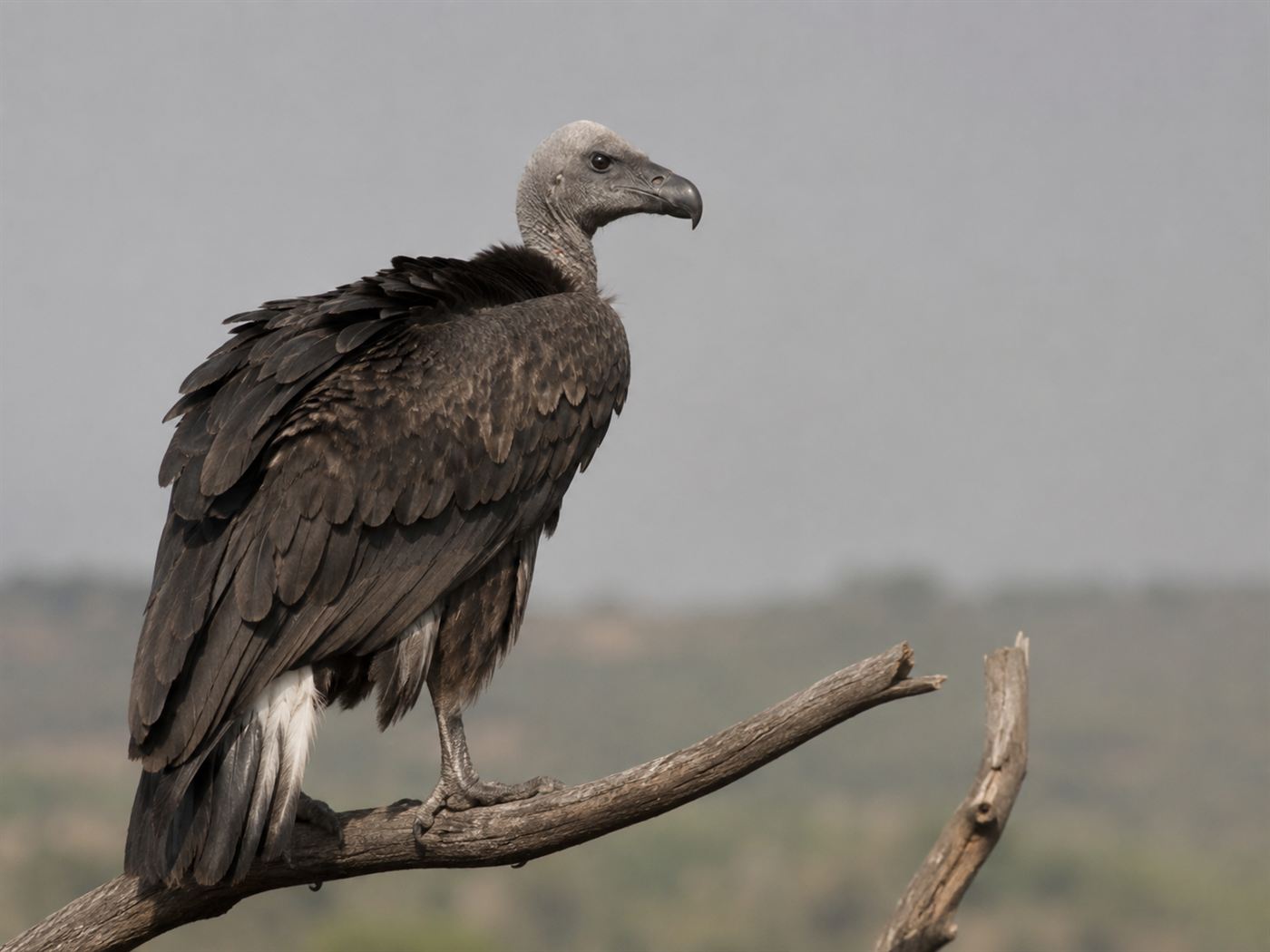
Indian vultures lost 99 percent of their population to a veterinary anti-inflammatory drug called diclofenac before anyone connected the deaths to the cause.
The peregrine falcon taught us what that pattern looks like.
The question is whether we learn it each time, or only after the eggs are already too thin to hold.
If you were designing the law that replaces the DDT ban, what would it require that the current one doesn't? Leave a comment below.
Sources