A honeybee tells its hivemates the exact compass bearing and distance to flowers by dancing in the dark, and one man spent 50 years learning to read it
When a honeybee finds a good patch of flowers, it flies home and does something extraordinary: it dances. The waggle dance is a coded message, performed in the pitch-dark hive, that tells the other bees precisely which way to fly and how far. It is one of the only true symbolic languages known outside humans.
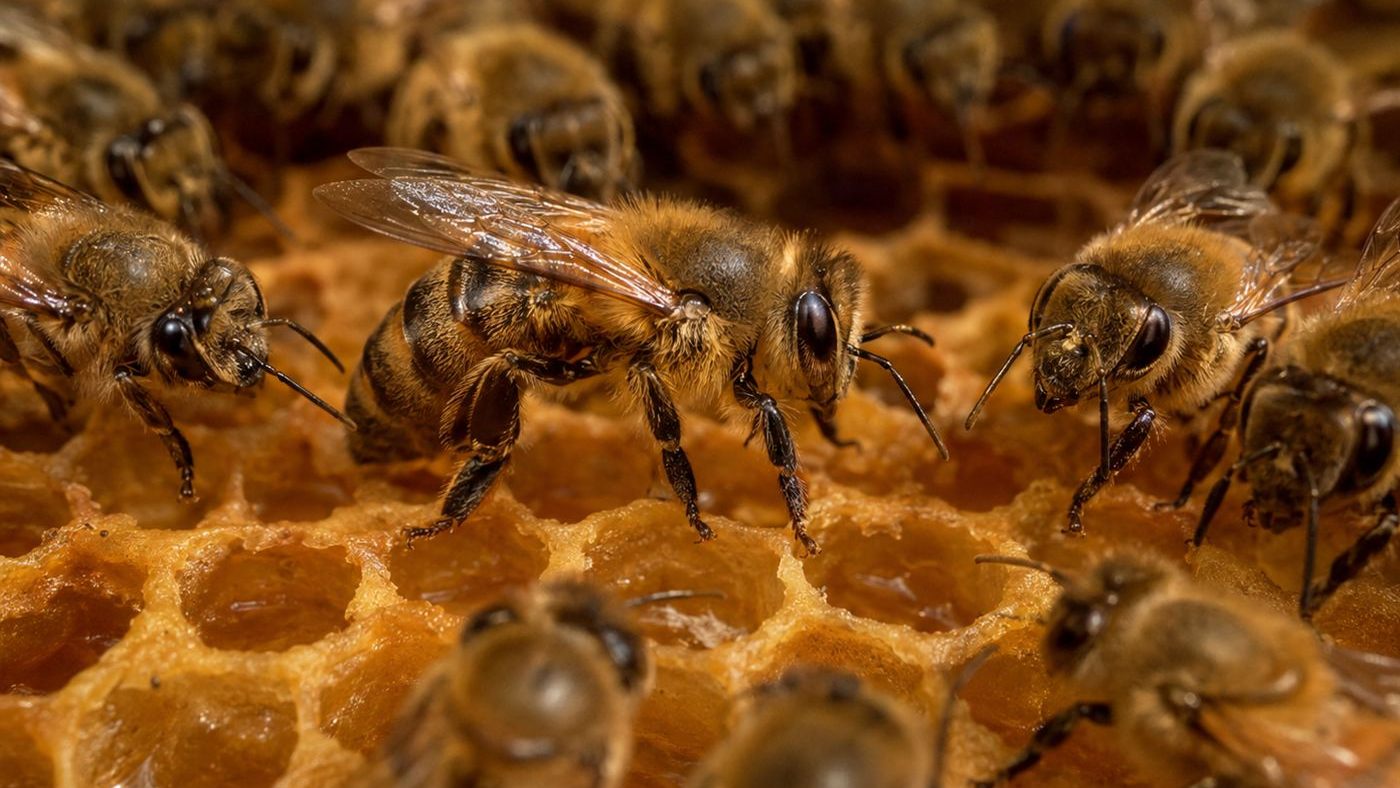
A forager dances on the comb while others read the message. Illustration: Watts & Wild.
Think about what the bee is actually doing. It has flown perhaps a couple of kilometres to a flower, navigated back to a hive the size of a box, and now needs to tell hundreds of sisters where to go, in the dark, without a map, a word or a pointing finger. It cannot lead them all there one by one. So instead it encodes the whole journey, direction and distance, into a little dance on the vertical wall of honeycomb, and the others read it with their antennae and bodies pressed close.
For most of history nobody knew this. Beekeepers saw the bees milling and shaking but assumed it was meaningless jostling. It took one patient scientist, the Austrian naturalist Karl von Frisch, to realise the movement was a message and then to spend decades cracking the code.
How the waggle dance points to flowers
The dance is a flattened figure-eight. The important part is the straight middle run, where the bee waggles its abdomen rapidly from side to side. The genius is in how it encodes direction. The hive comb hangs vertically, in darkness, so there is no way to simply point toward the sun. Instead, the bee uses gravity as a stand-in for the sun.
If the food lies straight toward the sun, the bee waggles straight up. If the food is, say, sixty degrees to the right of the sun, the bee runs sixty degrees to the right of vertical. As the Nobel Prize record notes, von Frisch was honoured in 1973 for decoding exactly this, the way bees translate the direction of food into the angle of their dance. The bee even adjusts the angle through the day as the sun moves across the sky, so the message stays accurate hours later.
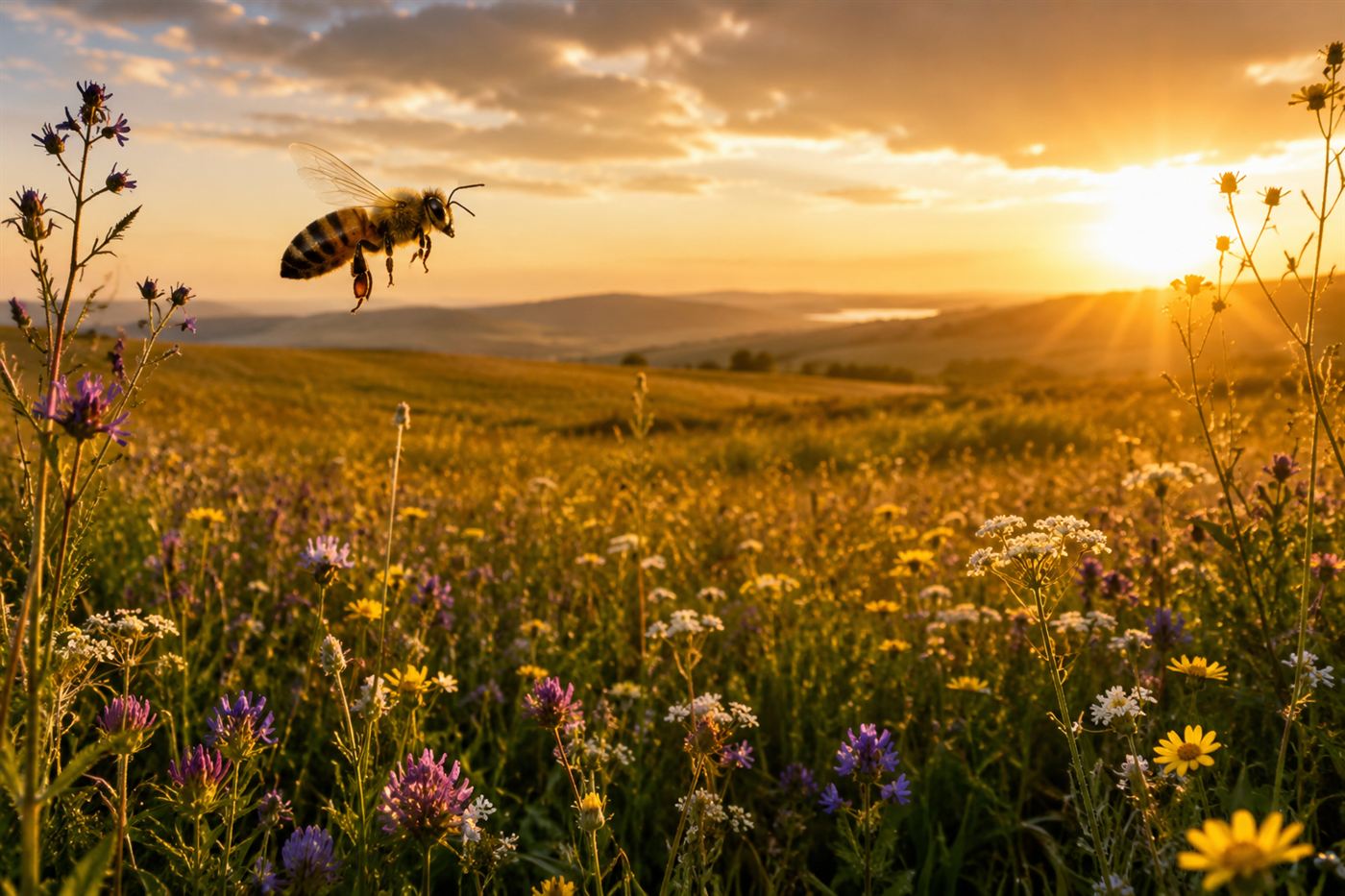
How does the waggle dance show distance?
Direction is only half the message. The bee also has to say how far to fly, and it does this with time. The longer it waggles during that straight run, the farther away the food is, very roughly on the order of a second of waggling for each kilometre, though the precise calibration differs between species of bee. A short, sharp waggle means a flower patch nearby; a long, drawn-out one means a serious journey.
Put the two together and you have a complete instruction: this far, in that direction. The watching bees gather the message, then fly out and find the flowers, often landing remarkably close to the target. A creature with a brain smaller than a grain of rice is sending and receiving spatial coordinates, which is the kind of thing that should not be possible and yet plainly is.
The man who learned to read bees
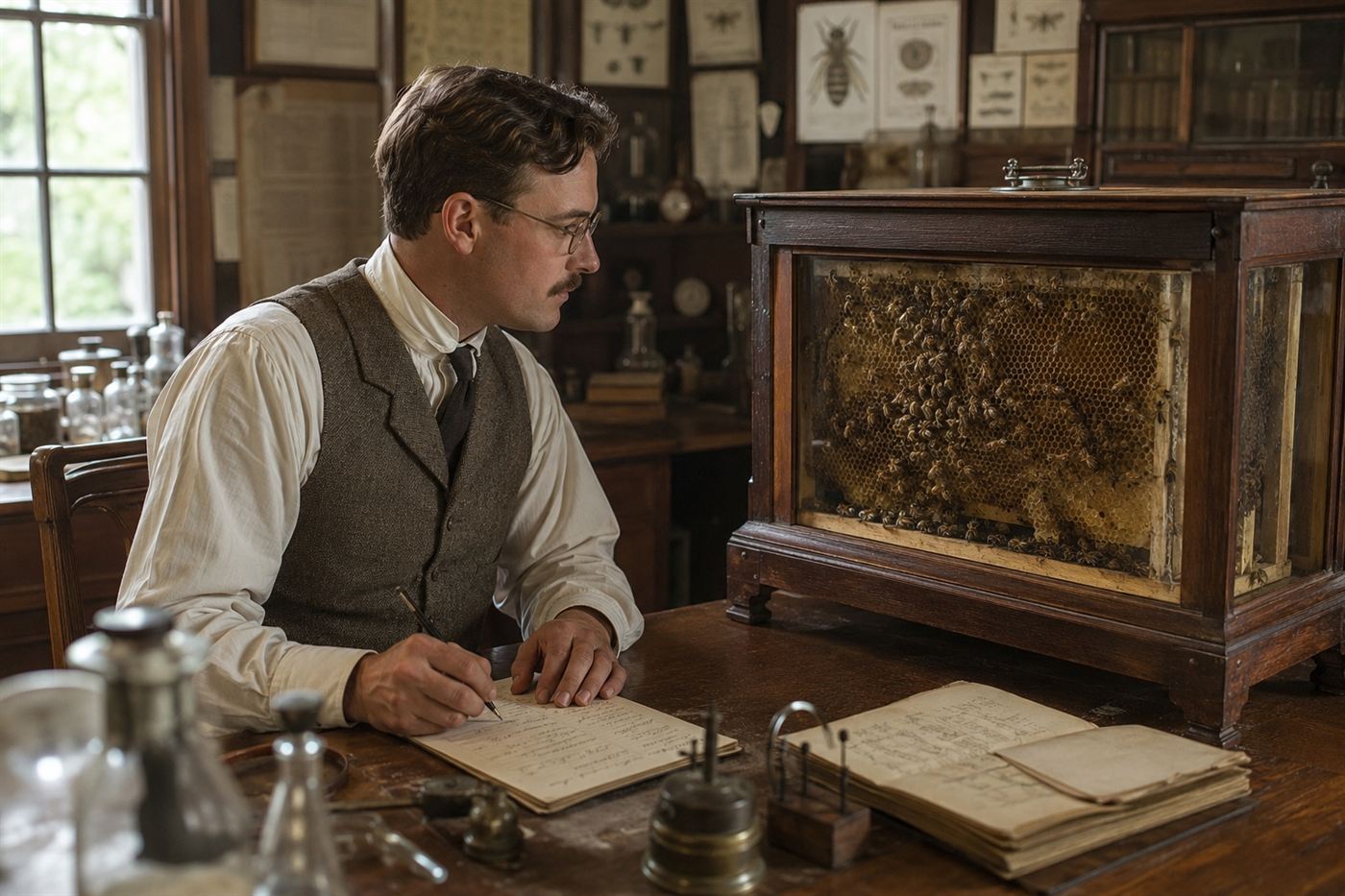
None of this would be known without Karl von Frisch, who treated the hive as a puzzle to be solved with patient experiment. He marked individual bees with dots of paint so he could follow them, set out feeding stations at known distances and directions, and watched, for years, how the dances changed. As the Linda Hall Library describes, his decades of meticulous work revealed that the dances carried real, decodable information, a claim so bold that many scientists at first refused to believe it.
He was eventually vindicated in the most satisfying way. As iGlobenews recounts, later researchers confirmed and extended his findings with modern experiments, including building tiny robotic bees that could "dance" and successfully send real bees to chosen spots. The insects obeyed the robot's directions, proving the dance really is the message. Von Frisch shared the 1973 Nobel Prize in medicine for the work.
The honest catch
A couple of careful qualifications are in order. Calling the dance a "language" is genuinely debated. It is an astonishing system for encoding and sharing information, but whether it deserves the full weight of the word language, with all that implies, is something biologists still argue about, and it is wise not to over-claim. The dance is a marvel without needing to be made human.
It is also not the bees' only tool. Many foragers ignore the dance entirely and rely on scent and memory to find food, and for years one school of thought, led by the biologist Adrian Wenner, argued that smell, not dancing, was really guiding the bees. That dispute was eventually settled in von Frisch's favour, but it is a useful reminder that the dance is one channel among several, not a magic remote control for the hive.
Why a dancing bee still matters
The waggle dance matters because it quietly dismantles the idea that abstract communication is something only big-brained animals do. A honeybee, with a nervous system we could once have dismissed as simple, performs a feat of symbolic translation, turning the position of the sun into a dance read by touch in total darkness, that we struggled for decades even to understand.
It should make us humble about how much is going on in the small lives around us. Does it change how you see a bee to know it can tell its sisters the way to a flower a mile off? Tell us in the comments.
Related reading: In Africa, a wild bird and a honey hunter call back and forth and team up to raid a beehive, a partnership no one taught either of them. See also how bumblebees spontaneously cracked a puzzle built to test the intelligence of chimpanzees.