African farmers kept losing whole harvests to elephants overnight, until a biologist found the six-tonne giants flee from honey bees and ringed the fields with beehive fences
For years across rural Africa, a single elephant could erase a family's entire harvest in one night, and frightened farmers sometimes shot the raiders. Then a biologist named Lucy King followed an old herders' hunch about bees, and the beehive fences for elephants she built from it are now spreading across nineteen countries.
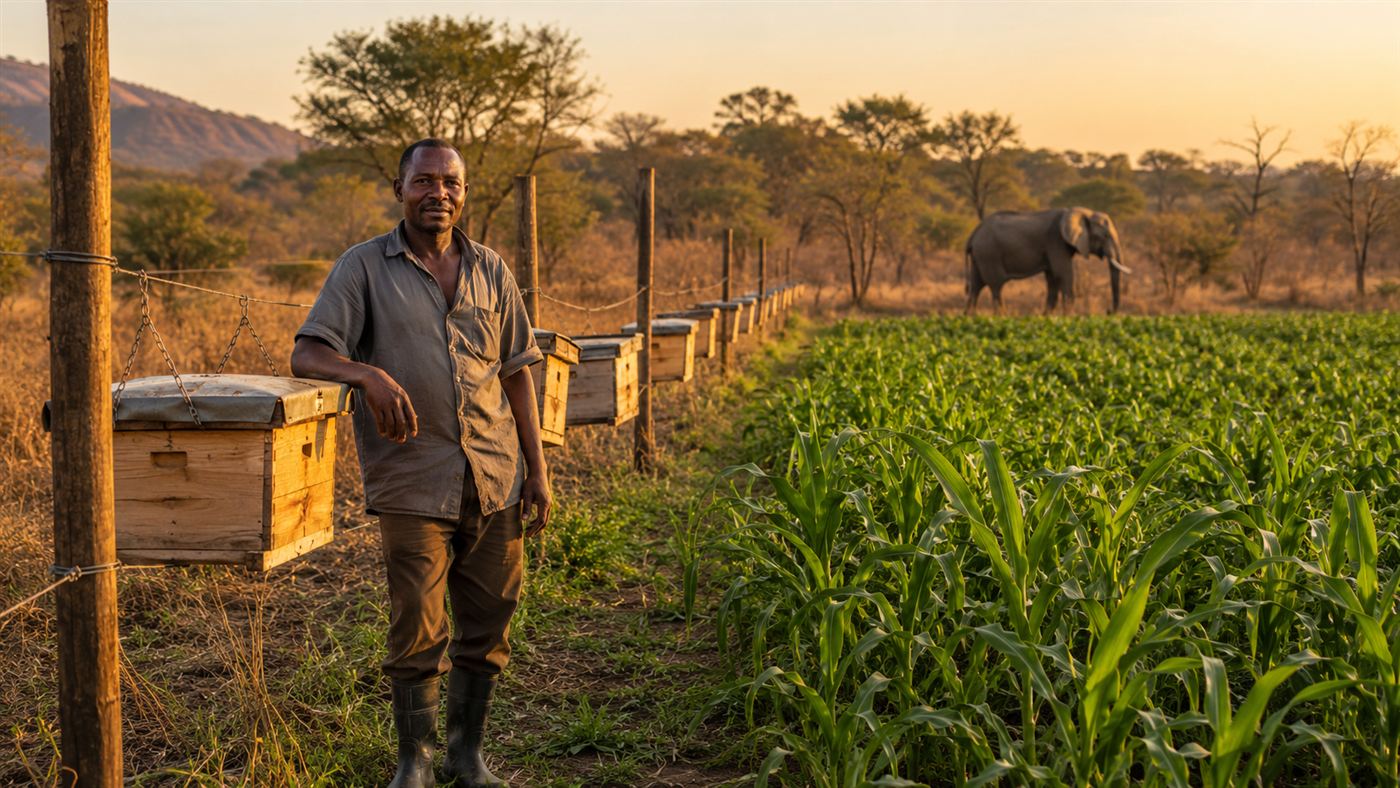
A beehive fence guards a small farm while a wild elephant keeps its distance. Illustration: Watts & Wild.
Picture a small farm at the edge of an African national park. A family weeds and waters it for months, watching the maize ripen, and then in a single night a herd of elephants walks in and flattens the whole field before sunrise. For people who live alongside Africa's elephants this is not a freak event but a regular season, and for generations the only defences were a sleepless night of shouting and firecrackers, or a gun.
A biologist named Dr Lucy King, who works with Save the Elephants and the University of Oxford, spent years on a far stranger defence, and in October 2024 a nine-year field study published in the journal Conservation Science and Practice, reported by the University of Oxford, finally measured how well it works. Her fences carry no wire and no current. They are made of bees.
The night an elephant empties a year
The arithmetic of crop-raiding is brutal for a smallholder.
A bull African elephant can weigh six tonnes and eat hundreds of kilograms of vegetation a day, and a field of ripe maize is an easy, concentrated meal.
One herd can wipe out a season's income, the family's food, and its school fees in a matter of hours.
When that happens often enough patience runs out, and farmers retaliate by spearing, poisoning or shooting the animals that ruin them.
It is a fight nobody wins: people are hurt and killed defending their fields, and elephants, already squeezed by poaching and shrinking habitat, die for the crime of eating a crop.
An old herders' hunch
The breakthrough did not begin in a laboratory.
While studying for her PhD in northern Kenya, King asked local pastoralists what kept elephants off their land, and as One Earth recounts, they told her something researchers had overlooked: elephants avoid trees that hold wild beehives.
It chimed with an earlier observation by Oxford scientists that acacia trees with bees nesting in them took less damage from elephants than trees without.
King decided to test whether the giants were genuinely frightened of something so small.
The giant that runs from a bee
The answer was emphatic.
When she played recordings of angry, buzzing bees through a hidden speaker near resting elephants, the animals turned and hurried away, often rumbling and shaking their heads as they went.
An elephant's hide is thick, but the soft tissue around its eyes, behind its ears and inside the tip of its trunk is not, and a swarm aiming for those places is genuinely dangerous to it.
King later found that elephants even make a specific low alarm call when they hear bees, a warning that sets the whole herd moving.
In other words, the largest land animal on Earth carries a real and useful fear of an insect that weighs almost nothing.
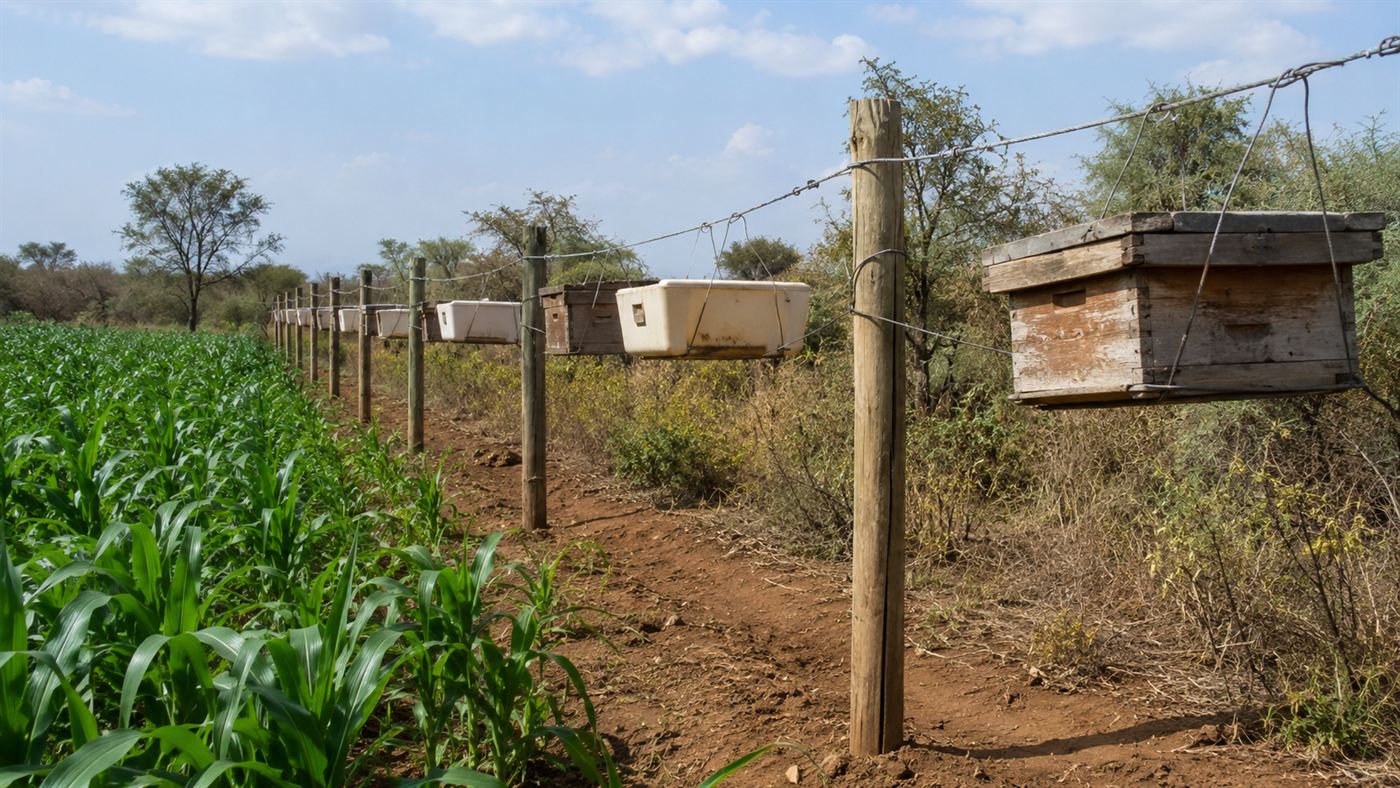
Beehive fences for elephants, built from fear
From that fear King built something almost absurdly simple.
As Save the Elephants describes it, a beehive fence rings a field with hives hung from wires strung between posts, with dummy hives in the gaps to keep the cost down.
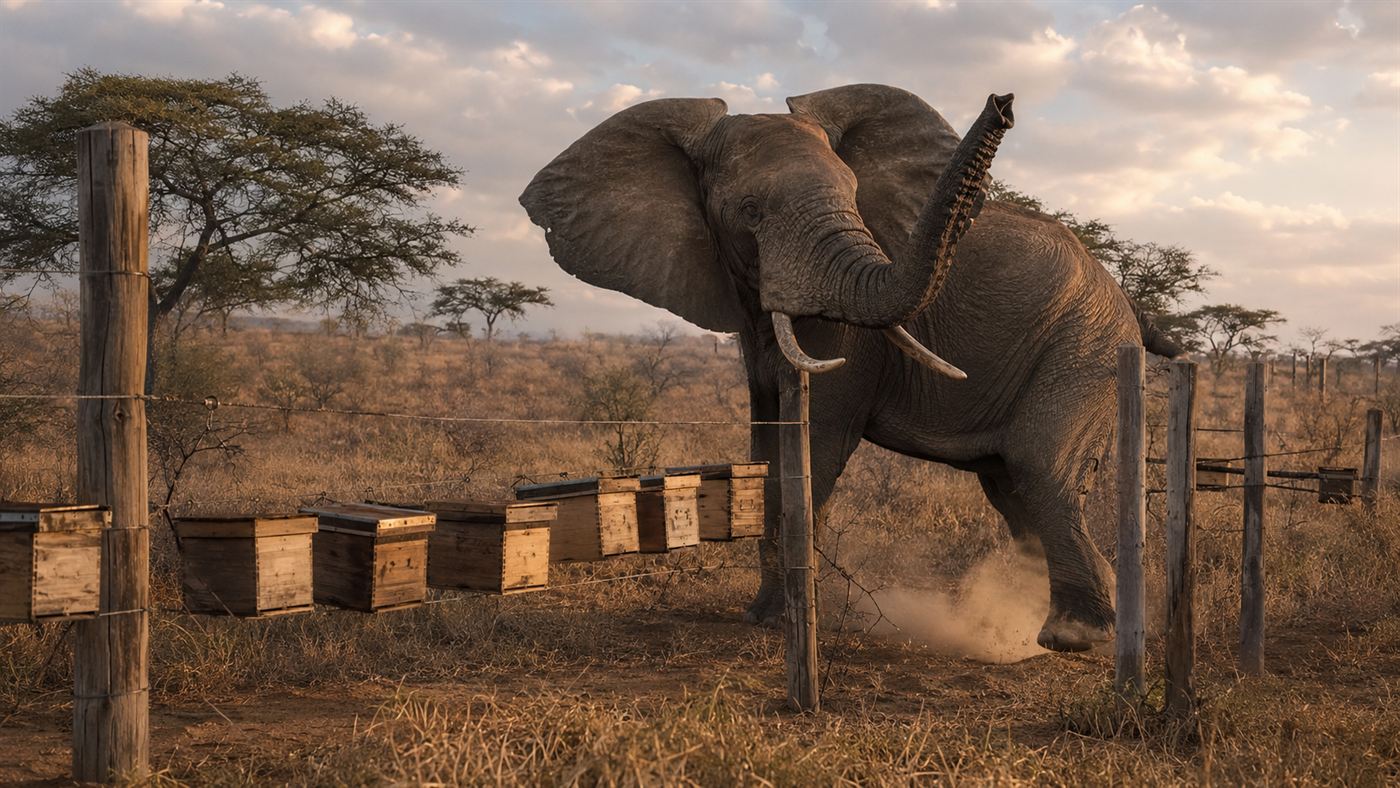
The hives are linked, so when an elephant pushes against the wire the whole line swings and the bees pour out.
A typical one-acre plot is protected by around twelve working hives and twelve dummies, built from local materials at a price a rural family can manage.
There is no electricity, no steel and nothing to import, just a living wall that defends itself.
Nine years of proof
The idea is charming, but charm is not evidence, which is why the long study matters.
Working with a community of farmers at Sagalla, beside Kenya's Tsavo East National Park, King's team tracked nearly 4,000 elephant approaches to bee-fenced farms over nine years.
The fences turned back an average of 76% of elephants across all seasons, and 86% during the peak months when ripe crops are most tempting.
"Beehive fences are very effective at reducing up to 86.3% of elephant raids when the crops in the farms are at their most attractive," King said of the results.
It is one of the most thoroughly measured non-lethal elephant deterrents anywhere in the world.
Honey instead of a gun
The cleverest part is what the fence gives back.
The same bees that scare the elephants pollinate the crops and fill the hives, and the farmers harvest and sell the result as "elephant-friendly honey".
During the study the Sagalla hives produced about a tonne of honey, turning a defence into a small business.
An animal that used to mean nothing but ruin becomes, oddly, a reason to keep bees and earn a little more.
That flip, from elephant as enemy to elephant as the neighbour your honey quietly depends on, is the whole point of the project.
From two fences to nineteen countries
What began as a couple of experimental fences has travelled a long way.
Save the Elephants now counts beehive-fence projects at more than 60 human-elephant conflict sites across about 19 countries in Africa and Asia.
In 2025 the idea reached a new scale when the Butterfly Pavilion and the Tanzanian Elephant Foundation finished what they call Africa's longest bee fence, more than six kilometres of hives wrapped around the village of Kisiwani on the edge of Tanzania's Mkomazi National Park.
King's work has been recognised with the Future for Nature Award and a string of other honours, and her TED talk has carried the idea to millions.
The honest catch
None of this makes the beehive fence a magic wall, and King is careful to say so.
A very hungry elephant, or a determined old bull, will sometimes take the stings and push through anyway.
The bees themselves are fragile: a drought in 2017 emptied about three-quarters of the hives at Sagalla, and honey income stayed depressed for three years afterwards.
"Our results also warn that increased habitat disturbance or more frequent droughts could reduce the effectiveness of this nature-based coexistence method," King cautioned.
The fences also need real upkeep, since the bees must be tended and the hives kept occupied, and each one guards a single field rather than a whole landscape.
They are a tool for living alongside elephants, then, not a cure for everything that threatens them.
For a farmer who once faced the elephants with nothing but a torch and a prayer, a fence that defends itself and pays in honey is close to miraculous.
It is a reminder that the best answer to a very big problem is sometimes the smallest one.
Would you trust a line of beehives to hold back a six-tonne elephant, or would you still want a stronger fence around your fields? Tell us what you think in the comments.
Related reading: Sea otters were hunted almost to extinction, and bringing them back turned out to be the key to saving entire underwater forests.

Maria Heloisa Barbosa Borges covers energy, heavy industry and the natural world for Watts & Wild, with an eye for the people caught where engineering meets the wild.