As the premier prepared to open the Sydney Harbour Bridge in 1932, a man in uniform rode out of the crowd on a horse and slashed the ribbon with a cavalry sword first
It took eight years, thousands of workers, and a nation's pride to build the Sydney Harbour Bridge. It took one furious man on a borrowed horse to hijack the moment it opened. The story of the Coathanger is half engineering triumph, half political pantomime.
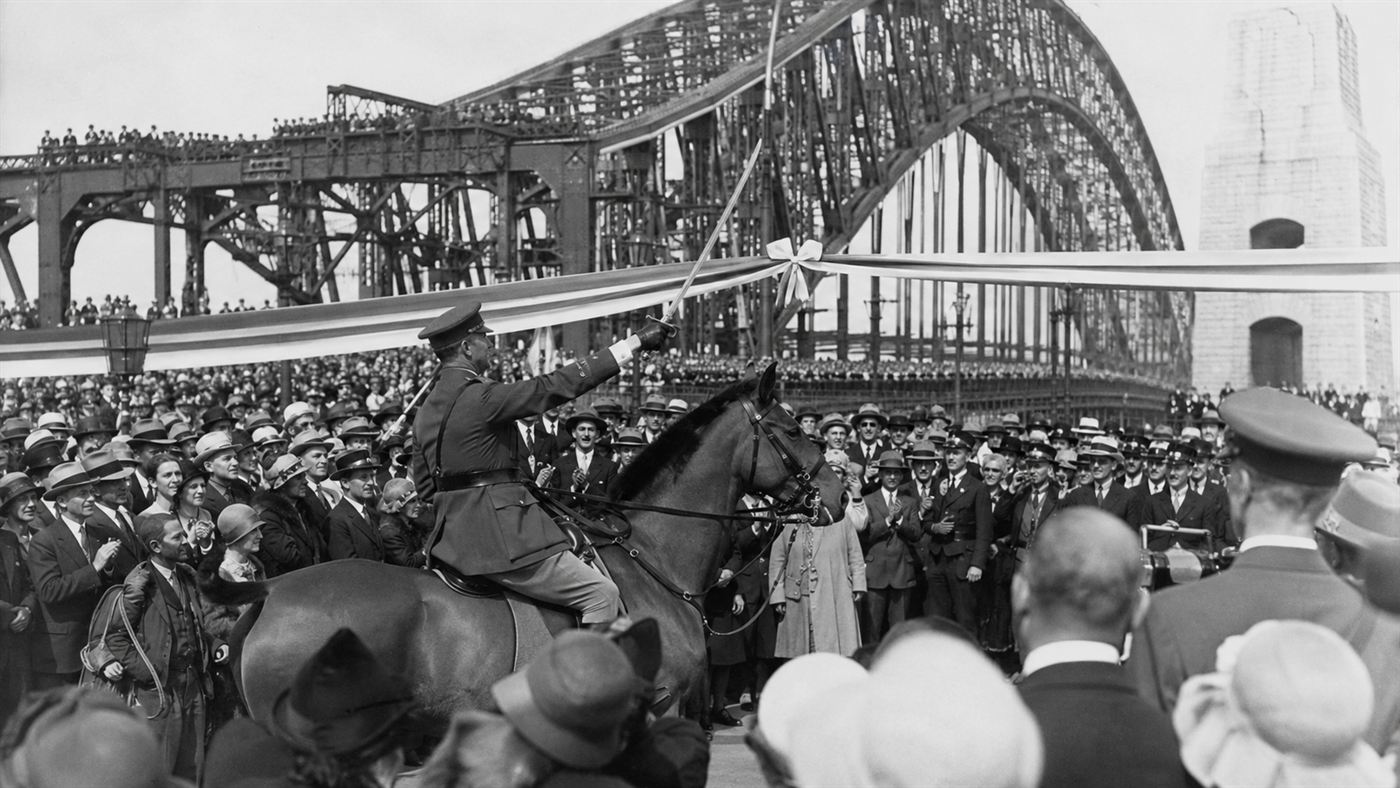
The most famous moment of the Sydney Harbour Bridge's opening was not the premier's speech, but a stranger on a horse with a sword. Illustration: Watts & Wild.
The Sydney Harbour Bridge is one of the most recognisable structures on Earth, a single soaring steel arch that has come to stand for an entire country. When it opened on 19 March 1932, it was among the greatest engineering feats of its age, built across one of the world's finest harbours in the teeth of an economic catastrophe. And yet the thing everyone remembers about that day is a man on a horse making a fool of the premier.
That collision of grand engineering and farce is what makes the story so good. The bridge is a monument to careful, patient, dangerous work by thousands of people, while its opening became a piece of pure political theatre that nobody in charge had scripted. Both halves are true, and you cannot really tell one without the other.
The Sydney Harbour Bridge, nicknamed the Coathanger, opened in 1932 after eight years of construction through the Great Depression under engineer John Bradfield. At the ceremony, Francis de Groot rode a horse out of the crowd and slashed the ribbon with a cavalry sword before the premier could cut it, the most notorious opening of any great bridge.
The Sydney Harbour Bridge that John Bradfield willed into being
The driving force behind the Sydney Harbour Bridge was an engineer named John Bradfield, who spent much of his career arguing that Sydney needed to link its two shores and planning how to do it. He shaped the vision, championed the design, and oversaw the build so completely that he is widely called the father of the bridge. The detailed engineering was carried out by the British firm Dorman Long of Middlesbrough, whose consulting engineer Ralph Freeman worked out much of how the great arch would actually stand.
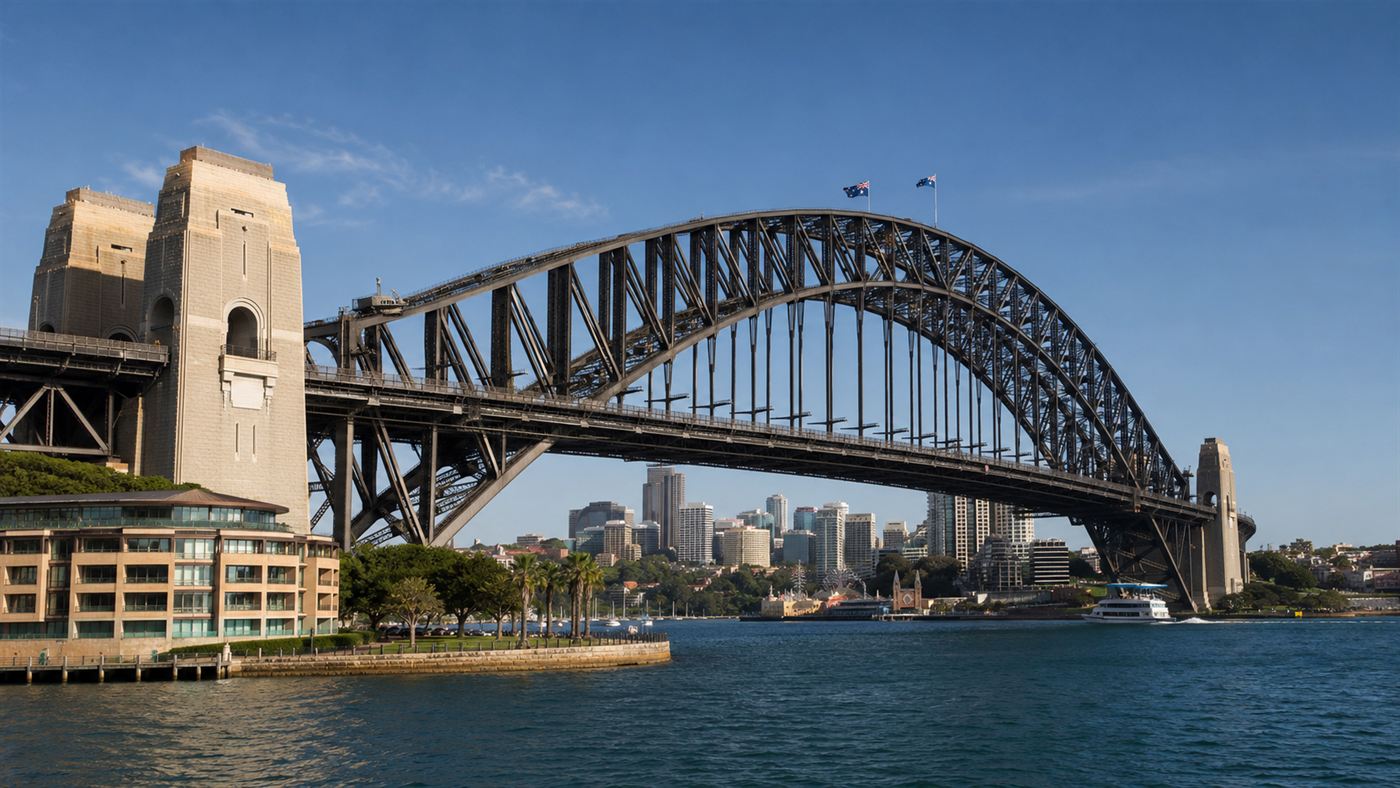
The design they settled on was a single steel arch, and a huge one: the span stretches 503 metres and the top of the arch stands 134 metres above the water. From a distance the road deck hangs beneath that curve in a way that quickly earned the bridge its enduring nickname, the Coathanger. The credit, as with many great structures, is genuinely shared, even if John Bradfield's name is the one Sydney remembers.
Building the Coathanger through the Great Depression
Construction ran from 1924 to 1932, which means most of it happened as the Great Depression tightened its grip on the world. That timing turned the bridge into something more than infrastructure. While the Great Depression wrecked the economy, banks failed and unemployment soared, and the project kept roughly 1,400 people in work, and the steady wage of a bridge job was a lifeline for the families lucky enough to get one.
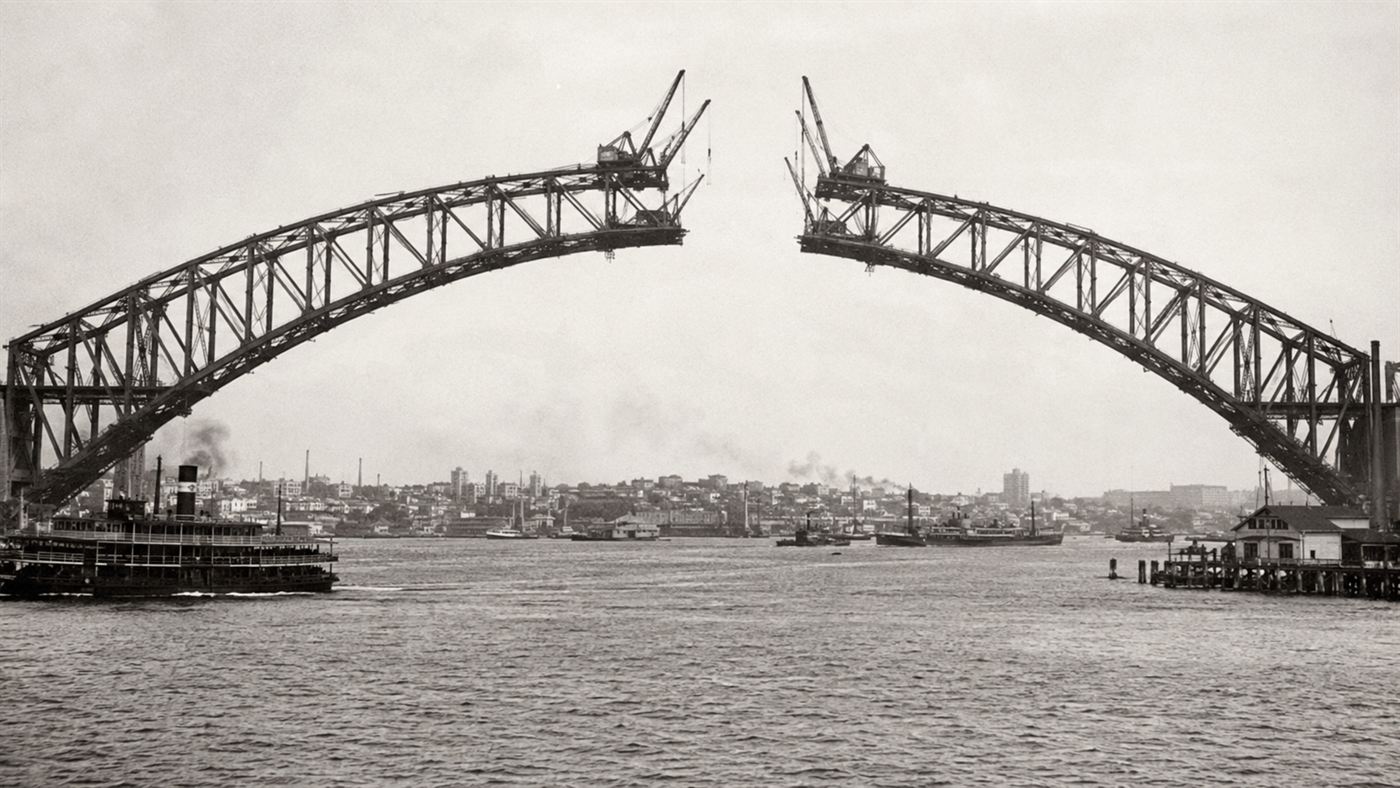
The engineering was audacious. The two halves of the arch were built outward from each shore as cantilevers, each held back by huge steel cables anchored in tunnels dug into the rock, reaching toward each other over the water with nothing connecting them until they finally met in 1930. It was assembled from steel and roughly six million rivets, much of it by men working at terrifying heights with little of the safety equipment a modern site demands, much like the briggers who built Scotland's Forth Bridge a generation earlier.
The day Francis de Groot stole the show
By opening day in 1932 the Sydney Harbour Bridge was a source of enormous public pride, and a crowd estimated in the hundreds of thousands gathered to watch the Labor premier of New South Wales, Jack Lang, cut the ribbon. But Lang had bitter political enemies, among them a secretive far-right paramilitary movement called the New Guard, who were outraged that a left-wing premier rather than a royal would have the honour.
So one of them did something about it. Francis de Groot, a Dublin-born antiques dealer and New Guard member, put on a military-style uniform, joined the mounted soldiers near the front on a borrowed horse, and at the crucial moment spurred forward and slashed the ribbon with his cavalry sword, declaring the bridge open, as the National Museum of Australia records, "in the name of the decent and respectable citizens of New South Wales." It was an act of sheer audacity, and it instantly upstaged the entire official ceremony.
Francis de Groot was promptly pulled from his horse, arrested, and later fined a few pounds, while officials hurriedly knotted the ribbon back together so that Lang could cut it as planned. The premier got his moment, but history did not remember it. Nearly a century later, it is Francis de Groot and his sword, not the speeches, that every Australian schoolchild learns about, the man who turned the opening of a national icon into farce.
The lives the bridge cost and changed
Behind the spectacle was a real human price. Sixteen workers died during the construction of the Sydney Harbour Bridge, most in falls, in an era when the safety net was often quite literally absent. They are part of the bridge's story as much as any engineer, the men who riveted and painted and rigged steel a hundred metres above the harbour so that a city could cross it.
The bridge also kept shaping lives long after 1932. For decades a small army of workers has done nothing but paint it, since by the time they finish one end the other needs starting again, giving rise to the Australian saying about a job like "painting the Harbour Bridge." One of those riggers and painters in the 1960s was a young man named Paul Hogan, who would later become world famous as Crocodile Dundee. The Coathanger has a way of threading through the country's whole story.
The honest catch
A couple of the proud claims deserve a gentle check. The Sydney Harbour Bridge is often called the longest steel arch in the world, but it was narrowly beaten to that exact record by the Bayonne Bridge in New Jersey, which had opened a few months earlier; Sydney's is the wider and heavier arch, but not quite the longest. And the romantic image of John Bradfield as sole genius glosses over Dorman Long and Ralph Freeman, whose detailed design made the thing buildable.
It is also worth not turning Francis de Groot into a lovable rogue. He was a member of an anti-democratic, ultra-nationalist movement that fantasised about overthrowing an elected government, and his stunt was political intimidation dressed up as theatre, however absurd it looks now. None of that diminishes the bridge itself. Built by thousands through the Great Depression, paid for in sweat and sixteen lives, the Coathanger has carried a city for nearly a hundred years, and it will be standing long after the sword is forgotten.
A nation built a masterpiece for eight years, and one man on a horse stole its big day in a single swing of a sword. Was de Groot's stunt a harmless prank or something more sinister dressed up as comedy? Tell us in the comments.
Related reading: The architect of the Gateway Arch died before it was built, and on the final day the two legs almost did not meet, or the Leaning Tower of Pisa, saved from collapse by engineers who dug out its high side.