When the final piece of the Gateway Arch would not fit, St. Louis firefighters hosed one leg with cold water to shrink it while jacks forced the gap open
The Gateway Arch in St. Louis is a 630-foot curve of stainless steel built in two halves that had to meet, perfectly, at the top. On the day they joined them in 1965, the final keystone would not fit, and saving the project came down to fire hoses, hydraulic jacks and the morning sun.
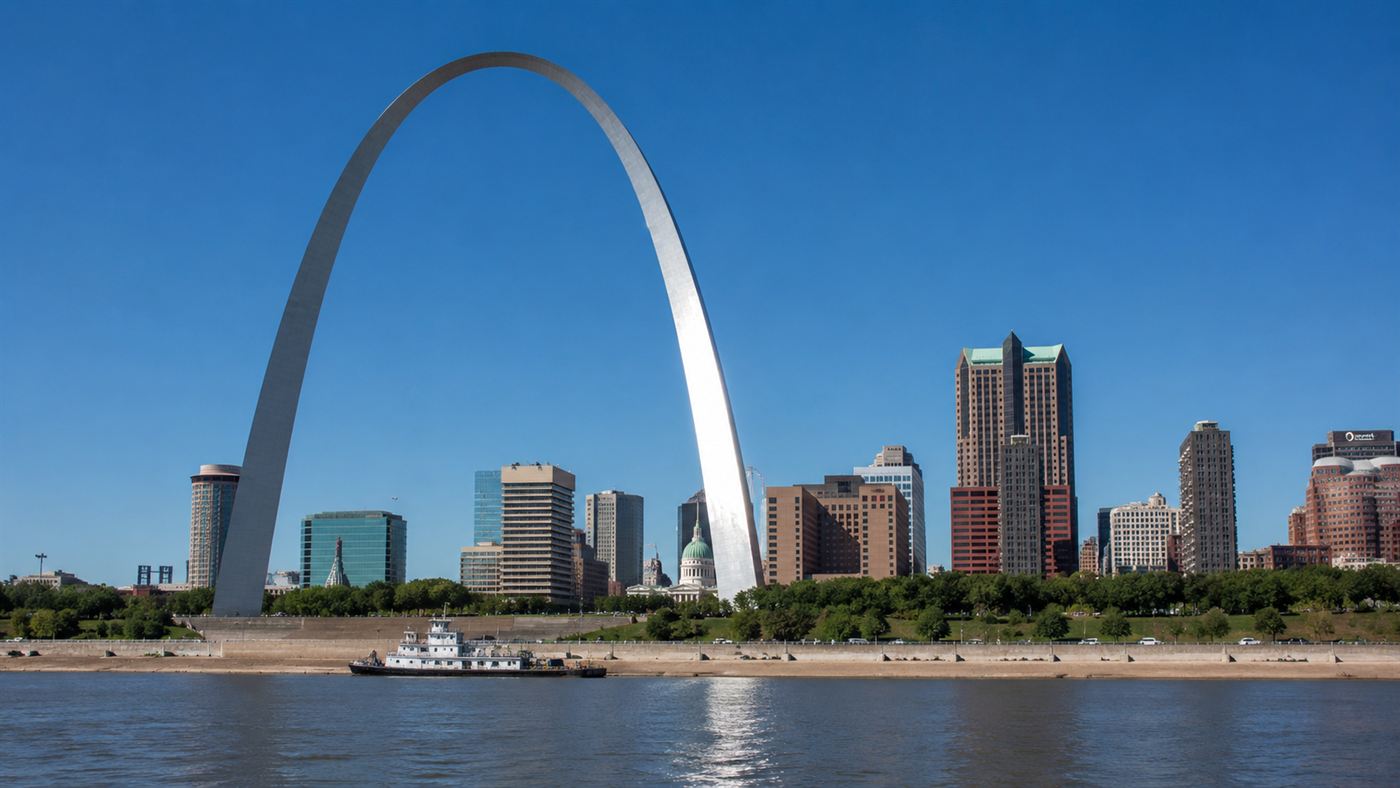
The Gateway Arch, a 630-foot stainless-steel curve built as two legs that had to meet at the top. Illustration: Watts & Wild.
The Gateway Arch should not really work, and on its final day it nearly didn't. The shining 630-foot arch over St. Louis was raised as two separate legs, each a hollow triangle of stainless steel climbing toward the sky and leaning gradually toward the other. The plan was for them to meet at the very top, where a last triangular section, the keystone, would drop into the gap and lock the whole structure together. The catch was that the two legs had to line up almost perfectly, within a margin measured in fractions of an inch, the same nerve-racking meeting-in-the-middle that built the arch of the Sydney Harbour Bridge.
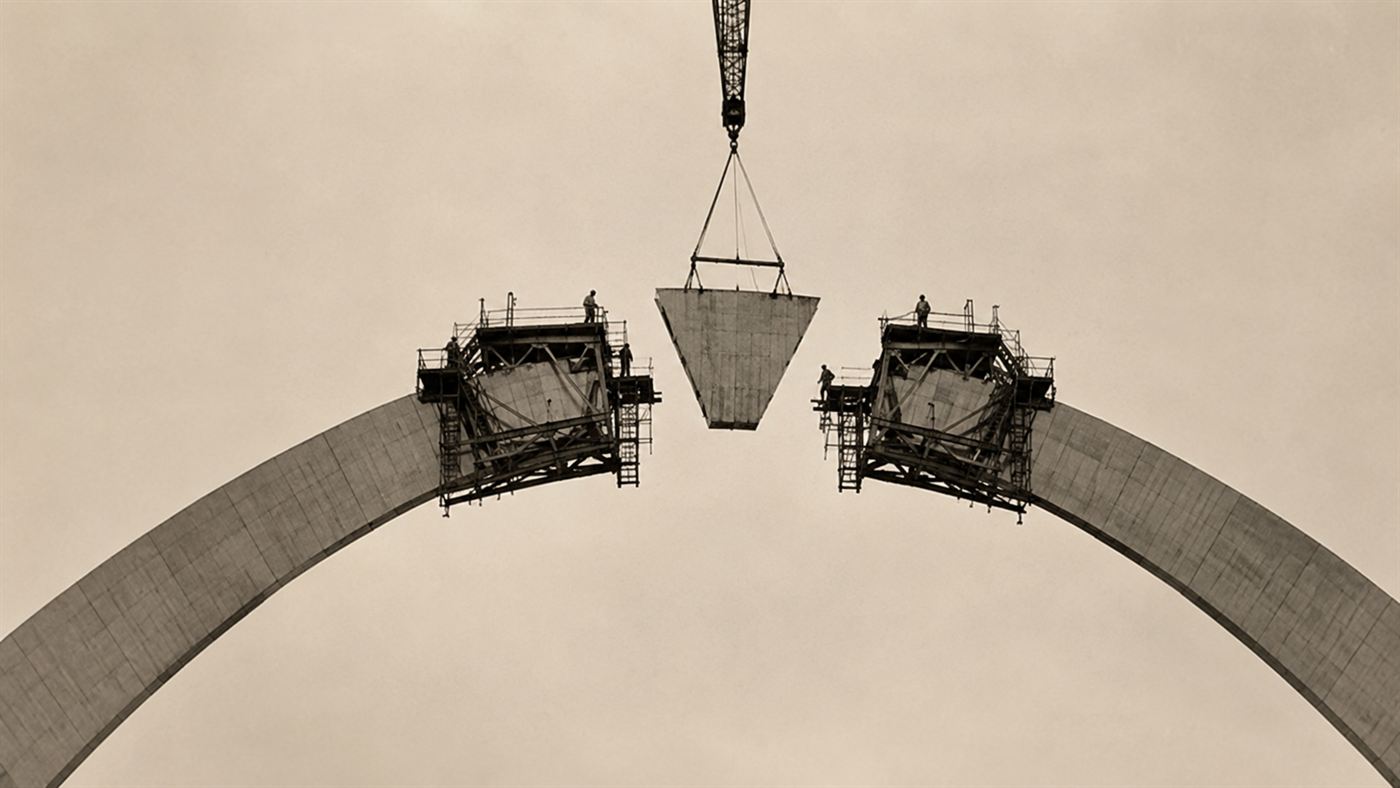
On the morning of October 28, 1965, the ten-ton keystone, with a time capsule of 762,000 signatures welded inside it, was hoisted to the top, and the gap waiting for it was too small. As the St. Louis station KSDK has recounted, the early sun had warmed the south leg, and the heated steel had expanded just enough to close the opening by about five inches. A monument years in the making was suddenly stuck, hundreds of feet up, because of the temperature of the morning.
How was the Gateway Arch finished? When the final keystone would not fit because the sun had warmed and expanded one leg, the St. Louis fire department sprayed that leg with water to cool and shrink it, while hydraulic jacks pushed the two legs apart to widen the gap. The keystone was then lowered into place in 1965.
How the Gateway Arch was built blind
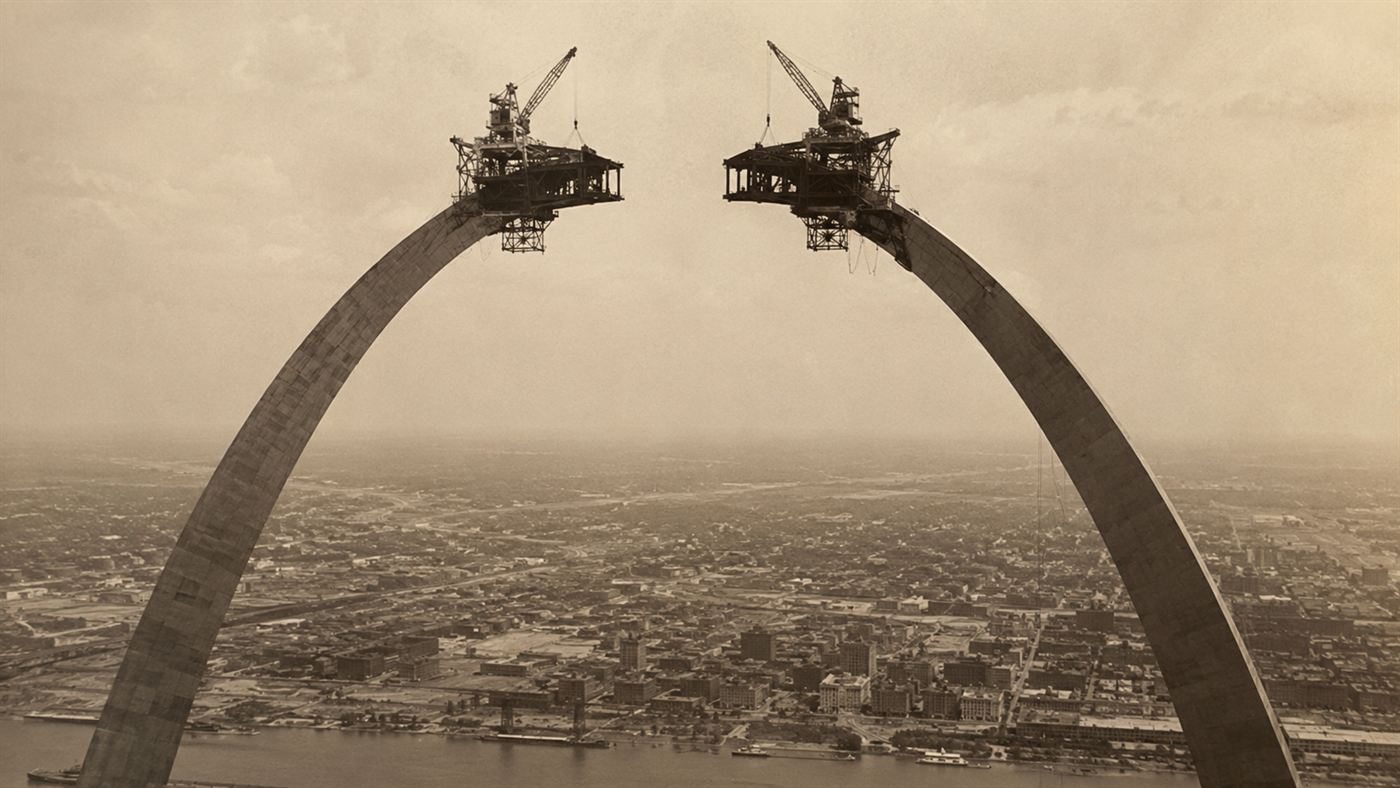
What makes the Gateway Arch so hard to build is that it has no straightforward way to hold itself up while it is going up. There was no internal scaffolding tall enough; instead, each leg was assembled section by section by a special creeper crane that climbed the leg as it rose, laying the next stainless-steel triangle on top of the last. Both legs grew this way, curving inward, with nothing connecting them until the very end.
That meant the entire project was a bet on precision. If the two halves drifted out of alignment by even a small amount as they climbed, the keystone at the summit would never fit. Engineers held the legs to tolerances of around a sixty-fourth of an inch, an almost absurd level of accuracy for a structure the height of a sixty-story building, knowing that the moment of truth would come only once, when the two arms finally reached for each other in the sky.
The morning the keystone wouldn't fit
When that moment arrived, physics nearly spoiled it. Steel expands as it warms, and on a sunny October morning the St. Louis sun fell on the south leg of the arch and heated it more than the shaded north leg, swelling the metal and squeezing the gap at the top shut by those crucial inches. The keystone, machined to fit a colder, narrower opening, simply would not go in.
The fix was beautifully low-tech against such a high-tech problem. The city fire department ran hoses up the south leg and sprayed it with water to cool the steel and make it contract, while crews drove 700-ton hydraulic jacks into the gap to force the two legs apart. Inch by inch the opening widened, the cooled leg shrank back, and the ten-ton keystone was lowered into place, as the Vice President watched from a helicopter circling overhead. The Gateway Arch was complete.
The architect who never saw it
There is a sad shadow over the triumph. The arch was the vision of the Finnish-American architect Eero Saarinen, who won the design competition back in the late 1940s with the spare, soaring curve that everyone now recognises. He shaped it as a weighted catenary, the elegant line a hanging chain makes under its own weight, turned upside down, which is also the strongest possible form for an arch to take.
Saarinen never saw it built. He died of a brain tumour in 1961, aged just fifty-one, four years before the keystone went in and the structure he had drawn finally stood over the Mississippi. The Gateway Arch is among the most beloved monuments in the United States, and the man who imagined it down to its perfect curve did not live to watch a single leg rise.
The safety record nobody expected
For all the danger, the construction produced one number that still astonishes. Building a 630-foot arch with no top scaffolding, with ironworkers riding creeper cranes up the inside of the legs in the early 1960s, was expected to be deadly; the official projections assumed that around a dozen workers would lose their lives. In the end, not one did. Every worker who built the Gateway Arch went home, a safety record almost unheard of for a project of its height and audacity in that era.
The finished arch is as clever as its construction. The double-walled stainless-steel skin, filled with concrete in its lower reaches, lets it stand without internal columns, and a unique tram of small egg-shaped capsules carries visitors up the curving inside to an observation deck at the very top. It sways gently in strong wind, by design, a 630-foot ribbon of steel that bends rather than breaks.
The honest catch
It is fair to add the parts that the postcard view leaves out. The land the arch stands on was cleared in a sweeping urban-renewal demolition that erased dozens of blocks of historic St. Louis riverfront, a loss the gleaming monument quietly sits on top of. And as a symbol, the "Gateway to the West" celebrates an expansion that, for the Native peoples already living there, meant displacement and worse.
The keystone drama, too, has been polished a little in the retelling over sixty years, though the core of it, the sun-warmed leg, the fire hoses and the jacks, is solidly documented. None of that diminishes the engineering. The Gateway Arch remains a genuinely astonishing thing: two halves built blind toward each other, joined by cooling one with water on the morning it mattered most, and not a single life lost raising it.
Two arms of steel were built blind toward each other for years, and on the day they finally met, the only thing that let them join was a fire hose cooling one leg in the morning sun. Does knowing how close the Gateway Arch came to not fitting make it more impressive, or more nerve-wracking? Tell us what you think in the comments.
Related reading: The Japanese bridge that an earthquake stretched a metre longer while it was still being built.