The mast of the Millau Viaduct in southern France stands taller than the Eiffel Tower, carrying drivers across a valley so high they often cross above the clouds
The Millau Viaduct was built to cure a traffic jam. The result, strung across a French river valley on seven impossibly slender piers, is the tallest bridge humans have ever built, its highest mast rising above the Eiffel Tower and, on misty mornings, above the clouds themselves.
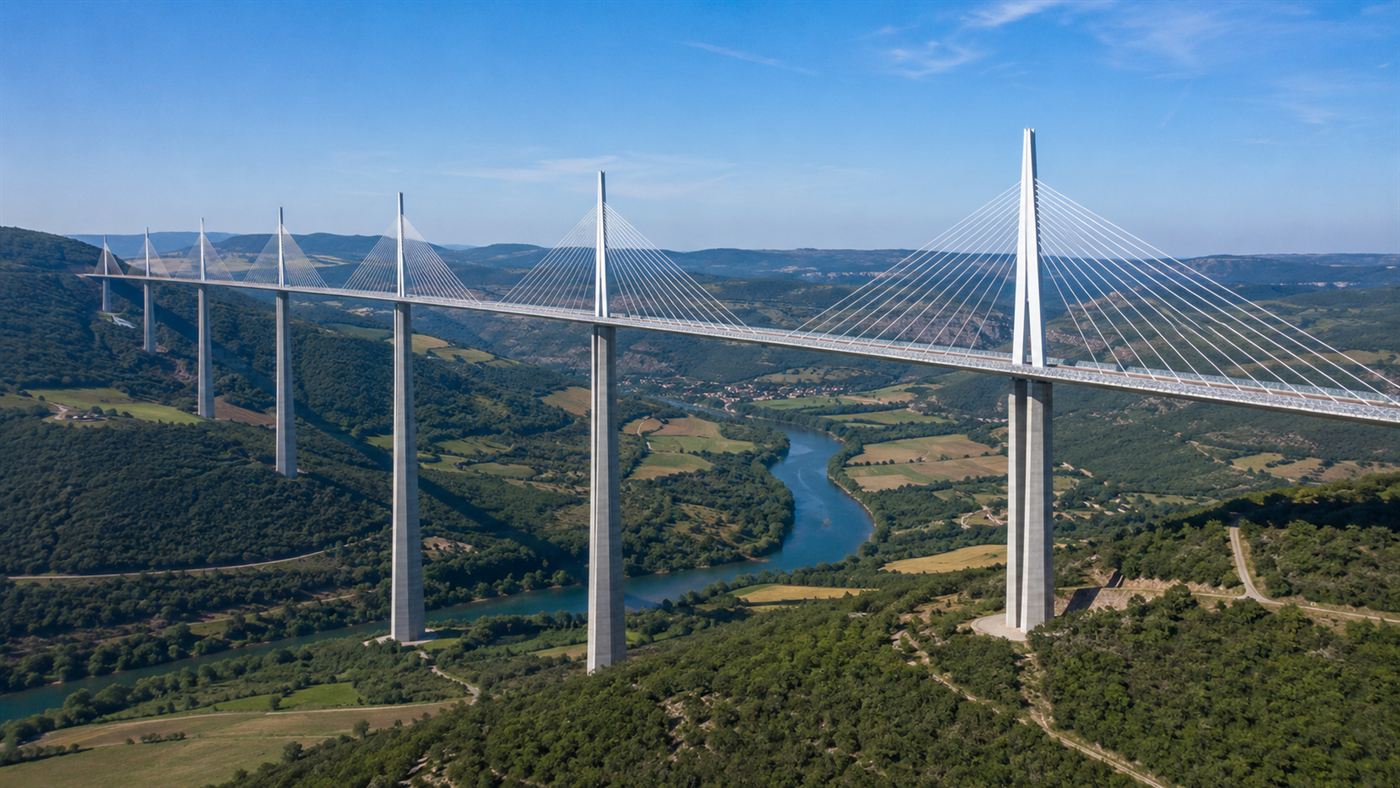
The Millau Viaduct crossing the Tarn valley in southern France. Illustration: Watts & Wild.
The Millau Viaduct does not look heavy enough to be real. Seen from the valley floor, it is a thread of white road laid across the sky on a row of pale, tapering towers, so slim that the eye keeps insisting they could not possibly hold up a motorway. Yet they do, and they have done so since 2004, carrying tens of thousands of vehicles a day across a gap in the hills of southern France that for decades had been one of the worst bottlenecks in the country.
It is the tallest bridge ever built. As the Institution of Civil Engineers records, the top of its tallest mast reaches 343 metres above the river, which makes it taller than the Eiffel Tower, and its deck stretches 2,460 metres from one side of the Tarn valley to the other. What is strange about it is not just the scale but the reason for it. Nobody set out to build a record. They set out to fix a traffic jam.
How tall is the Millau Viaduct? The Millau Viaduct in southern France rises 343 metres at the top of its tallest mast, making it taller than the Eiffel Tower and, for two decades, the tallest bridge in the world. Its deck runs 2,460 metres across the Tarn valley on seven slender piers.
A small town drowning in traffic
For most of the twentieth century, anyone driving from Paris towards the Mediterranean or Spain had to pass through the town of Millau. The main road funnelled holiday traffic down into the valley, across the Tarn, and back up the other side, and in July and August the result was misery: queues that stretched for kilometres, engines idling in the heat, a small medieval town choked every summer by cars that did not want to be there at all.
The fix that planners kept returning to was audacious. Rather than wind the motorway down into the valley and back out, they would carry it straight across the top, on a bridge so high it would clear the river by the height of a skyscraper. The idea sat on drawing boards for years before anyone believed it could actually be built.
The Millau Viaduct, taller than the Eiffel Tower
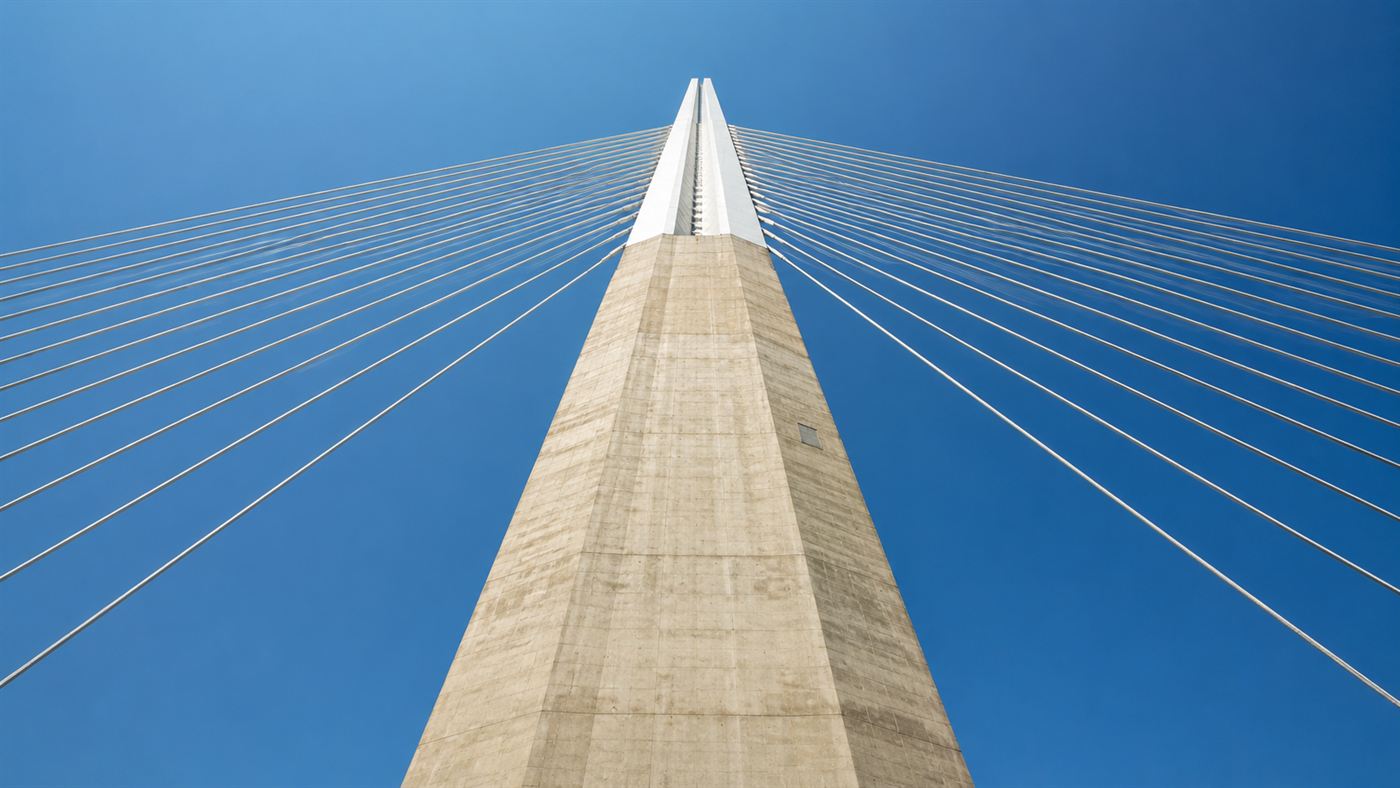
The Millau Viaduct that finally rose over the valley was the work of two people in particular: the French engineer Michel Virlogeux, who had spent much of his career on great bridges and who conceived its structure, and the British architect Norman Foster, who gave it its form. Together they produced something that reads less like infrastructure than like a drawing. Seven concrete piers climb out of the valley, the tallest of them rising higher than almost any structure in France, and from each one a single mast and a fan of steel cables hold up a thin, slightly curved roadway that Foster compared to the deck of a yacht.
The numbers are quietly staggering. The deck runs nearly two and a half kilometres. The tallest pier and mast together reach 343 metres, comfortably above the Eiffel Tower. And yet from a distance the whole thing looks weightless, because every part of it was shaped to use as little material as the physics would allow. It is, by structural height, the tallest bridge ever raised by human beings.
Building out over the void
Putting a road across a valley that deep is not a thing you can do with scaffolding. So the engineers built the deck on solid ground at each end of the crossing, on the plateaus above the Tarn valley, and then pushed it out over the piers, a few metres at a time, with hydraulic rams. Two long sections of steel roadway crept towards each other across hundreds of metres of empty air, guided by temporary towers, until they met in the middle almost exactly where the drawings said they would.
The whole crossing took about three years to build and cost in the region of 394 million euros. It was inaugurated in December 2004 and opened to traffic two days later. For a structure of its size and daring, it went up remarkably calmly, and it has carried its traffic ever since without the dramas that have dogged some far smaller bridges.
Crossing above the clouds
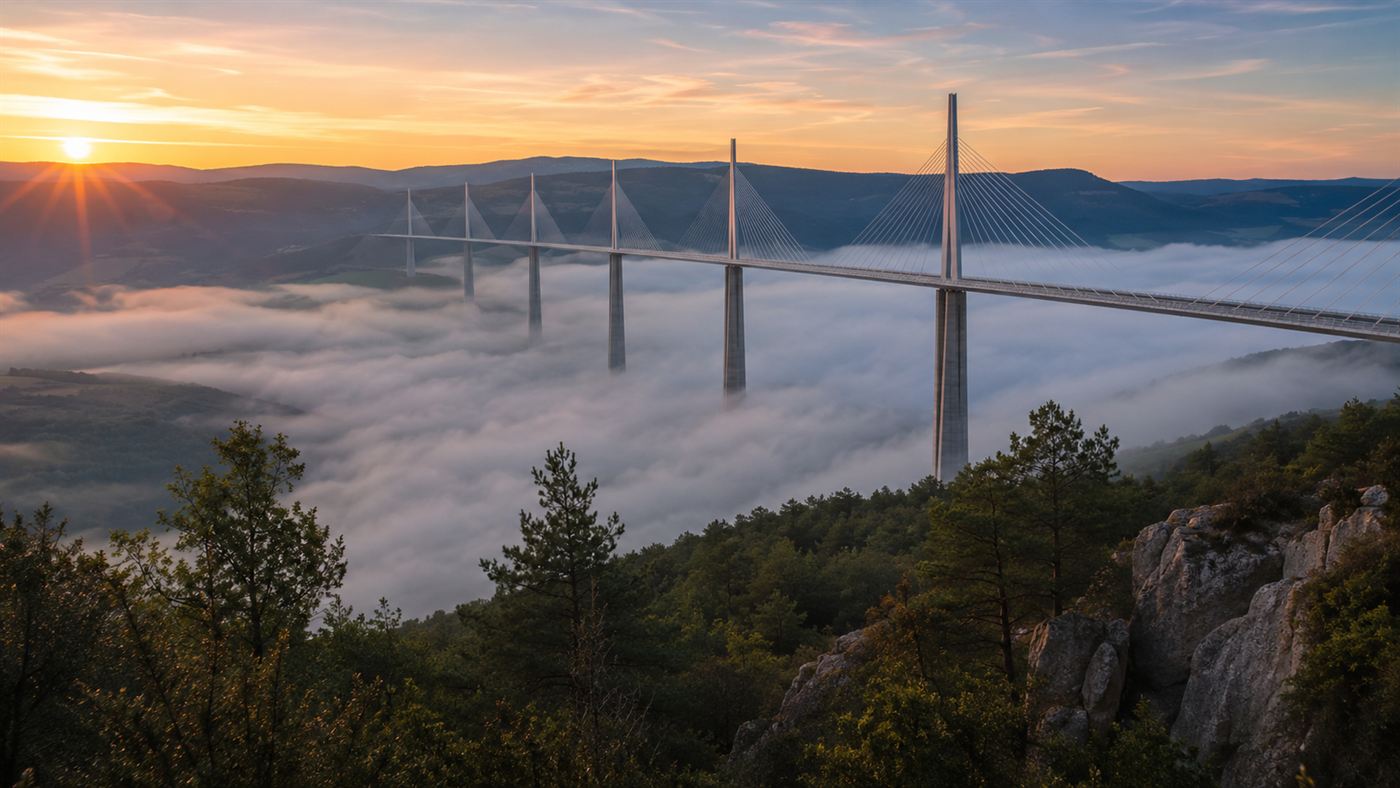
The most photographed thing about the Millau Viaduct is something its builders did not exactly design. On certain mornings the Tarn valley fills with low cloud, a soft white sea pooled in the bottom of the gorge, and the bridge floats clean above it, only the tops of its masts and the ribbon of road showing through. Drivers crossing on those days are, quite literally, motoring above the clouds, with nothing visible below the parapet but mist.
The effect turned a piece of motorway into a destination. People drive to the area simply to cross the bridge, or to stand in the valley and look up at it; there is a visitor centre, and viewpoints, and a steady trade in photographs of a road suspended in the sky. A structure built to let people pass through a place as fast as possible became, in the end, a reason to stop.
What it changed
For the people who used to crawl through Millau every summer, the bridge did exactly what it was meant to do. The bottleneck vanished almost overnight. A journey that could swallow an afternoon now takes a few minutes high above the town, and the route from northern Europe down to the Mediterranean coast was, in effect, redrawn. The small town that the road once strangled is now better known for the extraordinary thing built over its head.
The honest catch
Two things are worth keeping straight. The first is that "taller than the Eiffel Tower" refers to the very top of the tallest mast, not to the road; the deck you drive on sits lower, though still high enough to leave you breathless looking down. The second is the word "tallest". The Millau Viaduct held the record for the world's tallest bridge for more than twenty years, but in 2025 a vast new bridge over a canyon in China climbed past it. Millau is no longer the single tallest crossing on Earth.
Neither footnote takes much away. The viaduct remains one of the most beautiful large structures ever built, a piece of engineering so light on its feet that people travel across a continent to look at it. It was raised to solve an ordinary, irritating problem, and it solved it with something close to grace. That, more than any record, is why it still stops people in the valley to stare.
A bridge taller than the Eiffel Tower, built to end a summer traffic jam, that drivers now cross above the clouds. Would you take the long way round just to drive across it? Tell us in the comments.
Related reading: The Akashi Kaikyo Bridge, the record-breaking span an earthquake stretched longer mid-construction.