These tiny birds build the largest nests on Earth, and the weight can bring a whole tree down
In the deserts of southern Africa, a sparrow-sized bird builds something astonishing. A single sociable weaver nest is a giant communal pile of dry grass that shelters hundreds of birds for decades, and the heaviest can grow strong enough to snap the tree holding it up.
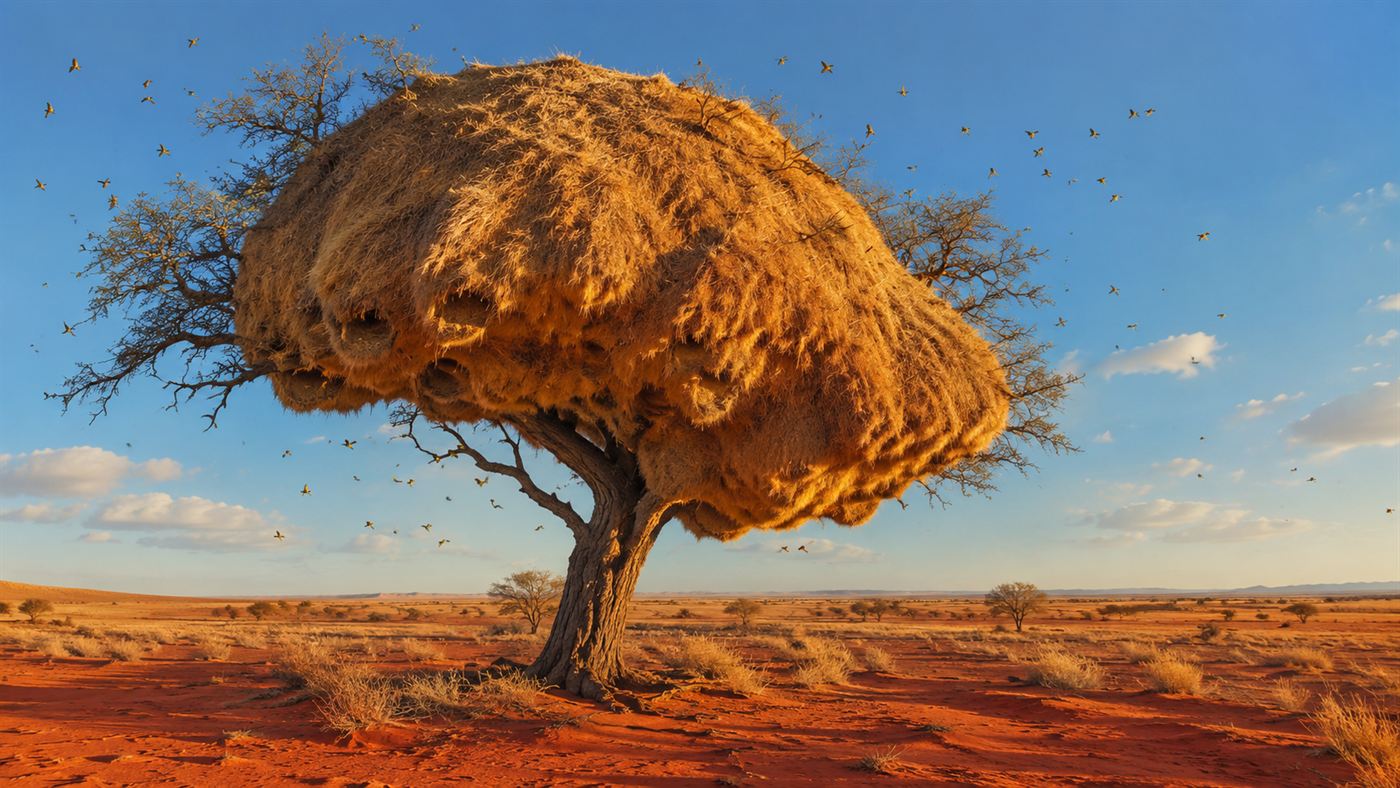
A single sociable weaver nest can swallow most of a desert tree. Illustration: Watts & Wild.
Most birds build a tidy cup, raise one brood and move on.
One small bird in the Kalahari does the opposite, and the result looks like a haystack that fell out of the sky and got stuck in a tree.
What is a sociable weaver nest? A sociable weaver nest is a giant communal structure built from dry grass by the sociable weaver, a small bird of southern Africa. A single nest can house dozens to hundreds of birds in separate chambers, is used and repaired for many years, and ranks as the largest nest built by any bird on Earth.
The sociable weaver nest, biggest in the bird world
The sociable weaver is a sparrow-sized bird found across the dry Kalahari of Namibia, Botswana and South Africa.
What it lacks in size it makes up for in ambition, building the largest nests of any bird anywhere.
The favourite foundation is the sturdy camelthorn tree, a hardy acacia of the Kalahari with branches strong enough to bear the load.
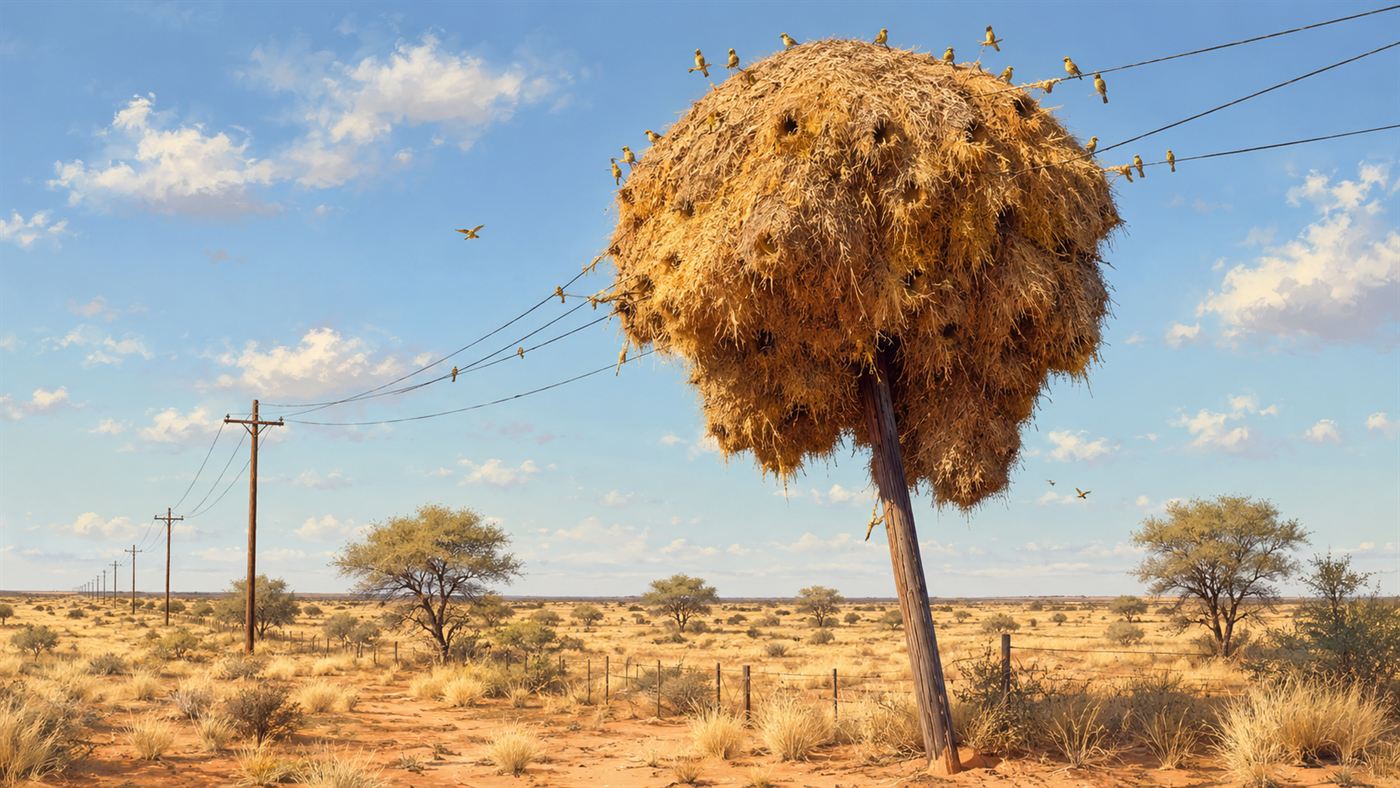
Where there are no big trees, the birds happily settle for the next best thing, and that is usually a telephone pole or an electricity pole.
From a distance the nest looks like a brown thatched roof slung over the tree, and it can stretch several metres across.
An apartment block built of grass
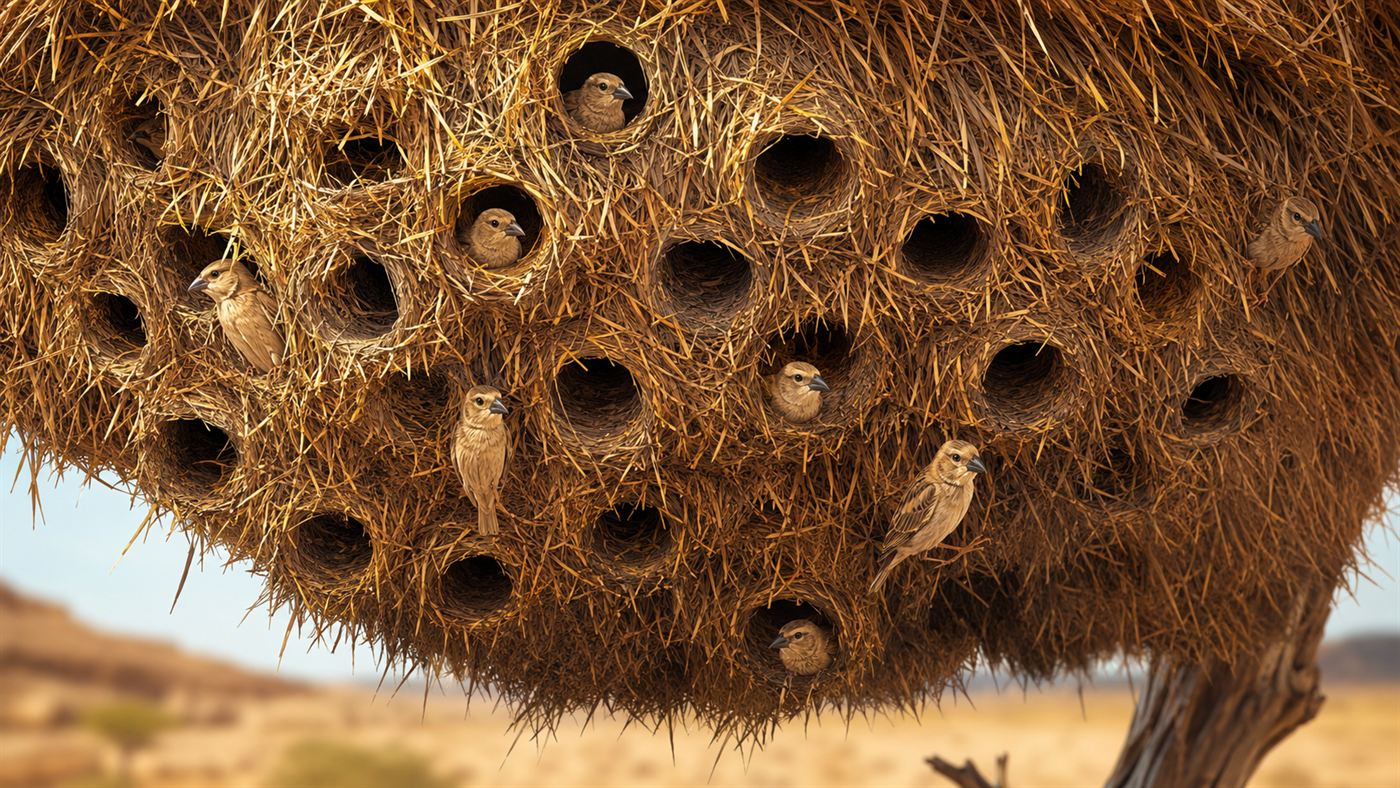
Up close, the great mound turns out to be a block of flats.
The underside is honeycombed with separate chambers, each reached by its own narrow entrance tunnel pointing straight down.
A single nest can hold a hundred or more chambers, home to several generations of birds at once.
The whole colony pitches in, adding grass year after year so that the same nest can stay in use for decades, and a few have stood for more than a century.
The tunnels are kept narrow, and some are lined with sharp grass stems pointing outward, a low-tech but useful defence against snakes climbing in.
Built-in air conditioning
The thick grass roof does more than keep the rain off, and in the desert that matters enormously.
Kalahari days can climb past 40 degrees Celsius while the nights drop close to freezing.
The deep central chambers stay snug after dark, holding the day's warmth so the birds roosting there save precious energy.
In the daytime heat the outer chambers stay noticeably cooler than the open air, giving the colony a shaded retreat.
For a tiny bird in a place of brutal extremes, that built-in insulation is the difference between thriving and merely surviving.
Heavy enough to bring down a tree
All that grass adds up to a serious amount of weight.
The largest nests can grow to around a tonne, an extraordinary mass for a structure made by birds that each weigh less than a slice of bread.
Branches sometimes give way under the load, and an entire tree can eventually be pulled down by the nest it carries.
On a wooden pole the ending is much the same, with the pole snapping or leaning drunkenly under the swelling mound of grass.
It is a rare case of architecture so successful that it destroys its own foundations.
A condominium for other species
A nest this big and this comfortable does not stay private for long.
The African pygmy falcon relies almost entirely on sociable weaver nests for its own breeding, moving into a spare chamber rather than building anything itself.
Rosy-faced lovebirds, finches and other small birds also squat in the outer rooms, turning the colony into a noisy mixed tenement.
Less welcome lodgers turn up too, since snakes such as the Cape cobra and boomslang will climb in to raid eggs and chicks.
One bird's home, it turns out, quietly becomes a whole neighbourhood for this corner of the Kalahari.
The honest catch
It is worth keeping the wonder in proportion.
Most sociable weaver nests are modest affairs, and the tonne-heavy, century-old giants are the rare exceptions rather than the rule.
The birds are not architects in any conscious sense, and the clever design is the work of instinct shaped over a very long stretch of evolution.
The poles are a genuine headache as well, because nests on the electricity network can cause short circuits, outages and even fires, so utility crews sometimes pull them down.
Stripped of the hype, what remains is still remarkable, a sparrow-sized bird that builds the biggest nest on the planet and shares it with half the desert.
The sociable weaver is a reminder that the most impressive engineering in nature does not always come from the biggest animals.
It sits happily alongside the other stories of small, stubborn creatures that refuse to read the script, from the insect that came back from the dead on a bare sea rock to the blue parrot brought home from extinction in the wild.
If a bird the size of a sparrow can build the largest nest on Earth and rent out rooms to falcons, what other quiet engineers are we walking past without noticing, and would you want one of these grass towers in your garden? Tell us in the comments.