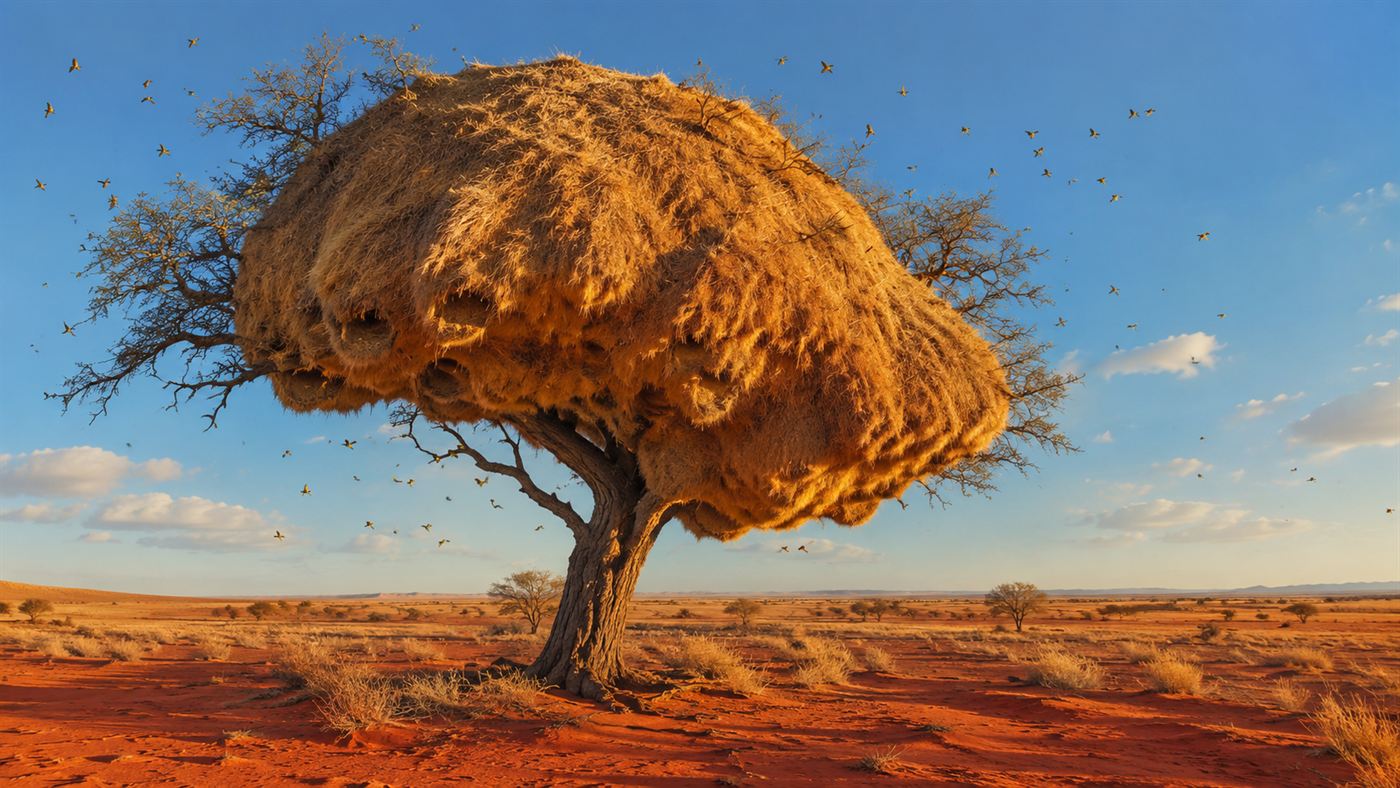
The blue macaw that inspired Rio went extinct in the wild in 2000, made it back with the first wild chicks in 24 years, then a bureaucratic fight and a lethal virus arrived
On May 24, 2024, two young Spix's macaws took their first flight in the wild scrubland of northeast Brazil, the first birds of their species born free in 24 years. By the time word spread, a government dispute over a zoo deal in India had already ended the partnership that made it possible, and a lethal virus with no known cure was spreading through the flock.
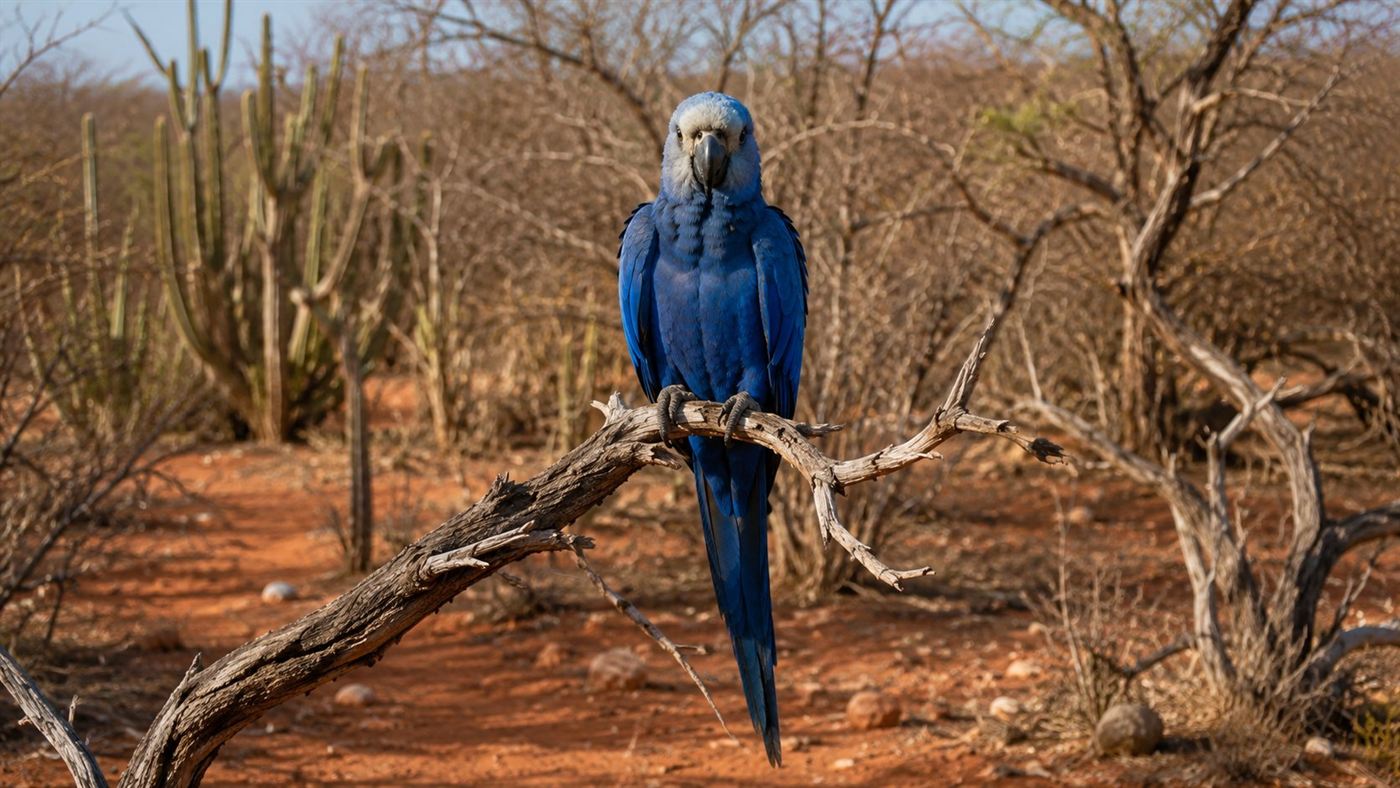
The Spix's macaw, the small blue parrot that inspired the movie Rio, was extinct in the wild for 24 years. Its return to the Caatinga in 2022 briefly looked like one of conservation's greatest wins. Illustration: Watts & Wild.
In 2011, the animated film Rio introduced a global audience to a small, brilliant-blue Brazilian parrot called Blu. The movie invented a happy ending for him. By the time it reached cinemas, the real bird it was based on, the Spix's macaw, had already been gone from the wild for eleven years.
The last confirmed wild Spix's macaw disappeared from the Caatinga scrubland of northeast Brazil in October 2000. What survived were fewer than 100 birds in captive breeding programs scattered across Europe, the Middle East, and Brazil. As Mongabay reported in July 2024, a decade of painstaking work to return them to the wild had produced its first undeniable success, and then, almost immediately, a crisis that threatened to undo it.
The bird the world lost
The Spix's macaw is not a large or flashy parrot. It is compact, about the size of a pigeon, with plumage so uniformly blue that in certain light it looks like a small piece of sky. It lived exclusively in the Caatinga, the dry inland forests of Bahia state in northeast Brazil, where it nested in the hollow trunks of caraibeira trees beside seasonal streams. Its range was always small and specific. That specificity is what made it vulnerable.
Deforestation of the Caatinga, trapping for the illegal pet trade, and the arrival of Africanized honeybees, which competed for the same nesting holes, reduced the wild population steadily through the 1980s and 1990s. By 1990, ornithologists counted just one known wild bird. For a decade that single individual was watched, photographed, and ultimately lost. When it disappeared in October 2000, the species was declared functionally extinct in the wild.
What remained were captive birds, mostly held by the Association for the Conservation of Threatened Parrots (ACTP), a Germany-based breeding organization, along with smaller holdings in Brazil, the Czech Republic, and Qatar. Over two decades, the captive population was slowly built up to around 160 to 170 individuals. The ambition was always to return them to the Caatinga.
The wild Spix's macaw returns to Caatinga
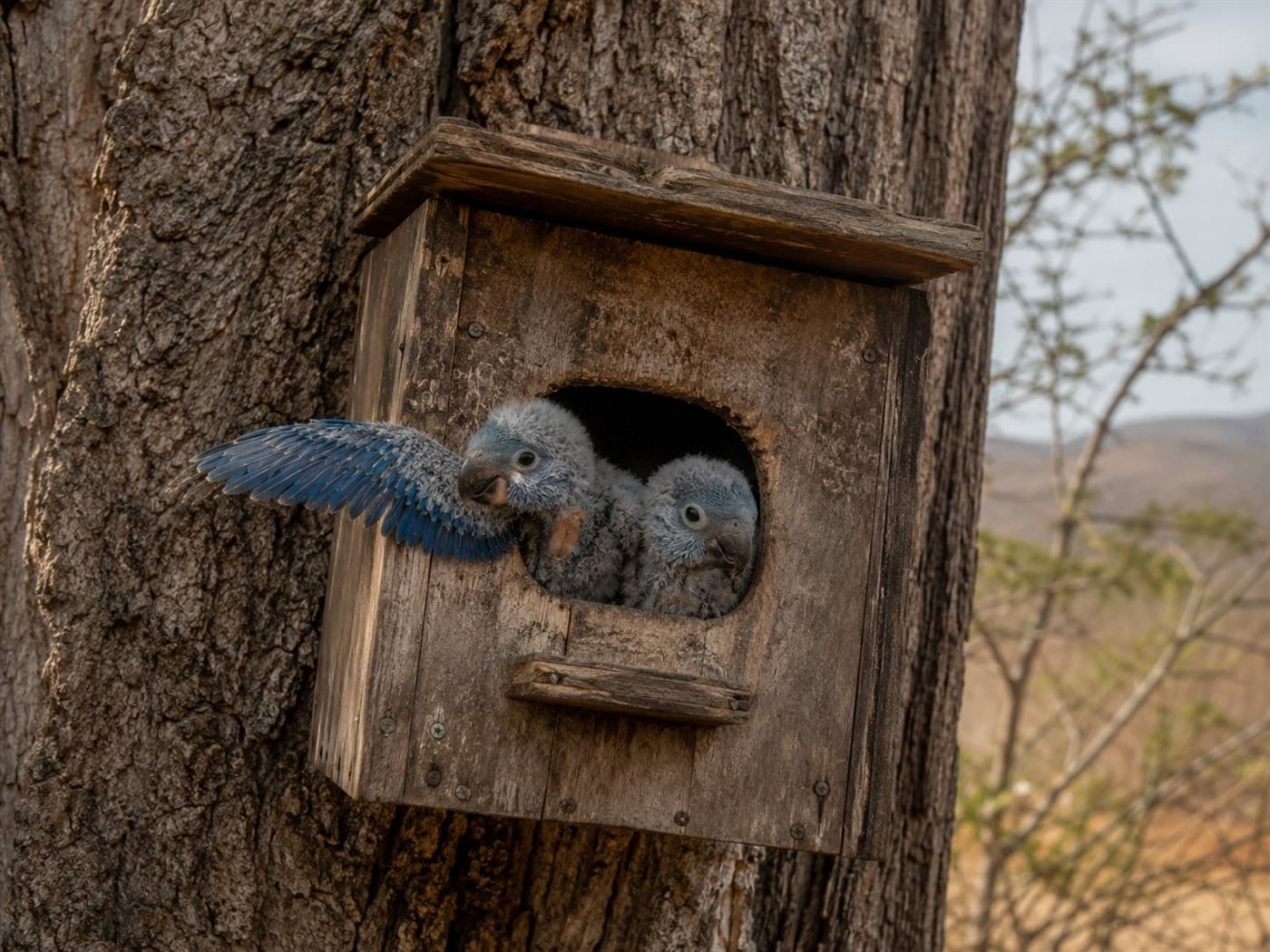
In June 2022, the ACTP and Brazil's federal conservation agency ICMBio released the first 20 Spix's macaws back into the wild near Curaçá municipality in Bahia state. The site had been prepared for years: native caraibeira trees replanted, invasive species managed, and local farmers and landowners brought in as partners in monitoring the birds.
The results in that first year were better than many expected. According to Mongabay's investigation, the first-year survival rate was 58.3%, with 65% of the released birds establishing stable activity areas within five kilometres of the release site. Three females laid eggs. Two pairs successfully reared chicks in artificial nest cavities. On May 24, 2024, two of those chicks took their first flights in the open Caatinga air, the first wild-born Spix's macaws to fly in 24 years. It was, by any measure, a conservation milestone.
The deal that split the program apart
While those first wild chicks were still fledglings, the partnership that had made their births possible was already breaking down. In 2023, the ACTP had transferred 26 Spix's macaws and four Lear's macaws, another endangered Brazilian parrot species, to a private zoo in India called Greens Zoological Rescue and Rehabilitation Centre. ICMBio objected. The Brazilian government agency cited the "commercial transactions" as incompatible with the terms of their cooperation.
In May 2024, the same month the wild chicks took flight, ICMBio announced it would not renew its technical cooperation agreement with the ACTP. The agreement expired in June. The ACTP disputed ICMBio's characterization of the India transfer. The disagreement left the reintroduction program without a clear path forward. Annual releases, considered essential by researchers to sustain the wild population at a viable level, were put on hold.
A new Brazilian partner organization, BlueSky, has since stepped in at the Curaçá breeding center to work with ICMBio. But the transition meant months of institutional uncertainty for a population of wild birds still in its most fragile early phase.
A lethal virus in a vulnerable flock
The second blow came in late 2025. In October and November, reports emerged that birds from the Curaçá population had tested positive for circovirus, a highly contagious pathogen that causes immunosuppression in parrots. As Phys.org reported in November 2025, at least seven birds had tested positive. There is no known cure. The disease progresses by weakening the immune system until secondary infections become fatal.
At the time of the outbreak, roughly 80 Spix's macaws were present in Brazil in total, split between the wild population, the Curaçá breeding facility, and the São Paulo Zoo. That number represents almost half of all living members of the species. A circovirus outbreak in a flock this small, already stressed by the institutional upheaval of 2024, carries a risk that conservationists describing the situation have not been shy about naming.
Researchers who published an analysis in Bird Conservation International in September 2024 had already warned that without continued annual releases, the wild population would be unlikely to reach self-sustaining numbers. The combination of a disease outbreak and a pause in releases, landing together in the same critical window, is exactly the scenario that paper was written to prevent.
The honest catch
The Spix's macaw comeback, even before the virus and the dispute, was always a fragile thing. The birds released in 2022 were captive-bred over many generations, and some showed behavioral gaps that made survival harder, an unfamiliarity with wild food sources and predator responses that their wild ancestors would have learned naturally. The Caatinga itself continues to face pressure from agriculture and drought. The caraibeira trees the macaws need take decades to grow to maturity and can be cleared overnight.
There is also the question of what "success" means for a species with this level of institutional conflict orbiting it. The first wild chicks were a genuine milestone. But the organizations that produced them are no longer speaking in the same terms, the breeding pipeline feeding future releases is interrupted, and a contagious disease is spreading in the flock. The movie gave Blu a happy ending. The real story is considerably more complicated.
Two small blue birds took their first flights over the Caatinga in May 2024, and the people watching them knew they were seeing something that had not happened in 24 years. Whether that moment becomes the start of a real recovery or a footnote depends on institutions resolving a dispute and on whether a virus can be contained in one of the world's most vulnerable bird populations.
When a species comes back from the wild extinction, who should have the final say over its future, the country where it lives or the organization that kept it alive while it was gone? Tell us in the comments.