A bird builds a decorated stage, sorts its treasures by colour, and arranges them to create an optical illusion, all to impress a mate who judges the artistry
Most birds attract a mate with bright feathers or a good song. The bowerbird does something far stranger: it becomes an architect, a collector and an artist, building and decorating an elaborate structure, and in one species even constructing a working optical illusion to seduce the female who comes to inspect it.
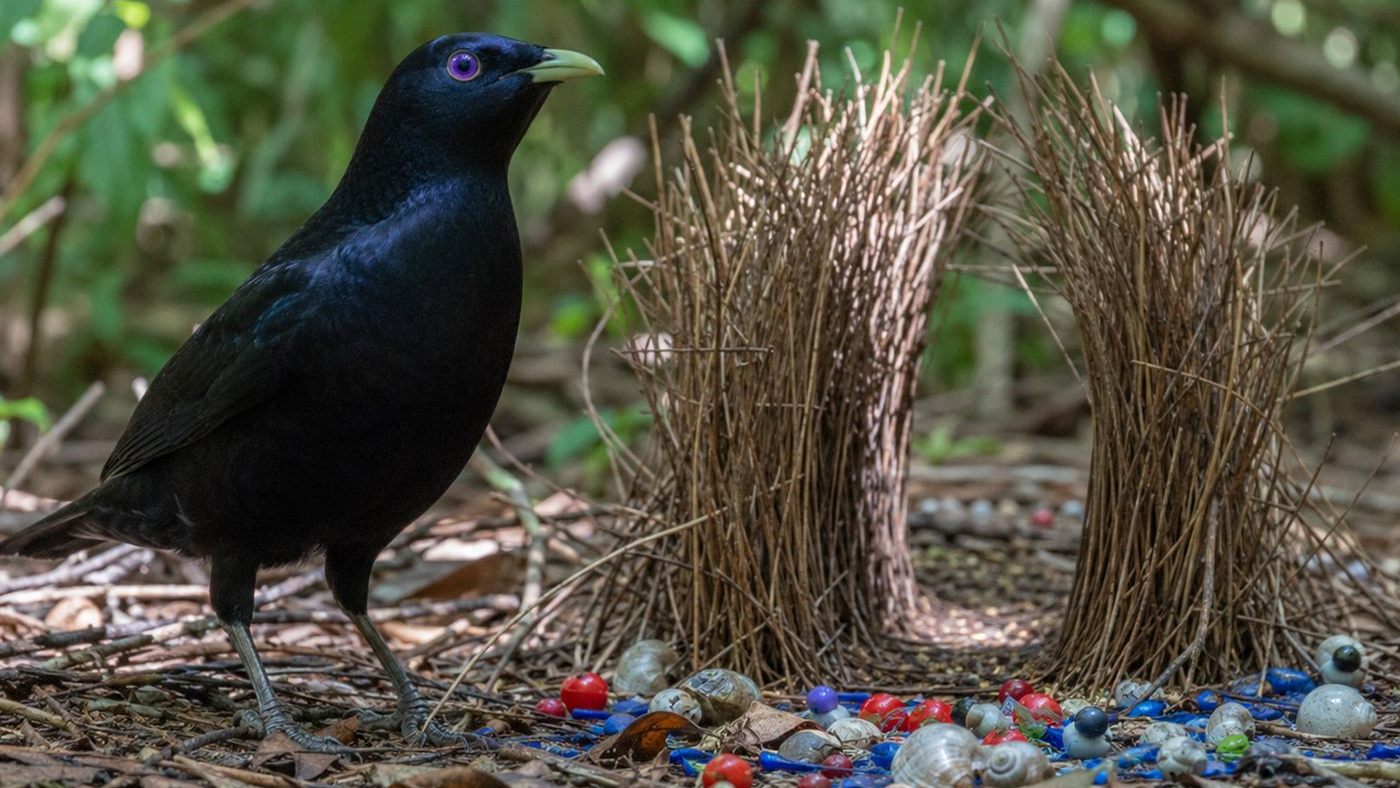
A male bowerbird at the stage it builds purely to court. Illustration: Watts & Wild.
The first thing to clear up is what a bower actually is, because it is easy to assume it is a nest. It is not. The female builds her nest somewhere else entirely. The bower is something with no equivalent in human terms except, perhaps, a stage set: a structure the male builds solely to perform in front of, and to impress visiting females. It serves no practical purpose at all beyond seduction.
Across the bowerbird family of Australia and New Guinea, males build these structures in different styles, from twin walls of upright sticks to towers around a sapling, and then they decorate, with a fussiness that is almost comic. Australian forests breed showmen of every kind, including the lyrebird, which seduces with sound rather than sculpture, mimicking twenty other birds and a chainsaw.
An obsession with colour
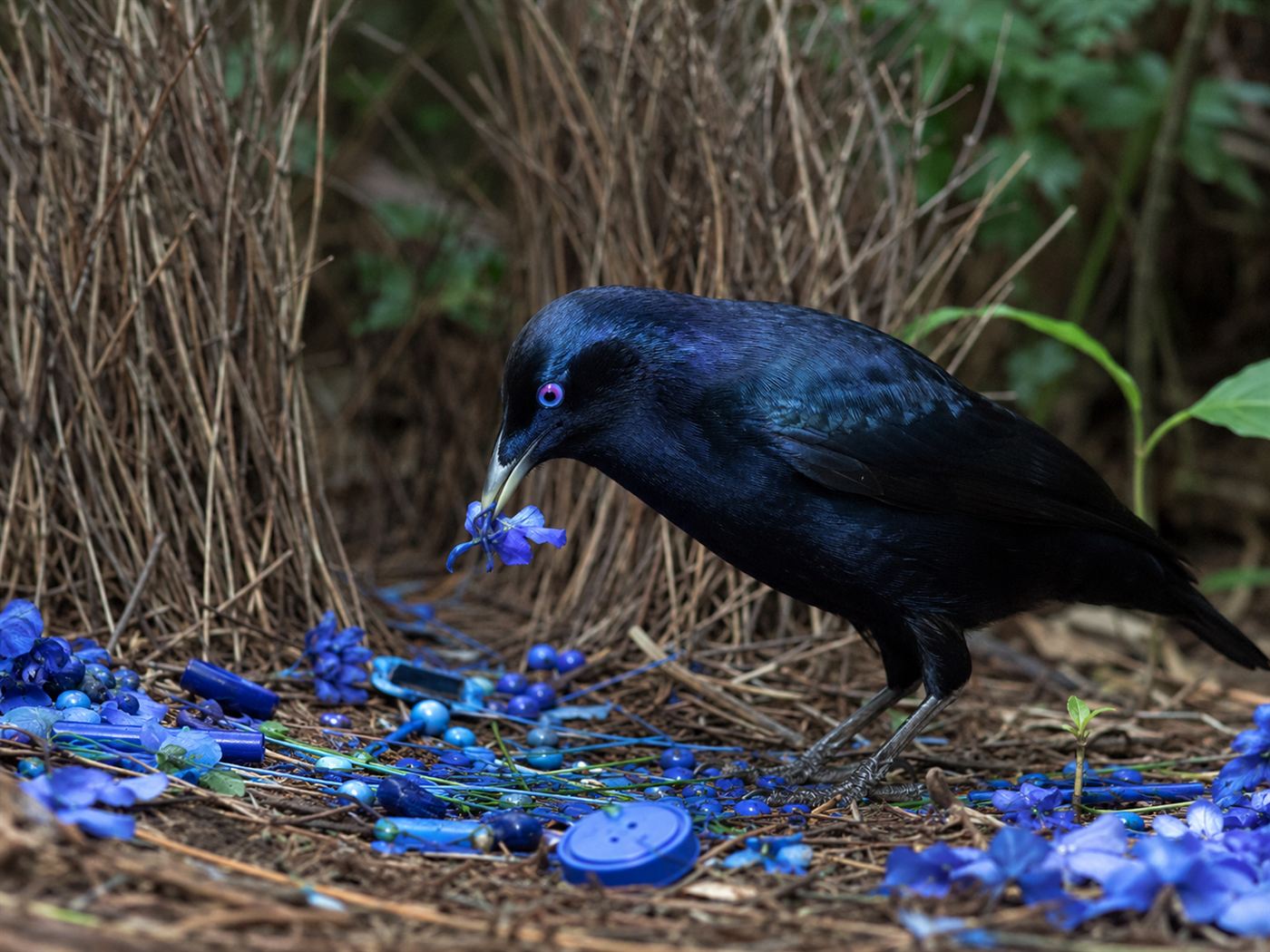
Bowerbirds are collectors with strong opinions. A male will gather dozens or hundreds of objects to ornament his bower, and different species are devoted to different colours. The satin bowerbird is famously obsessed with blue, hoarding blue flowers, feathers and berries, and in the modern world raiding gardens and rubbish for blue bottle caps, pen lids, straws and pegs. Great bowerbirds, by contrast, favour collections of grey stones, white bones and flashes of red and green.
He arranges all this carefully, steals choice items from rival males' bowers, and constantly tidies and rearranges. The female visits several bowers, inspects each male's construction and decoration and dance, and chooses. In effect the males are judged on their art, and the competition is fierce enough to have driven some of them to a genuinely astonishing trick.
How the bowerbird builds its illusion
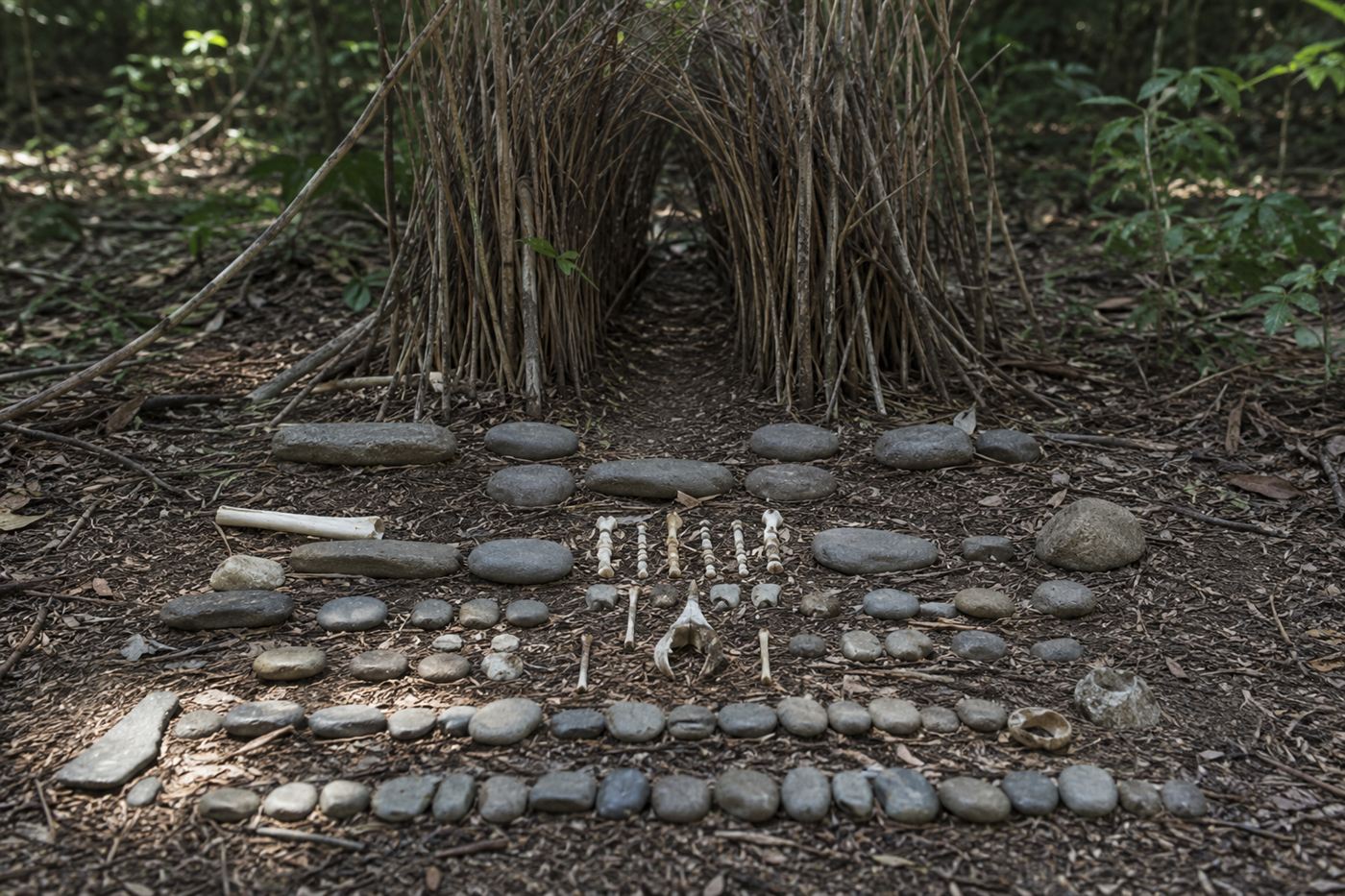
The trick belongs to the great bowerbird, and it is the part that stuns scientists. In front of his avenue of sticks, the male lays out a "court" of grey stones and bones, and he does not scatter them at random. As research published in PNAS by Laura Kelley and John Endler found, the males place these objects in a careful size gradient, with smaller items near the bower and larger ones farther away. The result is forced perspective: from where the female stands inside the bower, looking out, the court appears to be made of evenly sized objects, a smooth and regular visual field.
This is the same illusion film-makers use to make a model look like a full-sized building, deliberately built by a bird. As a follow-up study in Royal Society Open Science describes, the males actively construct and maintain these perspective illusions, and crucially, the quality of the illusion predicts how successful a male is at mating. The better the visual trick, the more likely he is to win.
A bird that fixes its own art
What really drives the point home is how deliberate it is. As Laura Kelley's research describes, if you deliberately disrupt the careful size gradient, scrambling the male's arrangement, he will rebuild it, restoring the illusion within days. He is not just dumping objects and getting lucky; he is maintaining a specific visual effect and notices when it is wrong.
This makes the great bowerbird one of the very few animals known to create a visual illusion of any kind. A creature with a brain the size of a nut is, in its own way, doing perceptual design, building a scene tuned to how another animal's eyes and brain will read it.
The honest catch
The temptation is to call this "art" and "trickery," and it is worth being careful with both words. The male is not an aesthete making beauty for its own sake, nor a con artist fooling a gullible female. This is sexual selection: females very likely use the quality of the bower and the illusion as an honest signal of a male's skill, health and brainpower, so building a great illusion is less about deceiving her and more about proving he is a high-quality mate. The female is reading the artist, not being conned by the art.
A few details deserve precision too. The dramatic forced-perspective illusion is documented in the great bowerbird; not every bowerbird species does it, though all are remarkable builders. And the satin bowerbird's lovely habit of collecting blue has a small dark side in the plastic age, since bright blue litter can be hoarded or, worse, mistaken for food. The wonder is real, but it is biology doing the wondering, not a bird with an art degree.
Why a bird's art still matters
The bowerbird is worth knowing about because it quietly demolishes a comfortable boundary. We like to think of construction, decoration, collecting and the manipulation of perception as human, even artistic, behaviours. A bird in an Australian forest does all four, with taste, persistence and an eye for how another creature sees, purely to win a mate.
It is humbling and a little delightful to share the planet with an animal that builds, curates and stages an illusion. Does the bowerbird's work feel like art to you, or is it something else entirely? Tell us in the comments.
Related reading: In the Kalahari, sociable weaver birds build giant communal nests the size of haystacks that last a century.