Santiago spent decades choking on the diesel smoke of its city buses, then built the biggest electric bus fleet outside China, and its 3 million daily riders are breathing the difference
Hemmed in by the Andes, the Chilean capital has long had some of the worst air in Latin America, and its diesel buses were part of the problem. By 2026 roughly two thirds of those buses had gone electric, the largest such fleet anywhere outside China.
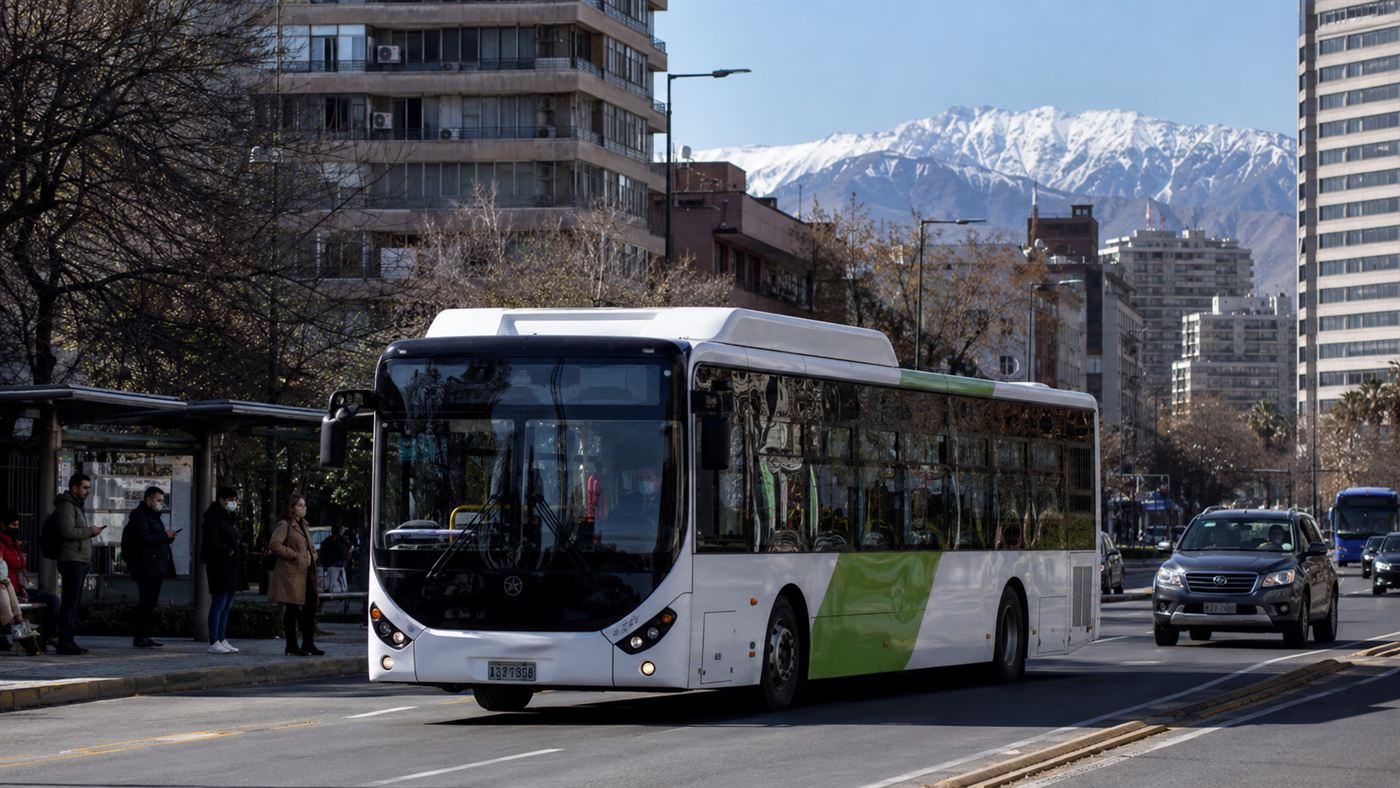
An electric bus on a Santiago avenue, the Andes that trap the city's air rising behind it. Illustration: Watts & Wild.
Santiago sits in a bowl. The Chilean capital is ringed by the Andes, and on bad days the mountains act like the lid on a pot, holding the city's exhaust over the heads of its nearly seven million people. For decades a large share of that haze came rattling and roaring down the avenues in the form of old diesel buses, loud, sooty and impossible to ignore. The Santiago electric bus fleet is quietly changing that, one silent bus at a time.
Santiago now runs the largest fleet of electric buses anywhere outside China, behind only Beijing and Shenzhen. As Sustainable Bus has reported, the city was on track to reach about 4,400 electric buses, roughly 68 percent of its entire fleet, with another large batch of 1,800 added in a single push. Those buses move a big share of the 3.3 million passengers who ride the network every single day. The change nobody voted on, but everyone can feel, is the noise. Or rather, the lack of it.
A city built to trap its own smoke
To see why this matters, you have to understand Santiago's geography. The city lies in a basin pressed up against the mountains, and in autumn and winter a layer of warm air can settle over it like a cap, a thermal inversion that pins cold, dirty air against the ground. The pollution has nowhere to go. For years that earned Santiago a place near the top of Latin America's most polluted capitals.
The old buses made it personal. The diesel "micros" that ran the city were notorious, belching black smoke at every stop, shaking the windows of the apartments they passed and filling the streets with a constant mechanical growl. For the millions of people who could not afford a car and lived their commute on those buses, the pollution was not an abstraction on a map. It was the air at the bus stop.
How the Santiago electric bus fleet scaled to 391 routes
The network swallowing all these electric buses is enormous. Red Movilidad, the operator behind Greater Santiago's public transport, runs 391 bus routes carrying around 3.3 million passengers a day. Turning a system that big substantially electric in just a few years is the part transport planners elsewhere find hard to believe.
What makes it remarkable is the speed and the scale together. Plenty of cities run a showcase handful of electric buses on one tidy route. Santiago pushed past that into the thousands, until the electric bus stopped being the novelty and the diesel one became the exception. A middle-income country, not a wealthy one, built the second-largest urban electric bus operation on the planet.
What a rider actually feels
For the passenger, the upgrade is immediate and physical. The electric buses pull away without the diesel lurch and roar, gliding off in near silence, and there is no plume of soot at the stop to breathe in while you wait. The ride is smoother, the cabins are newer and better lit, and the rolling, rattling racket that used to be the soundtrack of a Santiago commute has simply faded out.
It changes the texture of an ordinary day for millions of people. A bus is where a huge slice of a city actually spends its mornings and evenings, and making that space quieter and cleaner is the kind of improvement that does not make headlines but is felt every single trip. The driver, sitting at the front of a calm electric cab instead of a juddering diesel one, feels it for an entire shift.
Why it actually pencils out
None of this would have happened if the buses only cleaned the air. They also save money to run. As the Global Drive to Zero initiative has documented, Santiago's electric buses cost about 44 percent less to maintain than diesel ones and are at least 65 percent cheaper per kilometre to run. The fuel for a bus is a huge running cost, and electricity in Chile, increasingly drawn from cheap Atacama solar, undercuts diesel by a wide margin.
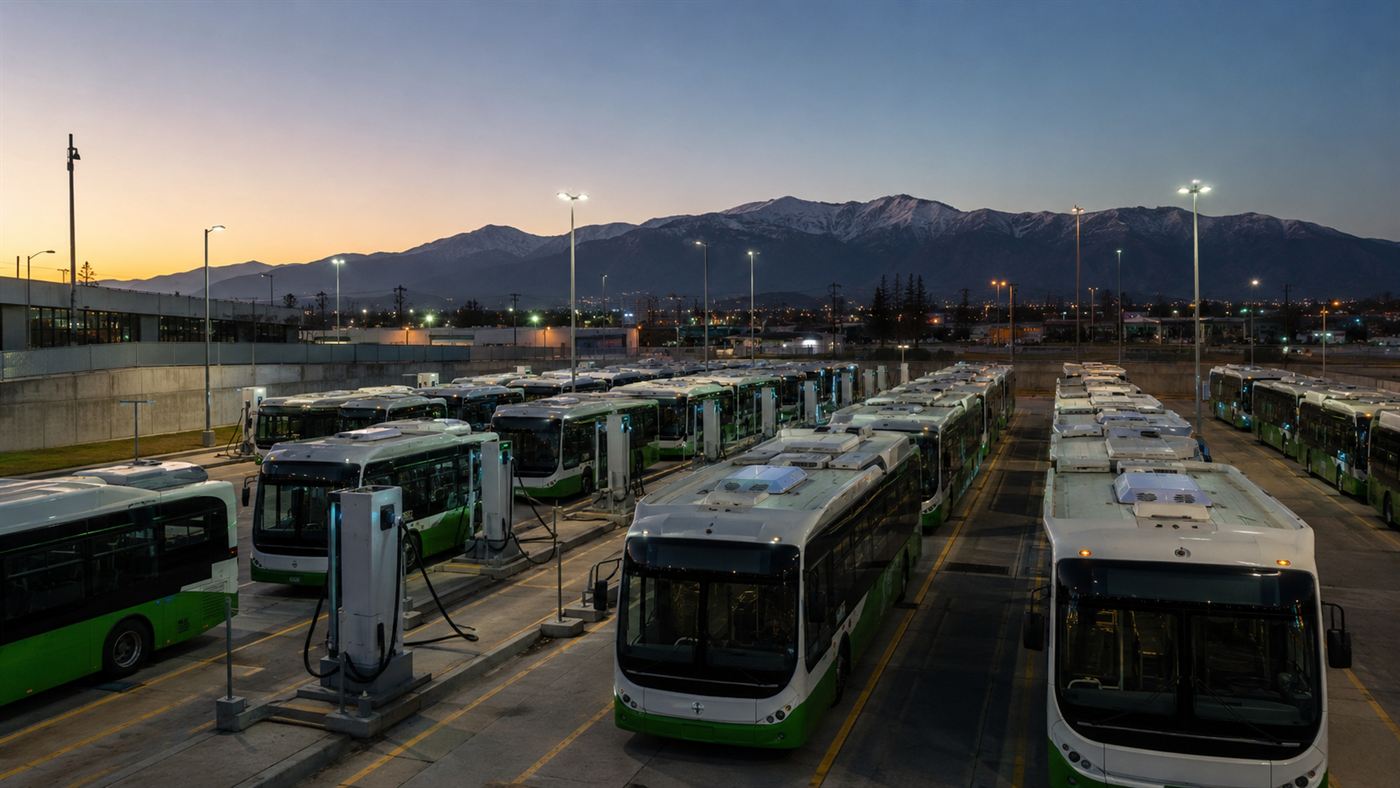
Chile also got clever about the upfront price. Rather than asking bus operators to swallow the high cost of the vehicles, it split the deal so that one set of companies owns the buses and chargers while another simply runs them, spreading the heavy initial investment. New charging depots, the electroterminals where the fleet powers up overnight, are being built out across the city to keep pace. The buses themselves are mostly imported, with Chinese makers like Foton, BYD and Yutong supplying the bulk of the fleet.
The honest catch
This is a real success, and it is also unfinished. Around a third of Santiago's buses still run on diesel, so the smog and the noise have not vanished, only thinned. And buses are only one source of the city's bad air, which also pours from private cars, wood-burning heaters and industry, so a cleaner bus fleet alone will not hand Santiago blue skies.
There are deeper dependencies too. An electric bus is only as clean as the power that charges it, which ties Santiago's gains to how fast Chile keeps greening its grid. The fleet is built almost entirely on imported vehicles, mostly from China, which is cheap and fast but leaves the city reliant on a distant supply chain. The model worked because of careful financing and political will, not because electric buses are magically easy. Santiago has proved the global south can lead on clean transport. It has not proved the job is done.
A city famous for choking on its own bus fumes now runs the biggest electric bus fleet outside China, and the people who feel it first are the millions who ride it every day. Should cleaning up the everyday city bus count for more than the flashier electric cars that get all the attention? Tell us what you think in the comments.
Related reading: For Africa's motorcycle-taxi riders the petrol pump ate the day's wages, so they are switching to electric bikes that swap a battery in under two minutes.
See also: Oakland's electric school buses that feed power back to the grid.