Solar power has one obvious flaw, the sun sets, so in the Atacama desert Chile built a tower ringed by 10,600 mirrors that stores the sun's heat in molten salt and keeps making electricity long after dark
The great weakness of solar power has always been the most obvious one: it stops working at night. In the Atacama desert of northern Chile, the driest and one of the sunniest places on Earth, an extraordinary machine called the Cerro Dominador solar tower gets around that in a way ordinary solar panels never could. It does not just turn sunlight into electricity. It bottles the sun's heat and saves it for after dark.
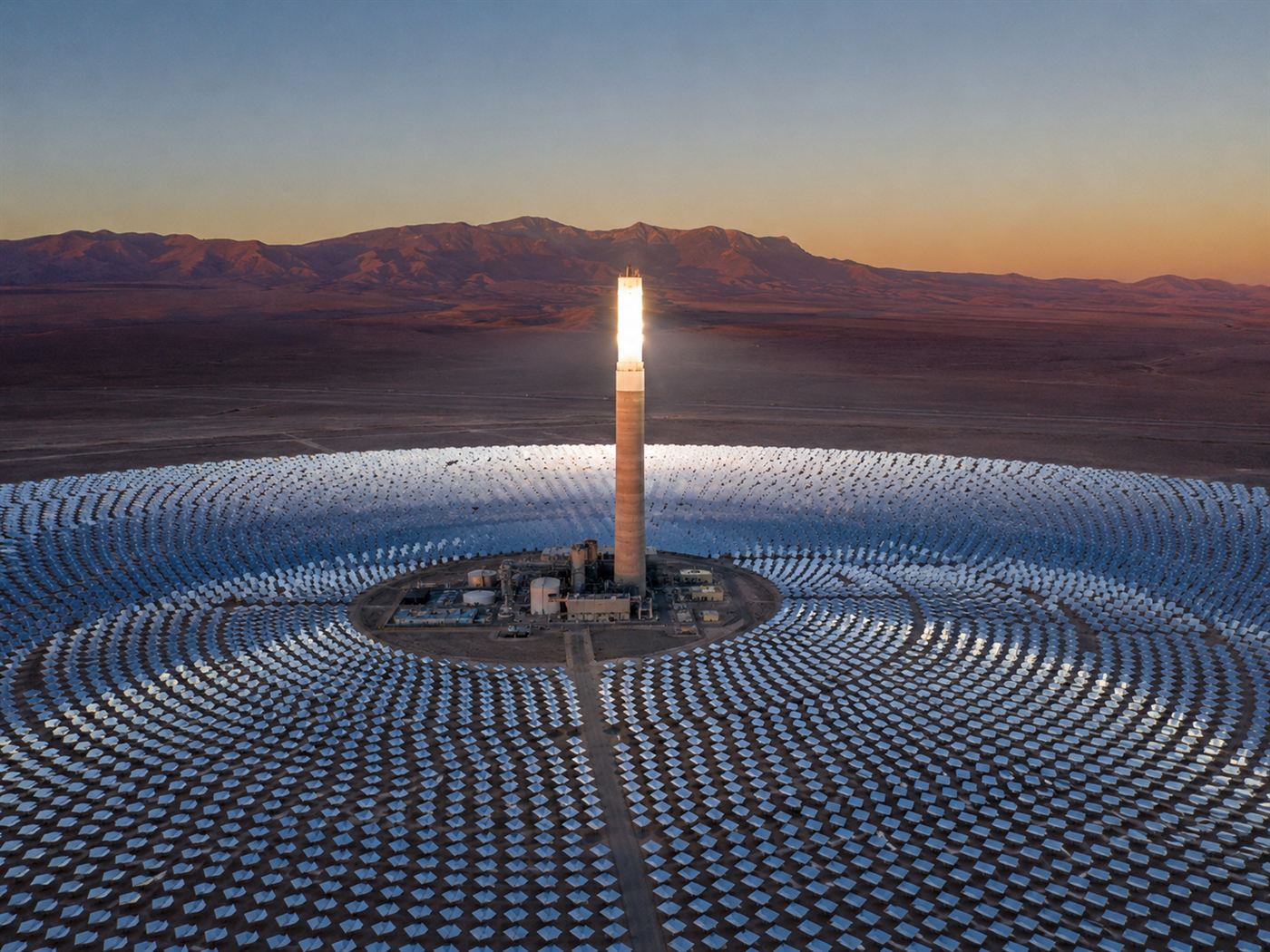
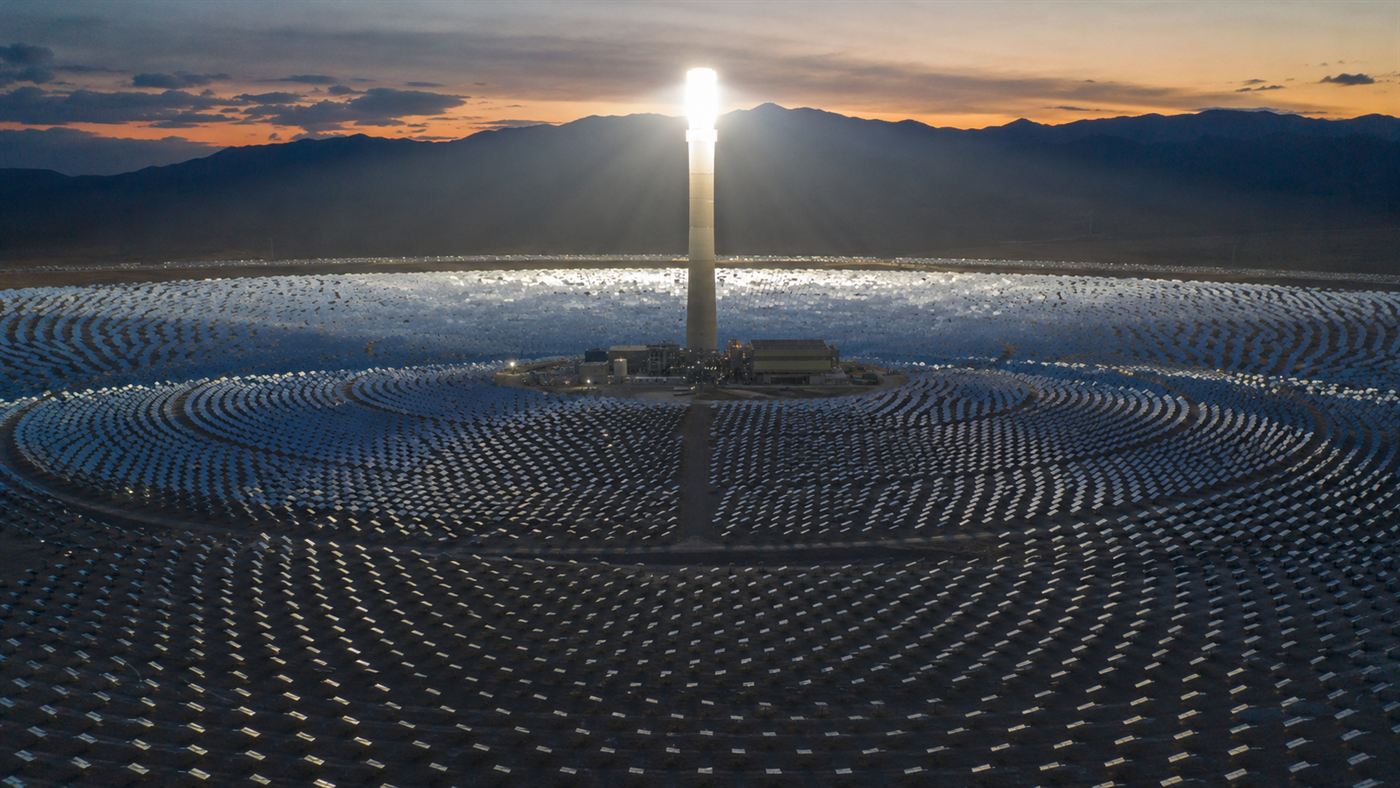
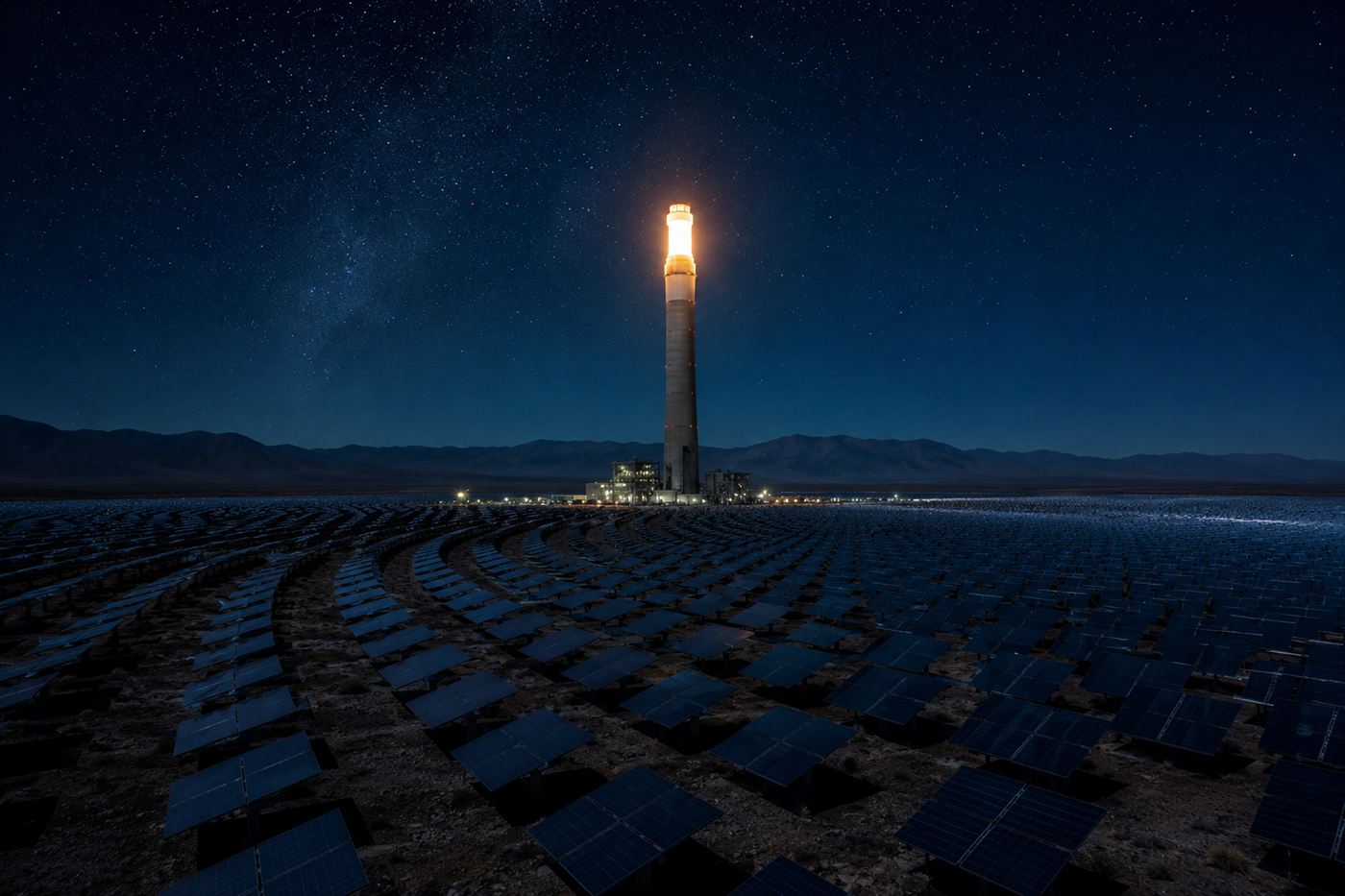
Cerro Dominador's tower glows as 10,600 mirrors focus the desert sun onto its peak. Illustration: Watts & Wild.
From a distance it looks less like a power station than something built by a vanished civilisation: a single slender tower standing in the desert, crowned by a point of light so bright it is hard to look at, encircled by ring upon ring of mirrors stretching to the horizon. This is not science fiction. It is the first concentrated solar power plant of its kind in Latin America, and it has been feeding the Chilean grid since 2021.
What makes it remarkable is not that it makes power from the sun. Plenty of plants do that. It is that Cerro Dominador can keep the lights on in the middle of the night, hours after the last sunbeam has gone, running on heat it captured during the day and tucked away in tanks of molten salt.
The one problem solar could never beat
Ordinary solar panels have a hard limit written into physics: no sun, no power. Output collapses under clouds and vanishes entirely at night, exactly when many households flick on their lights. For decades that has been solar's Achilles heel, the reason critics said it could never be more than a fair-weather helper to coal and gas.
The usual fix is to bolt on giant lithium batteries, storing daytime electricity to release after dark. That works, but big batteries are expensive and best suited to a few hours of supply. Cerro Dominador takes a completely different route. Instead of storing electricity, it stores heat, which turns out to be a far cheaper thing to keep for a long time.
The Cerro Dominador solar tower in the driest desert
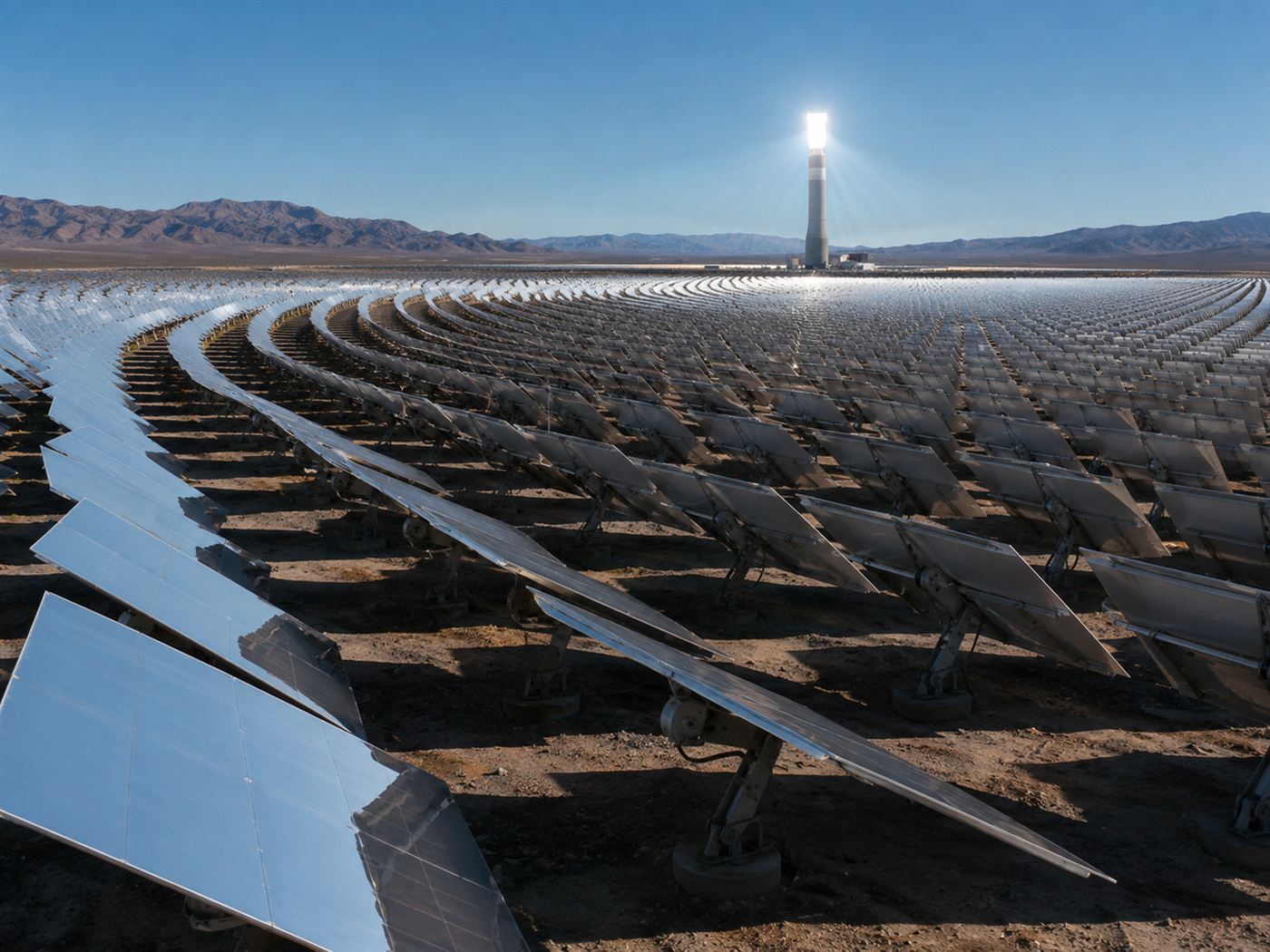
The plant sits in the Atacama for a simple reason: nowhere on Earth gets more reliable, intense sunshine. As the plant is documented, a field of 10,600 mirrors, called heliostats, spreads across 700 hectares, each one tracking the sun and bouncing its light onto a single receiver near the top of a 252-metre tower. Together those mirrors act like a giant magnifying glass aimed at one fixed point in the sky.
The result at that focal point is staggering heat. Concentrated sunlight from thousands of mirrors lands on the receiver all at once, and instead of warming water it heats a special molten salt pumped through the tower. The salt comes out blisteringly hot, around 560 degrees Celsius, a glowing liquid carrying the gathered energy of the whole mirror field back down to the ground.
How you store sunshine in salt
This is where the real trick lives. The scorching salt is not used all at once; much of it is poured into a giant insulated tank, where it sits like heat in a thermos, barely cooling. When electricity is needed, hot salt is drawn from the tank and used to boil water into steam, and that steam spins a perfectly ordinary turbine to make power. Once it has given up its heat, the now cooler salt goes into a second tank, ready to be sent back up the tower and reheated the next day.
Because that tank of hot salt holds so much energy, the plant can run its turbine whenever it likes, not just when the sun is shining. As its builder ACCIONA describes it, Cerro Dominador has up to 17.5 hours of thermal storage, enough to deliver power around the clock. In practice that means the plant can soak up sun all day and then carry a town through the entire night on stored heat alone.
Why heat can beat batteries
It is worth dwelling on why storing heat is so clever. Keeping electricity for many hours means a mountain of expensive battery cells that slowly degrade. Keeping heat means two big tanks of cheap salt that essentially never wear out. For the job of carrying solar power deep into the night, hour after hour, hot salt is one of the most economical storage media we have.
That changes what solar can be. A plant like this does not just generate clean electricity; it generates dispatchable clean electricity, power the grid can call on at 3am as confidently as at noon. That is the quality that fossil-fuel plants have always had and that cheap solar panels have always lacked, and it is exactly what a grid running on renewables most desperately needs.
The honest catch
For all its elegance, concentrated solar power has not swept the world, and the reasons are real. It is expensive and complicated to build compared with plain solar panels, whose price has collapsed so far that simply pairing cheap panels with batteries now undercuts towers like this for many jobs. Concentrated solar plants are big, capital-heavy projects that take years to finish, and several have struggled with cost overruns and delays. Cerro Dominador itself was a long and difficult build.
There are physical limits too. These towers only make sense in a handful of places on Earth with fierce, dependable direct sun, deserts like the Atacama, and they still need cooling and careful water management in regions where water is scarce. None of that makes Cerro Dominador a failure. It makes it a specialist: a brilliant answer in the right desert, not a universal replacement for the humble solar panel.
Why a solar plant that runs at night matters
Strip away the debate over cost and what is left is genuinely important. The single biggest knock against renewable energy has always been that the sun and wind come and go on their own schedule, not ours. Cerro Dominador is a standing demonstration that this is not an iron law, that with the right engineering the sun can be stored and served up on demand, even at midnight.
As the world races to build grids that run without fossil fuels, that ability to deliver steady, controllable clean power becomes priceless. A tower glowing in the Atacama, quietly running a town through the small hours on heat it caught at noon, is a glimpse of a future where the setting of the sun no longer means the end of solar power.
A tower of mirrors in the desert can run a town through the night on sunshine it saved at noon. Is storing the sun as heat the smartest way to make solar work around the clock, or have cheap panels and batteries already won that race? Tell us what you think in the comments.