The brightest bioluminescent bay on Earth went dark after Hurricane Maria, and Vieques feared its blue glow was gone for good, until the water lit up again brighter than before
In a bay off the small Puerto Rican island of Vieques, the water glows electric blue when you touch it, lit by millions of tiny living organisms. In September 2017 Hurricane Maria put the glow out, and the people who live by it feared the magic was over.
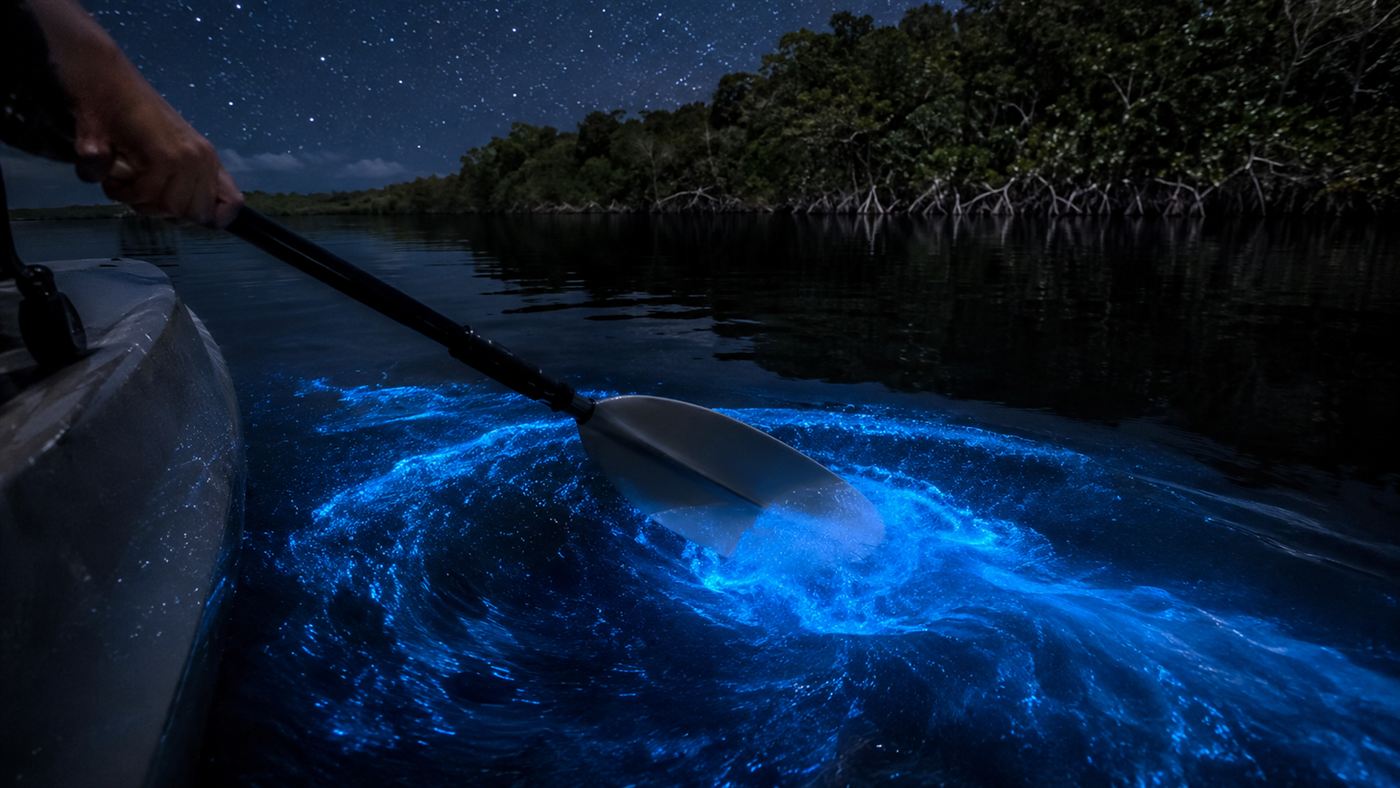
A paddle stroke sets the water of Mosquito Bay glowing electric blue. Illustration: Watts & Wild.
On a moonless night in Mosquito Bay, you can dip a paddle into the black water and watch it erupt in cold blue fire. The bay, on the small Puerto Rican island of Vieques, is the brightest stretch of bioluminescent water on Earth, lit from within by countless microscopic organisms that flash electric blue whenever the water is disturbed. Fish streak past like shooting stars and every paddle stroke leaves a glowing wake.
Then, in September 2017, the fire went out. Hurricane Maria tore across Puerto Rico, killing thousands and plunging the whole island into a blackout that lasted for months. As NPR reported at the time, Mosquito Bay went dark along with the island, the glowing organisms crashed, and tour operations stopped for the better part of nine months. People who had grown up with the glow began to fear that this time it might not come back.
Inside the Mosquito Bay bioluminescent glow
The light is alive. The water of Mosquito Bay is packed with a single-celled organism called Pyrodinium bahamense, a dinoflagellate that produces a quick flash of blue light whenever it is jostled, a chemical reaction not so different from the one inside a firefly. One on its own is invisible. Crowded together in their millions, they turn the whole bay into a sheet of living light.
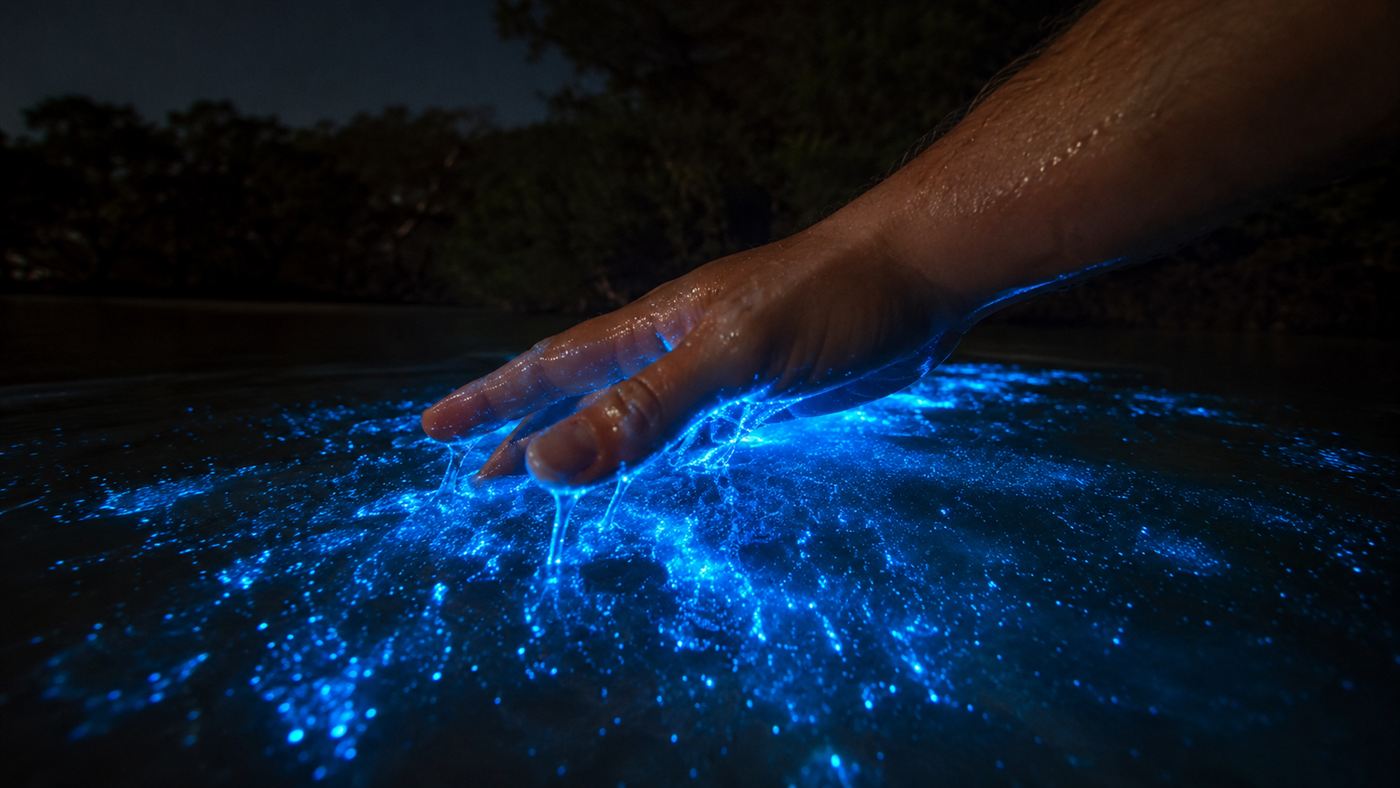
And they really are crowded. As CNN has described it, the bay holds up to around 700,000 of these organisms in a single gallon of water, which is why Guinness World Records named it the brightest bioluminescent bay in the world back in 2008. Move a hand through it and your fingers trail blue sparks. Slip in a fish, a paddle or a falling raindrop, and the surface answers in light.
Why this one bay glows so hard
Bioluminescent water exists in a handful of places, but almost nowhere does it burn this bright, and that comes down to a fragile set of coincidences. Mosquito Bay has a narrow mouth that lets the organisms drift in but makes it hard for them to drift back out, so they concentrate. The mangroves ringing the shore drop nutrients, including the vitamin B12 the dinoflagellates need, into the warm, shallow water.
The last ingredient is darkness. Vieques is a small, sparsely lit island, and Mosquito Bay sits away from any town, with almost no artificial light to wash out the faint glow. Take away any one of those things, the narrow bay, the mangroves, the warm water, the dark sky, and the spectacle fades. It is less a fixed landmark than a delicate balance that happens to hold.
The night the glow went out
That balance is exactly what Hurricane Maria smashed. When the Category 4 storm hit in September 2017, its winds and surge churned the bay, displaced its water and tore at the mangroves that feed it. With the delicate conditions wrecked, the dinoflagellate population collapsed, and the brightest bay on Earth simply stopped shining.
For Vieques, that was not just a lost view. The bay is the island's signature wonder and a backbone of its economy, the reason visitors come and the livelihood of the guides who paddle them out at night. With the glow gone and the tours shut for months, the fear was real and specific: that the storm had broken the one thing that made the island famous, perhaps for good.
Brighter than before
Then, slowly, the water began to answer again. The dinoflagellates that had crashed started to multiply, and the glow crept back through 2018. As Smithsonian magazine reported, the population not only recovered but spiked, climbing to roughly 600,000 organisms per litre by the middle of 2018 and pushing the bay's brightness past its pre-storm levels. The bay came back not just intact but stronger.
It is a rare kind of good news. A natural wonder that looked like another casualty of a catastrophic storm turned out to be quietly resilient, and its return became part of how Vieques itself climbed back, the tours restarting, the visitors returning, the island reclaiming its glow. Nature, given the right conditions, can rebuild something that looked lost.
The honest catch
The comeback is real, but so is the fragility, and that is the part worth holding onto. Bioluminescent bays are easily snuffed out, and others have been. Lights from new development, chemicals and sunscreen washing off swimmers, boat pollution and silt have all dimmed or killed glowing waters elsewhere in Puerto Rico and beyond. The very thing that makes Mosquito Bay special, its delicate balance, is also what makes it so easy to ruin.
That is why swimming in the bay is now banned, and why the glow is best thought of as borrowed rather than guaranteed. The brightness also changes from night to night with the moon and the weather, so it is never the same show twice. And the deeper threat has not gone anywhere: a warming ocean is expected to bring stronger storms, and the next Maria could hit a bay that does not bounce back so kindly. The light returned this time. It is not promised forever.
The brightest living light on the planet was switched off by a hurricane, and the people who depend on it watched it come back stronger than ever. Would you rather a wonder like this stay wild and fragile, or be locked down so tightly that almost no one is allowed near it? Tell us what you think in the comments.