Soviet planners drained the world's fourth-largest lake until ships sat rusting in the desert, but a single dam has brought the North Aral Sea and its fishermen back from the dead
For decades the Aral Sea was the textbook example of how people destroy a place beyond repair, a lake turned to salt desert with trawlers stranded miles from water. Then Kazakhstan built one dam. By 2026 the northern sea had clawed back a third of its water, and the fish were back.
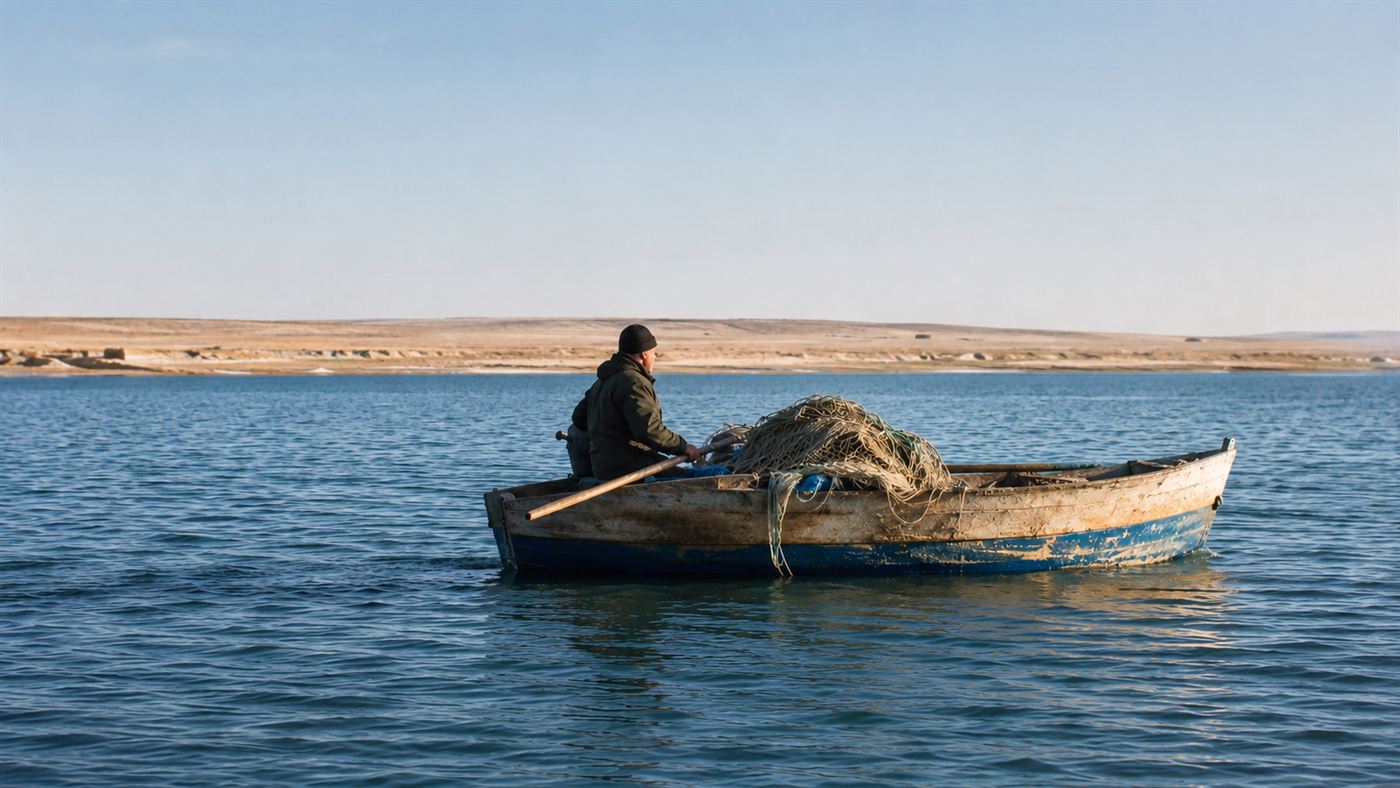
Water and boats have returned to the North Aral Sea, a lake the world had written off as dead. Illustration: Watts & Wild.
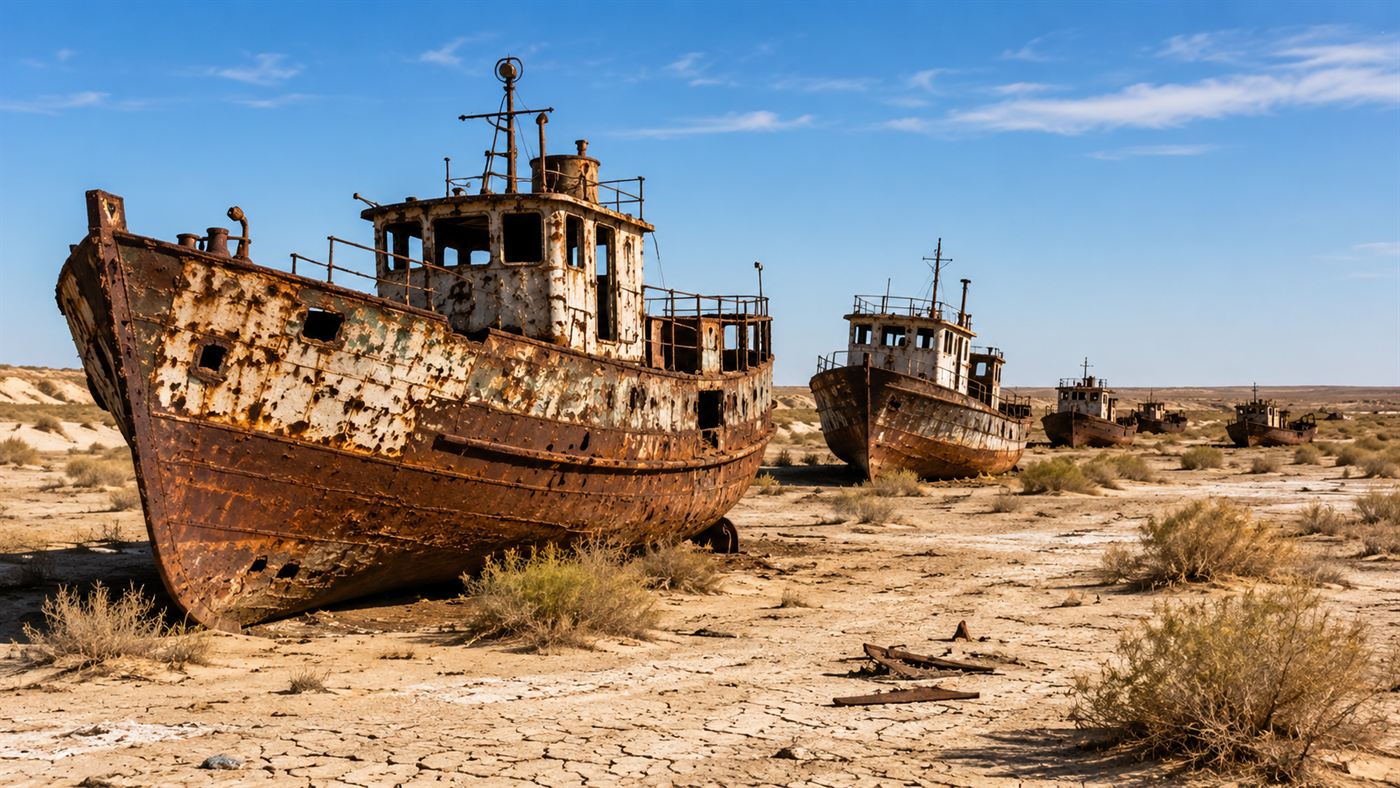
For most of a generation, the harbour at Aralsk had no harbour in it. The Kazakh fishing town sat at the edge of what had once been the fourth-largest lake on Earth, and the lake had simply walked away. The North Aral Sea comeback that followed is one of the few times a man-made disaster on this scale has been partly reversed. It retreated tens of kilometres across the sand, leaving rusting trawlers marooned in the desert like beached whales. The sea that had fed the town for generations was gone, and almost nobody believed it was ever coming back.
They were wrong. In February 2026, Euronews reported that the northern part of the Aral Sea had regained roughly a third of its water through Kazakhstan's restoration effort, the fish had returned and the boats were working again. The thing that pulled one of the planet's worst man-made disasters back from the dead was not a miracle. It was a single, unglamorous dam.
How you kill a sea
The Aral did not die by accident. Starting in the 1960s, Soviet central planners diverted the two great rivers that fed it, the Amu Darya and the Syr Darya, to irrigate vast cotton fields in the deserts of Central Asia. The rivers that had kept the lake full for thousands of years were bled off into canals, and the Aral, with nothing coming in, began to evaporate away.
The collapse was staggering. Over the following decades the lake lost something like 90 percent of its volume, split into separate fragments and, in places, vanished entirely. As the water shrank, the salt left behind grew so concentrated that the fish died, and the fishing industry that employed tens of thousands collapsed with them. Toxic dust laced with salt and farm chemicals blew off the exposed seabed, poisoning the air for people who lived nearby. It became the standard photograph of environmental ruin: camels walking past shipwrecks on dry land.
The dam that drew a line
By the 2000s the sea had broken into a smaller northern lobe, inside Kazakhstan, and a larger southern one, mostly in Uzbekistan. Kazakhstan made a hard, clear-eyed choice. Rather than try to save the whole impossible thing, it would wall off the part it could actually rescue.
With backing from the World Bank, the country finished the Kok-Aral Dam in 2005, a long dike thrown across the strait between the two basins. The dam stopped the northern sea's water from draining south into the salt flats, and let the Syr Darya, the river that still reached it, slowly refill just that northern pool. It was a tourniquet on a hemorrhaging patient, sacrificing one limb to save the other.
The North Aral Sea comeback came faster than anyone hoped
What happened next surprised even the optimists. The northern sea began to refill more quickly than the engineers had predicted, the water level climbed, and as it rose the salt that had killed everything was diluted back toward something fish could live in. The fish came home. Around 20 species that had disappeared reappeared in the recovering water.
The catch tells the story in hard numbers. As Global Voices documented in its account of how Kazakhstan resurrected the North Aral Sea, the annual fish catch has risen more than tenfold since the early 2000s, and official fishing quotas climbed by hundreds of percent within a decade of the dam going up. The country has kept pushing more water toward the lake, redirecting several times as much down the Syr Darya in 2024 as it had just two years earlier, according to the figures reported by Euronews.
Aralsk gets its sea back
For the people of Aralsk, this is not a statistic. It is the water creeping back toward a town that had spent decades staring at sand. Fishermen who had given up the trade, or left for the cities, have boats in the water again, and the processing sheds that gut and freeze the catch have work to do. A place defined for a generation by absence is being defined again by a sea.
The plan is to push the recovery further. Kazakhstan intends, over the second half of this decade, to raise and strengthen the Kok-Aral Dam so the northern lake can hold even more water and rise higher still, pulling the shoreline back closer to the towns that the sea abandoned. The ambition now is not just to stop the bleeding, but to keep filling the basin.
The honest catch
This is a genuine good-news story, which is exactly why it needs an honest asterisk. The sea that is coming back is only the small northern slice of the original. The vast southern Aral, on the Uzbek side, is largely gone, a dry, salty plain that the Kok-Aral Dam, by keeping the water in the north, arguably helped to write off for good. Saving one half meant, in practice, letting the other go.
The bigger threat has not gone anywhere either. The rivers that feed the Aral are still shared, and still fought over, by several thirsty countries upstream, and cotton is still a powerful, water-hungry industry. Add a warming climate and shrinking mountain glaciers at the rivers' source, and the flow that revived the north is far from guaranteed. The North Aral Sea is proof that even catastrophic damage can sometimes be partly undone. It is not proof that it is easy, cheap or complete.
A sea that humans wiped off the map is filling back up behind a single dam, and a fishing town that watched its water vanish is watching it return. Does the rescue of the North Aral Sea make you more hopeful that we can undo our worst environmental mistakes, or does losing the southern sea show the real cost? Tell us what you think in the comments.
Related reading: Engineers pulled four dams off the Klamath River in the largest dam removal in US history, and within ten days the salmon came back. See also how a lake California drained a century ago for cotton came roaring back in 2023.