It fishes with a living lantern, and its mate melts into its body forever
A mile or more below the waves, in water so deep that sunlight has never reached it, there is no food to be found and almost no other living thing to meet. To survive down there, one fish carries its own glowing bait on a rod above its mouth, and solves the problem of finding a partner in a way so strange it borders on horror. It lets its mate dissolve into its body and never leave.
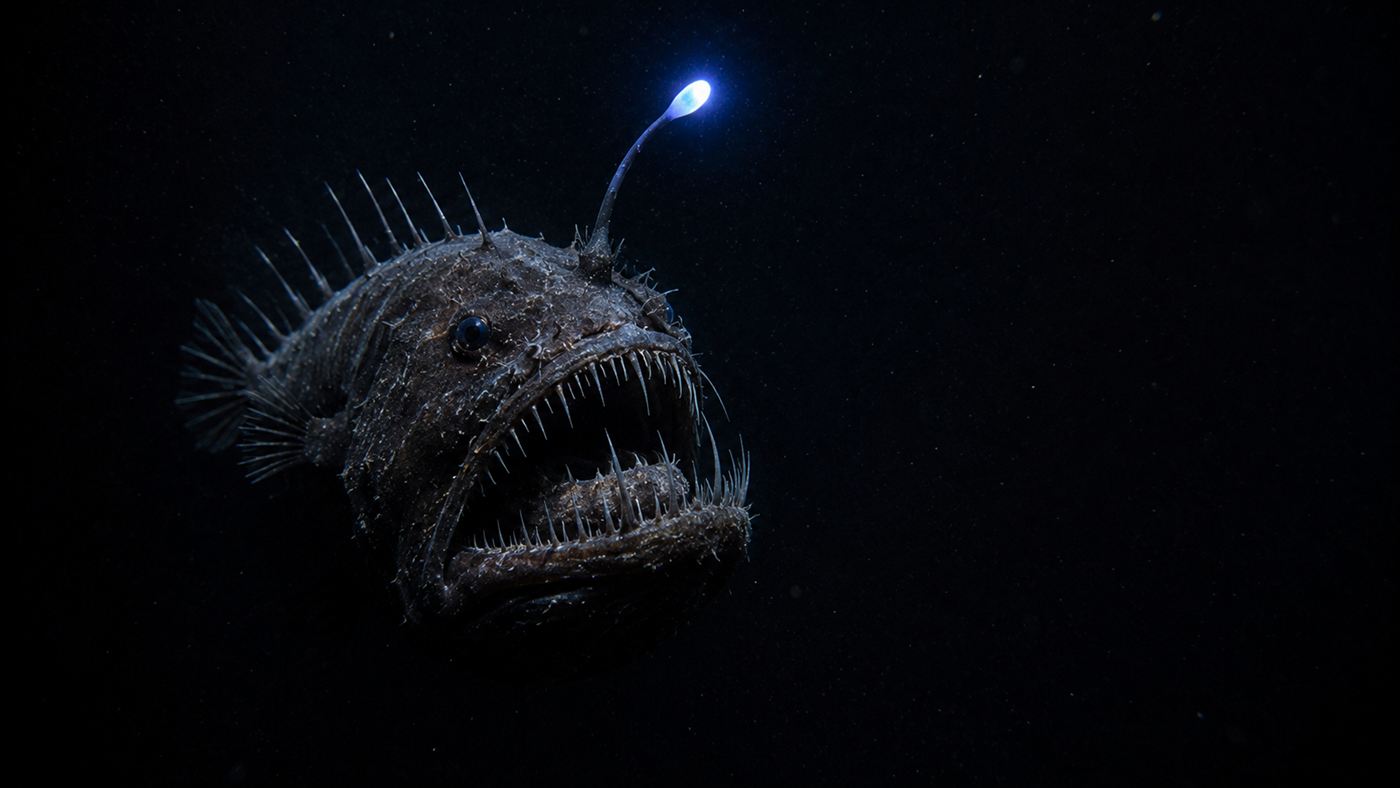
The anglerfish dangles a glowing lure above a mouth full of needle teeth. Illustration: Watts & Wild.
The deep-sea anglerfish lives in the cold black water between about a thousand and four thousand metres down, where the pressure would crush a submarine and a meal might drift past only rarely. Everything about it is shaped by scarcity, and its two most famous tricks, the glowing lure and the fused mate, are both answers to the same brutal question: how do you find anything at all in the dark?
The first answer is to make your own light. The second, stranger answer is to hold on to the first mate you ever find and never, ever let go.
Fishing with light in the dark
Over millions of years, the front spine of the anglerfish's dorsal fin migrated forward until it dangled out over its head like a fishing rod, tipped with a small fleshy bulb called the esca. That bulb glows, and in the total darkness it is the only thing a passing animal can see, a tiny point of light in an endless void. Curious creatures swim toward it, straight into the reach of a huge mouth lined with long, inward-curving teeth.
Because food is so rare, the anglerfish cannot afford to be fussy. Its jaws and stomach can stretch enormously, letting it swallow prey as big as itself on the rare occasions something comes within range. The glowing lure is not a luxury, it is the difference between eating once in a while and not eating at all.
The lamp the anglerfish cannot light itself
Here is the first twist: the anglerfish does not actually make the light. The glow comes from billions of bioluminescent bacteria that live inside the esca, producing light through a chemical reaction. The fish provides the bacteria with a safe home and a supply of nutrients, and in exchange it borrows their light to hunt, a partnership written into its own head.
Each kind of anglerfish tends to pair with its own particular species of glowing bacteria, and those bacteria have become so dependent on their host that they can barely survive alone any more, their genomes shrunken over time. It is a living lantern, but one the fish could never switch on by itself. The most iconic light in the deep ocean is, in truth, a loan.
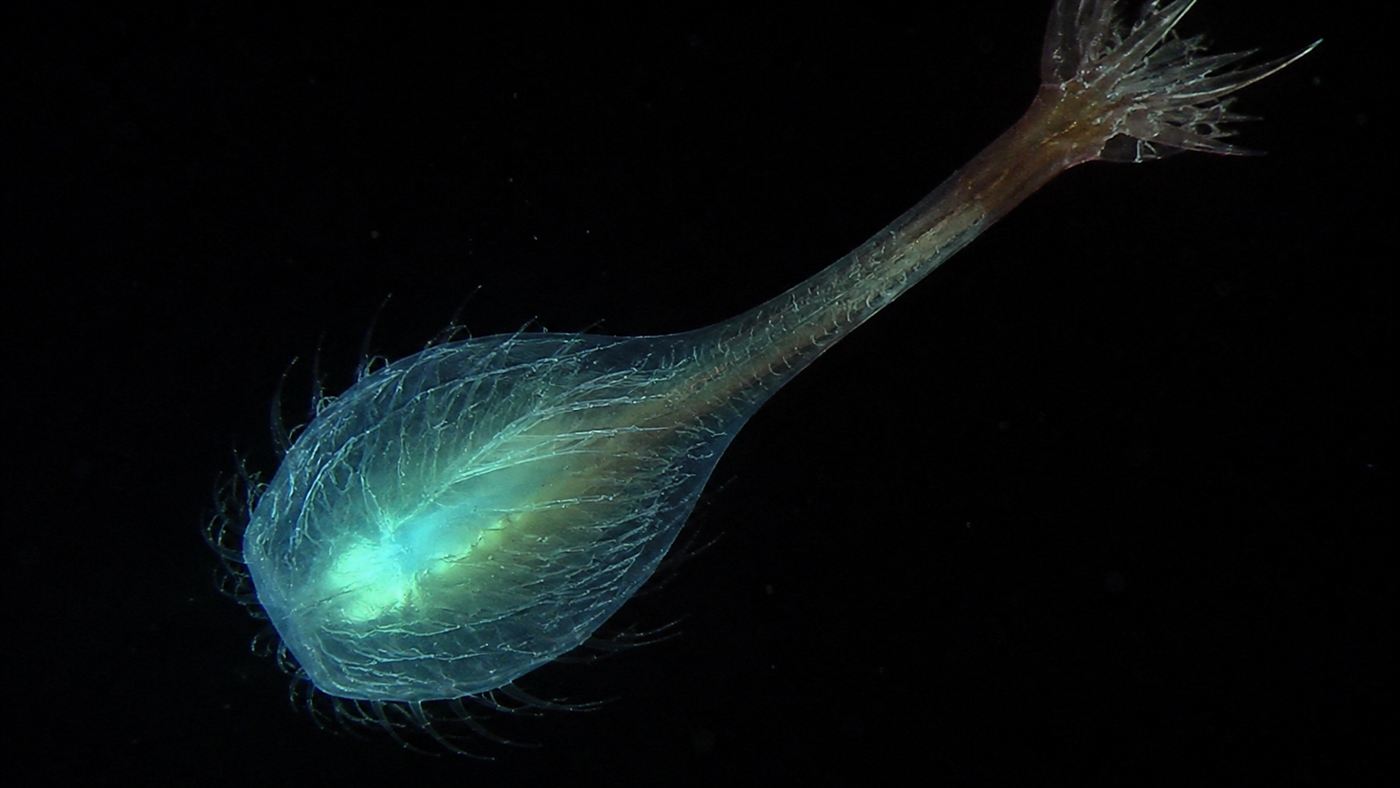
The males that dissolve into their mates
The lure is only the start of the strangeness. In many deep-sea anglerfish, the female is the large, toothy hunter everyone pictures, while the male is a tiny creature a fraction of her size, with no real lure and a barely functioning gut. He is born for one purpose only: to find a female in the dark before he starves, using huge eyes and a keen sense of smell.
When he finds her, he does not court her so much as latch on. He bites into her skin and releases enzymes that begin to fuse his mouth to her body. Over the following weeks their tissues knit together and their bloodstreams join, his eyes and fins and organs wither away, and he shrinks into little more than a permanent lump on her flank that produces sperm on demand. A single female can carry several of these fused males at once, a cluster of mates she will never have to go looking for again. Biologists call it sexual parasitism, and it is the most extreme version of it anywhere among animals with backbones.
Giving up the immune system for love
That fusion should not even be possible. In almost any other animal, joining your flesh permanently to another individual's would trigger the immune system to attack the foreign tissue, the same way a body rejects a mismatched transplant. Somehow the anglerfish does not reject its mate. Studies have found that these fish have given up large parts of the very immune defences that protect the rest of us, trading away their ability to fight foreign tissue in order to let two bodies become one.
It is a staggering bargain. To guarantee a mate in a place where mates are almost impossible to find, the anglerfish has surrendered part of the immune system that any other creature would consider essential. Everything about this animal is a deal struck with the emptiness around it.
The honest catch
A couple of clarifications keep this honest. Anglerfish are not a single creature but a sprawling group of hundreds of species, and the dramatic, permanently fused male belongs only to the deep-sea branch; not all anglerfish do it, and even among those that do, some males attach only briefly. The glowing female with the dangling lure that everyone pictures is just one part of a much larger family. Bioluminescence itself is common in the deep, not unique to this fish, and the exact uses of the glow may go beyond luring prey.
But the wonder survives the footnotes. In the most hostile, lightless place on the planet, an animal learned to grow its own lamp from borrowed bacteria and to fold its mate permanently into its flesh, both of them answers to a world with almost nothing in it. The deep sea does not reward the picky or the proud. It rewards whatever works, however strange.
A fish grows a lantern from bacteria and lets its mate melt into its body, just to survive a place with nothing in it. Is the anglerfish a monster, or simply the most honest answer to a world of total darkness? Tell us what you think in the comments.
Related reading: the bay that glows blue at night, lit by billions of tiny living lights. See also the hagfish, the jawless fish that chokes sharks with slime and ties itself in knots. And off Brazil, one expedition just found more than 30 new deep-sea species in days.