Divers in the Solomon Islands thought they had found a shipwreck, but it was the largest coral on Earth, a single 300-year-old creature of nearly a billion polyps so big it can be seen from space
In October 2024, a team filming in the Solomon Islands spotted what looked like a vast rock, or the wreck of a ship, just under the surface. It turned out to be alive. They had found the world's largest coral, a single colony three centuries old and bigger than a blue whale, the biggest such organism ever recorded.
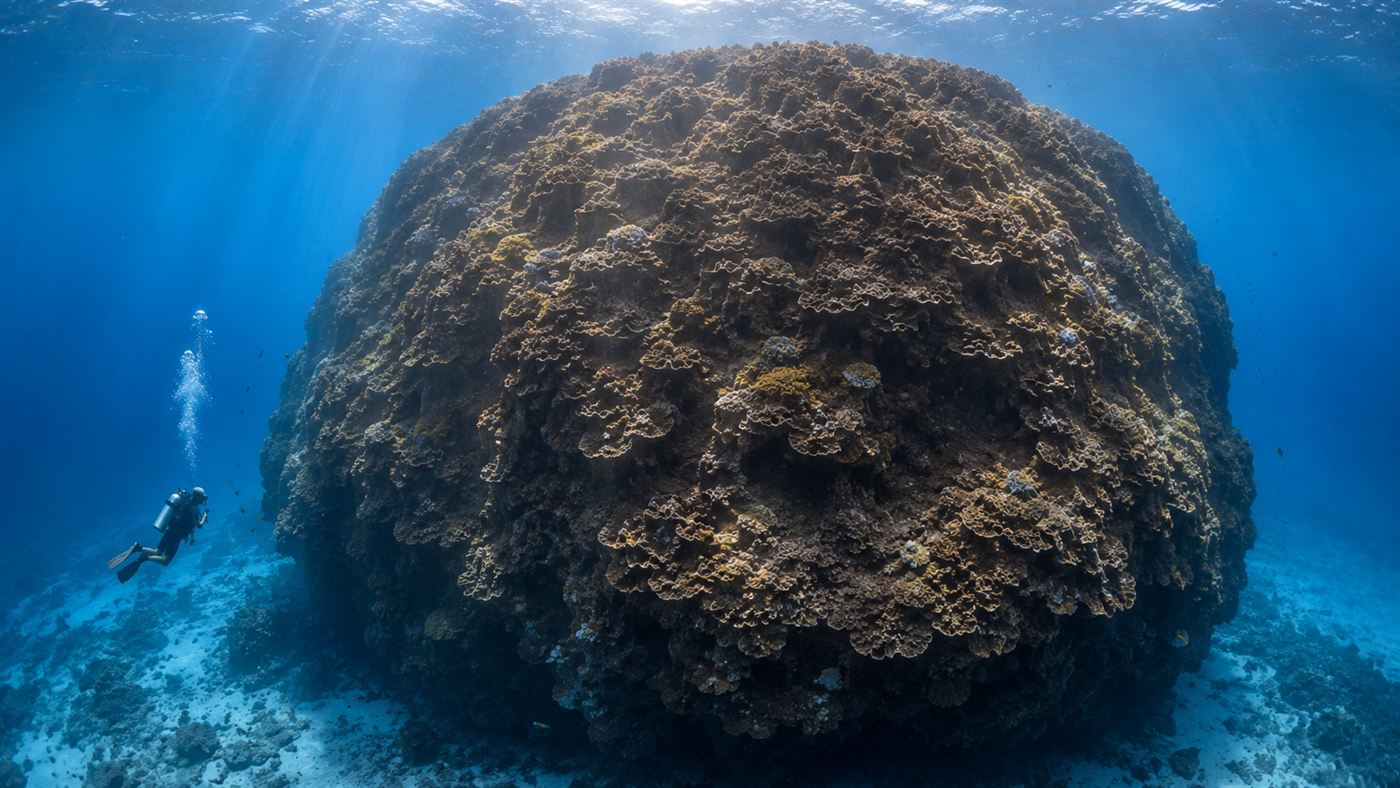
The mega coral is longer than a blue whale, dwarfing the diver beside it. Illustration: Watts & Wild.
The discovery happened almost by accident. A team from the National Geographic Society's Pristine Seas project was working in the waters of the Solomon Islands, in the southwest Pacific, when they noticed an enormous shape under the boat. As National Geographic recounted, the team at first thought the huge brown mass might be the remains of a shipwreck, because nothing living was supposed to be that big. When they dived down to look, they realised it was a single, continuous coral.
Molly Timmers, the lead scientist on the expedition, described the find as completely serendipitous. The team had not gone looking for a record. They simply swam into one of the most extraordinary living structures on the planet, a creature that had been sitting quietly on the seabed since long before the boat, the camera, or the country that sent them existed.
One coral, nearly a billion polyps
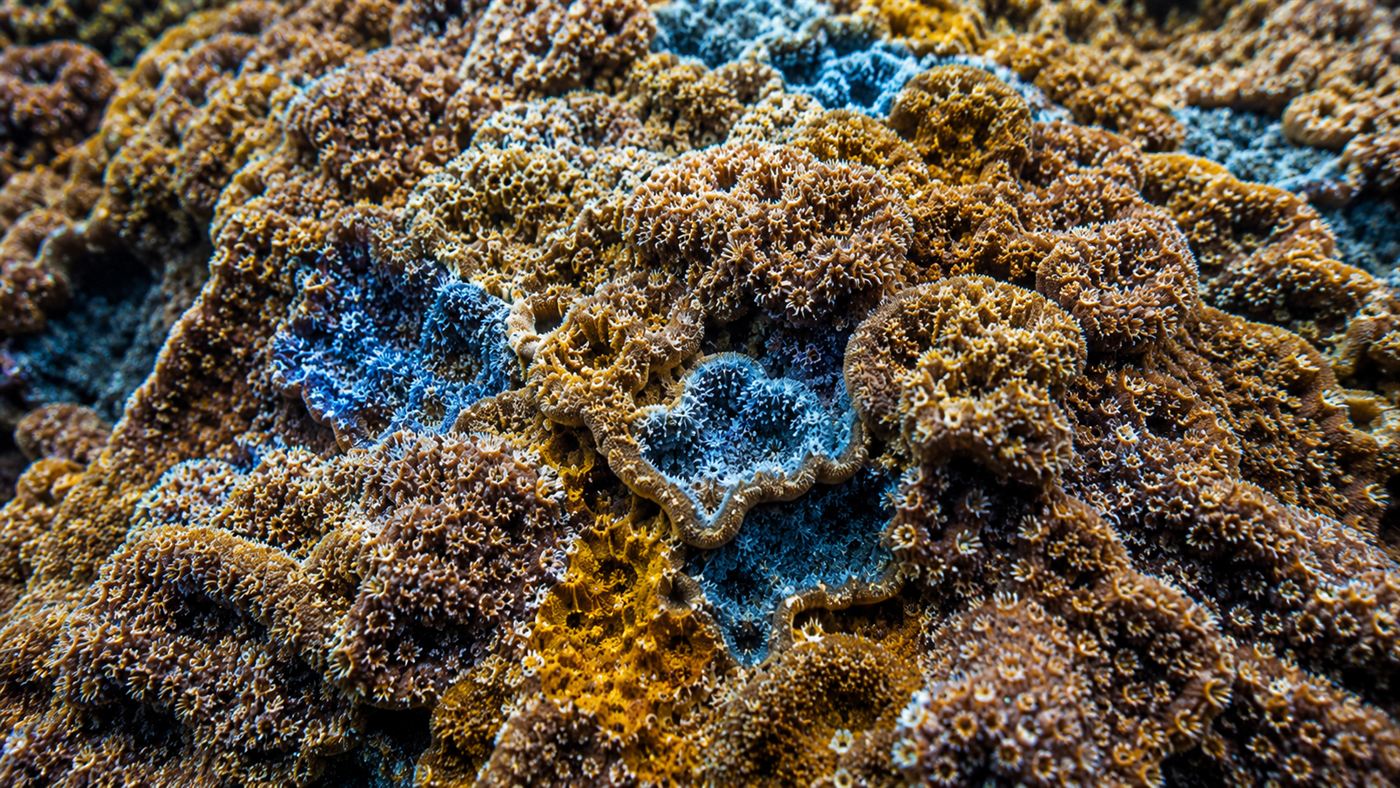
It helps to be clear about what a coral like this actually is, because it is easy to picture a reef. This is not a reef. A reef is a whole community of many separate corals, fish and other life. What the divers found is a single colony, one organism, made of nearly a billion tiny polyps, all genetically identical, all descended from one founding polyp and living together as a single connected body.
Each of those polyps is a soft little animal no bigger than a fingernail, building a shared skeleton of limestone beneath it. Multiply that by close to a billion and let it grow for three centuries, and you get this: a brown dome shot through with flashes of yellow, blue and red, of a species called Pavona clavus, sprawling across the seabed on a scale that belongs to geology more than biology.
Bigger than a blue whale, older than most nations
The measurements are what tip it from impressive into staggering. The colony is about 34 metres wide and 32 metres long, which makes it longer than a blue whale, the largest animal that has ever lived. As Al Jazeera reported, that makes it roughly three times the size of the previous record holder, a coral known as Big Momma in American Samoa.
It is so large that it shows up in satellite imagery, a living thing visible from space. And it is old. Researchers estimate the colony has been growing for around 300 years, which means it was already a substantial coral when the first steam engines were being built, and it has survived everything the ocean has thrown at it since. To stand, or rather float, next to something that has been alive and growing that long is a genuinely humbling thing.
Why it survived when so many corals are dying
The discovery is bittersweet, because it comes at the worst possible time for coral in general. Rising sea temperatures have triggered mass bleaching events around the world, in which stressed corals expel the algae that feed and colour them and often die. Against that backdrop, finding the biggest, healthiest coral ever recorded feels almost miraculous.
Part of the answer seems to be where it sits. The colony lies in slightly deeper, cooler water than the shallow reefs that bleach first, which may have sheltered it from the worst of the heat. Scientists have been careful to frame it as a beacon of hope rather than proof that corals are fine, a reminder that the ocean still holds resilient giants worth protecting, even as the shallows struggle.
The honest catch
It would be a mistake to read one enormous survivor as good news for coral as a whole, and the researchers have not. This single colony is an exception, protected by luck and depth, not evidence that the wider crisis has eased. The reefs that most marine life depends on are still bleaching and dying at an alarming rate, and a 300-year-old coral is not immune to a warming ocean, only better placed than most for now.
There is also a quieter risk in simply knowing where it is. A structure this rare and this famous needs protection from the boats, anchors and tourism its own fame can attract, which is part of why the exact site is being carefully managed. The giant has survived three centuries unbothered precisely because no one knew it was there. Keeping it safe now is a responsibility that comes with the discovery.
Why the world's largest coral matters
It is rare, in a world that feels thoroughly mapped, to stumble on something this big that nobody knew existed. A single living animal the size of a small building, three hundred years old, hiding in plain sight just beneath the surface, is a reminder of how much of the ocean we still have not seen.
The largest coral on Earth has been quietly building itself for three centuries, one tiny polyp at a time, and we found it almost by chance in 2024. Whether it becomes a symbol of resilience or a monument to what we are losing depends a great deal on what happens to the ocean around it. Does a discovery like this leave you hopeful for the reefs, or more worried about everything we might lose before we even find it? Tell us what you think in the comments.
Related reading: New York just finished a 111 million dollar living seawall off Staten Island, a 2,400 foot chain of eight stone reefs built to grow oysters and break storm waves. And scientists are now breeding corals by the million to replant damaged reefs.