Most animals that mimic can only copy one thing, but the mimic octopus can impersonate a dozen different creatures, and it seems to pick which disguise to wear for each threat
In nature, plenty of animals fake being something else, a harmless fly dressed as a wasp, a moth patterned like an owl. But they each have a single costume. The mimic octopus carries a whole wardrobe, and changes outfits depending on who is trying to eat it.
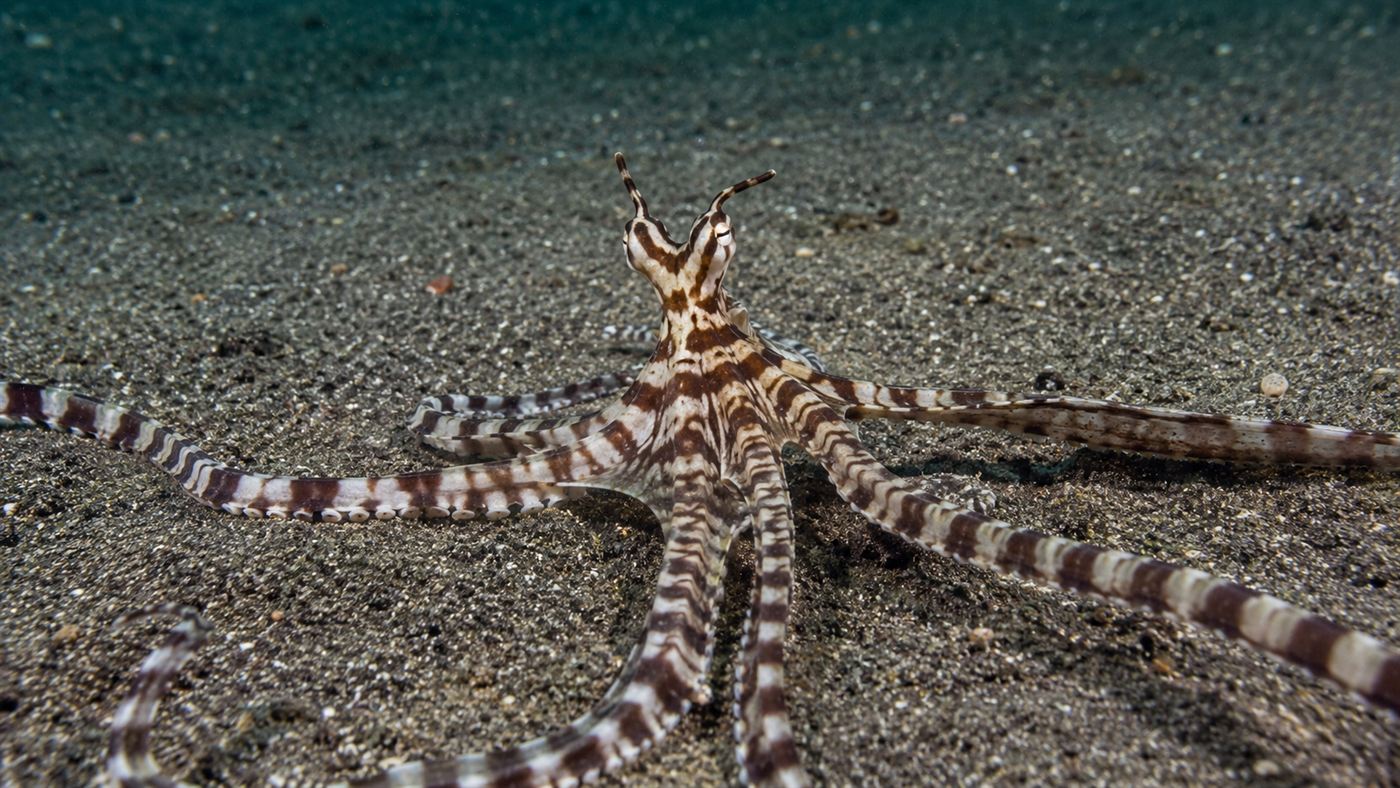
The mimic octopus on the open seabed, where it has nowhere to hide but its disguises. Illustration: Watts & Wild.
Octopuses are already the great quick-change artists of the sea, able to shift colour and texture in an instant to melt into a reef or a patch of sand. But the mimic octopus takes that talent somewhere stranger and more theatrical. It does not just blend in. It actively pretends to be entirely different animals, and not just one of them, but a rotating cast of at least a dozen, complete with the right shape, colour and even the right way of moving.
As the record of the species notes, the mimic octopus and its close relative are among the only animals known to actively imitate several different animals to elude predators. Most creatures that mimic are locked into a single impression for life. This octopus improvises, choosing from a repertoire, which makes it one of the most remarkable performers in the entire animal kingdom.
The short version: The mimic octopus, from the Indo-Pacific, is one of the only animals known to actively impersonate many different species, including lionfish, sea snakes and flatfish. It lives on open seabeds with nowhere to hide, so it survives by using its shape, colour and movements to look like more dangerous animals, and it appears to pick the right disguise for the threat it is facing.
One animal, many disguises
The mimic octopus, scientific name Thaumoctopus mimicus, was only discovered in 1998, off the coast of Sulawesi in Indonesia, on the muddy bottom of a river mouth. That is remarkably recent for such a spectacular animal, and it hints at how much is still hidden in the sea. It is a modest-looking creature, striped brown and white, with long, slender arms, and it lives across the Indo-Pacific.
What sets it apart is the breadth of its act. Divers and scientists have watched it take on the appearance of many different animals, and while the exact number is debated, a handful of impersonations are well documented and utterly convincing. This is not the general camouflage that all octopuses use. It is targeted impersonation of specific, recognisable creatures, performed on demand.
How to become a lionfish or a sea snake
The techniques are wonderfully clever. To imitate a venomous lionfish, the octopus hovers above the seabed and spreads all its arms out around its body, so the trailing limbs look just like the fish's array of poisonous spines. To become a flatfish, it does the opposite, pulling its arms tightly behind it and jetting along the bottom as a single flat, undulating shape.
Its most famous trick may be the sea snake. The octopus buries six of its eight arms out of sight and holds the remaining two out stiffly in opposite directions, banded in warning colours, so that it looks exactly like a deadly sea snake gliding through the water. Each disguise borrows the reputation of an animal that predators have learned to leave alone, letting a soft, edible octopus wear the armour of something dangerous.
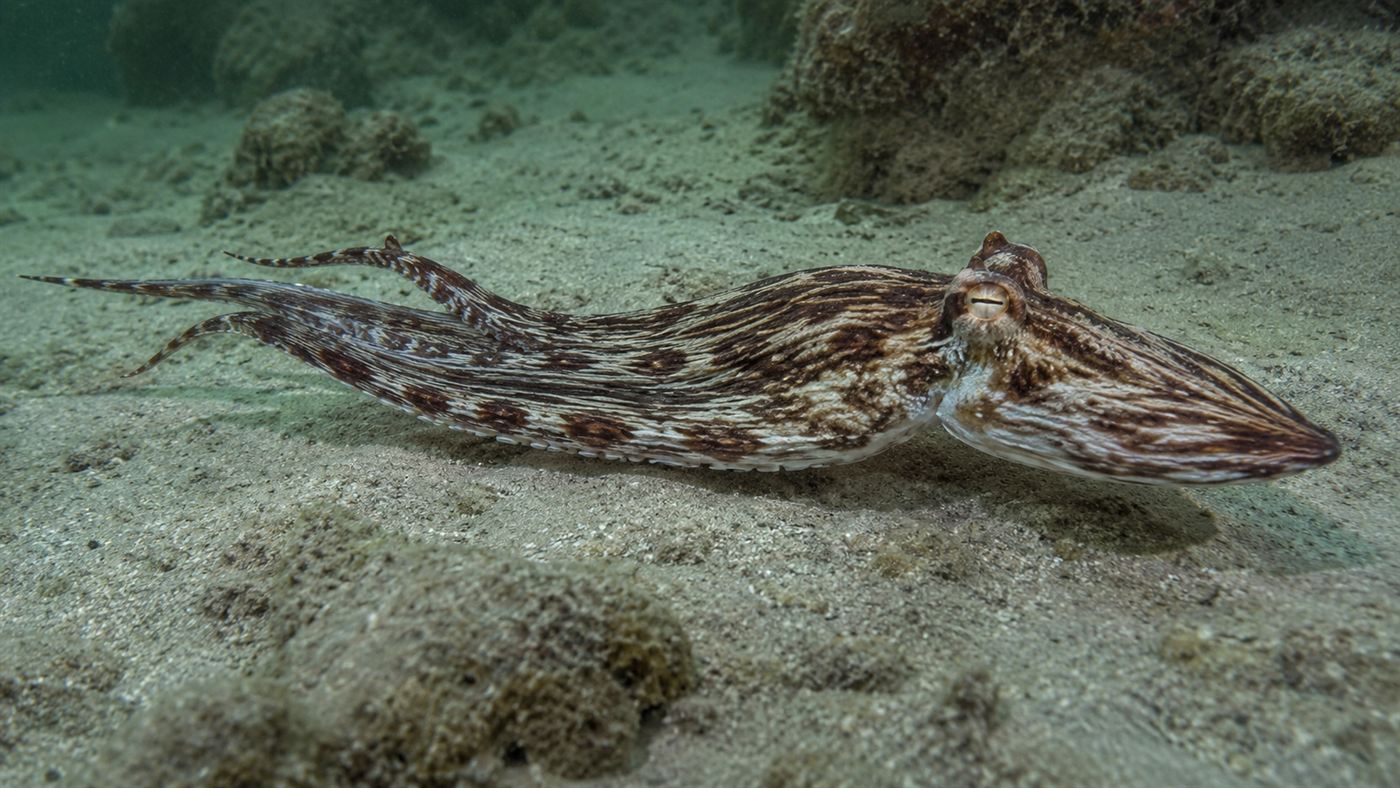
Choosing a costume for the threat
The most astonishing claim about the mimic octopus is that it does not just have costumes, it may choose them wisely. Observers have noticed that the animal it decides to impersonate can match the danger it is facing at that moment, as if it understands which disguise will scare off which enemy.
The classic example involves damselfish. When a mimic octopus is being harassed by damselfish, it has been seen to transform into a sea snake, which happens to be a predator that hunts damselfish. In other words, the octopus appears to answer a specific threat by turning into that threat's own nightmare. If that interpretation holds, it is not just mimicry, it is mimicry aimed with something close to strategy.
Why the mimic octopus needs so many faces
To understand why the mimic octopus evolved such an elaborate act, look at where it lives. Most octopuses shelter among rocks, coral and crevices, ducking out of sight when danger appears. The mimic octopus instead roams open expanses of bare sand and mud, exposed river-mouth flats with almost nowhere to hide. Out there, ordinary camouflage is not enough.
Stripped of hiding places, and being a boneless, defenceless parcel of meat, it needed another way to survive, and impersonation became its armour. Interestingly, its preferred guise seems to be the flatfish, a harmless shape it can hold while going about its day. One study watching a single individual over five days recorded it mimicking a flatfish around five hundred times. The many faces of the mimic octopus are not a party trick, they are the price of living out in the open where everything can see you. Its skill at camouflage did not just hide it, it let it walk around in plain sight wearing someone else's threat.
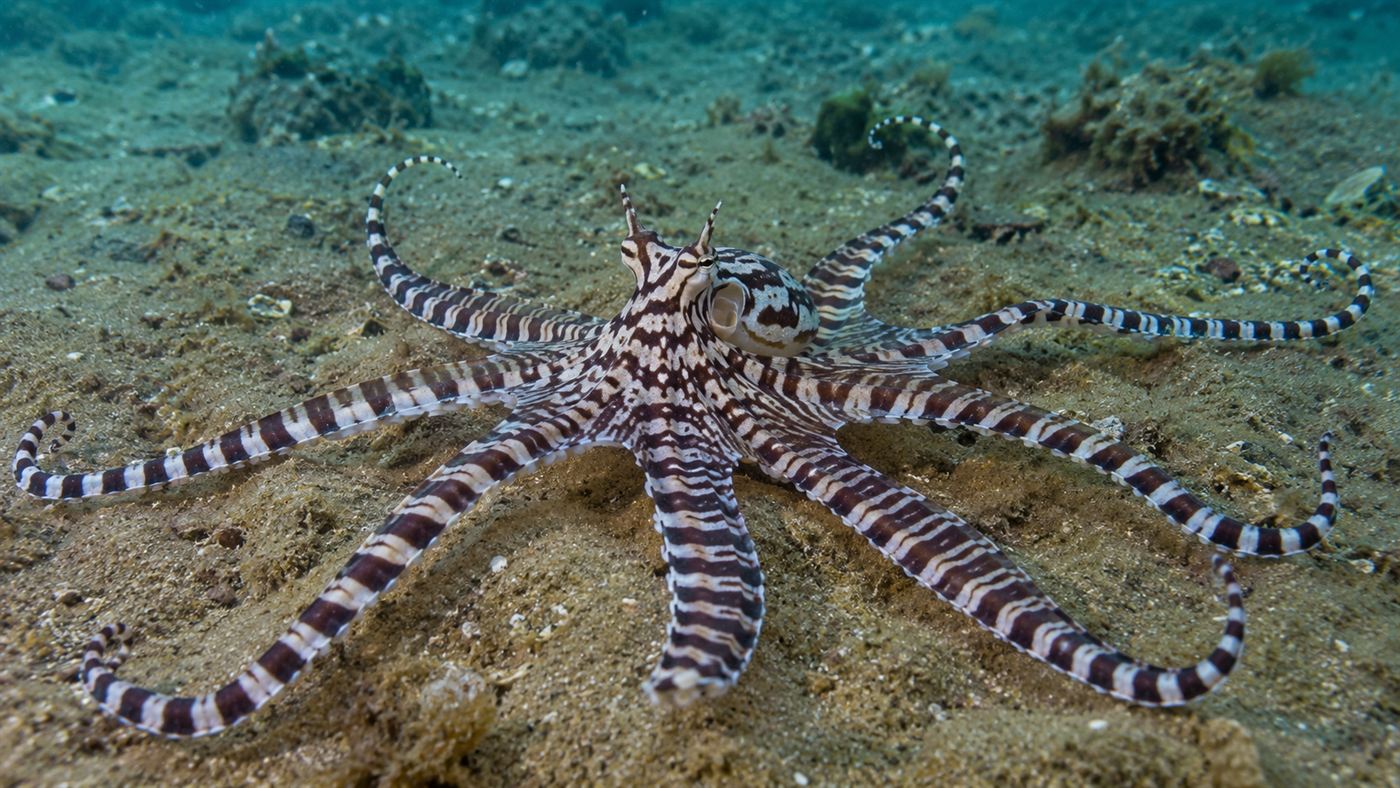
Masters of a shape-shifting family
The mimic octopus is the flamboyant star of a genuinely uncanny group of animals. All octopuses are soft, brainy and astonishingly good at changing their appearance, using special colour cells in their skin and muscles that can raise bumps and ridges to alter their texture in a heartbeat. They are, in a sense, walking screens that can repaint themselves.
What the mimic octopus adds is behaviour. It combines the family's skin tricks with a repertoire of movements and postures to complete the illusion, so that it does not merely look like a sea snake but swims like one too. It is a striking reminder that intelligence in the ocean took a completely different path from ours, producing a soft, boneless mind that thinks, in part, by reshaping its own body into whatever it needs to be.
The honest catch
As with any crowd-pleasing animal, the legend runs a little ahead of the proof. The mimic octopus is often said to impersonate fifteen or more species, but only a few of those, the flatfish, lionfish and sea snake, are really well documented. Many of the others come from one-off diver reports and are not firmly confirmed, so the full glittering list should be taken with some caution.
The idea that the octopus deliberately chooses a disguise to suit each predator is likewise compelling but not fully proven. As the Ocean Conservancy has described, the mimic octopus is a genuine master of disguise, but it is also a fairly newly discovered, still understudied animal, and it is easy to project more conscious cleverness onto it than the evidence yet supports. None of that dims the real marvel, though. Here is a defenceless creature on an empty seabed that survives by convincingly becoming other, scarier animals, and even the modest, confirmed version of that talent is one of the strangest and most brilliant survival strategies in the sea.
A defenceless octopus stays alive by turning into whichever dangerous animal a predator fears most. Does the mimic octopus reveal a kind of ocean intelligence as sophisticated as our own, or are we too eager to read strategy into a very clever reflex? Tell us what you think in the comments.
Related reading: The cuttlefish, a colour-blind cousin that still camouflages itself perfectly against any background, or the Portuguese man o' war, a drifting animal that is really a colony.
More from Watts & Wild
More in Energy & the Wild →

Maria writes about wildlife, ecology, and the strange places where nature and human history collide. She is based in Brazil.