A slime mold has no brain, no nerves and is not even an animal, yet it can solve a maze and design a transport network better than teams of human engineers
It looks like something you would scrape off a damp log and never think about again, a spreading smear of bright yellow goo. But the slime mold can do things that sound impossible for a creature with no brain, and in doing them it quietly asks a very large question: what is intelligence, really?
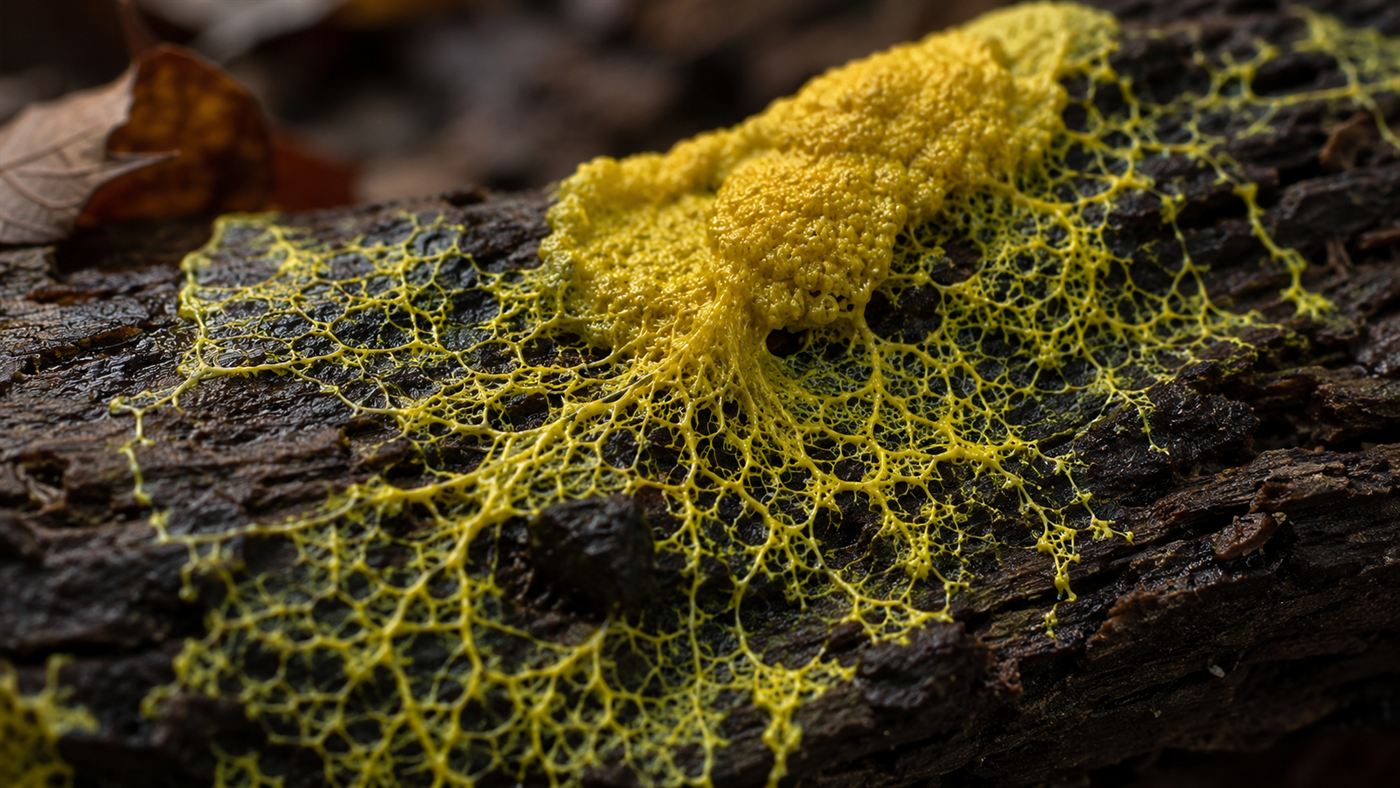
The slime mold Physarum is a single cell that spreads into a living network. Illustration: Watts & Wild.
The slime mold in question is called Physarum polycephalum, and it is one of the strangest organisms on Earth. It has no brain, no nerves, not a single neuron. And yet, in a series of experiments that have delighted and unsettled scientists, it has solved mazes, made efficient decisions, and even reproduced the layout of one of the world's great railway systems. It should not be able to do any of this, and it does it anyway.
As Scientific American reported, a slime mold was able to build a network almost identical to the Tokyo rail system, a design that took human engineers many years to perfect. The blob did it in about a day. To understand how, you first have to accept what this creature actually is, because it is not what you think.
The short version: Physarum polycephalum is a slime mold, a single-celled organism with no brain. In experiments it has found the shortest path through a maze and grown a network mirroring the efficient, fault-tolerant Tokyo rail system. It achieves this not by thinking but through simple biochemical rules, which is exactly why it challenges our idea of what intelligence requires.
Neither plant, animal, nor fungus
Despite the name and the look, a slime mold is not a mold or a fungus. Physarum belongs to a strange group of life all its own, and in its active phase it is essentially one enormous single cell, filled with many nuclei, that can grow to cover a dinner plate. It oozes across forest floors and rotting logs, engulfing bacteria and spores as it goes.
What it does not have is any of the machinery we associate with cleverness. There is no brain, no nervous system, no controller sitting somewhere issuing orders. It is, in the most literal sense, mindless. And yet this single-celled smear behaves, when you set it a problem, as if it were carefully working things out, which is the puzzle that has drawn researchers to it for decades.
The blob that solved a maze
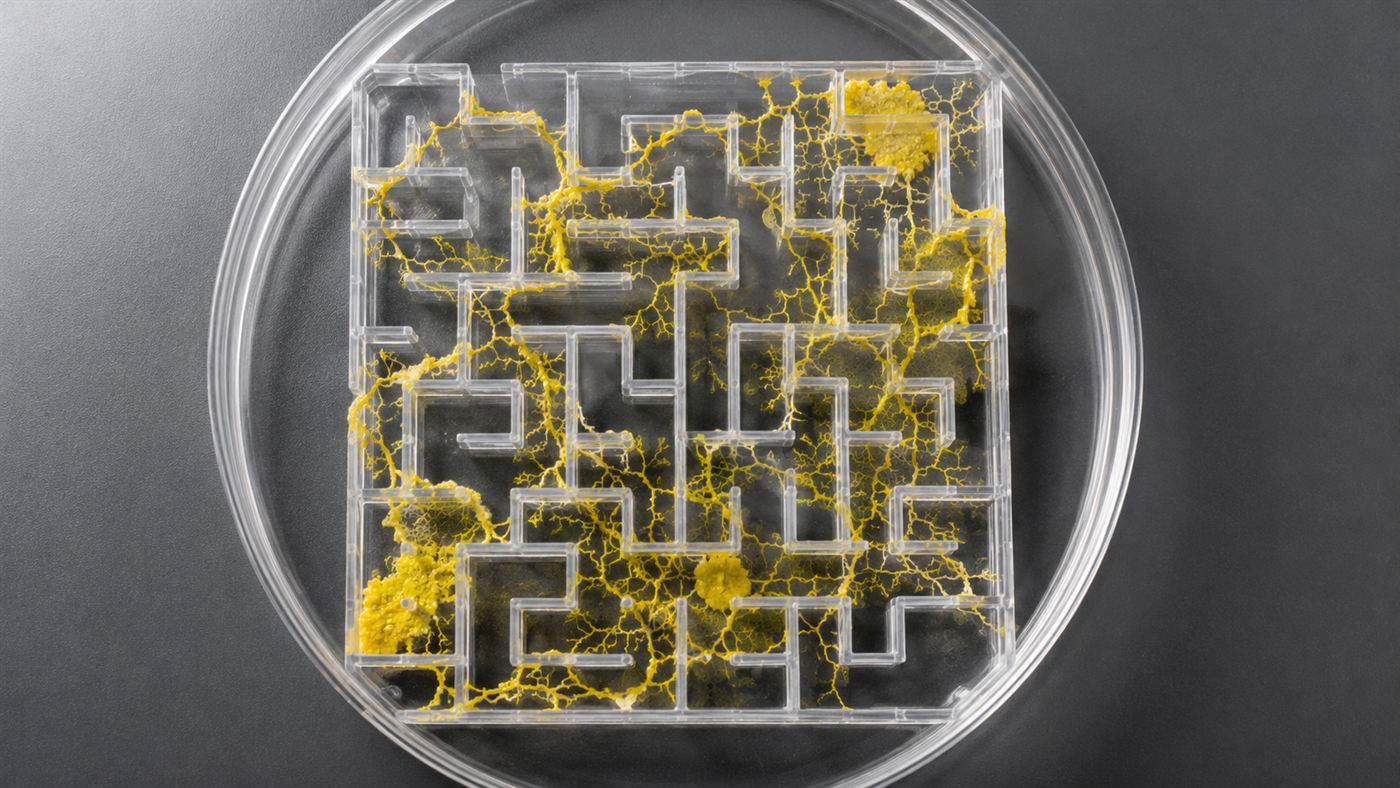
The experiment that made Physarum famous took place in Japan in 2000. Scientists placed a slime mold into a small plastic maze and set a tempting flake of oats at each of two exits. At first the mold did the only thing it knows how to do, spreading out to fill every corridor of the maze, dead ends and all, searching blindly for food.
Then something remarkable happened. Having found food at both ends, the mold began to withdraw from the passages that led nowhere and thicken the tubes that connected the two meals. After about a day, it had abandoned every wrong turn and left a single fat tube running along the shortest possible route through the maze. The result was published in a leading journal under a title that says it all: maze-solving by an amoeboid organism.
Rebuilding the Tokyo rail map
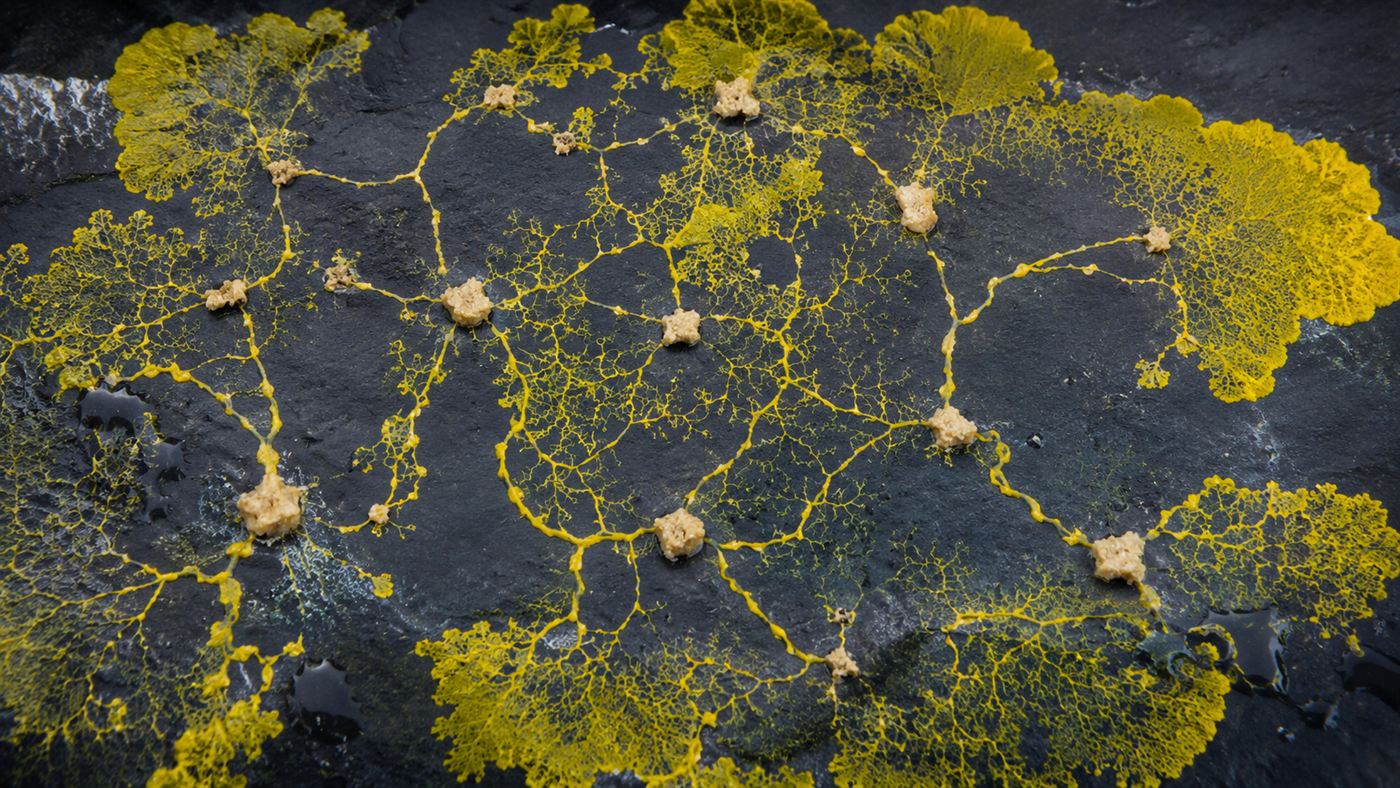
If the maze was a party trick, the next experiment was genuinely startling. In 2010, researchers laid out oat flakes on a surface in the pattern of the cities and towns surrounding Tokyo, a little edible map of the region. Then they let a slime mold loose in the middle and watched it grow outward to connect the food.
As National Geographic described, the network the mold produced closely matched the real Tokyo rail network, one of the most efficient and heavily used transit systems on the planet. The Tokyo rail network is the product of decades of expert planning, cost analysis and revision. The slime mold arrived at a strikingly similar solution, balancing efficiency against resilience, in the time it takes to grow across a dish.
How the slime mold thinks without a brain
So how does a brainless blob do it? The answer is beautifully simple, and it is not thinking in any way we would recognize. The slime mold explores everywhere at once, and inside its body, the tubes that happen to carry a lot of flowing nutrients grow thicker, while tubes that carry little gradually shrink and disappear. Useful routes are reinforced, useless ones are abandoned, automatically.
Out of that one simple rule, applied everywhere in the creature at the same time, an efficient network emerges, with no plan and no overview of the whole. It is problem-solving without a problem-solver. Some studies suggest Physarum can go further still, learning to ignore a harmless irritant over time and even passing that habit to another mold by merging with it, all with no memory organ to store the lesson in.
What a yellow blob teaches us
This is why a humble slime mold ends up in serious scientific conversations about intelligence. It shows that some of the things we treat as signs of a clever mind, finding shortest paths, building efficient networks, adapting to circumstances, do not actually require a mind at all. They can emerge from simple rules running in parallel across a very simple body.
That idea has practical value. Engineers and computer scientists study Physarum for inspiration in designing networks that are efficient and fault-tolerant, from data routing to road and rail planning, precisely because the mold is so good at finding robust, economical layouts. A creature with no brain has become, of all things, a teacher for the people who build our smartest systems.
The honest catch
A word of caution is needed, because it is very easy to oversell this. Calling the slime mold intelligent, or saying it thinks, stretches those words past breaking point. It does not understand a maze or a map, and it has no goals or awareness. What looks like clever decision-making is really physics and chemistry, flow reinforcing flow, dressed up by our own instinct to see minds where there are none.
It also helps to remember that scientists carefully arrange these experiments, choosing where to put the food and how to shape the space, so the blob is not solving problems out of nowhere. Outside that narrow game of connecting food efficiently, Physarum is not solving anything. But even with all those qualifications, the core fact remains genuinely astonishing. A single cell, with nothing we would call a brain, can compute real solutions to hard problems. Intelligence, or something unnervingly like its results, turns out to be far cheaper and stranger than we assumed.
A brainless yellow blob solves problems that stump engineers, using nothing but simple rules. Should we call what the slime mold does a kind of intelligence, or does insisting on the word just flatter our need to see minds everywhere? Tell us what you think in the comments.
Related reading: The fairy circles of Namibia, another pattern that organizes itself with no designer, or the Boquila vine that copies the leaves of any plant it climbs.
More from Watts & Wild
More in Energy & the Wild →




Maria writes about wildlife, ecology, and the strange places where nature and human history collide. She is based in Brazil.