The Portuguese man o' war looks like a single drifting jellyfish, but it is really a colony of separate creatures, none of which could survive on its own
Wash up on a warm beach and you might find one, a beautiful, translucent blue bladder trailing long threads, and assume it is a jellyfish. It is not. The Portuguese man o' war is one of nature's strangest tricks, a creature that is not really one creature at all.
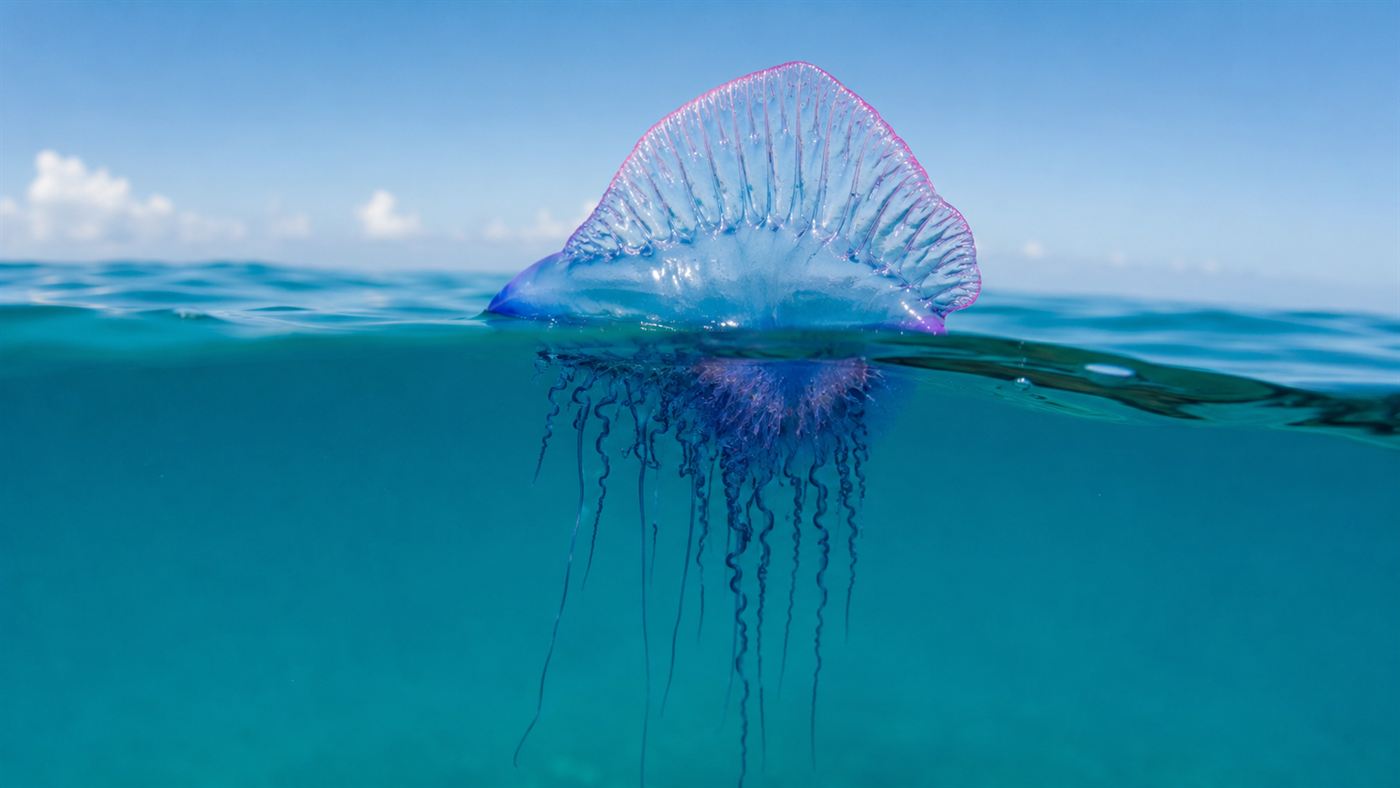
The Portuguese man o' war sails the open ocean on a gas-filled float. Illustration: Watts & Wild.
Almost everything most people believe about the Portuguese man o' war is wrong, starting with the basics. It is not a jellyfish, though it looks and stings like one. And it is not, in the way we normally mean the word, a single animal. It is something far stranger and more thought-provoking: a floating colony of many small, separate organisms that have specialised so completely, and depend on one another so utterly, that together they behave as one being.
As NOAA explains, the Portuguese man o' war is often mistaken for a jellyfish, but it is actually a siphonophore, an animal made up of a colony of organisms working together. That single fact turns a common seaside curiosity into one of the most quietly mind-bending creatures in the ocean, and a genuine puzzle about what it even means to be an individual.
The short version: The Portuguese man o' war is not a jellyfish and not a single animal. It is a siphonophore, a colony of specialized organisms called zooids. Some form its gas-filled float, some its stinging tentacles, some its digestion and some its reproduction. Each does one job and none could live alone, yet together they drift the seas and hunt as one creature.
Not a jellyfish at all
The resemblance to a jellyfish is understandable. Both are soft, translucent, drifting sea creatures armed with venomous, stinging tentacles, and both belong to the same broad family, the cnidarians. But the Portuguese man o' war, known to scientists as Physalia physalis, sits on a different branch of that family, the siphonophores, and its body plan is nothing like a true jellyfish.
A jellyfish is a single organism, one animal with one body. The man o' war only looks that way from a distance. Come closer, and its apparent unity dissolves into something much odder, a cooperative crowd of tiny bodies bundled so tightly together that you cannot see the joins. It wears the disguise of a single animal, but it is really a well-organised gang.
A colony pretending to be an animal
The organisms that make up the man o' war are called zooids, and here is the crucial part: each zooid is, in a sense, its own tiny animal, but it is so specialised that it can only do one job and cannot survive by itself. They are not like the cells of your body, which are parts of one organism. They are more like individual creatures that have given up living alone to become permanent organs of a shared, larger life.
This is what biologists mean when they call the man o' war a colonial organism, or a siphonophore. It blurs the line between one animal and many, sitting right on the boundary where the idea of a single individual starts to break down. A person is clearly one being. A flock of birds is clearly many. The Portuguese man o' war is somehow both at once, a fleet that functions as a ship.
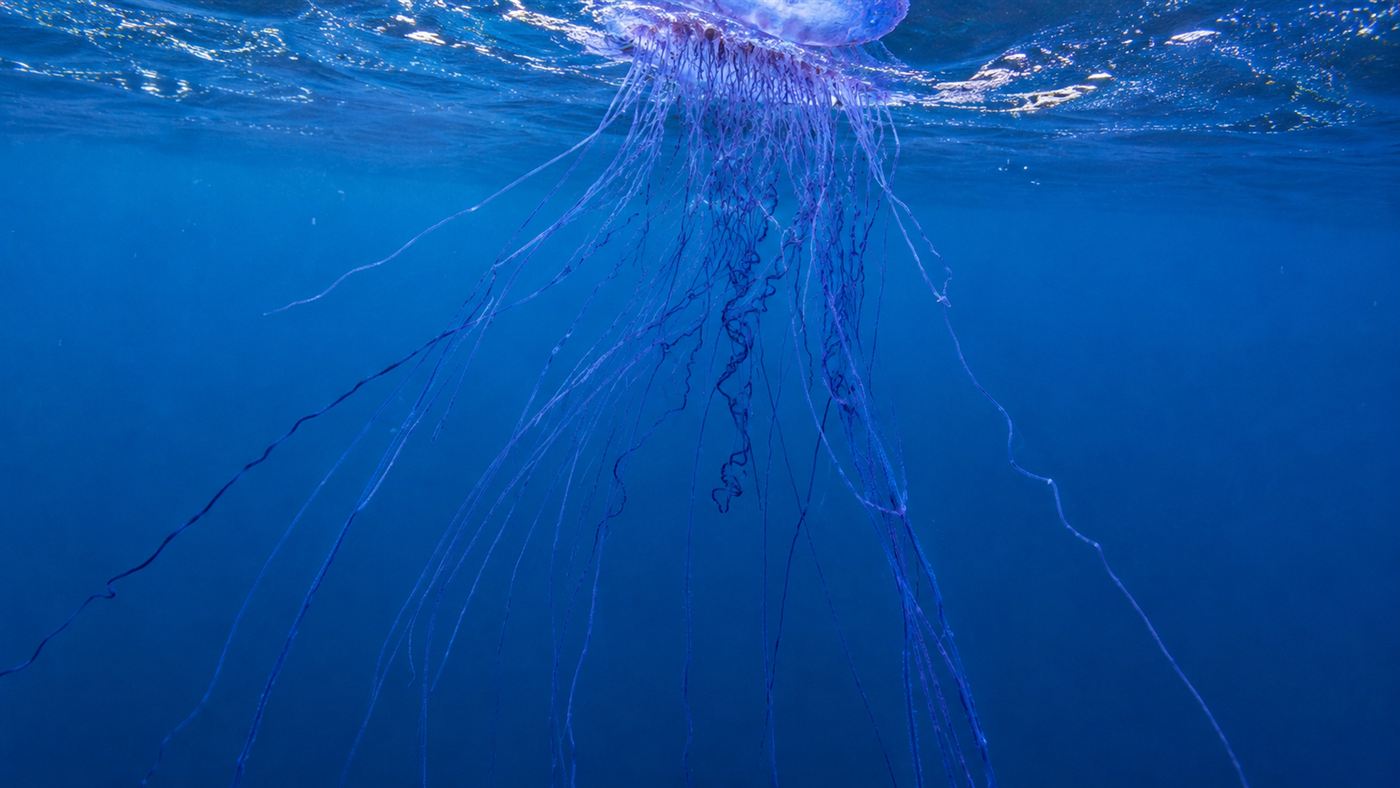
Four kinds of specialist
The colony is built from four main types of zooid, each a specialist. The most visible is the float, a gas-filled bladder that sits above the waterline in shades of blue, purple and pink. It is this sail-like float, catching the wind, that gives the animal its name, because to early sailors it looked like an old warship, a man o' war, under full sail.
Hanging beneath the float are the other specialists. Long tentacles, made of stinging zooids and capable of stretching many metres down into the water, are the colony's weapons and nets, studded with venom-filled cells that paralyse small fish and other prey. Another set of zooids handles digestion, wrapping around captured food to dissolve it, and another set handles reproduction. The whole thing is a division of labour so complete that no single member has a mouth, a stomach and a way to reproduce all at once. Only the colony, taken together, is a functioning animal. The tentacles catch the meal, the digestive zooids eat it, and everyone shares.
How the Portuguese man o' war lives
Because it has no means of swimming, the Portuguese man o' war is entirely at the mercy of the elements. Its float doubles as a sail, and the animal drifts wherever the wind and currents carry it across the open ocean, often gathering into great flotillas of thousands. In a neat evolutionary hedge, the floats come in left-leaning and right-leaning shapes, so that a single wind pushes the population in two different directions and they are never all blown ashore at once.
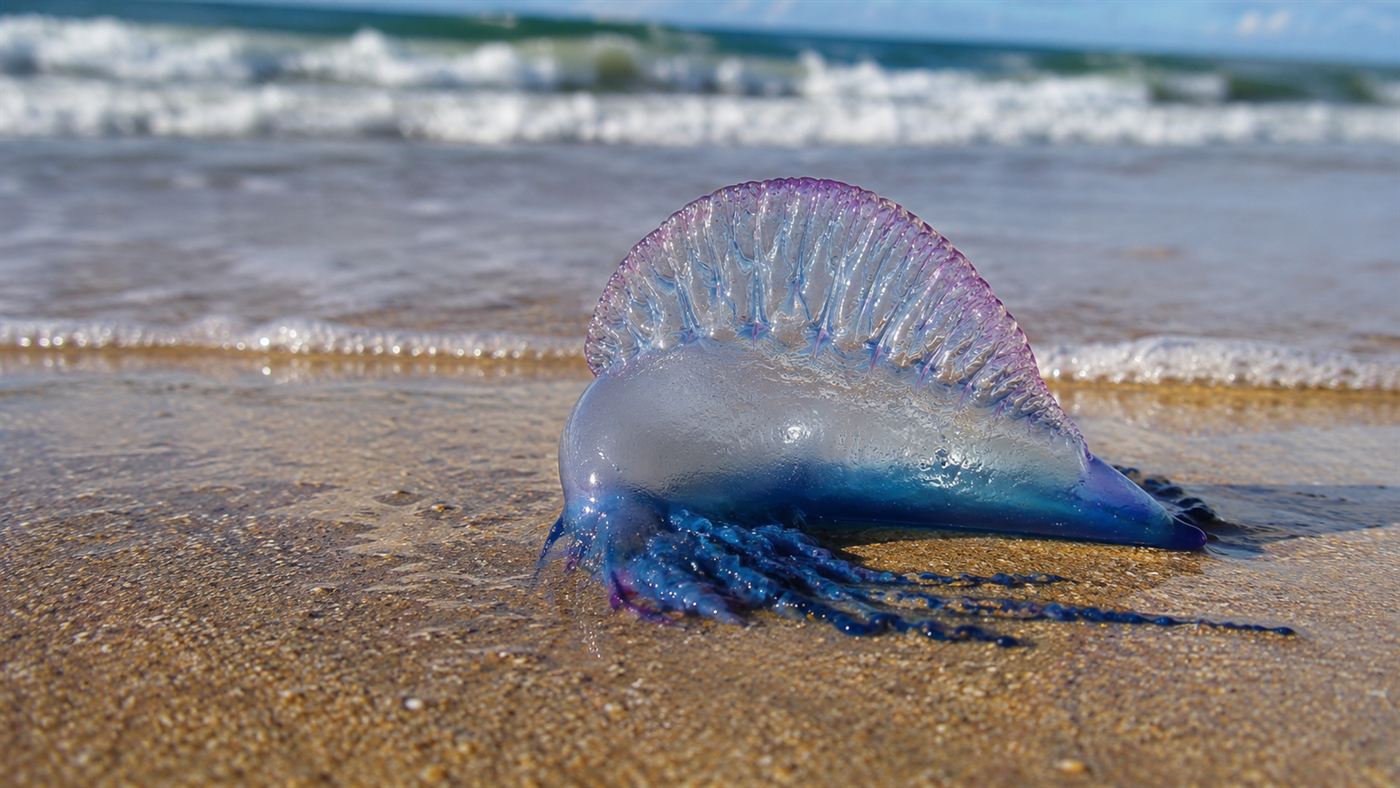
When they do reach the shore, they become a hazard, and a lingering one. The sting of a man o' war is intensely painful to humans, and the tentacles keep their venom even after the animal is dead and stranded on the sand, so a beached man o' war can still deliver a nasty sting hours later. It is beautiful, alien and best admired from a respectful distance, a drifting colony that has conquered the surface of the sea by being many things pretending, very successfully, to be one.
What is an individual, anyway?
The deepest thing the man o' war offers is not a fact but a question. We move through the world assuming that every living thing is either one individual or a group of them, and that the difference is obvious. This creature quietly proves that it is not. Its zooids all grow from a single fertilised egg and share the same genes, which makes them sound like one organism, yet they develop into physically distinct little bodies, which makes them sound like many.
So which is it, one animal or a colony of animals? The honest answer is that the question does not have a clean edge, and the man o' war lives in the blur. It is a reminder that the tidy categories we impose on nature, individual and group, self and other, part and whole, are our inventions, and that life is perfectly happy to ignore them. Somewhere off a warm coast right now, a few thousand of these strange committees are sailing along, each one a living argument that being a single self is not the only way to be alive.
The honest catch
It is worth admitting that the striking phrase, a colony of separate animals, is partly a matter of interpretation. Because all the zooids come from one egg and carry one set of genes and are fully wired together, some biologists prefer to call the man o' war a single organism built from modular parts, more like a body with unusual organs than a true gathering of individuals. The truth is that it sits genuinely in between, and the argument is as much about the definitions of our words as about the animal itself.
A couple of smaller cautions round it off. Calling it a jellyfish is the most common error, and it is a cnidarian cousin rather than the real thing. And while its sting is genuinely painful and occasionally causes serious reactions, deaths are very rare, so it deserves caution rather than dread. None of that lessens the wonder. Whether you count it as one creature or thousands, the Portuguese man o' war remains a beautiful, unsettling demonstration that nature draws the line around a single life wherever it likes, and sometimes does not draw it at all.
A creature you thought was one animal turns out to be a whole cooperative crowd. Does the Portuguese man o' war show that the line between an individual and a colony is more blurred than we like to admit, or is it simply one strange animal with unusually specialised parts? Tell us what you think in the comments.
Related reading: The mimic octopus, another soft-bodied ocean animal with a genius for survival.
More from Watts & Wild
More in Energy & the Wild →

Maria writes about wildlife, ecology, and the strange places where nature and human history collide. She is based in Brazil.