Off the northern tip of Scotland sits the world's largest tidal power station, turbines bolted to the seabed that spin with the pull of the moon to make the most predictable renewable energy on Earth
Solar power stops at night. Wind drops when the air goes still. But there is one renewable source that never surprises anyone, that can be written into a timetable centuries in advance, because it is governed by the orbit of the moon. In a violent stretch of water off the north coast of Scotland, a project called MeyGen is quietly turning that certainty into electricity, and MeyGen tidal power is now the largest project of its kind in the world.
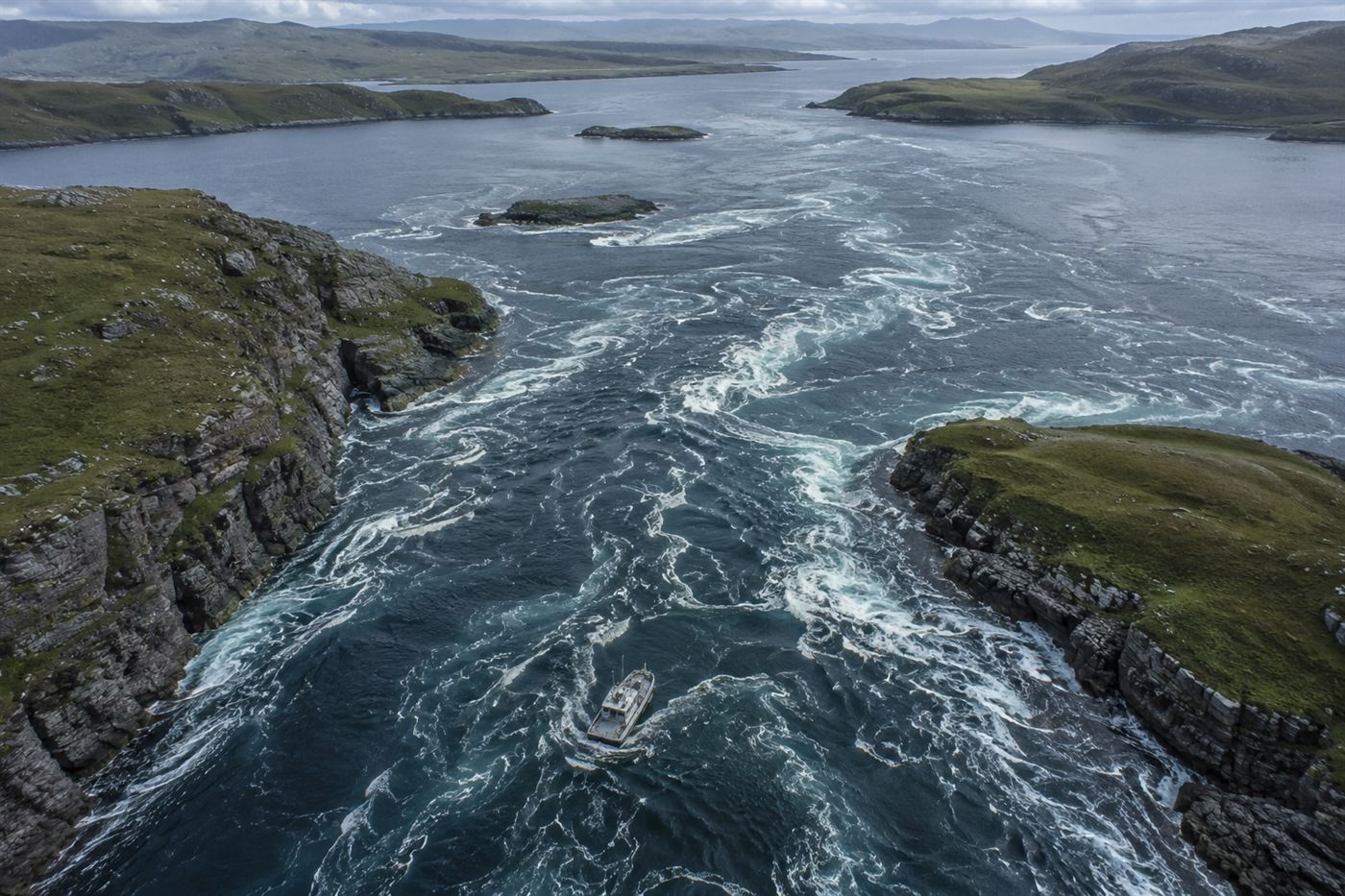
The Pentland Firth funnels two oceans through a narrow gap, creating some of the fastest tides on Earth. Illustration: Watts & Wild.
The water in question is the Pentland Firth, the narrow channel that separates the Scottish mainland from the Orkney Islands. Twice a day the Atlantic and the North Sea trade places through this gap, and squeezing that much ocean through such a tight space whips up tidal currents among the strongest anywhere in the world, fast enough to drag a ship sideways.
For centuries sailors treated the Firth as something to survive. MeyGen treats it as a fuel. Sitting on the seabed of a stretch called the Inner Sound, between the mainland and the little island of Stroma, are turbines that look a lot like underwater wind turbines, and they spin not on the breeze but on the relentless march of the tide. It is a gentler approach than the old way of harnessing tides, the giant estuary barrage pioneered at La Rance in France in 1966.
The most reliable power source almost nobody uses
The case for tidal energy starts with a single, powerful idea: predictability. The wind and the sun are generous but moody, and grid operators spend enormous effort guessing what they will do next. The tide has no moods. It is driven by the gravitational pull of the moon and the sun on the oceans, and that means it can be forecast with astronomical precision, not for the next few hours but for decades.
An engineer can tell you, today, exactly how fast the water will be moving through the Inner Sound on a specific afternoon ten years from now. No other renewable comes close to that kind of certainty. If you could build enough of it, tidal power would be the steady, bankable heartbeat that intermittent sources like wind and solar so badly need.
Why this particular patch of sea
Tidal stream power only works where the water moves fast, and most coastlines simply do not flow hard enough to bother. The Pentland Firth is a glorious exception. The geography that made it a graveyard for sailing ships, a deep narrow channel between two open bodies of water, is exactly what makes it one of the best tidal sites on the planet.
That is why the UK government has described MeyGen as the world's biggest tidal array, and why developers have been circling these waters for years. The resource is genuinely world class. The challenge has only ever been building machines tough enough to harvest it without being torn apart.
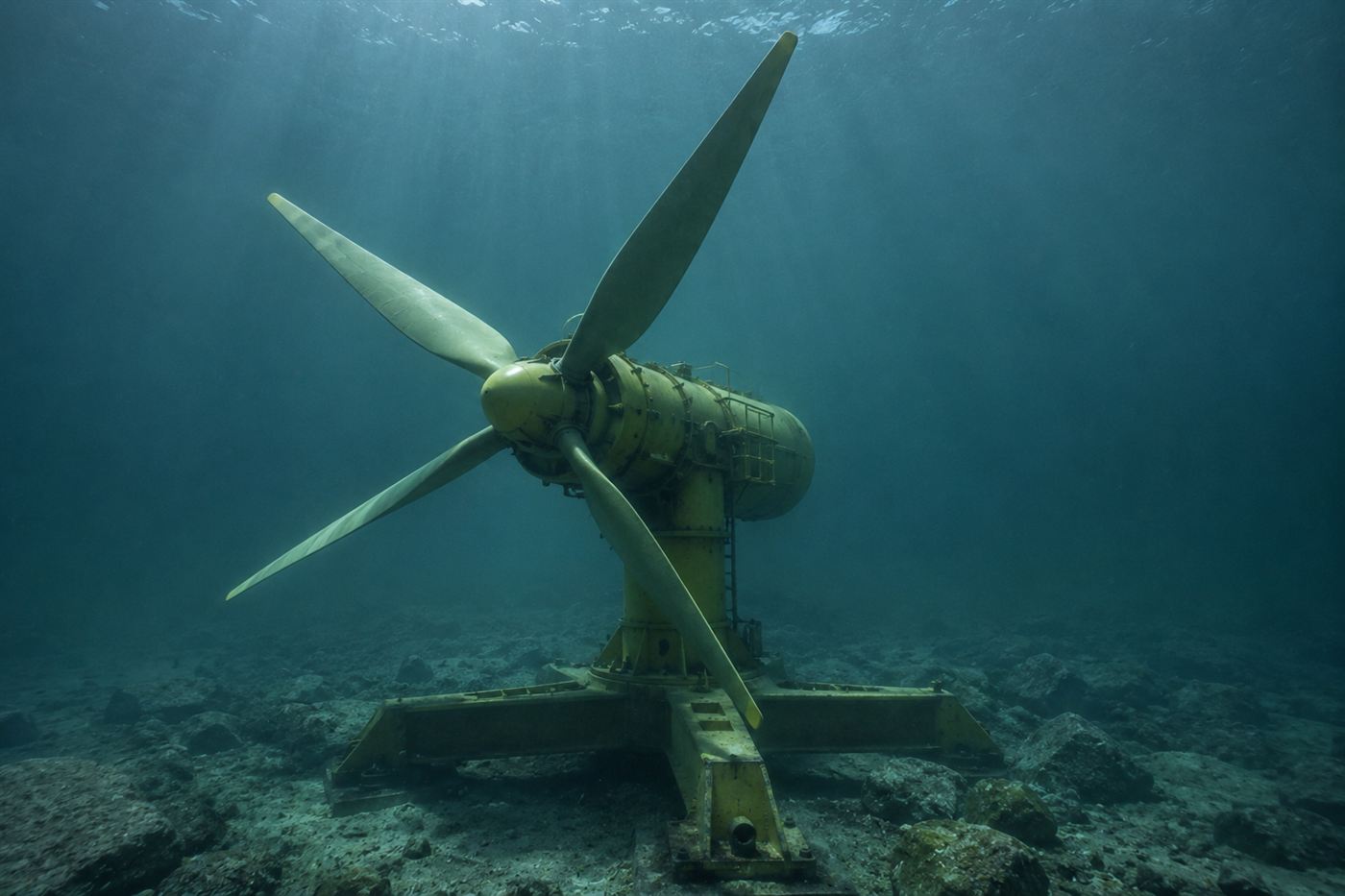
Turbines you will never see
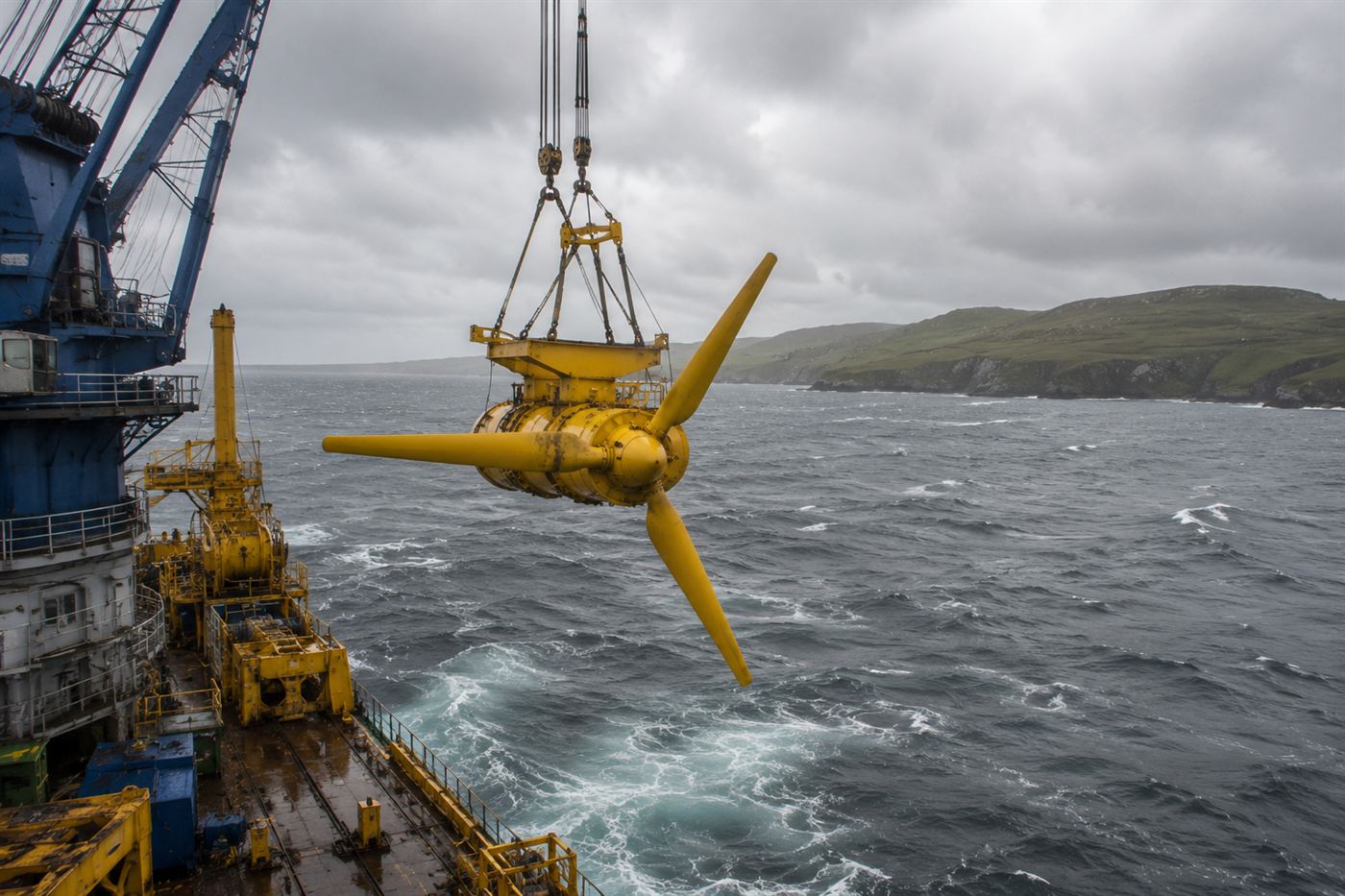
If you stood on the cliffs at Caithness and looked out at the Inner Sound, you would see nothing but cold, fast water. The whole power station is underwater. The first phase put four turbines on the seabed, each rated at 1.5 megawatts, with rotor blades around 18 metres across, anchored to the bottom and left to turn in the current well below the reach of passing ships.
Being invisible is part of the appeal. There are no blades on the skyline, no panels carpeting the land, nothing to spoil the view that fishing towns and tourists prize. The trade-off is brutal engineering. Saltwater is corrosive, the currents are punishing, and any machine down there has to keep running through conditions that would shred ordinary equipment, all while being expensive and awkward to reach for repairs.
MeyGen tidal power by the numbers, so far and to come
It is important to be honest about scale. The four turbines running today add up to just 6 megawatts, a rounding error next to a big offshore wind farm. But they have been proving the concept for years in one of the harshest marine environments on Earth, and by 2025 the array had fed more than 80 gigawatt-hours of electricity into the grid, a record for the technology.
The ambition is far larger. The site is leased to grow in stages toward as much as 398 megawatts, which would be enough to power on the order of 175,000 homes. Further phases of tens of megawatts are lined up for the late 2020s, each one a chance to drive the cost down and prove that tidal can scale from a clever demonstration into a real slice of the grid.
The honest catch
For all its elegance, tidal stream power has not taken over the world, and the reasons are real. It is still expensive, much pricier per unit of energy than the offshore wind and solar it competes with, precisely because the sea fights back so hard. Building and maintaining machines on a storm-lashed seabed is slow and costly, and the number of places with currents strong enough to make it worthwhile is small.
So nobody should pretend a handful of turbines off Scotland is about to replace power stations. What MeyGen offers is not scale yet but proof, and a kind of energy the others cannot provide. The right way to see it is as the patient, stubborn opening chapter of an industry, banking on the one thing about the future we can actually be sure of: that the tide will keep coming in.
Why predictable power is worth the trouble
As grids fill up with wind and solar, their biggest headache is not making power but matching it to demand when the weather refuses to cooperate. A source you can schedule years ahead is worth a premium that raw cost per kilowatt-hour does not capture. Tides peak on their own clock, often when the wind is calm, and a fleet of tidal turbines around Britain's coast could quietly plug some of the gaps that leave operators scrambling.
There is something fitting about the whole idea. The moon has been hauling the oceans back and forth across the face of the Earth for billions of years, long before anyone needed a kilowatt. In a narrow, furious channel at the top of Scotland, we have finally built machines patient enough to take a small cut of that ancient, dependable motion, and turn the pull of the moon into light in the kitchen.
The tide is the one renewable we can predict for a hundred years, yet it powers almost nothing. Is tidal stream power a niche that will always be too expensive, or the steady backbone a weather-dependent grid will eventually pay anything for? Tell us what you think in the comments.
Related reading: China just built a 26 MW offshore wind turbine with a 310-metre rotor, smashing the old 20 MW record while Western makers stalled near 18 MW. See also osmotic power, the clean energy hidden where rivers meet the sea, or the Pelamis sea snake, the red machine that built the world's first wave farm.