Scotland reconnected two canals that had been cut apart for decades not with a staircase of locks but with a single giant wheel that scoops boats up and turns them through the air
Two of Scotland's great canals once met in a long, slow ladder of locks that ate up most of a day. When the country decided to join them again, it threw out the ladder entirely and built something that had never existed anywhere in the world.
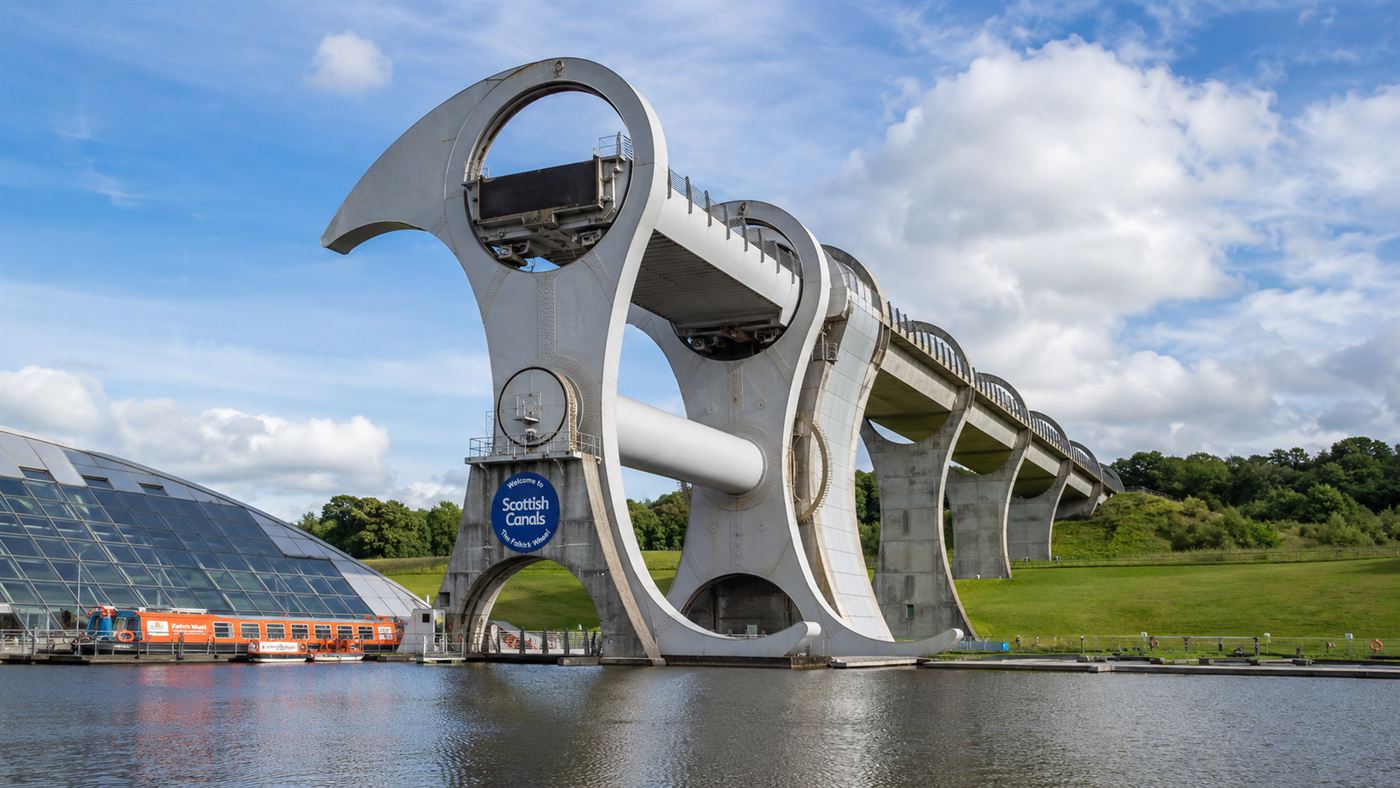
The Falkirk Wheel, the only rotating boat lift in the world. Illustration: Watts & Wild.
On 24 May 2002, Queen Elizabeth II opened a machine in central Scotland unlike anything built before or since. As the record of the Falkirk Wheel sets out, it is the only rotating boat lift of its kind in the world, built as the centrepiece of an 85 million pound project to reunite the Forth and Clyde and the Union Canals, two waterways that had once carried the traffic of the Industrial Revolution across Scotland and had since been left severed and derelict. The wheel did not just join two canals. It became an instant icon of what engineering can look like when it stops being merely useful.
To see why it is so clever, you have to understand the dull, brute force problem it replaced.
The ladder that ate a day
The two canals do not sit at the same height.
Where they once met, the Union Canal ran far above the Forth and Clyde, and the only way to move a boat between them was to walk it down a flight of eleven locks, each one a chamber that fills and empties to raise or lower a vessel one step at a time.
It worked, but it was painfully slow, it swallowed thousands of tonnes of water every time a boat made the trip, and it took most of a day to get from one canal to the other.
By the middle of the twentieth century the canals had fallen out of use as railways and roads took over, and that staircase of locks was dismantled and built over, leaving the two waterways stranded with no link at all.
When Scotland decided at the turn of the millennium to bring its canals back to life, it faced a choice: rebuild the old ladder, or invent something better.
The Falkirk Wheel boat lift instead of a staircase
It chose to invent.
The Falkirk Wheel works like nothing else: two enormous curved arms turn around a central axle, and slung between them are two water filled tubs, called caissons, each big enough to hold a boat.
A vessel sails into the lower tub, a gate seals it in, and the whole wheel rotates a half turn, swinging that tub up and over while the other comes down, lifting the boat 24 metres into the air to meet an aqueduct that carries it on to the higher canal.
The structure stands about 35 metres tall, and the whole graceful manoeuvre takes only a few minutes rather than the better part of a day.
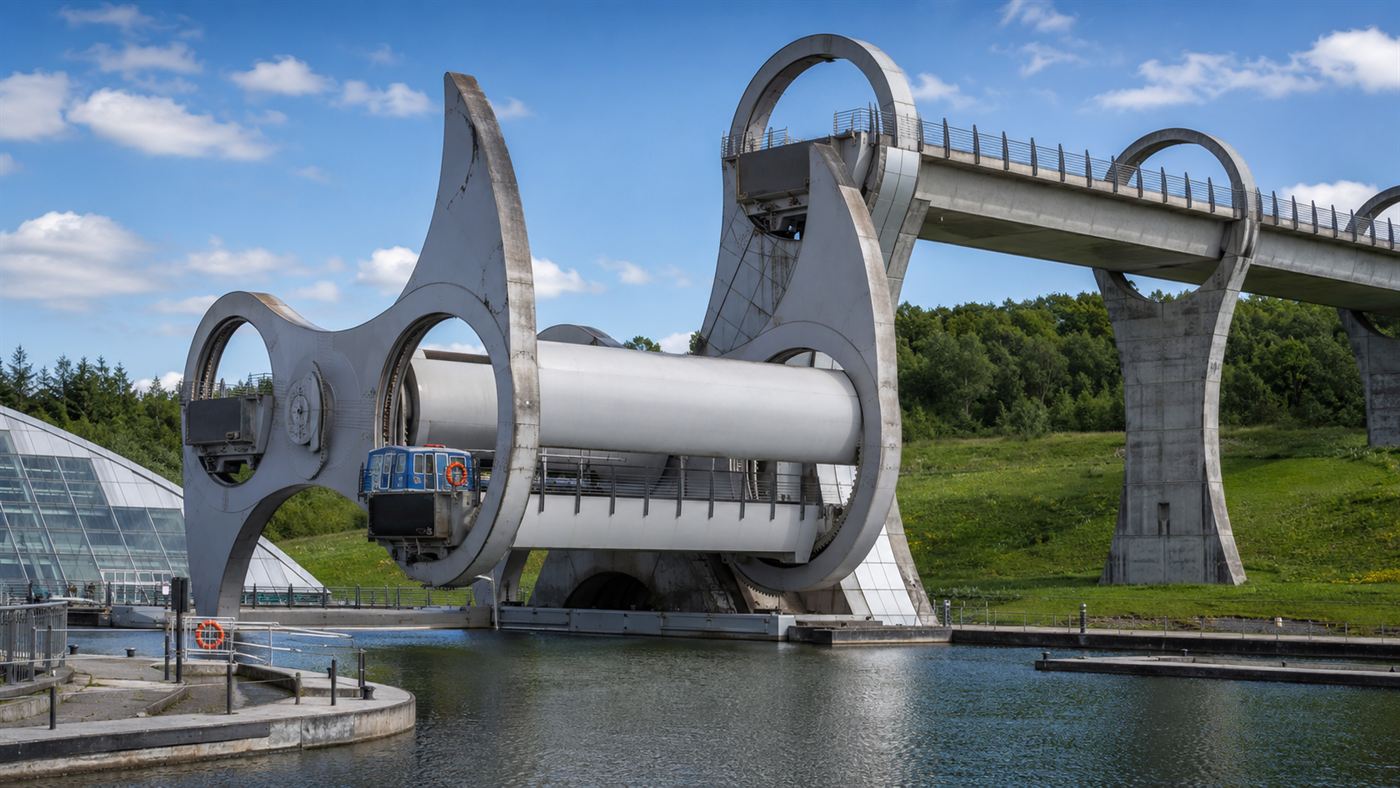
A two thousand year old trick
The most beautiful part is hidden in the physics, and it is ancient.
That means a boat floating in a caisson does not actually make that side any heavier, because the water it pushes out weighs exactly as much as the boat.
So the two tubs, one with a heavy barge and one with nothing but water, always weigh the same and the wheel stays perfectly balanced.
Because it is balanced, it barely has to fight gravity at all, and turning it takes an almost comical amount of power, on the order of the energy it takes to boil a handful of kettles for a single rotation.
A structure tall enough to lift a boat the height of an eight storey building does it on less electricity than your home uses to make a few cups of tea.
Bringing dead canals back to life
The wheel was the showpiece, but the point was bigger than the machine.
Waterways that had been written off as derelict relics of a vanished age became, almost overnight, a reason for people to visit, a place to walk and boat, and a symbol that a rusting industrial past could be turned into something people actually wanted.
The honest catch
And here is where the romance needs a cold splash of canal water.
The Falkirk Wheel is magnificent, but let us be honest about what it is and is not.
The canals it reconnected are not bustling freight arteries again, because the lorries and trains that killed them in the first place never went away, so the wheel mostly carries pleasure boats and the tourists who come specifically to ride the strangest lift in the world.
It is, in plain terms, a spectacular visitor attraction more than a vital piece of transport infrastructure, and the whole millennium project cost the better part of a hundred million pounds.
You could argue, fairly, that the country paid a fortune for a beautiful sculpture that moves.
But that framing misses something.
The wheel works, it does exactly what it was designed to do with an elegance that still stops people in their tracks, and it proved that reviving a discarded piece of heritage can be worth doing for what it gives a place rather than only for the tonnes it shifts.
Sometimes the most quietly radical thing a country can build is a machine whose main job is to make people look up and feel that engineering can be a kind of wonder.
Scotland could have rebuilt an old staircase of locks, and instead it built the only rotating boat lift on Earth, a balanced wheel that swings boats through the air on almost no power.
Is a stunning piece of engineering like this worth the money just for the wonder of it, or should a machine always have to earn its keep? Tell us what you think in the comments.