The horse that seemed to do math, and the trick no one meant to play
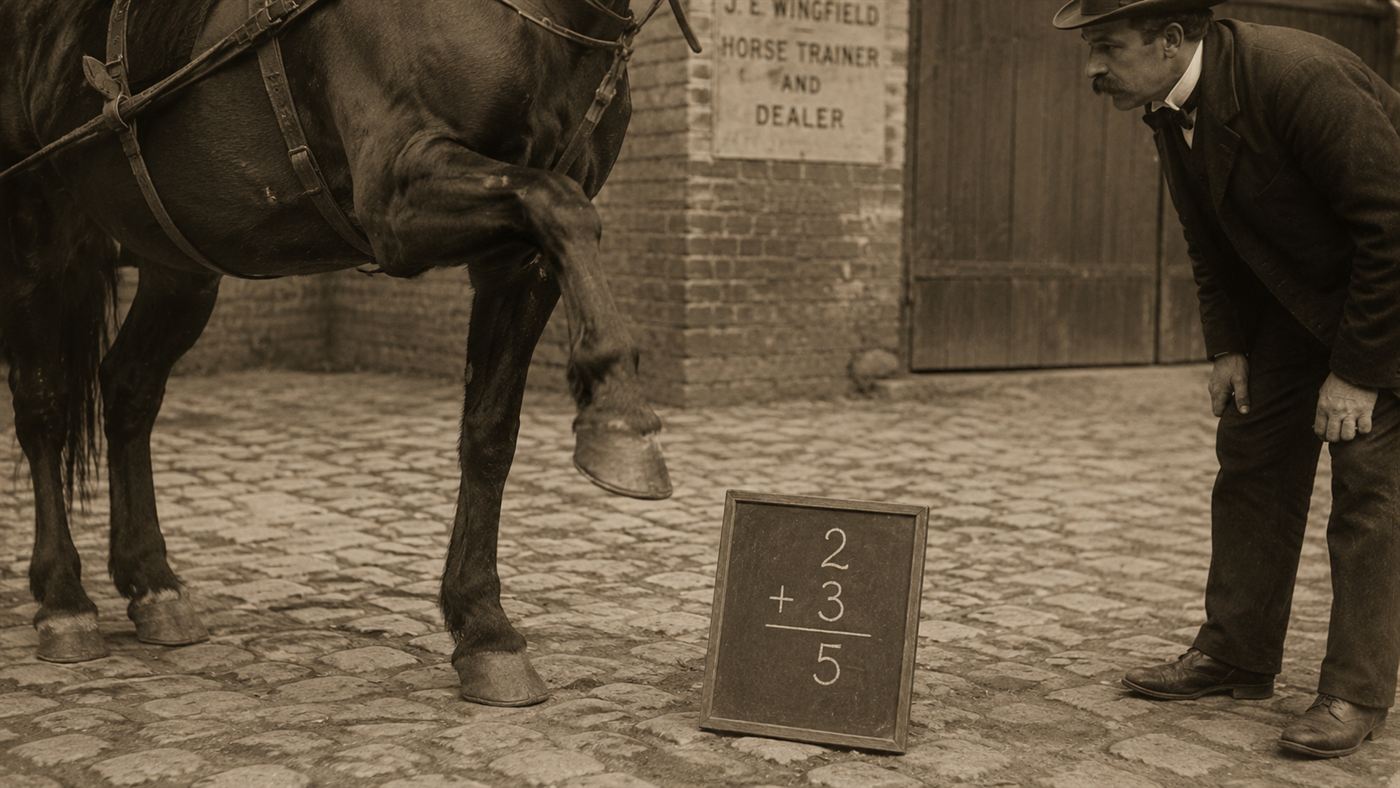
In a Berlin courtyard around 1904, crowds gathered to watch a horse do the impossible. Ask him to add two numbers and he would tap out the answer with his hoof. He could tell the time, spell words, and name musical notes. A panel of serious scientists examined him and declared there was no trickery at all. They were right, and yet they had completely missed what was going on. Clever Hans was reading minds, in a way.
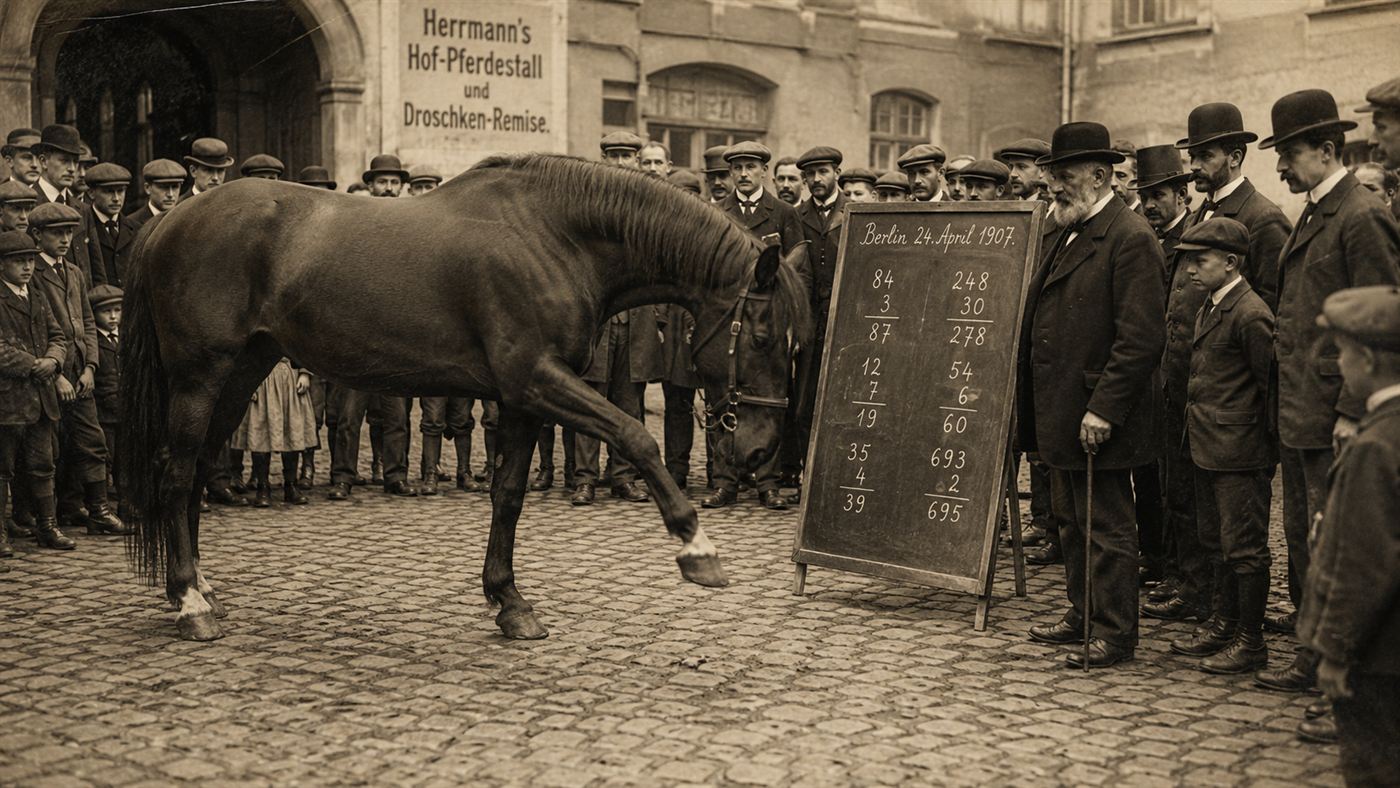
A horse that seemed to count, watched by crowds and scientists alike. Illustration: Watts & Wild.
The story of Clever Hans is one of the most important in the history of science, and not because a horse could do sums. It is important because of how thoroughly an intelligent, careful public fooled itself, and how one young man finally saw through it. What looked like a counting horse was really a lesson about the hidden signals people give off without ever meaning to.
It is a lesson that still shapes how every careful experiment in the world is run today.
The horse that could count
Clever Hans belonged to Wilhelm von Osten, a retired Berlin maths teacher who was convinced animals were far cleverer than anyone believed. He spent years teaching his horse, and by the early 1900s Hans appeared able to add and subtract, work with fractions, read German, spell out words and tell the time, answering everything by tapping a hoof or nodding his head.
Von Osten charged no money and seemed entirely sincere. He toured Hans before astonished crowds, and newspapers around the world carried the tale of the wonder horse of Berlin. To the people watching, the conclusion seemed obvious and thrilling: an animal was thinking, reasoning and calculating just like a person.
How Clever Hans fooled the experts
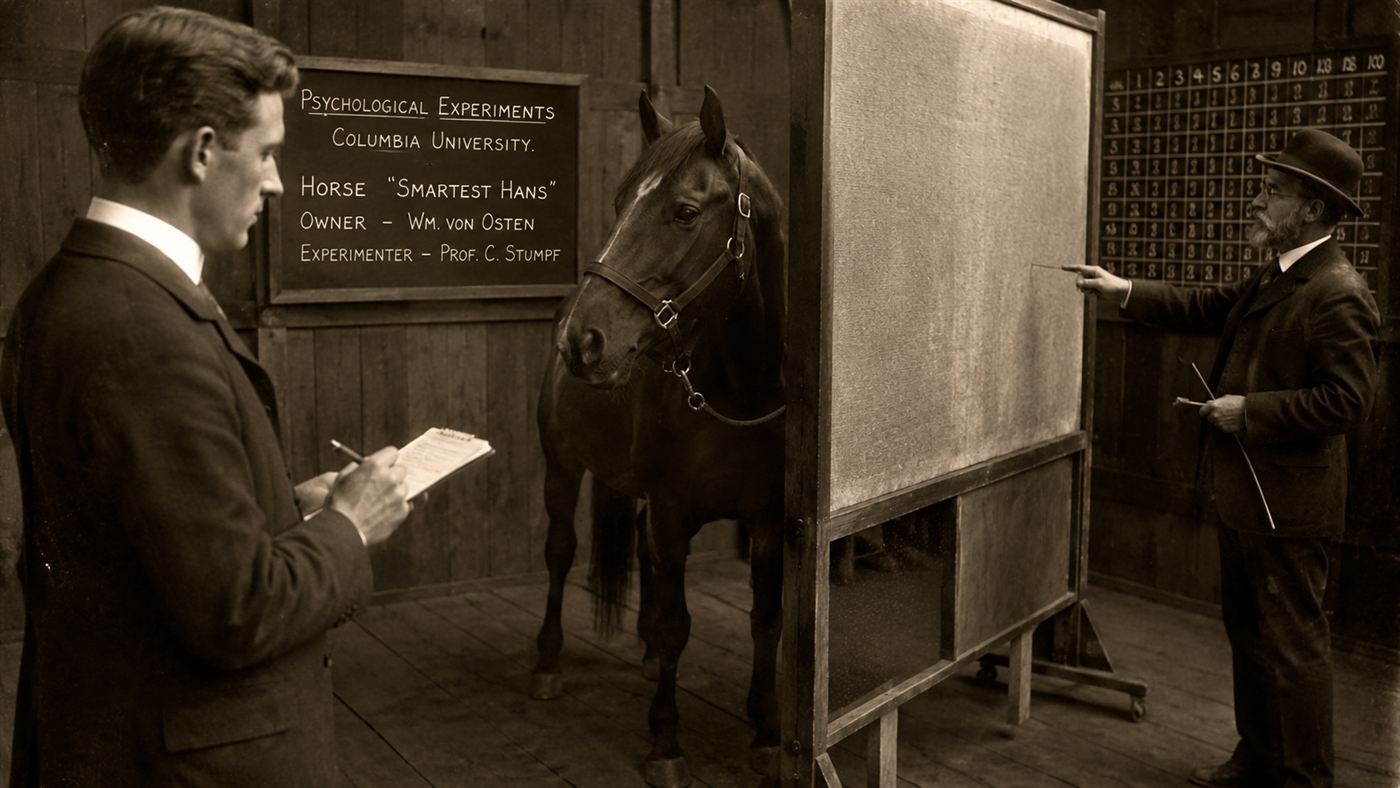
The claims were so striking that in 1904 the German authorities convened a formal panel to investigate, sometimes called the Hans Commission. Made up of thirteen people including a circus trainer, a vet, schoolteachers and the respected psychologist Carl Stumpf, the commission tested Hans and concluded there was no deliberate fraud.
That verdict was actually correct, which is what makes the case so unsettling. Von Osten was not cheating, and there were no hidden signals being given on purpose. The horse really did answer questions, often correctly, in front of people determined to catch a con. The commission simply could not explain how, and so the mystery deepened rather than cleared. It would take a different kind of investigator to ask a better question.
The man who watched the watchers
That investigator was Oskar Pfungst, a young psychologist who, in 1907, stopped testing the horse and started testing the humans. Pfungst found that Hans was right about 89 percent of the time when the questioner knew the answer, but only around 6 percent of the time when the questioner did not.
The clue was devastating. If the person asking the question did not themselves know the answer, the horse was lost. Pfungst also found that Hans needed to be able to see the questioner. Watching closely, he realised that as the taps climbed toward the correct number, the questioner unconsciously grew tense, leaning in or holding their breath, and then relaxed the instant the right number was reached. That tiny release was the signal. Hans had learned to keep tapping until the human in front of him quietly flinched, and then to stop.
The Clever Hans effect
The horse was not a calculator but something arguably stranger: an exquisite reader of human body language. Hans had no idea what the numbers meant, but he could detect a flicker of tension on a face that the people themselves did not know they were showing.
It is important to be fair to everyone here. Von Osten was not a fraud, and he was reportedly devastated by the findings, refusing to fully accept them. The watching public were not stupid; they were caught by a trap that fools careful people to this day. That trap now has a name, the Clever Hans effect, and it is why serious experiments are run blind, with the testers kept unaware of the right answer so they cannot leak it. The same problem has since turned up with sniffer dogs, with so-called facilitated communication, and anywhere a hopeful human stands too close to the result. A horse in Berlin taught science to distrust its own expectations.
Was Clever Hans really doing math?
No, and that is the heart of it. Clever Hans could not add, count or read at all, but he could watch the people around him so closely that he knew exactly when to stop tapping, which looked from the outside like genuine arithmetic.
In a way the truth is more impressive than the myth. Doing sums is something we can build a cheap machine to do. Reading the unconscious micro-signals of a tense human face, well enough to pass for a mathematician, is a feat of perception we still struggle to fully explain. Hans was a genius, just not the kind anyone expected.
What is the Clever Hans effect?
It is the trap the horse exposed. The Clever Hans effect is when a subject appears to perform a task but is in fact picking up unconscious cues from an observer who already knows the answer, rather than doing the task itself.
Naming it changed how science is done. Researchers learned that simply intending to be objective is not enough, because the leak happens below the level of intention. The cure is to keep the people running a test in the dark about what the right outcome should be, so their faces and hands have nothing to give away. Every double-blind trial that protects us from fooling ourselves owes a quiet debt to a horse who was only ever watching our faces.
A horse that could not count still managed to read the room better than any of us can. How often do we mistake someone simply reflecting our own hopes back at us for real understanding? Tell us what you think in the comments.
Related reading: the Mechanical Turk, the chess machine that seemed to think, with a man hidden inside.