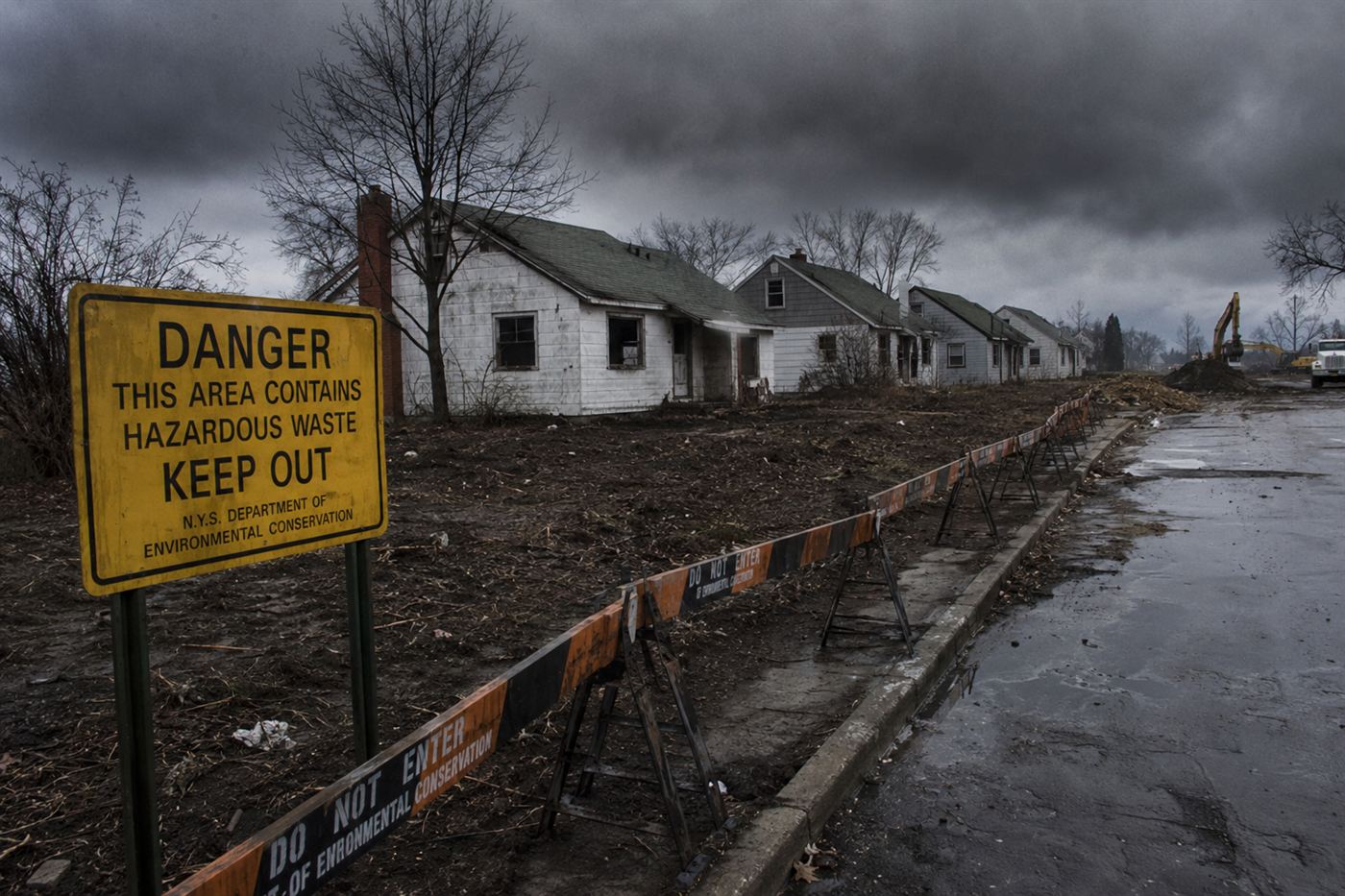
The story of Love Canal and Lois Gibbs begins decades before she was born. Between 1942 and 1953, the Hooker Chemical Corporation dumped approximately 22,000 tons of toxic waste into an unfinished canal on the southern edge of Niagara Falls, New York. The canal had been dug in the 1890s by an entrepreneur named William T. Love, who wanted to build a model industrial city powered by hydroelectric energy. He ran out of money. The ditch sat empty. Hooker found it useful.
In 1953, Hooker sold the land to the Niagara Falls Board of Education for one dollar. The company inserted a clause into the deed stating that the site contained chemical wastes, that the board was aware of this fact, and that Hooker assumed no liability for any injury or damage resulting from the use of the land. The board built an elementary school on top of the dump. A residential neighborhood grew up around it. Love Canal became a quiet American suburb, and nobody told the families who moved there what was underneath their lawns.
Love Canal was a residential neighborhood in Niagara Falls, New York built on 22,000 tons of toxic chemical waste buried by Hooker Chemical. In 1978 Lois Gibbs organized 900 families to demand evacuation. The campaign forced the United States government to create the Superfund program, the main federal tool for cleaning up toxic waste sites.
What was Love Canal and how did Hooker Chemical bury 22,000 tons of toxic waste there?
William T. Love's original canal was intended to be a short waterway connecting the upper and lower sections of the Niagara River, bypassing the falls and allowing a hydroelectric plant to power a planned industrial city.
The project collapsed during the economic depression of the 1890s.
The partially dug trench, roughly 900 metres long and 25 metres wide, was abandoned and eventually acquired by the city of Niagara Falls.
Hooker Electrochemical Company, later known as Hooker Chemical, obtained the right to use the site in 1942 and began filling it with chemical byproducts from its nearby plant.
Over eleven years, the company deposited an estimated 22,000 tons of toxic waste into the clay-lined trench: pesticides, dioxins, benzene, chlorinated compounds, and other industrial byproducts.
In 1953, with the canal full, Hooker covered it with a layer of clay and sold the land to the Niagara Falls Board of Education for one dollar.
The deed included explicit language warning that the land contained chemical waste and that Hooker accepted no responsibility for any damage or injury.
The board's lawyers reviewed and accepted those terms.
The 99th Street Elementary School was built directly adjacent to the dump and opened in 1955.
Through the 1950s and 1960s, the city sold residential lots around the school, and hundreds of families built homes and raised children there, unaware of what the clay cap was holding below their feet.
How did Love Canal residents discover they were living on toxic waste?
The summer of 1977 brought heavy rains to Niagara Falls.
The Love Canal neighborhood began to smell.
Black oily residue seeped up through basement walls.
Children playing in backyards developed chemical burns on their hands and feet.
Drums of toxic waste corroded and collapsed underground, creating sinkholes in people's gardens.
Local health officials investigated but were slow to act.
In the spring of 1978, Lois Gibbs, then 26 years old, was reading a local newspaper report by investigative journalist Michael Brown that named Love Canal as a serious contamination site and identified the 99th Street school as being built on the dump.
Her son Michael had been attending that school since the previous year.
He had developed epilepsy, a urinary tract disorder and a low white blood cell count after starting kindergarten.
Gibbs went to the school board and asked to have her son transferred to a different school.
The board refused, on the grounds that if it transferred one child it would have to acknowledge the school was dangerous.
Gibbs went door to door instead.
Over three weeks in the summer of 1978, she knocked on more than 1,000 doors in the Love Canal neighborhood, documenting illnesses, miscarriages, birth defects and strange clusters of disease she found at nearly every house she visited.
How did Love Canal resident Lois Gibbs organize 900 families to force a federal emergency?
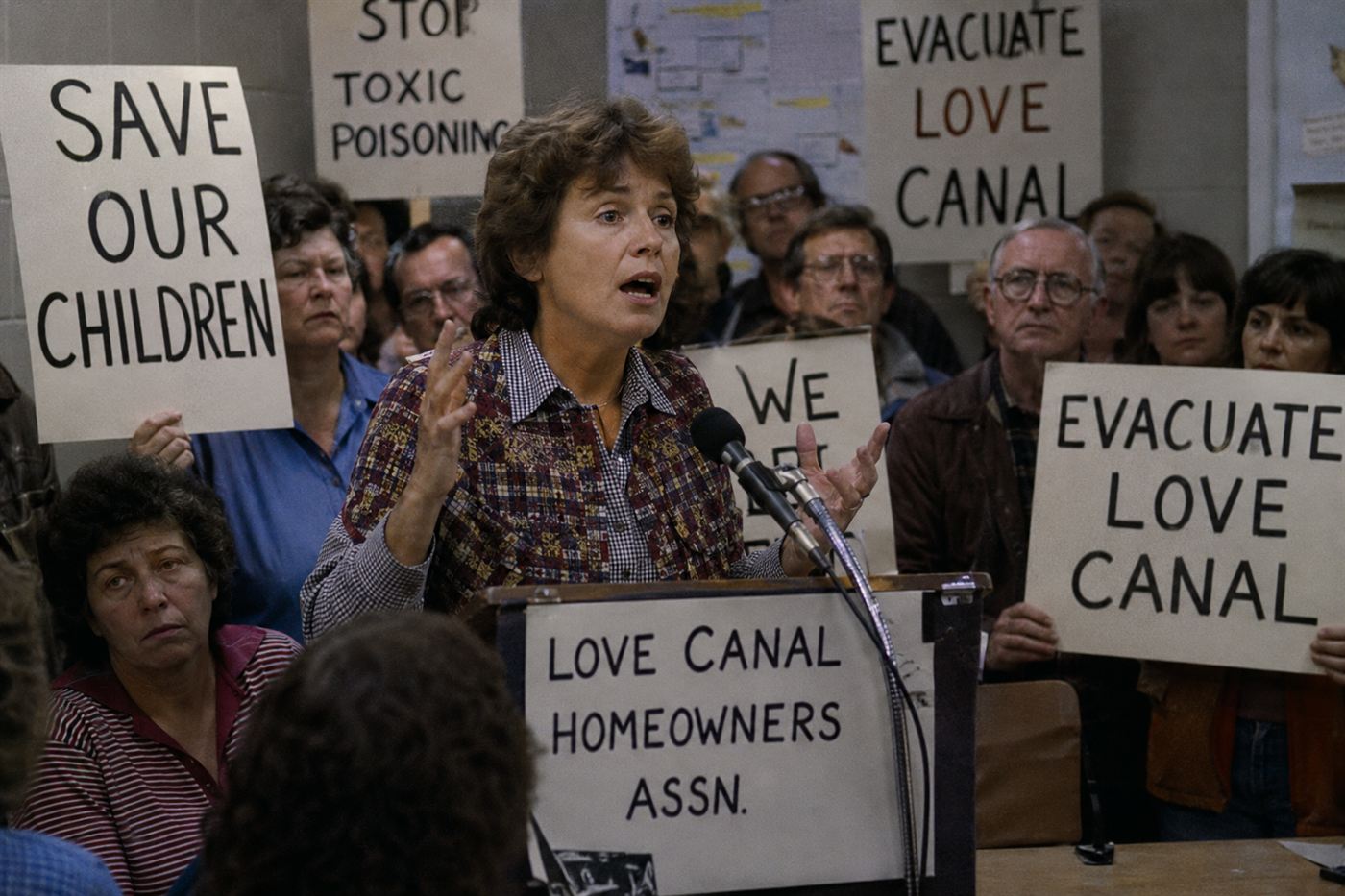
Lois Gibbs had no experience in organizing, law or politics.
She had never spoken in public.
She formed the Love Canal Homeowners Association in the summer of 1978 with her data from the door-to-door survey.
The association held public meetings, brought in scientists to test soil and air, and generated a stream of documentation that local authorities and the state health department could not easily ignore.
In August 1978, New York State Health Commissioner Robert Whalen declared Love Canal a health emergency and recommended that pregnant women and children under two years old leave the area.
President Jimmy Carter signed a federal emergency declaration later that month, the first time in American history that the federal government had declared an emergency in response to a man-made chemical disaster rather than a natural one.
The initial evacuation covered 239 families living closest to the former dump site.
Gibbs and the association kept pressing.
In 1979 and 1980, new studies identified elevated rates of chromosomal abnormalities, miscarriages, birth defects and cancer among residents across a wider area of the Love Canal neighborhood.
In May 1980, two EPA officials who came to Love Canal to discuss the studies were detained by residents and held for several hours in what was described as a citizen's arrest.
President Carter declared a second federal emergency in August 1980, authorizing the permanent relocation of the remaining Love Canal families.
More than 1,000 families were eventually relocated at federal expense.
What did Hooker Chemical know, and what did the one-dollar deed actually mean?
The legal status of Hooker Chemical's liability was more complicated than the narrative of corporate villainy suggests.
The company had disclosed the presence of chemical waste in the deed.
It had explicitly warned the school board in writing.
Hooker representatives later testified that they had verbally warned the board's officials on multiple occasions that the land was not safe for construction, and that digging would rupture the clay cap and release the buried chemicals.
The board went ahead anyway, in part because it needed a site for the school and the land was free.
The city then extended sewage lines and utility trenches through the clay cap, puncturing it in multiple places and allowing toxic waste to migrate through the soil.
In subsequent litigation, courts found that Hooker bore substantial responsibility for the contamination and had not done enough to prevent the predictable damage.
In 1995, Occidental Petroleum, which had acquired Hooker Chemical in 1968, agreed to pay the US government $129 million toward the cleanup costs of Love Canal.
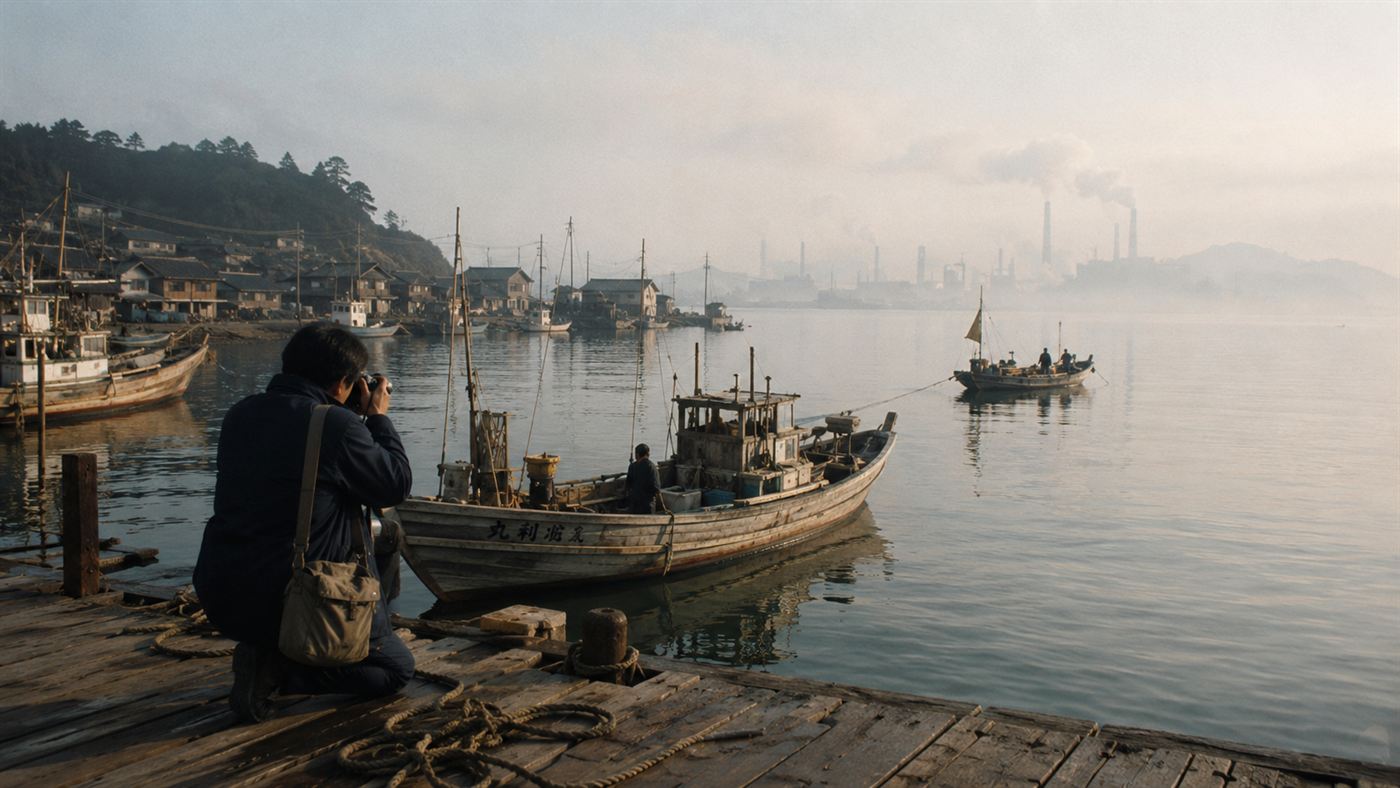
The comparable mechanism had been seen at Minamata in Japan, where Chisso Corporation similarly denied and deflected responsibility for industrial contamination that killed and disabled thousands of people over decades.
How did Love Canal create the Superfund program?
The federal response to Love Canal exposed a fundamental gap in American environmental law.
There was no comprehensive mechanism for the federal government to identify, assess and clean up toxic waste sites.
There was no way to make polluters pay for contamination they had caused in the past.
The Love Canal crisis, along with a separate chemical contamination emergency at Times Beach, Missouri, provided the political pressure needed to pass new legislation.
In December 1980, two months after the second Love Canal emergency declaration and in the final weeks of the Carter administration, Congress passed the Comprehensive Environmental Response, Compensation, and Liability Act.
It is known as CERCLA, or more commonly as the Superfund.
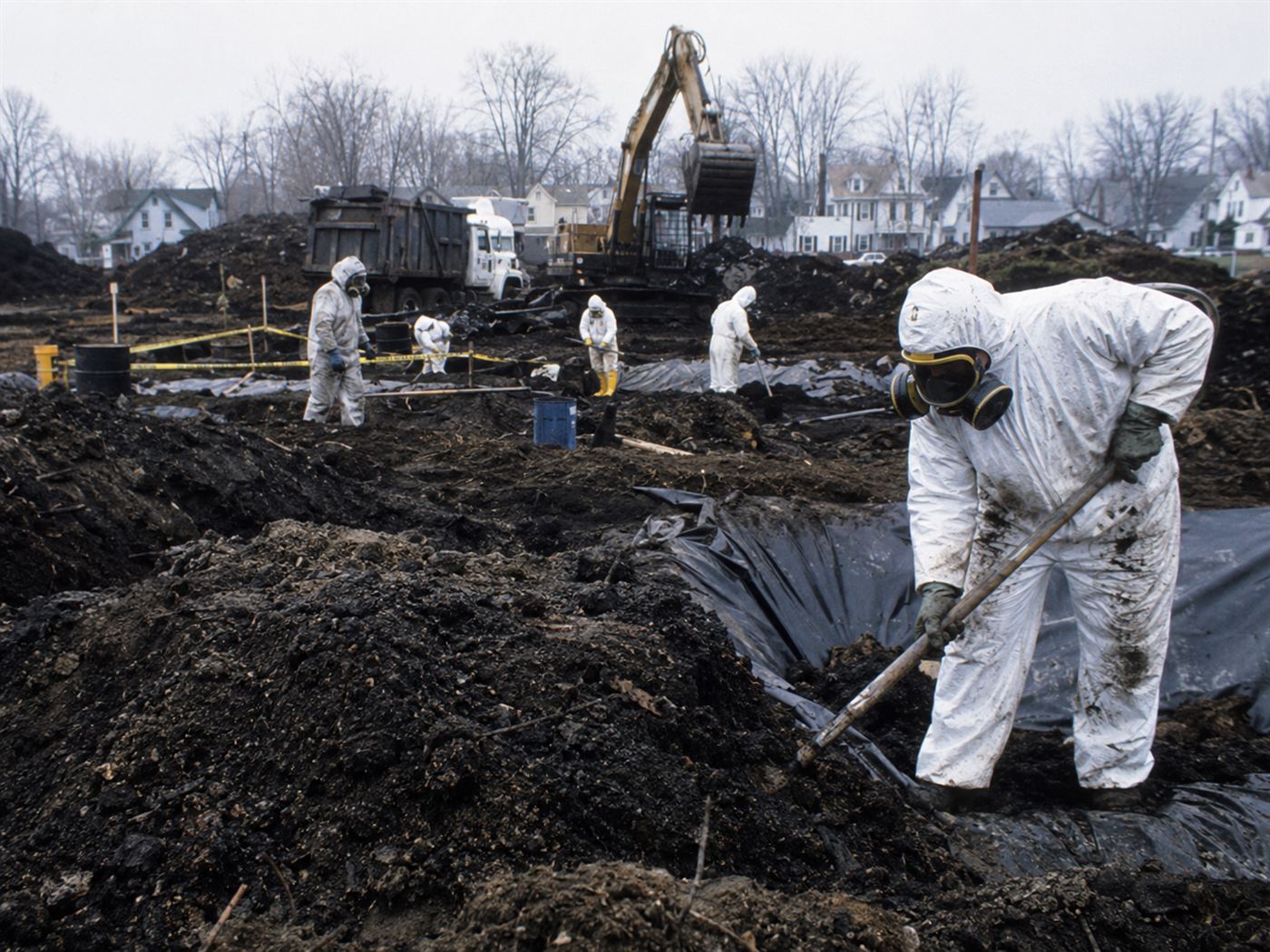
Superfund gave the federal government the authority to clean up toxic waste sites and to recover the costs from the responsible parties.
It established a national priorities list of contaminated sites requiring urgent attention.
It created the legal principle of strict liability, meaning that companies responsible for contamination could be held liable even if their actions had been legal at the time.
The corporate negligence that drove the Seveso dioxin disaster in Italy two years earlier had already prompted European regulators to create the Seveso Directive; Love Canal played a parallel role in pushing American environmental law in the same direction.
The honest catch
The health effects of Love Canal are well documented in general but harder to quantify precisely than the political narrative suggests.
Early studies showing elevated chromosomal abnormalities among Love Canal residents were contested by other scientists, and the epidemiology of toxic waste exposure is genuinely complex.
Not every illness that occurred in the Love Canal neighborhood can be causally attributed to the chemical dump.
Hooker Chemical's legal position was stronger than it might appear: the company had disclosed the contamination in writing, had warned the school board, and had not been the entity that built on the site or punctured the clay cap.
Courts ultimately found the company substantially liable anyway, on the grounds that the foreseeable harm was severe enough that disclosure and a dollar transfer were not sufficient precautions.
Lois Gibbs is sometimes described as having single-handedly created the Superfund, which is an overstatement.
The legislation had multiple parents: EPA administrators, sympathetic members of Congress, a pre-existing advocacy movement and the simultaneous emergency at Times Beach all contributed.
What Gibbs unambiguously did was make Love Canal a nationally visible crisis at the moment when the political conditions for passing major environmental legislation were briefly present.
That timing mattered enormously.
The Superfund has cleaned up more than 400 contaminated sites since 1980, though hundreds more remain on the national priorities list, and funding for the programme has been persistently contested. See also how New York turned its Fresh Kills landfill, once the largest on Earth, into a giant park.
Sources
Love Canal showed that the most dangerous polluter is not always the one who dumped the chemicals but the system that decided the warning in a deed was enough. What responsibility do you think companies should carry for contamination they disclosed but did not prevent?