In the wettest place on Earth, steel bridges rust and wash away, so for centuries the Khasi people have not built their bridges at all, they have grown them from living tree roots
A bridge that nobody builds, because it is alive. In the soaking hills of north east India, two peoples solved the problem of crossing rivers in a way no engineer would dare to copy, by planting a bridge and waiting decades for it to grow.
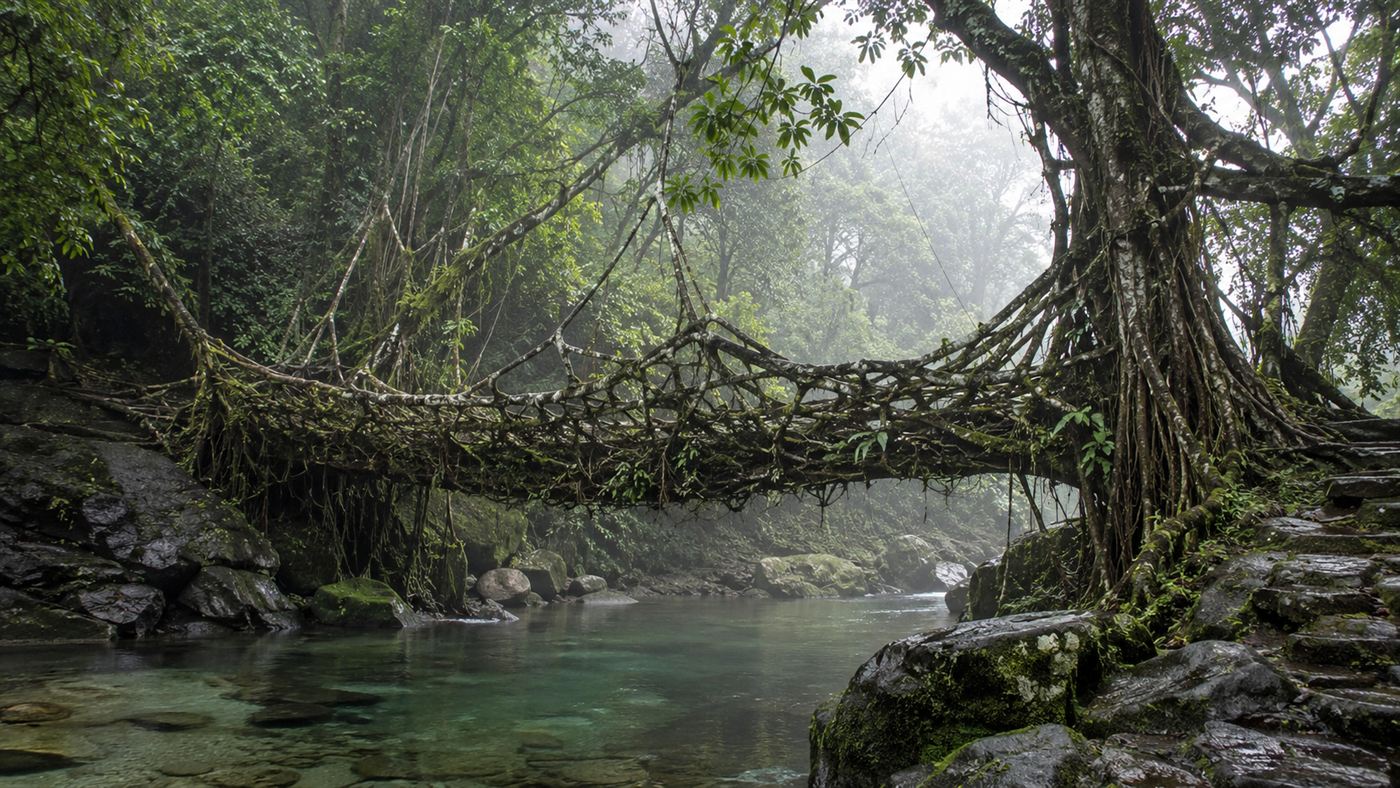
A living root bridge in Meghalaya, grown rather than built, from the woven roots of a rubber tree. Illustration: Watts & Wild.
In early 2026, India put one of the strangest structures on the planet forward for World Heritage status: a set of living root bridges that nobody ever built, because they were grown. They sit in Meghalaya, a small state in the soaking, cloud wrapped hills of north east India, and they are made entirely of the living roots of trees. As The Diplomat reported when the bridges first reached UNESCO's tentative list in 2022, these jingkieng jri are woven by the Khasi and Jaintia communities from the roots of the Indian rubber tree, and some are thought to be more than five hundred years old.
The reason they exist is brutally practical. This is one of the wettest places on Earth, and water destroys everything you try to build over it.
Where bricks and steel go to die
Meghalaya means "abode of the clouds", and it earns the name. Its towns of Cherrapunji and nearby Mawsynram trade the title of the rainiest inhabited place on the planet between them, drowning in monsoon rains that turn quiet streams into raging brown rivers for months on end. Cherrapunji still holds the all time records for the most rain ever measured in a single month and a single year.
In that climate, a normal bridge is a losing bet. Timber rots. Steel rusts. Bamboo spans get torn apart and swept downstream by the floods. Anything dead that you lay across a Meghalaya river is on a countdown. So at some point, centuries ago, the people who lived in these gorges stopped fighting the water with dead materials and started working with something that does not rot, because it is alive.
How you grow a bridge
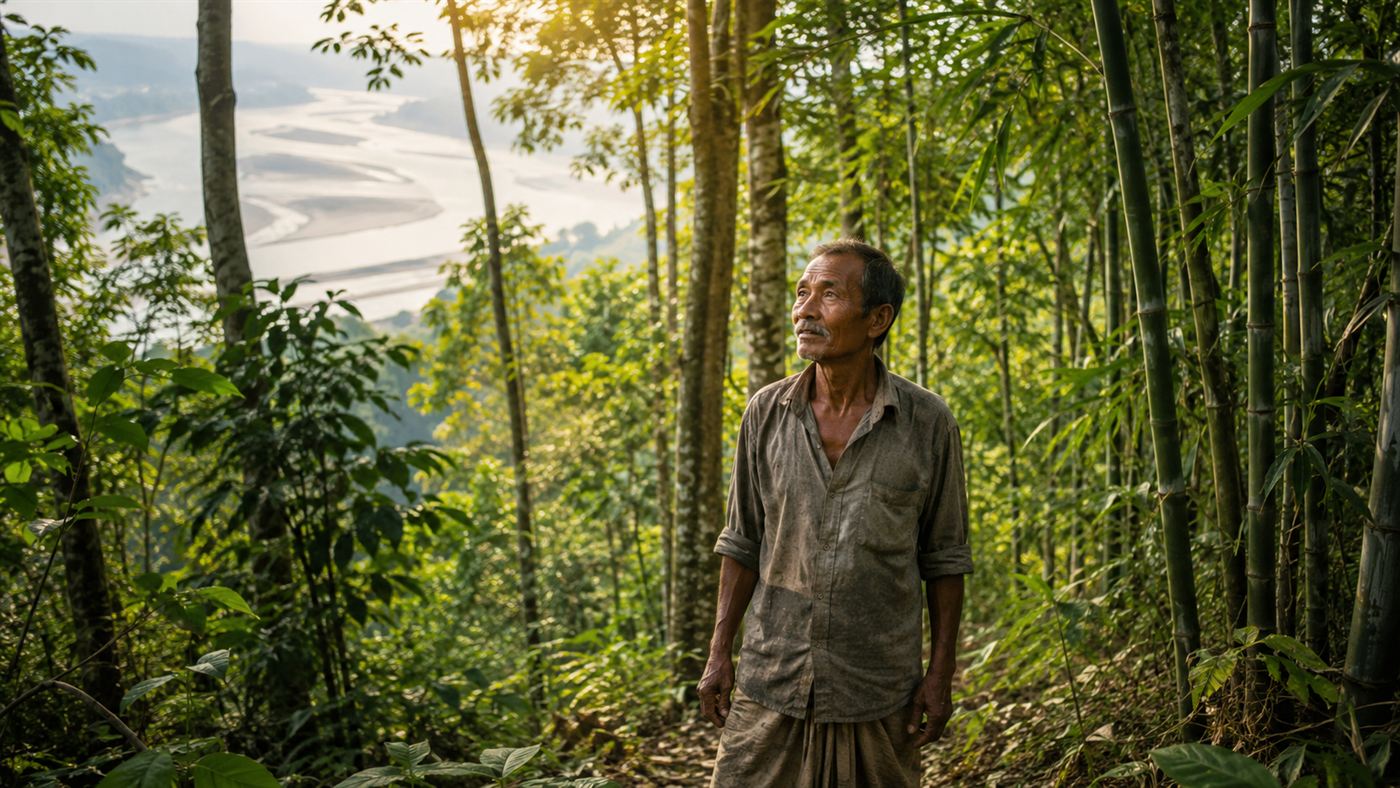
The trick is the Indian rubber tree, a species of fig that throws out tough, secondary roots from high on its trunk. The Khasi take those young, pliable aerial roots and guide them out across a stream, often threading them through the hollowed out trunk of a betel palm laid down as a temporary scaffold. The roots are coaxed, tied and trained to grow towards the far bank, where they take hold in the soil and keep thickening.
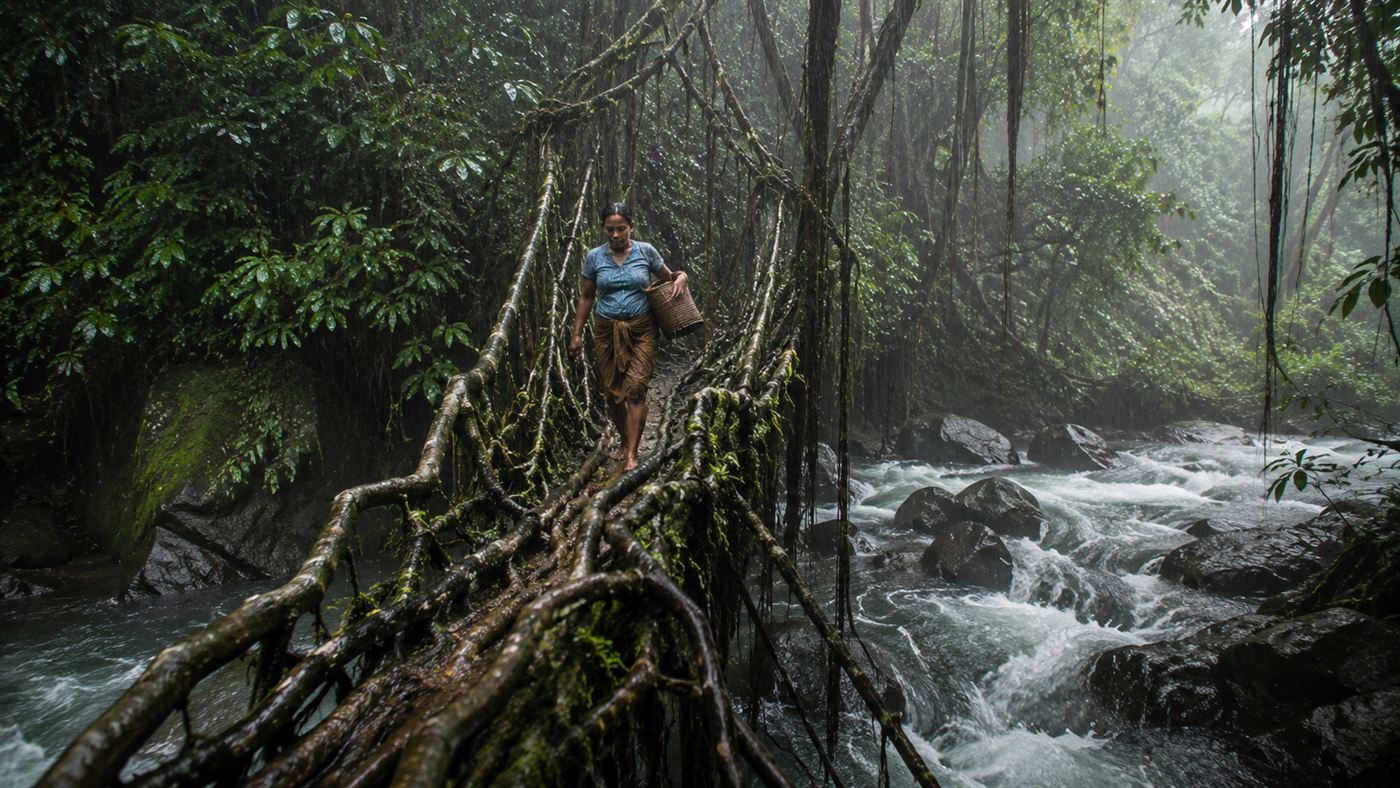
Year after year the builders add more roots, weave in the new growth, and let the whole thing knit together into a dense, walkable lattice. It is less like construction and more like very slow, very patient gardening. A bridge can take anywhere from fifteen to thirty years before it is strong enough to carry a person, which is the part that stops a modern mind in its tracks.
A gift you will never use
Think about what that means. The man or woman who starts a root bridge will, in most cases, never walk across the finished thing. They are planting it for their children, and more often for their grandchildren. The bridge is a promise made across generations, tended by people who will be long gone before it carries its first full load.
And unlike everything humans normally build, it does not begin to decay the moment it is finished. It does the opposite. The roots keep growing, fusing and thickening, so a living root bridge gets stronger every single year and can stand for centuries, quietly repairing its own scrapes and breaks as long as the tree is alive. The most famous of them, the double decker bridge at Nongriat, is two tiers stacked one above the other. As the record of the Umshiang double decker bridge explains, the lower span kept being swallowed when the river ran high, so the villagers simply grew a second bridge on top of the first.
What an engineer would envy
Strip away the romance and there is hard sense in it. A steel footbridge in this terrain has to be hauled in, paid for, and then maintained and eventually replaced as it corrodes. A root bridge is grown from a tree that was already there, costs nothing but knowledge and patience, anchors the riverbank against erosion, and gets better with age instead of worse. It is a piece of infrastructure that feeds itself, fixes itself and outlives the people who made it.
That is exactly why the idea is suddenly fashionable far beyond Meghalaya, with architects and engineers studying these bridges as a model for buildings and structures that are quite literally alive. A technology developed by people without written records, simply by watching how their forest worked, is now being treated as a glimpse of a more sustainable future.
The honest catch
It would be lovely to end there, but the bridges are in real trouble, and the threat is us. As Mongabay India has documented, the living root bridges are now squeezed between tourism and concrete. The same fame that won them a World Heritage nomination brings crowds of visitors whose feet wear down the roots, while unregulated trekking and litter stress the fragile gorges the bridges depend on.
The deeper danger is more ordinary. As roads reach remote villages, it is faster and easier to drop in a reinforced concrete or steel footbridge than to spend thirty years growing a living one, and government money has even paid for concrete stairs, walls and ticket booths built right against the bridges, sometimes cutting or burying the very roots that hold them up. Add the steady drift of young people to the cities, taking the unwritten, handed down knowledge with them, and you have a craft that could vanish in a generation. A bridge that survives centuries of flood can still be killed in a decade by a cement mixer and a forgotten skill.
What the living root bridges are really for
The living root bridges work because their makers accepted something our own building rarely does, that you do not always have to defeat nature to live with it, and that the best structure is sometimes the one you grow rather than the one you pour. They are slow, they demand patience measured in human lifetimes, and they ask one generation to labour for another it will never meet. In a world that wants everything finished by next quarter, that might be the most radical engineering idea of all.
A people who get more rain than almost anywhere on Earth gave up fighting their rivers and started growing bridges from living roots, planting them for grandchildren they would never see cross. Would you start something that took thirty years to finish, knowing someone else would be the one to use it? Tell us what you think in the comments.
See also: Mostar's Old Bridge, destroyed in war and rebuilt stone by stone.