A hundred years ago California banned indigenous burning and the forests turned to tinderboxes, and now the Karuk and Yurok are the ones being asked to bring fire back
For thousands of years the Karuk and Yurok tribes set California cultural burns on purpose, lighting their forests to keep them from burning out of control. The U.S. Forest Service banned the practice in the early 1900s. The fuel built up. The megafires came. On January 1, 2025, a California law the Karuk co-sponsored finally made it legal to burn again without a state supervisor standing over every flame.
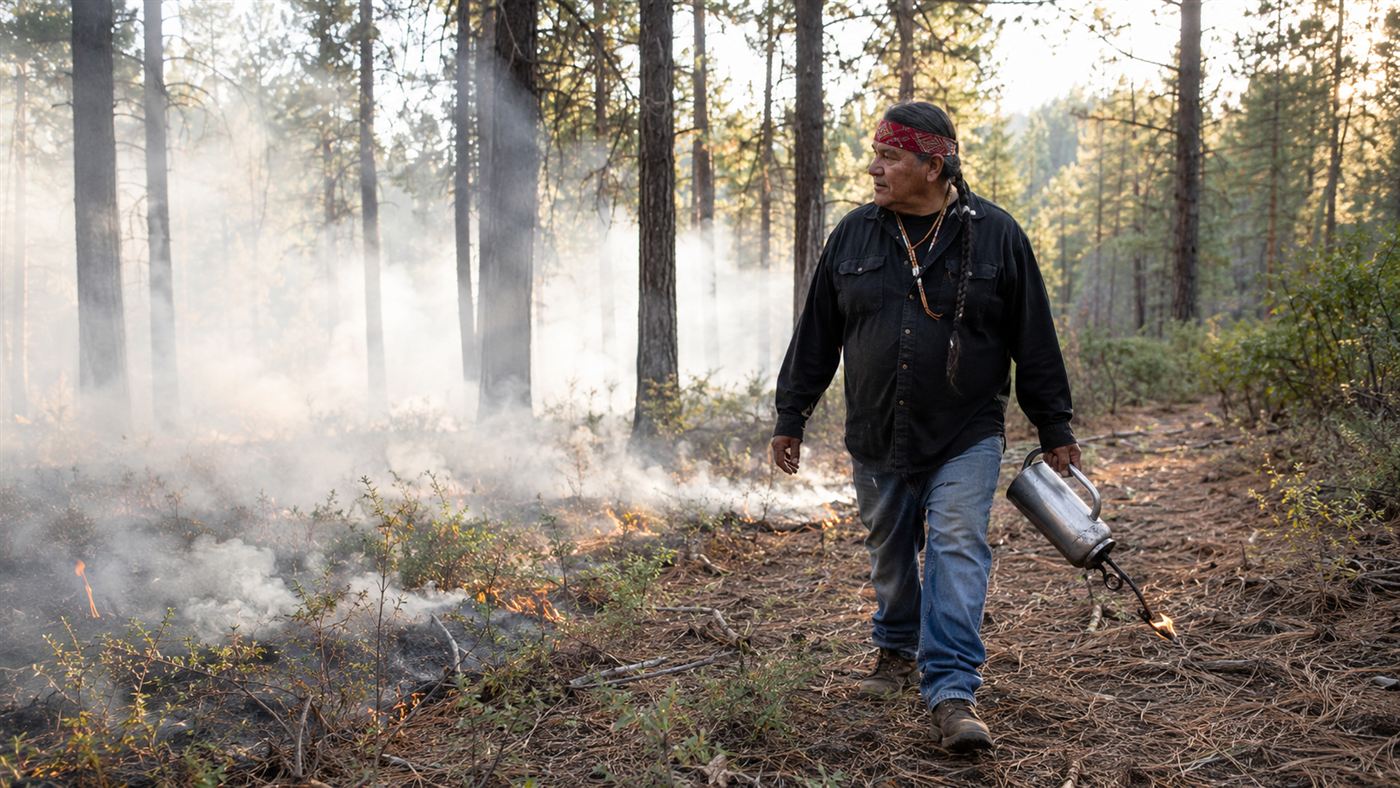
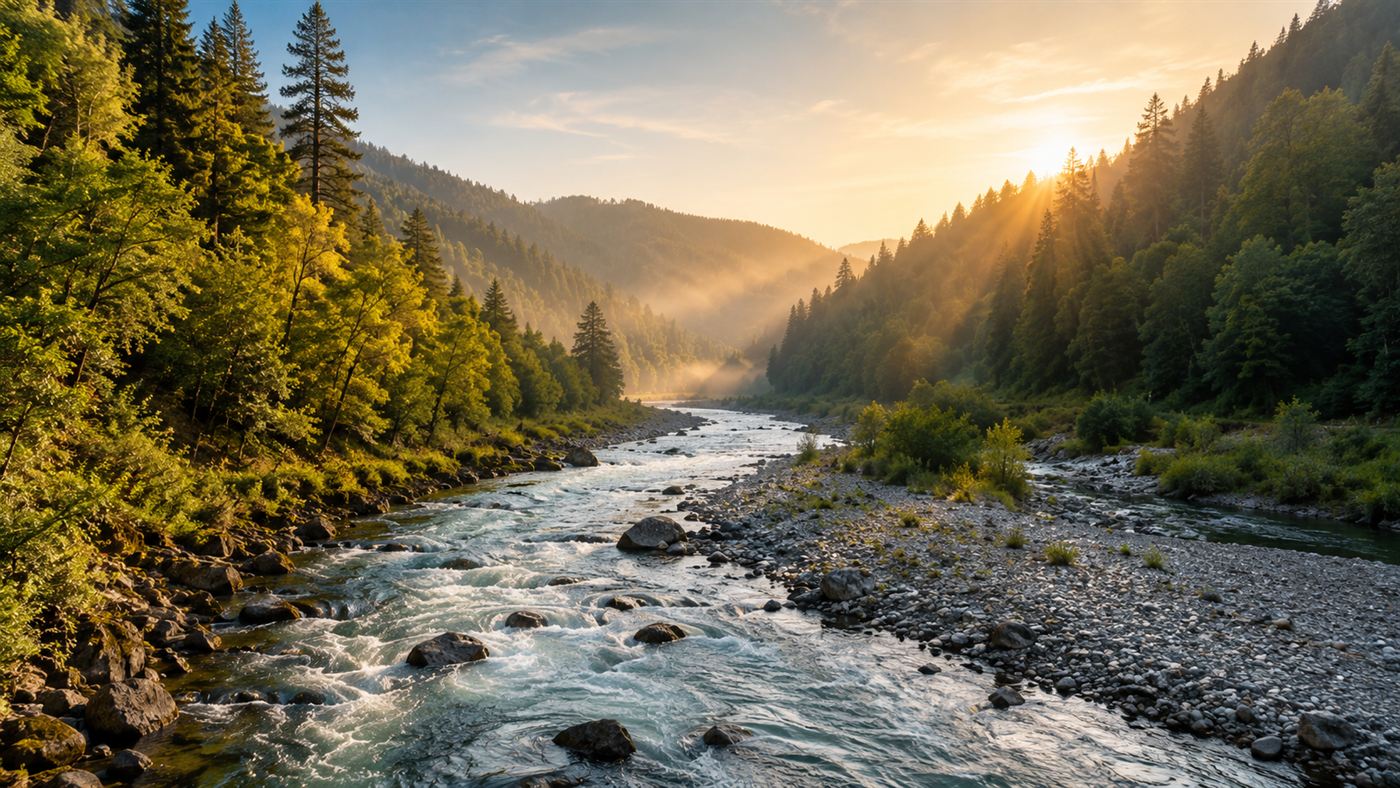
A Karuk tribal fire practitioner at work in Northern California. The tribe has been pushing to restore its burning practices for decades. Illustration: Watts & Wild.
On January 1, 2025, a California law took effect that the Karuk Tribe had co-sponsored after years of advocacy. Senate Bill 310 formally recognized indigenous cultural burns as a legitimate fire management practice and allowed trained tribal members to conduct them without needing a state-certified fire supervisor at every burn. For Bill Tripp, the Karuk Tribe's director of natural resources and environmental policy, it was a law his people should not have needed. According to a January 2025 report from Wyoming Public Media, the Karuk are now working to reestablish cultural burning as a common practice, with tribal members certified and qualified to lead burns in the forests of Northern California's Klamath River basin.
The reversal embedded in that sentence is worth pausing on. The Karuk and Yurok peoples had been burning those same forests for at least 10,000 years before anyone told them to stop. The practice kept the forests open, reduced fuel loads, nurtured the plants their communities depended on, and, in ways that ecology has only recently begun to quantify, made the landscape dramatically less likely to explode. When the state and the federal government suppressed indigenous burning across the early twentieth century, the forests had no one left who was allowed to manage them with fire. The fuel accumulated for a hundred years. Then, in 2020, California experienced the worst fire season in its recorded history, burning through more than five million acres in a single year. The connection between those two facts is not subtle.
California cultural burns, a practice as old as the landscape
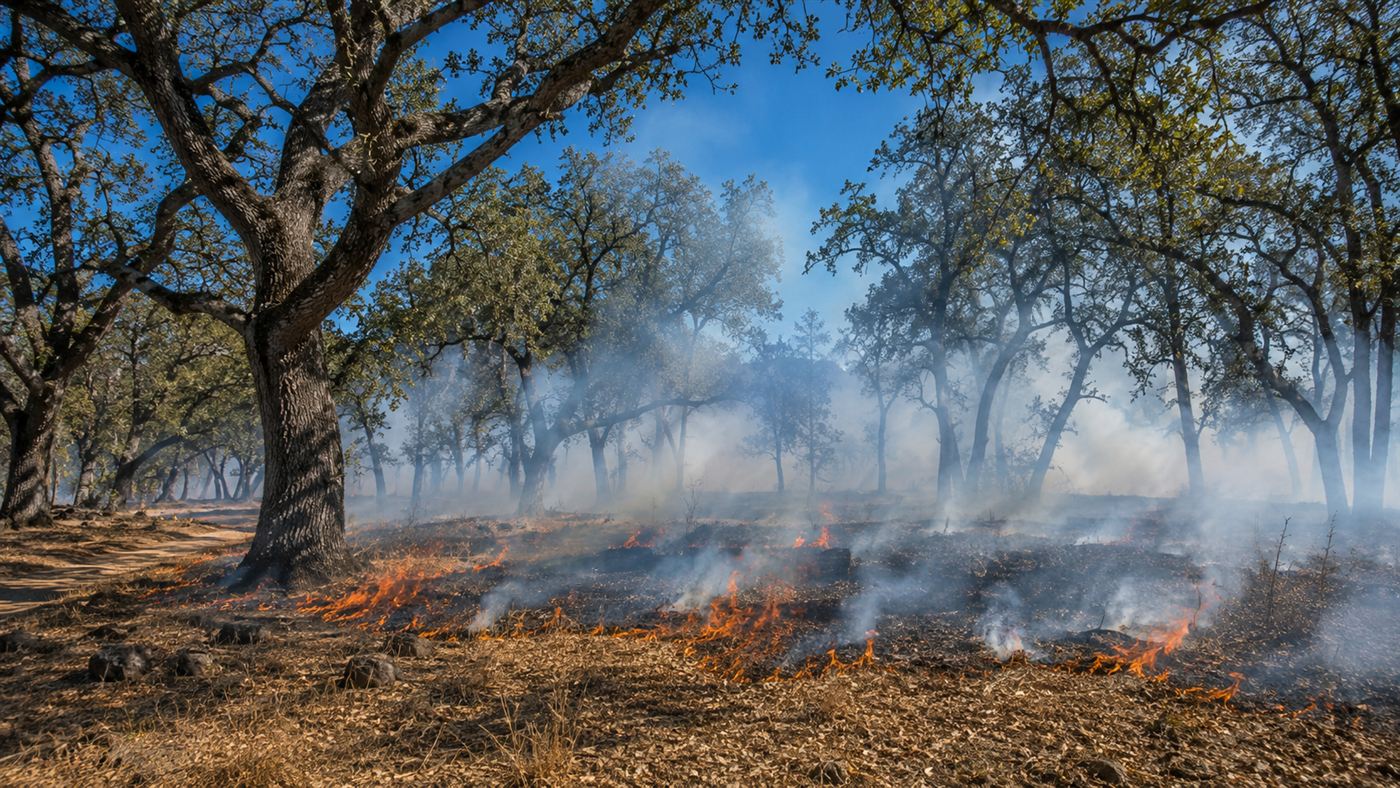
The Karuk and Yurok did not manage fire the way the Forest Service later managed it, by suppression. They used it the way farmers use water, to grow specific things in specific places. Hazelnut is the clearest example. The plant produces long, straight stems that Karuk and Yurok weavers use for the frames of baskets, but only after fire has burned back the older growth. Without burns, hazelnuts produce dense, gnarled stems. With regular burns on three-to-five-year cycles, they produce exactly what the weavers need. The same principle applied to the oak woodlands that produced the acorns at the center of the food culture, and to the ridgelines and meadows where fire was used to drive elk and concentrate deer.
The ecological effects went beyond individual plants. Researchers working with the tribes and reviewing historical records have found that forest biomass in the Klamath Mountains region was roughly half its current level under traditional burning regimes. That difference is the fire risk that built up over a century of suppression. Open, regularly burned forests burn cool and slow when fire does come through. Forests with twice the fuel burn hot and fast and kill everything in their path, including the trees themselves. The Karuk and Yurok were not just tending their food and their craft materials. They were, in effect, maintaining the fire behavior of millions of acres.
How a century of suppression loaded the gun
The U.S. Forest Service introduced what became known as the 10 AM Policy in the early twentieth century: all wildfires were to be suppressed by 10 in the morning of the day after they were reported. The goal was to protect timber and reduce fire risk. The effect, applied across a landscape that had been managed with fire for millennia, was to remove the only process that had been keeping fuel loads from building to dangerous levels. Indigenous burns were actively discouraged, then effectively banned through a combination of Forest Service policy and California state regulations that made the practice impractical without layers of certification and oversight.
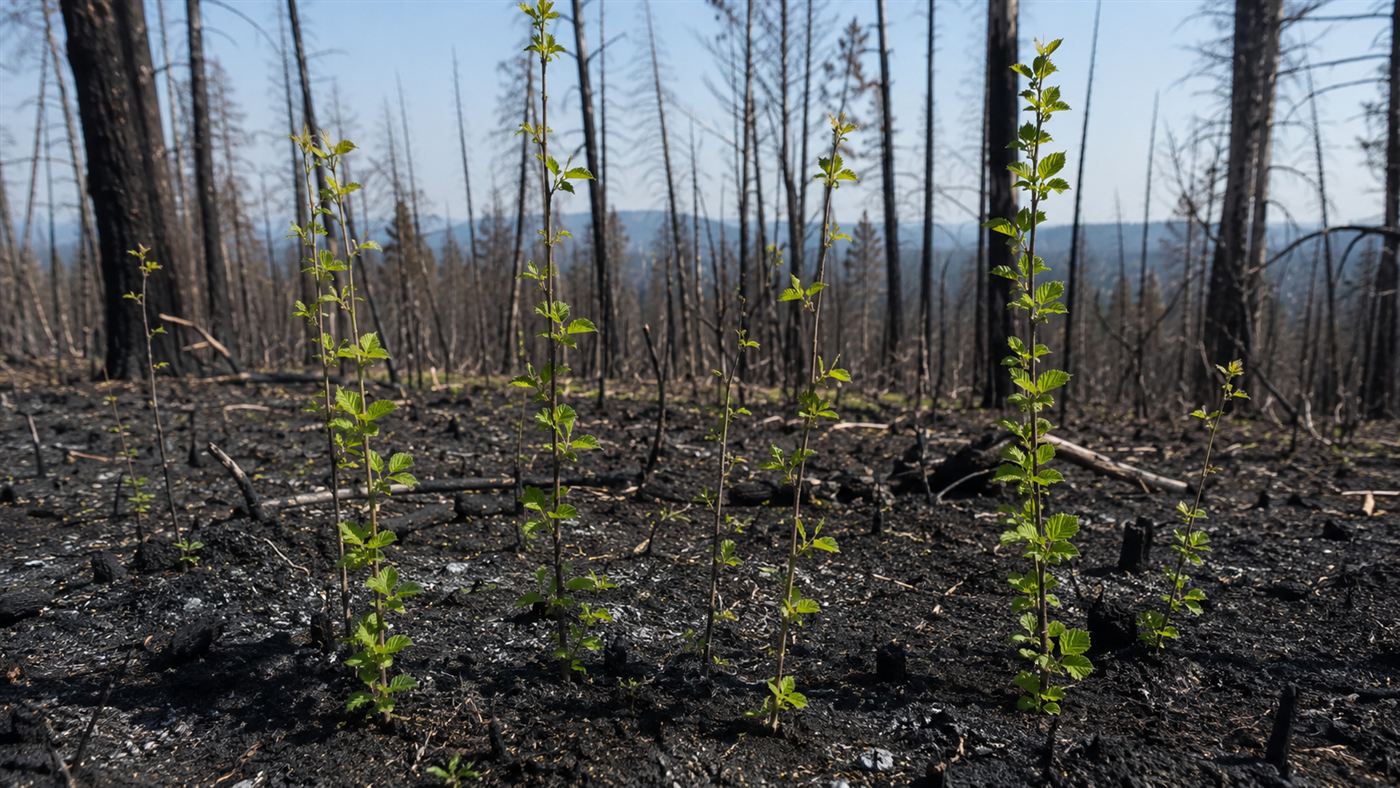
The fuel accumulated quietly. A century of growth without fire doubled the biomass in forests that had evolved to burn regularly. Dense young trees and shrubs moved into what had been open woodlands. Dead wood built up across the forest floor. Then the conditions that produce catastrophic fire arrived, and the results were devastating. The Camp Fire of 2018 killed 85 people and destroyed the town of Paradise in a few hours. 2020 burned more than five million acres across California, roughly five times more than any year before 2017. 2021 brought the Dixie Fire, which became the largest single wildfire in California history. These were not natural disasters in any straightforward sense. They were the predictable outcome of removing, for a century, the practice that had prevented them.
Margo Robbins, Bill Tripp, and what it takes to burn again
The work of bringing fire back has not been fast or simple. Margo Robbins of the Yurok Tribe co-founded the Cultural Fire Management Council, which began coordinating planned burns with regional partners, tracking their ecological effects, and lending equipment and practical support to families who wanted to burn their land the way their grandparents had. The U.S. Geological Survey has formalized a research partnership with the Yurok Tribe to study the effects of cultural burns on vegetation, water, and wildlife, a recognition that the knowledge the federal government needs is held by the people the federal government once told to stop. In the most recent year, the Cultural Fire Management Council held 24 prescribed burns with cultural objectives and supported 10 family burns.
California took legislative steps in this direction. SB 332 in 2021 acknowledged cultural burning as a legitimate fuel management practice and recognized indigenous practitioners as qualified to conduct burns without Cal Fire burn bosses. As CalMatters reported in September 2024, advocates argued that California needed to go further and recognize tribal authority over cultural burns on tribal lands, removing the remaining liability barriers that made the practice difficult for private landowners and communities outside the formal regulatory structure. SB 310, which the Karuk co-sponsored and which took effect at the start of 2025, was the next step in that direction.
The honest catch
The laws have changed. The underlying obstacles have not all followed. Liability remains complicated even with SB 310, and private landowners who want to burn their land using cultural techniques still face paperwork and risk that can make the practice impractical. Getting from the law to the actual burns requires trained practitioners, insurance, air quality permits, and coordination with county and state agencies, a stack of requirements that takes years to navigate and can stop a burn before it starts.
The scale gap is the deeper problem. The Cultural Fire Management Council and the Karuk Tribe are burning hundreds of acres per year in a state where ecologists say millions of acres need to burn annually to bring fuel loads back to levels that won't produce the fires of 2020 and 2021. The legislative recognition is real and meaningful, and the burns that happen matter. But the gap between what is happening now and what the landscape needs is measured in orders of magnitude.
There is also what a century of suppression did to the knowledge itself. The chain of transmission was broken. Elders who knew which slopes to burn and when, how to read the wind and the moisture and the time of year, are fewer than they were, and some of what they knew was not written down anywhere. Margo Robbins and others are training a new generation of practitioners, and that work is genuine and urgent. But knowledge embedded in practice over thousands of years does not fully return in a decade. The burns that happen now are a beginning, and a beginning is not the same as restoration.
What the smoke knows
The story of indigenous burning in California is often told as a story about fire management, and it is that. But it is also a story about what happens when the institutions of one civilization look at the practices of another and conclude that suppression is an improvement. The Karuk and Yurok did not burn their forests because they had not thought of a better idea. They burned because they knew what happened when you didn't, and they had watched it for generations. That knowledge was erased, or rather silenced, by policy. The forests filled with fuel in the silence. Then the fires came and burned louder than any policy.
California is now doing something it took megafires to produce: listening. The drip torches are lit, the smoke is rising through the Klamath pines, and the forest is responding the way it always did. Slowly and imperfectly, the practice that kept millions of acres fire-safe for thousands of years is coming back. It is not coming back fast enough to be comfortable, but it is coming back.
The people who burned California's forests for 10,000 years are finally being asked to do it again. The law is in place, the practitioners are certified, the burns are happening. What would it take, in your view, to close the gap between what is happening now and what the landscape actually needs? Tell us in the comments.
Related reading: The four dams that tribes fought for a century to remove came down in 2023, and the salmon came back in ten days. See also how firefighters wrapped a giant sequoia in foil as megafires killed thousands of the ancient trees, and how a worn hook on a power line sparked the Camp Fire that destroyed Paradise.