A chemist in Newcastle lit a working electric bulb before Edison's famous lamp, lit the first house in the world, and beat Edison so soundly in court that the great inventor had to merge with him
Ask who invented the light bulb and almost everyone says Edison. Yet on a winter evening in Newcastle, months before Edison's famous demonstration, a quiet northern chemist stood before a packed hall and switched on a glowing lamp. Joseph Swan not only lit a bulb first in Britain, he lit the first house in the world, and history has very nearly forgotten him.
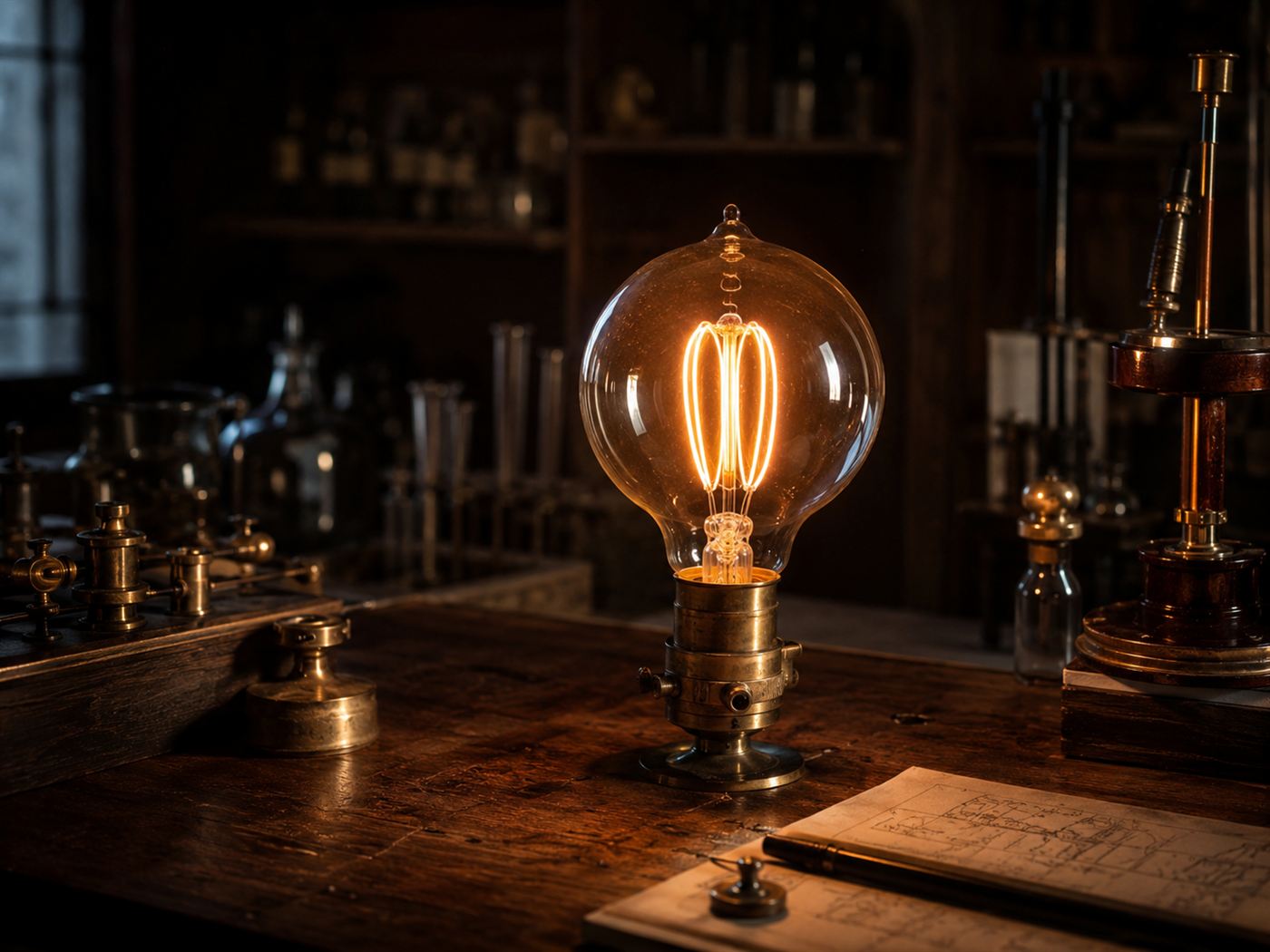
An early carbon-filament lamp, the kind Joseph Swan brought to life in Newcastle. Illustration: Watts & Wild.
Joseph Wilson Swan was born in Sunderland in 1828 and spent his working life in the north-east of England as a chemist and inventor, a long way from the limelight of New York. He had been chasing the idea of electric light for decades, on and off, ever since the 1840s, but the same obstacle defeated everyone who tried it: a thin filament heated white-hot in air simply burned away in seconds. The answer was to take the air out, and better vacuum pumps finally made that possible in the 1870s.
With a good vacuum and a slender rod of carbon, Swan had the pieces. What he did next is the part the usual story leaves out.
The night Joseph Swan switched on the light
On 18 December 1878 Swan showed an incandescent lamp to the Newcastle Chemical Society. It glowed brightly for a few minutes and then failed, overwhelmed by the current, but the principle was there for all to see. As the Institution of Engineering and Technology records, he repeated the demonstration successfully in January 1879 and, on 3 February 1879, showed a working lamp to an audience of more than seven hundred people at the Literary and Philosophical Society in Newcastle, with Sir William Armstrong in the chair.
That date matters. Edison's celebrated demonstration at Menlo Park came in October 1879, the better part of a year later. Whatever was happening across the Atlantic, the people of Newcastle had already watched a steady electric light burn in a glass bulb, in public, with their own eyes.
The first house in the world
Swan did not stop at the lecture theatre. He wired up his own home, Underhill, in Low Fell on the edge of Gateshead, and in doing so made it the first house in the world to be lit by electric light bulbs. While most of humanity still lived by candle, gas and oil lamp, one Victorian villa in the north-east glowed from within at the flick of a switch.
He kept improving the lamp itself, too, working out how to make a far better filament by treating cotton thread into a smooth, even carbon, and securing a British patent for it in 1880. The Lit & Phil became the first public building lit by the new lamps, and Swan's light began to spread from the drawing rooms of the north into the wider world.
How Joseph Swan forced Edison to the table
When Edison's company moved into Britain, a clash was inevitable, and it went to court. As North East Museums recounts, Swan's prior work and patents in Britain put him in a commanding legal position. Edison sued for infringement of his 1879 patent, but his lawyers could see the danger: if Swan proved in open court that he had published and demonstrated his lamp first, Edison's case in Britain would collapse.
So rather than fight a battle he might lose, Edison's side chose to join forces. In 1883 the two rivals merged into the Edison and Swan United Electric Light Company, universally known as Ediswan. Tellingly, Swan's company came away with the larger share of the new business, a quiet acknowledgement that, on British soil at least, the northern chemist had the stronger claim.
The honest catch
It would be just as unfair to flip the legend and crown Swan the sole inventor instead. The truth is messier and more interesting: the two men worked independently and arrived at much the same place at much the same time, and they were not the only ones, since a string of earlier experimenters had made fragile, short-lived incandescent lamps before either of them.
And Edison genuinely earned his fame, just not only for the bulb. His real triumph was the whole system around it, the generators, the wiring, the durable high-resistance lamp designed to run economically across a city-wide network. Swan's early lamp was elegant but electrically awkward to scale. Edison thought like the founder of an industry; Swan thought like the brilliant chemist he was. Both were needed.
Why Swan still deserves the credit
What the tidy "Edison invented the light bulb" story costs us is a truer, richer picture of how invention actually happens: not as a single flash of genius in one famous workshop, but as parallel work by careful people in unglamorous places. Joseph Swan lit a hall in Newcastle and a house in Gateshead while the world still burned gas, and the merger that bears half his name is the receipt.
Next time you flick a switch, you might spare a thought for the man from Sunderland. Does it change the story of the light bulb for you to know Swan lit the first house in the world? Tell us in the comments.
Related reading: The Victorian arms baron whose mansion became the first house in the world lit by hydroelectric power, with Swan's own lamps. See also the Centennial Light, a bulb that has burned since 1901.