Decades before the electric car, a battery-powered boat was already carrying passengers up a Russian river in front of the Tsar, the first time electricity ever moved people
We tend to think of electric transport as a recent idea, born with modern batteries. It is far older than that. Jacobi's electric boat carried fourteen people up the river Neva in St Petersburg in 1839, powered by nothing but batteries and an electric motor, more than forty years before the first electric car.
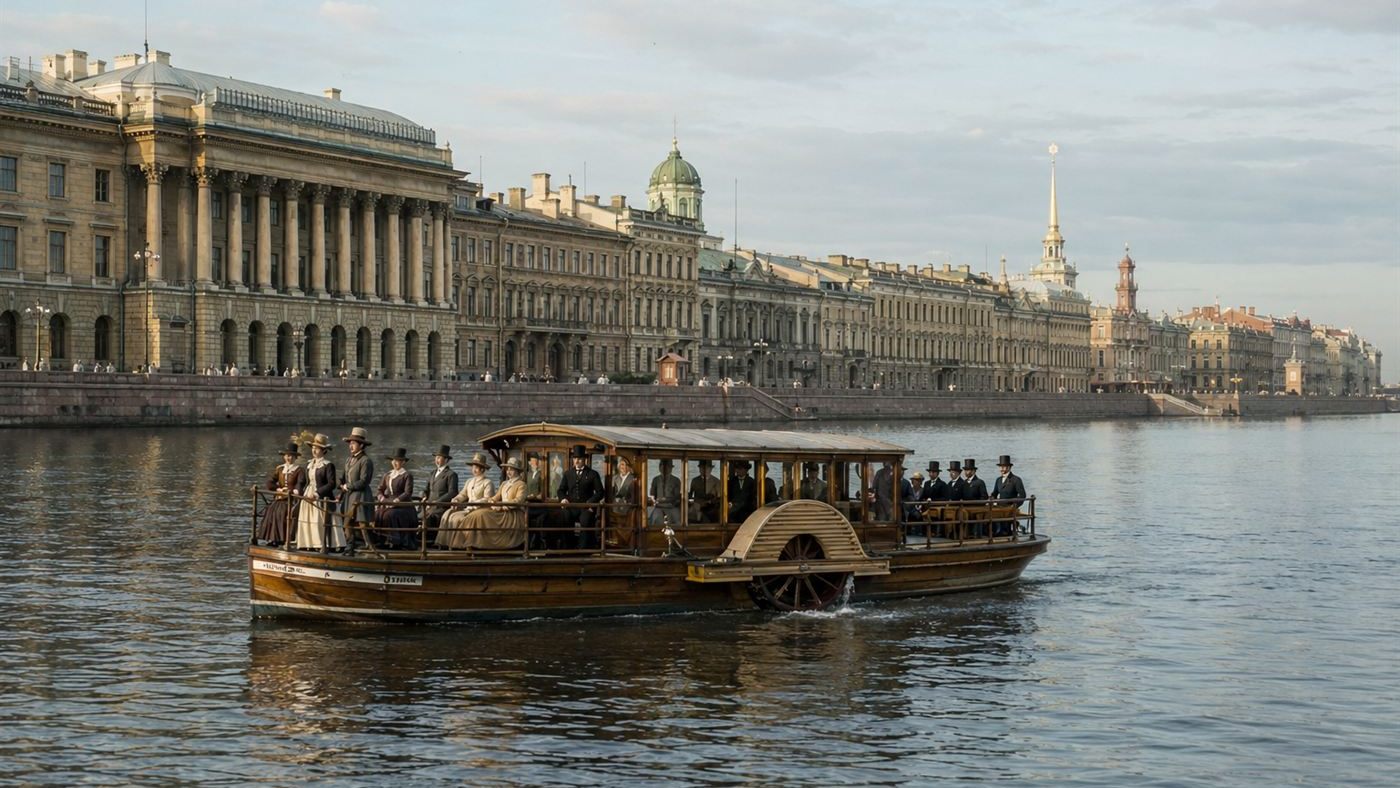
A boat that moved on electricity, on the Neva in 1839. Illustration: Watts & Wild.
The man behind it was Moritz Hermann von Jacobi, a German-born engineer and physicist who had moved to St Petersburg in 1837 to work at the Russian Academy of Sciences. Electricity was a young, exciting science, and Jacobi was at the front of it: a few years earlier he had built one of the first genuinely useful rotating electric motors, the kind of machine that could turn a shaft and do real work rather than just twitch in a lab.
A motor that can turn a shaft can, in principle, turn a paddle wheel. Jacobi set out to prove it, and he found a powerful backer.
How Jacobi's electric boat worked
The patron was the Tsar himself. As a history of the project records, with financial support from Tsar Nicholas I, Jacobi built a boat about 28 feet long, driven by his electric motor and powered by banks of battery cells. In 1839 he took it onto the Neva, the broad river running through St Petersburg, and it worked: the boat carried fourteen passengers and pushed upstream, against the current, under its own electric power.
It was not fast. The boat managed only around three miles an hour, little better than walking pace, and the current it was fighting made that feel slower still. But the speed was almost beside the point. For what may have been the first time in history, a group of people were being carried along by electricity, with no sail, no oars, no steam and no smoke, just current flowing from batteries into a motor and out through a paddle into the river.
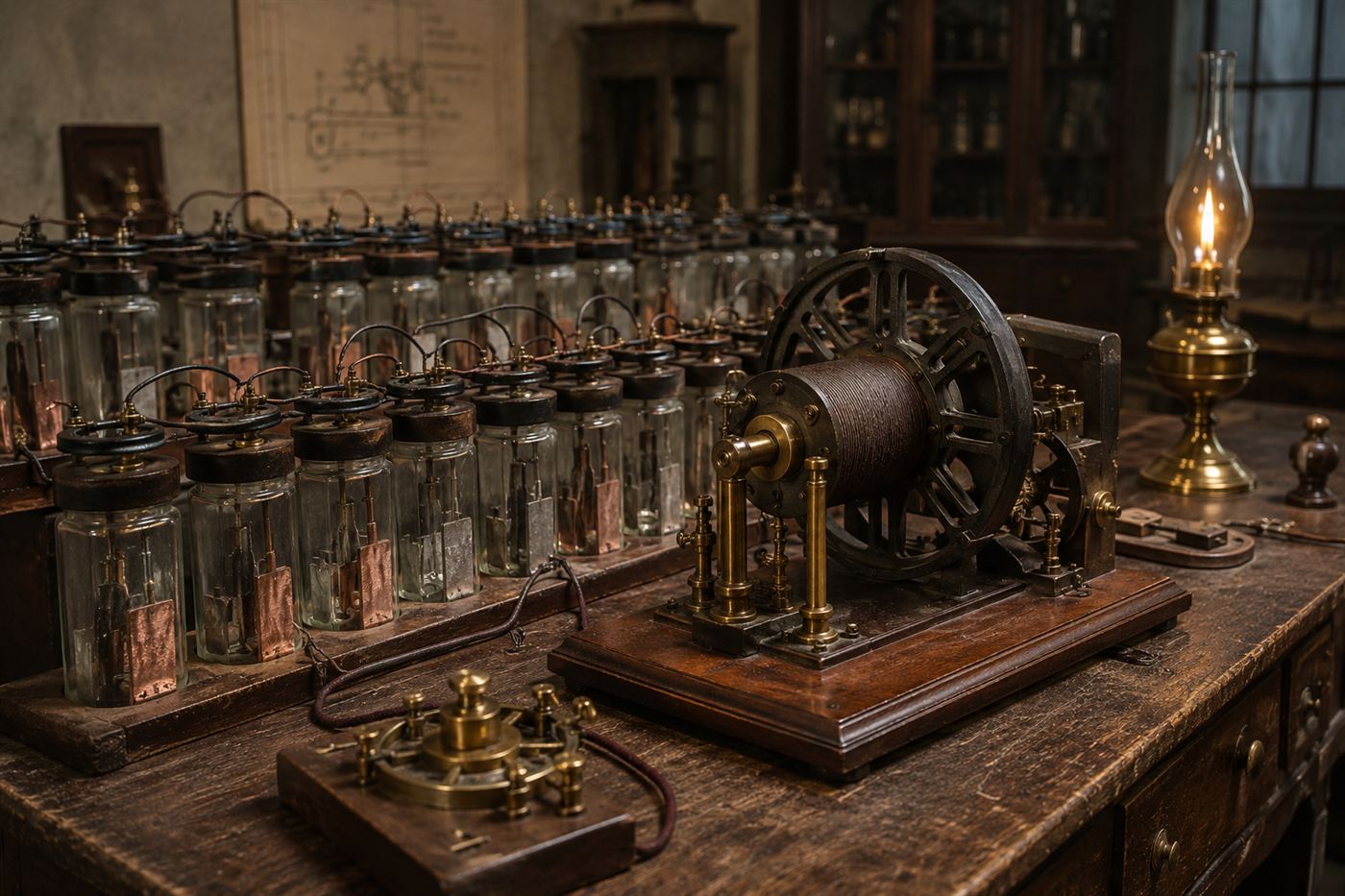
A motor before its time
Jacobi was not a showman stumbling on a trick; he was a serious scientist, and the boat was part of deeper work. While studying how to get the most power out of a battery driving a motor, he worked out a fundamental rule of electrical engineering, the principle that there is a particular matching between source and load that delivers maximum power, an idea still taught today. The boat on the Neva was, in a sense, that theory taken out for a ride.
To demonstrate it to the Emperor, on the great river of the imperial capital, was a statement about where technology might be heading. Here was a glimpse, in 1839, of a future in which machines moved on stored electricity, decades before most people had even seen an electric light.
Why Jacobi's electric boat failed to catch on
For all its symbolic power, the boat went nowhere, and the reason was the same one that would haunt electric transport for a century and a half: the battery. Jacobi's cells used platinum, which made them dazzlingly expensive, and they drained quickly, so the boat could not run far before its power was gone. It was a triumph of physics and a failure of economics.
Jacobi himself understood this. He recognised that, with the batteries of his day, his electric boat could not hope to compete with steam, which was cheap, powerful and improving fast. The technology was right but the storage was hopeless, and it would take more than thirty years of progress in batteries and motors before electric boats became anything like practical. The Neva demonstration was a door opened far too early.
The honest catch
A little precision keeps the story honest. Jacobi's boat was a demonstration, a one-off paid for by a curious emperor, not a product anyone could buy, and calling it "the first electric boat" carries the usual asterisks; other inventors were tinkering with electric motors at the same time, and some sources put the date a year earlier. What is not in doubt is that, around 1839, real passengers really were carried on the Neva by electricity.
It is also worth resisting the temptation to make Jacobi a thwarted prophet of clean energy. He was a working scientist solving the problems in front of him, and he was clear-eyed about the boat's limits rather than crusading for an electric future. The poignancy is in the timing, not in any lost campaign: he had the right idea and simply lived a century before the batteries could keep up.
Why a slow boat still matters
The lasting value of Jacobi's electric boat is how completely it rearranges the timeline in our heads. The electric vehicle is not a child of the twenty-first century, or even the twentieth; the basic dream of moving people on stored electricity was alive, and working, in 1839. Everything since has been a long wait for the battery to catch up with the motor.
That is a useful thing to remember as electric transport finally comes into its own. Does it change how you see today's electric boom to know the first electric passengers rode in 1839? Tell us in the comments.
Related reading: A forgotten Frenchman built the first electric road vehicle in 1881, beat the petrol car by years, and ended in a pauper's grave, and the Telharmonium, the 200-ton machine that streamed music over phone lines in 1906.