Britain built its Antarctic science base on giant skis so the ice could not swallow it, and when a crack opened beneath the station, the whole thing got up and walked 23 kilometres away
Antarctica had destroyed five British research stations in a row, slowly burying each one under the endless snow until it was crushed. So for the sixth, the Halley VI Antarctic station, the engineers gave up fighting the ice and decided to outmanoeuvre it instead, on hydraulic legs and a set of enormous skis.
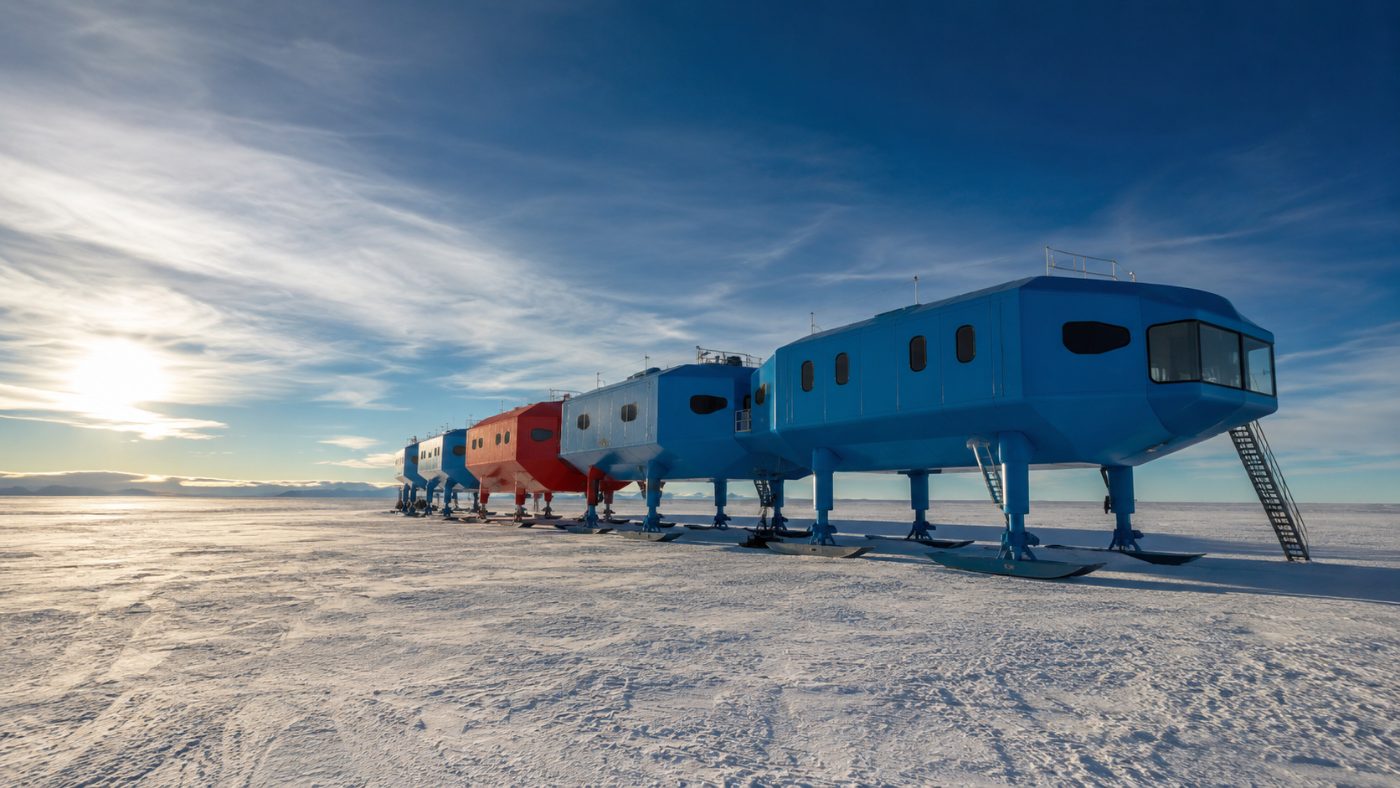
Halley VI, the world's first relocatable research station, stands on legs and skis on a floating Antarctic ice shelf. Illustration: Watts & Wild.
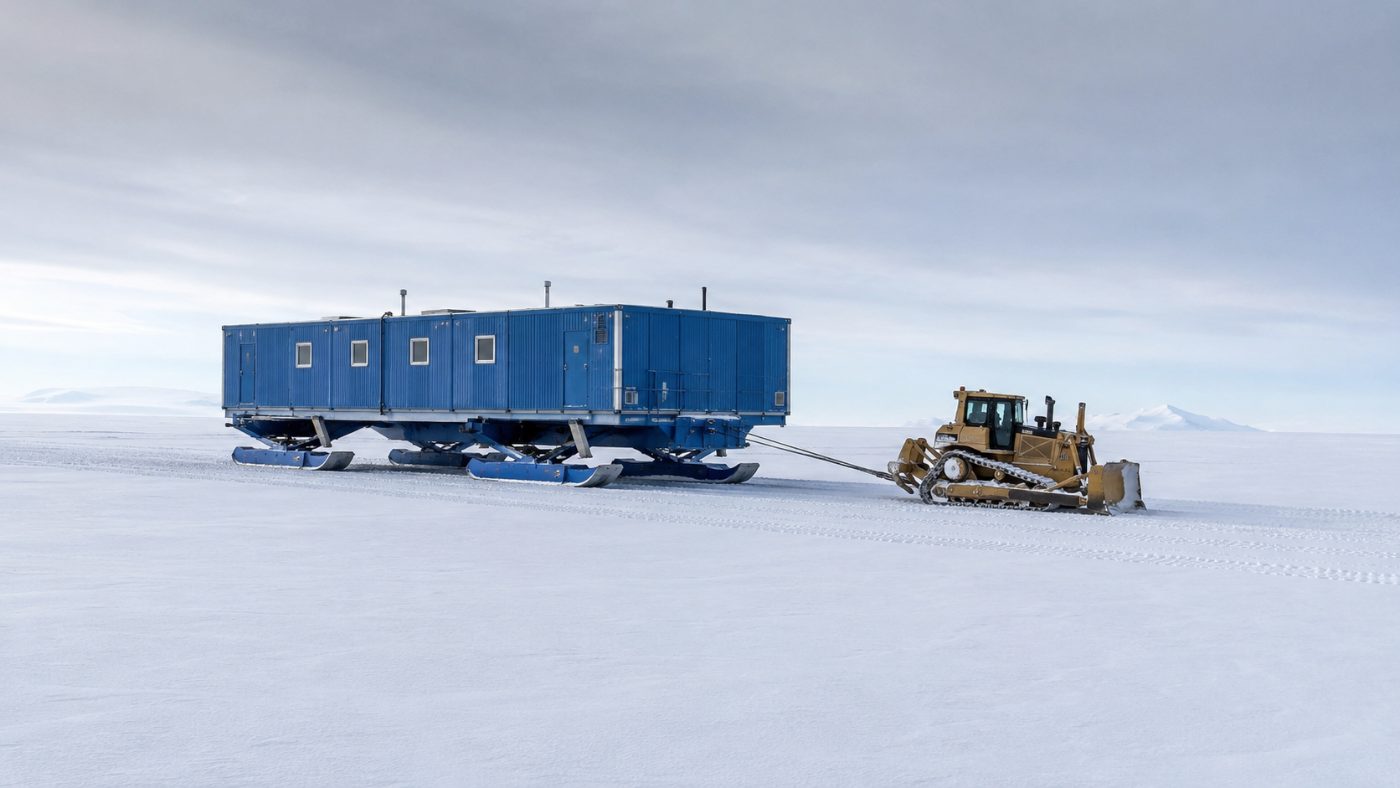
Across the summer of 2016 and 2017, on a floating shelf of ice in Antarctica, a building got up and walked. Halley VI, Britain's flagship polar research station, is a row of eight bright blue and red pods, each the size of a bus, standing on hydraulic legs that end in giant skis. Over several weeks a fleet of bulldozers towed the whole thing 23 kilometres across the snow to a new home.
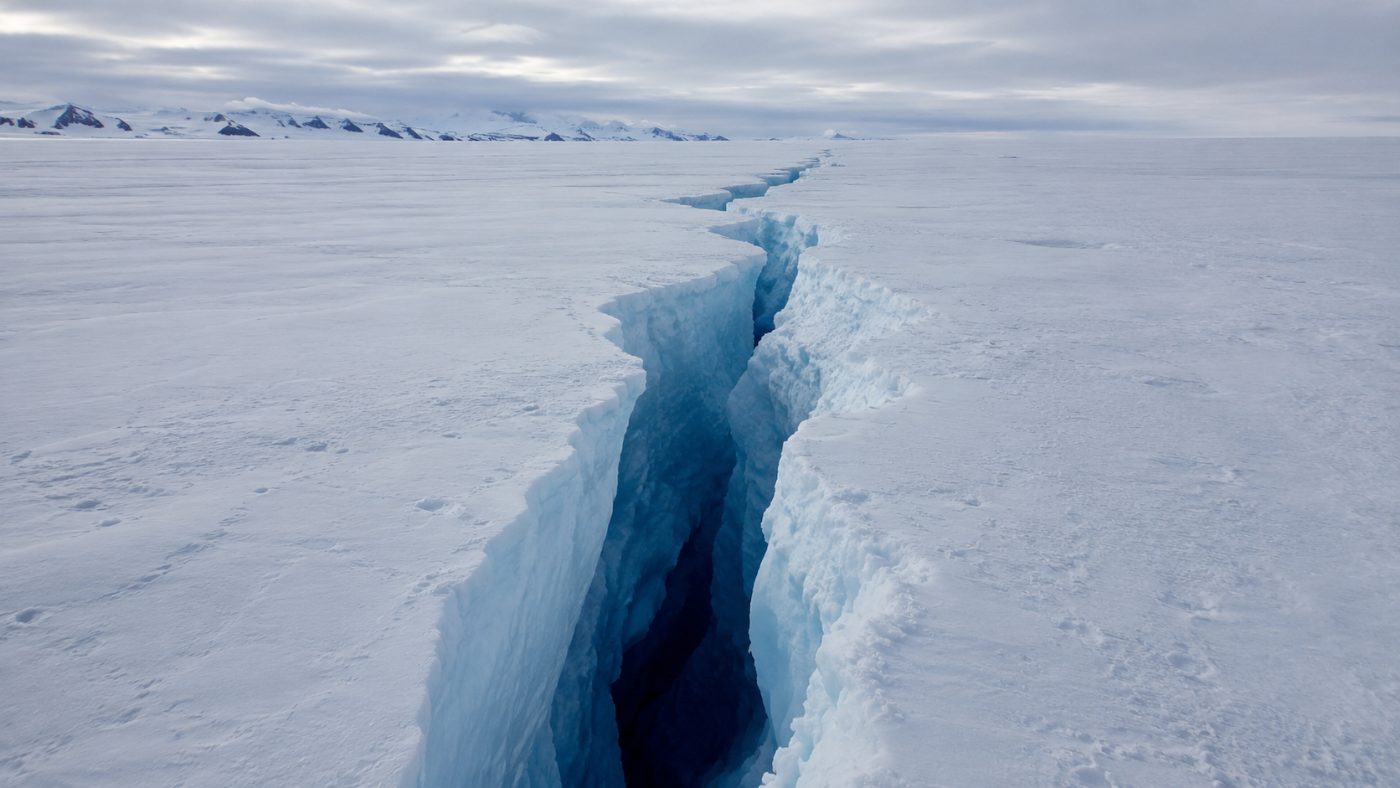
It moved because the ice was about to betray it. As widely reported, a long-dormant crack in the Brunt Ice Shelf had begun growing again, threatening to slice the station off from the main body of the shelf and one day set it adrift on an iceberg. Halley VI is the world's first research station built to be relocatable, and it had just proved exactly why that mattered, by running away.
Five stations the ice ate
Britain has kept a base on the Brunt Ice Shelf since 1956, and for decades it was a losing battle. The first five Halley stations were fixed structures, and the Antarctic does to anything fixed what it does to everything: it buries it. Metres of snow fall every year, never melting, slowly swallowing each station and crushing it under the accumulating weight until it had to be abandoned, while the shelf carried the wreckage out toward the sea.
Halley VI was designed to break that cycle. Its modules sit on hydraulic legs that can be jacked up a little each year so the station climbs above the rising snow instead of drowning in it. And because those legs end in skis, the entire base can be unhitched and towed somewhere else, which is precisely what no Halley before it could do.
The Halloween Crack and the empty winter
The relocation should have been the end of the drama, but the ice had another surprise. While the station was being moved away from the old chasm, a brand-new crack tore open across the shelf on the 31st of October 2016, and was promptly named the Halloween Crack. It threatened the station from a different direction, and there was a problem with no easy answer.
In the Antarctic winter there are months of total darkness and no way to fly anyone in or out, so if the ice failed there would be no rescue. Faced with that, the British Antarctic Survey made an unprecedented decision in 2017: pull every single person off the base for the winter and leave it to fend for itself. Halley has been a summer-only station ever since, its instruments humming away alone in the dark.
The little station that found the hole in the sky
It would be easy to treat Halley as a quirky building, but its real importance is in the data. As the British Antarctic Survey notes, Halley has carried out long, unbroken records of the atmosphere for decades, and in 1985 that patient watching paid off in spectacular fashion. Scientists at Halley discovered the hole in the ozone layer over Antarctica, a finding that stunned the world.
That single discovery, made by people measuring the sky year after year from this freezing outpost, led almost directly to the Montreal Protocol, the global treaty that banned the chemicals eating the ozone layer. It remains one of the few times humanity spotted an environmental catastrophe in time and actually fixed it, and it happened because someone kept a station running on the ice.
The honest catch: you can move a building, not the ice
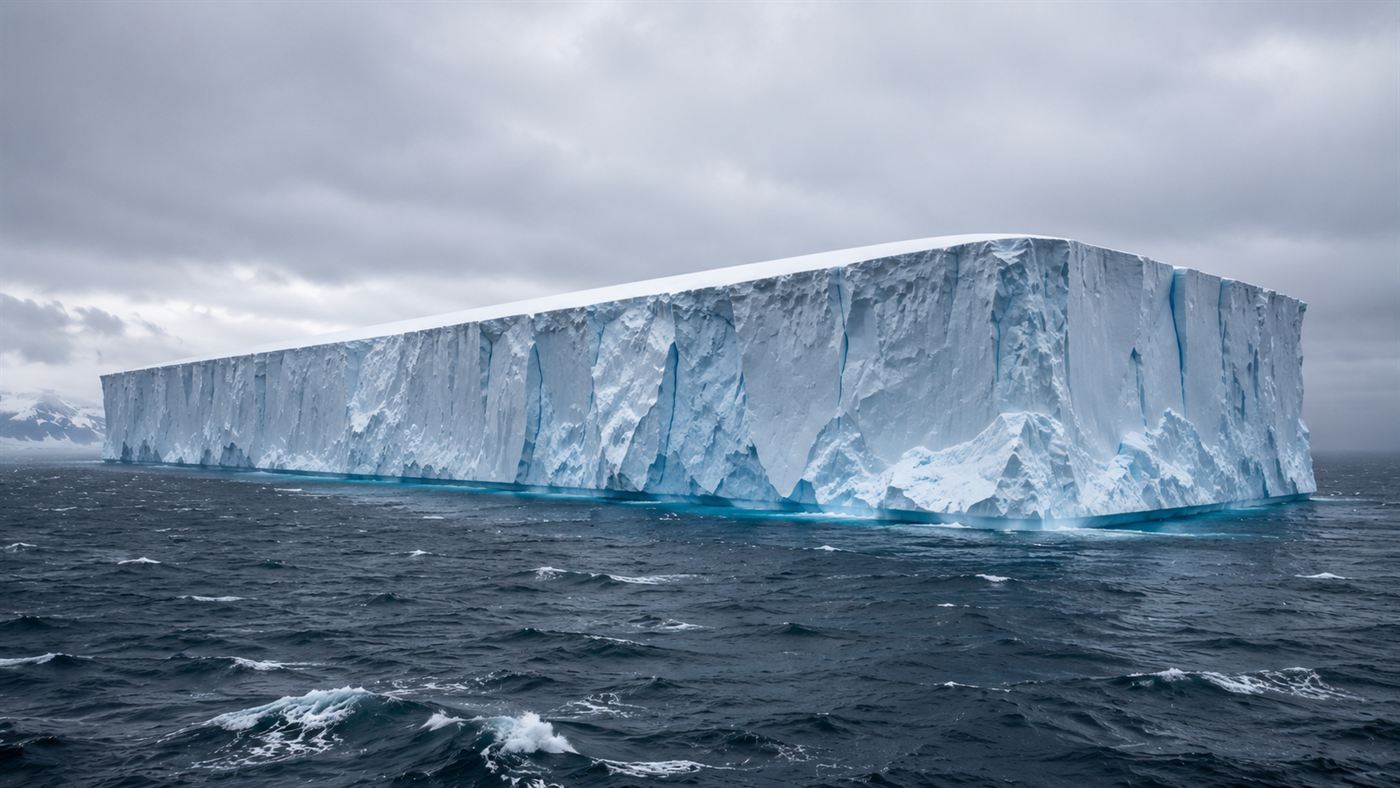
The walking trick beat the snow, but it cannot beat the ice shelf itself. The Brunt is floating, fracturing, and shedding enormous icebergs, including the city-sized A-81 in 2023 and A-83 in 2024. Halley sits, for the moment, on the safe side of the cracks, but the ground beneath it is quite literally drifting toward the ocean. Moving the station bought time, not permanence, and one day the ice it stands on will break away.
The empty winters cost something, too. The continuous, year-round measurements that once caught the ozone hole are now interrupted, because in the dark months the base runs on automated instruments alone, and if their power or their link home fails during the six-month night, that data is simply lost. The price of keeping the people safe is a gap in one of the most important records in science.
Why the Halley VI Antarctic station matters
Halley VI is what it looks like when humans stop trying to dominate a hostile place and start trying to live lightly and nimbly within it, ready to pick up and move the moment it shifts. As ice shelves grow less stable in a warming world, a building that can lift its own legs and walk away from danger may turn out to be less a curiosity than a glimpse of how we will have to build on a changing planet.
A small blue station keeps watch on the sky from a patch of ice that is slowly carrying it out to sea. Is a building that runs from cracks in the ice a brilliant fix, or a sign that we are trying to live somewhere we probably should not? Tell us what you think in the comments.