The world's largest iceberg sat stuck on the seabed for over 30 years, then broke free and drifted a trillion tonnes of ice toward an island of two million penguins, where it is now shattering apart
For three decades it was less an iceberg than a frozen island, pinned to the ocean floor near Antarctica. Then in 2020 the trillion-tonne slab called A23a tore loose and began a slow march north. In 2025 it ran aground beside South Georgia, and now it is falling to pieces.
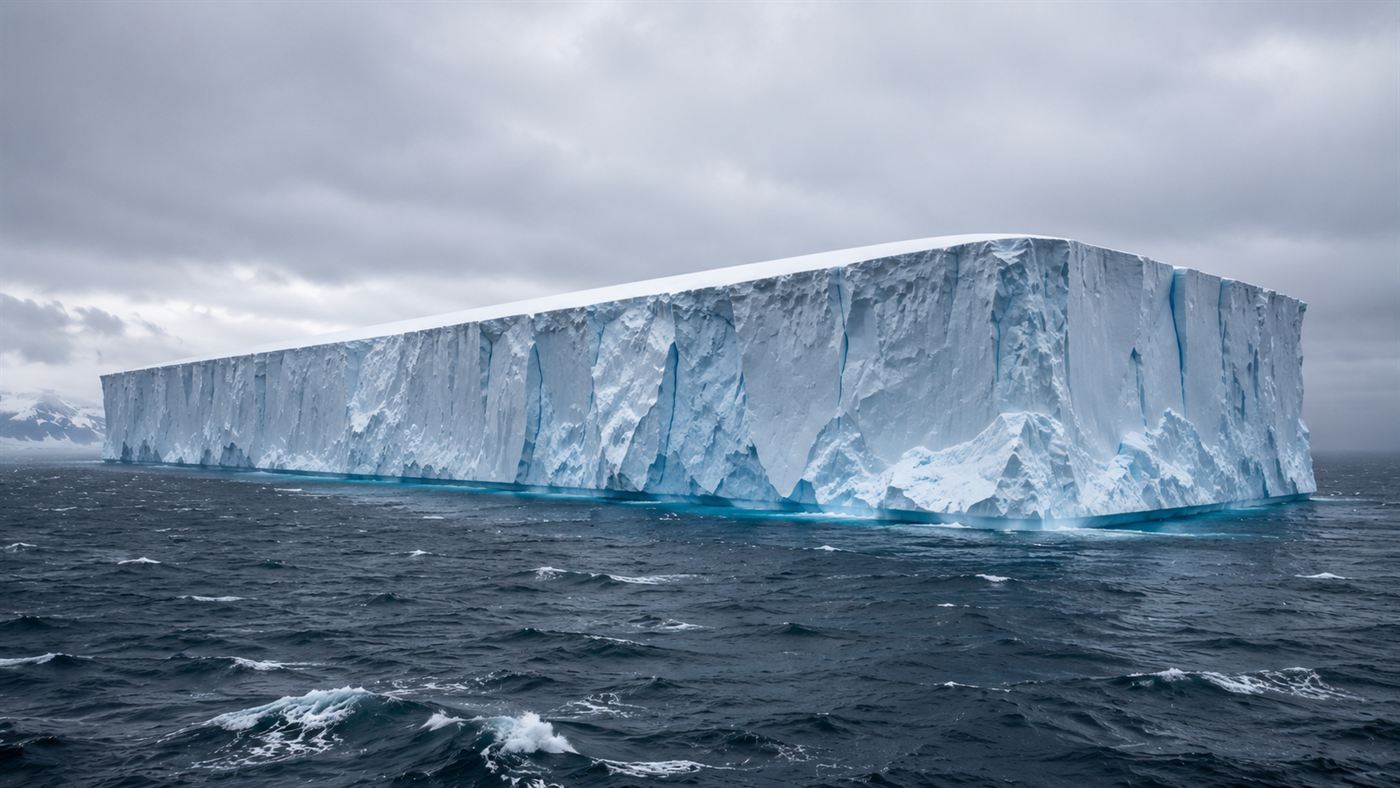
A23a held the title of largest iceberg on Earth for years. Illustration: Watts & Wild.
Most icebergs are fleeting things. They calve off a glacier, drift into warmer water, and melt away within a season or two. The A23a iceberg was not like that. When it broke away from Antarctica's Filchner-Ronne Ice Shelf in 1986, it was so vast and so deep that it promptly jammed its underside into the floor of the Weddell Sea and simply stopped, a continent-sized ice cube that refused to move.
It stayed there for more than thirty years. As CNN reported as the berg began to fall apart, A23a finally pulled free of the seabed around 2020 and started a long, slow drift north, still weighing close to a trillion tonnes. For years it was the largest iceberg on the planet, and its journey turned into one of the most closely watched in the history of polar science.
An iceberg the size of a small country
The numbers are hard to hold in your head. At the start of 2025 A23a still covered around 3,500 square kilometres, larger than many countries and several times the size of a major city. It rose from the water as a wall of ice tall enough to dwarf a ship, and most of its bulk, like any iceberg, hid below the surface. All told it weighed somewhere near a trillion tonnes, which is roughly the mass of three thousand Empire State Buildings made entirely of ice.
For a frozen object, it had a remarkably eventful life. After it finally floated free, it spent part of 2024 trapped in a spinning column of ocean water, turning slowly in place for months before the current released it. Only then did it resume its drift toward the warmer waters of the South Atlantic, on the same path that has earned this stretch of sea the nickname "iceberg alley."
A collision course with two million penguins
That path pointed straight at South Georgia, a remote British island that is one of the most important wildlife nurseries on Earth. The island and its waters are home to more than two million penguins, along with vast colonies of seals, and for a while it looked as though the largest iceberg in the world was going to park right on their doorstep.
On March 4, 2025, that is more or less what happened. A23a ran aground about 73 kilometres from South Georgia, grinding to a halt on the shallow continental shelf. Some scientists worried the grounded giant could block the routes that penguins and seals use to reach their feeding grounds, forcing parents to swim further for food while their chicks and pups waited ashore. Others were more relaxed, pointing out that the island has weathered drifting bergs before.
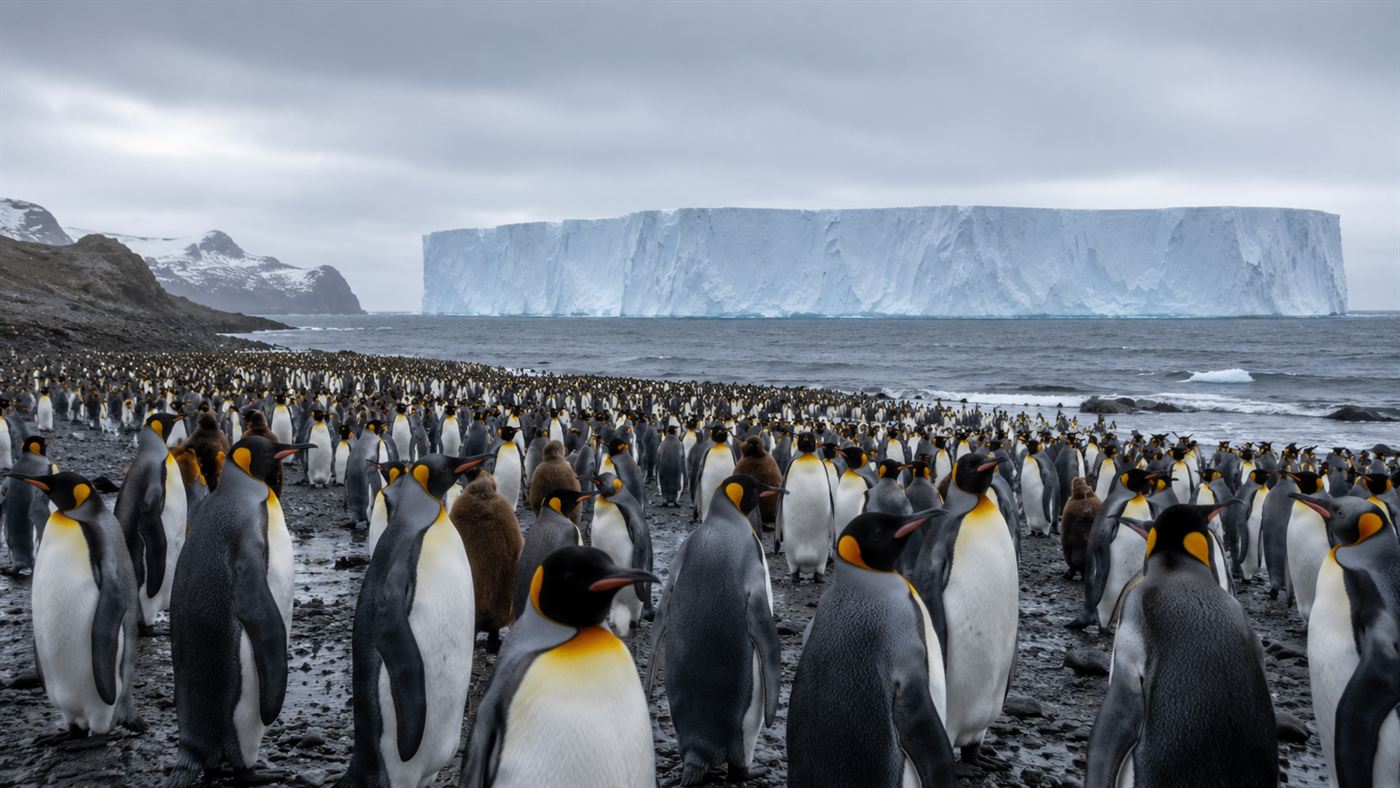
The A23a iceberg begins to fall apart
Grounding turned out to be the beginning of the end. Stuck in one place and exposed to warmer water and waves, A23a started to crack. By early September 2025, Live Science reported the berg was disintegrating into thousands of pieces beside the penguin refuge, having already shed chunks as large as 400 square kilometres. It had shrunk to less than half its original area, down to roughly 1,770 square kilometres, and was visibly coming apart in satellite images.
When an iceberg this big breaks up, it does not melt quietly. It scatters a fleet of smaller bergs and countless growlers, lumps of ice the size of cars and houses, across shipping lanes and fishing grounds, which is exactly why the demise of A23a has been tracked so carefully from space. A trillion tonnes of ice does not simply vanish. It disperses.
The honest catch
It is tempting to read a story like this purely as a climate-change parable, and it is worth being careful there. Icebergs calving and drifting and melting is something Antarctica has always done, and A23a broke away back in 1986, long before the current acceleration. This particular berg is not, on its own, evidence of a warming world. The honest picture is more complicated than a single dramatic headline.
There is even a twist that turns the threat on its head. As a giant iceberg melts, it releases the dust and nutrients locked in its ice, especially iron, which fertilises the surrounding ocean and can trigger blooms of the tiny plankton that feed the whole food web. The same berg that looked like a barrier to South Georgia's penguins may end up enriching the very waters they hunt in. Nature rarely tells a simple story.
Why a dying iceberg matters
For a few years A23a was a kind of slow-motion spectacle, a single object so large it blurred the line between iceberg and island, tracked by satellites as it lumbered across the bottom of the world. Watching it finally come apart near South Georgia is a reminder of the sheer scale of the forces at work in the Southern Ocean, far from almost everyone who will ever read about them.
The largest iceberg on Earth is now a shrinking field of broken ice, and within a year or two the name A23a will belong to the record books rather than the map. Something else will inherit the title of biggest berg, drift its own strange path through iceberg alley, and one day break apart too. That cycle is older than any of us, and watching one turn of it play out in real time is a rare thing.
An iceberg the size of a small country, stuck for thirty years and weighing a trillion tonnes, drifted into a refuge of two million penguins and is now breaking into thousands of pieces. Does a story like A23a make you feel the scale of the planet, or just how small we are beside it? Tell us what you think in the comments.
Related reading: A Scottish family abandoned nine cattle on the island of Swona in 1974, and 50 years later the herd is still there, gone fully wild and ruling the island alone.