Byzantium guarded the recipe for Greek fire, a weapon that burned even on water, so jealously that the secret was finally lost and no one can reproduce it today
For seven centuries the Byzantine Empire defended itself with Greek fire, a liquid flame sprayed from its warships that clung to everything and burned even on the surface of the sea. The recipe was guarded so completely that it was eventually lost, and we still do not know how it was made.
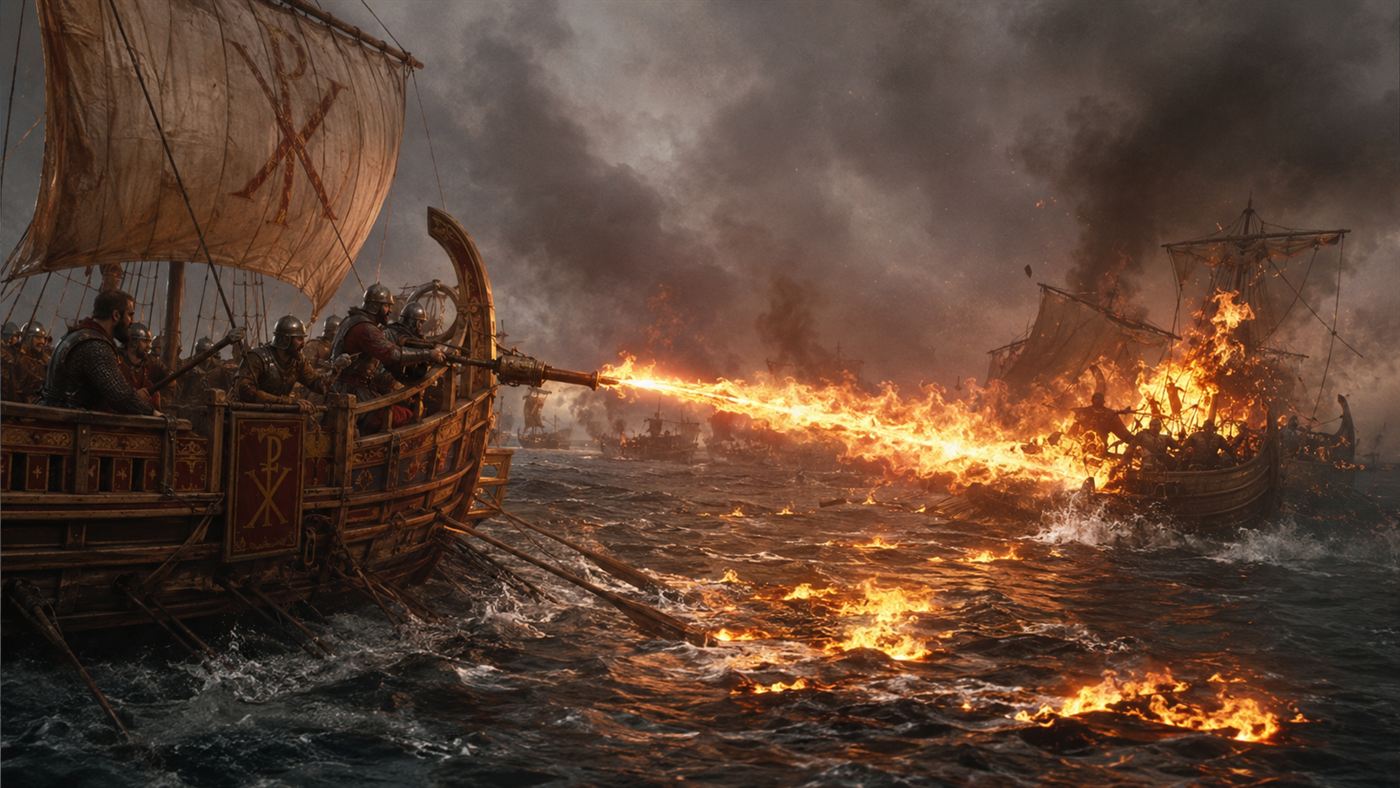
A Byzantine ship spraying Greek fire, the flame that burned on water. Illustration: Watts & Wild.
Greek fire was the closest thing the medieval world had to a superweapon. It was a burning liquid that the Byzantine navy sprayed from its ships onto its enemies, and what made it so terrifying was not only that it set wood and sail and flesh alight, but that water did almost nothing to stop it. Splash the sea over a man covered in Greek fire and the flames spread rather than died. To sailors of the age it must have looked like the empire had learned to set the ocean itself on fire.
For something so famous, it is remarkably mysterious. As historians acknowledge, the precise composition of Greek fire is unknown to this day, because the people who made it kept it among the best-protected secrets any state has ever held. We know roughly what it did, and how it was thrown, but not what it was, and that gap has fascinated chemists and historians for centuries.
What was Greek fire? Greek fire was a Byzantine incendiary weapon, a burning liquid sprayed from bronze siphons on warships that stuck to its targets and kept burning on water. Introduced around 672 AD, it helped save Constantinople from Arab fleets. Its exact recipe was kept secret and is now lost.
A fire that water could not put out
The defining trick of Greek fire was its refusal to be extinguished by water, the one thing every sailor reached for when fire broke out at sea. Accounts say it stuck to whatever it touched, floated and burned on the waves, and could only be smothered with sand, vinegar or old urine, not seawater. Whether it truly burned on the open sea or simply could not be washed off once it clung to a hull, the effect in battle was the same: a fleet hit with it had almost no way to fight the flames.
That single property changed naval warfare. An enemy could no longer close in, grapple and board a Byzantine ship without risking a wall of inextinguishable flame, and a tightly packed fleet could be turned into a field of floating fires. For a defending navy, it was the perfect weapon. On land, in the same centuries of invasion, people defended themselves very differently, by vanishing into Derinkuyu, an underground city carved eighteen storeys deep.
The siphon on the prow
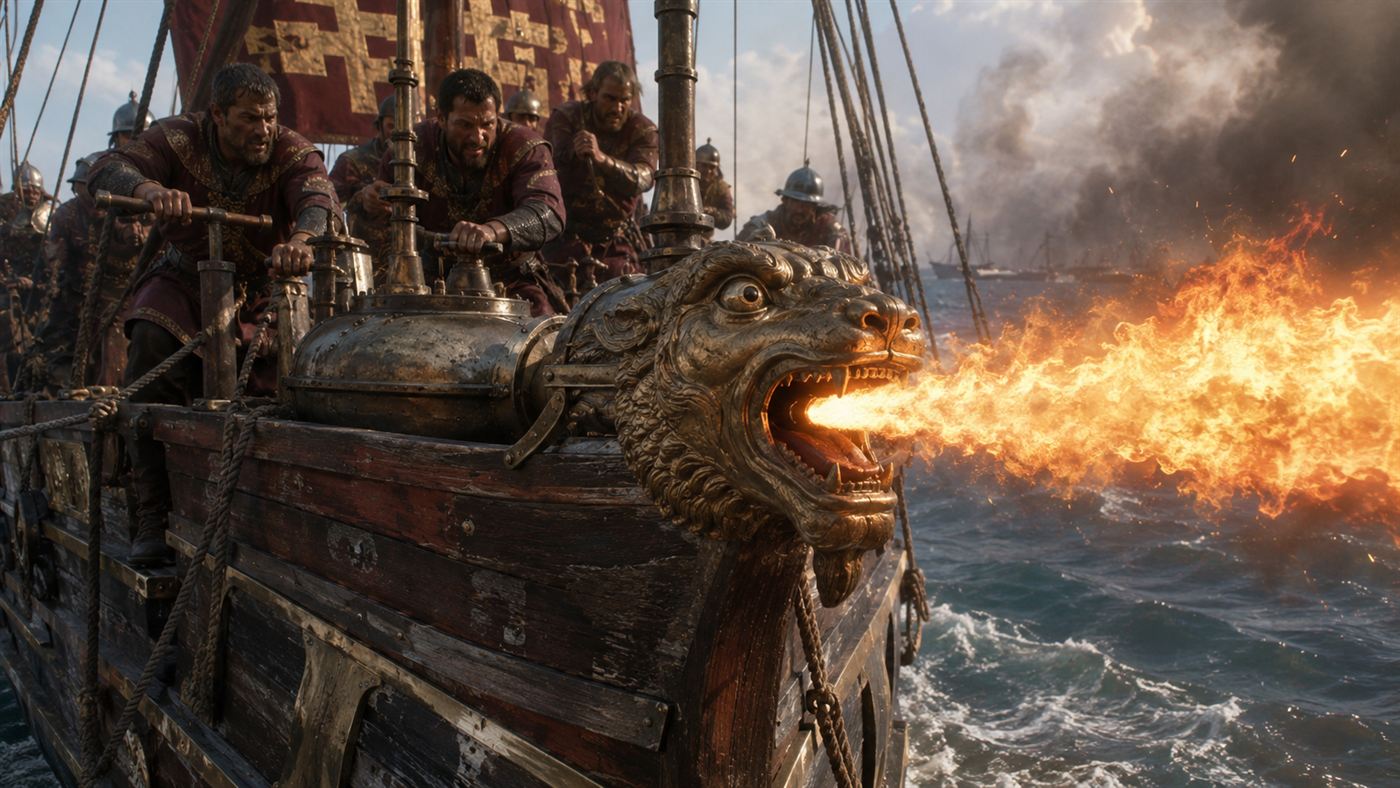
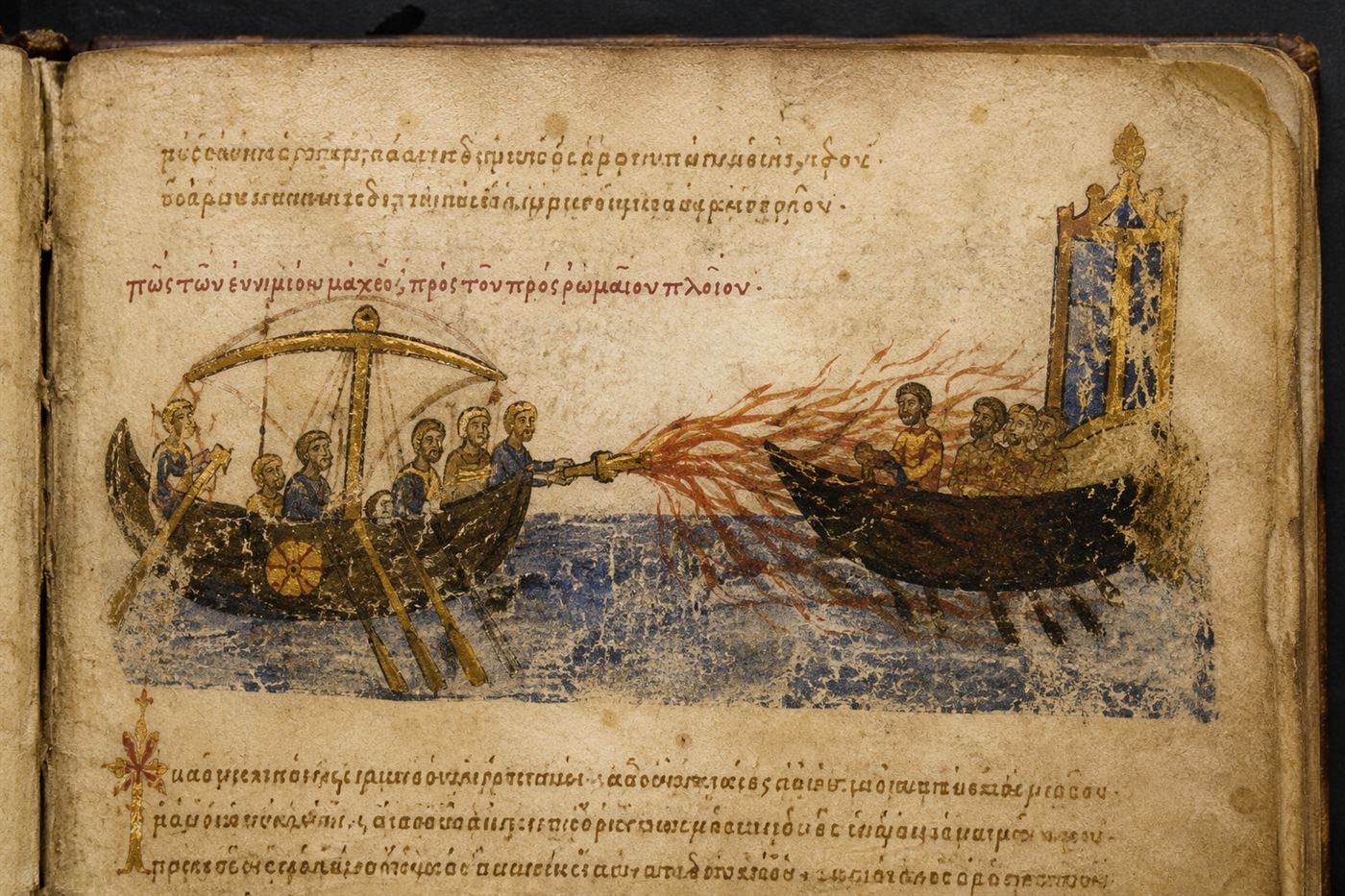
Delivering the stuff was its own feat of engineering. The liquid was heated and put under pressure in a sealed bronze container, then forced out through a tube, a siphon, mounted on the bow of a warship, and set alight as it sprayed. In effect the Byzantines had built a flamethrower more than a thousand years before the word existed, a brass nozzle that threw a roaring jet of fire across the gap between ships.
Operating it safely, on a wooden ship, with a pressurised tank of flammable liquid being heated over a flame, took specially trained crews and steady nerves. There were smaller versions too, hand-held siphons and sealed pots of the mixture thrown like grenades, but the great ship-mounted siphons were the heart of the system, and they made Byzantine galleys the most feared vessels on the sea.
How Greek fire saved Constantinople
Tradition credits Greek fire to a man named Kallinikos, an engineer and refugee who is said to have brought the secret to Constantinople around the year 672. He arrived at a desperate moment. Arab fleets were pressing hard against the Byzantine capital, and the city, and with it much of Christian Europe's eastern shield, was in real danger of falling.
Greek fire turned the sea battles. In the great Arab sieges of Constantinople in the 670s and again in 717 and 718, Byzantine ships armed with it burned attacking fleets on the water and broke the assaults. Historians have argued that without this one weapon the city might well have fallen centuries earlier than it did, and the map of the medieval world would look very different. For roughly seven hundred years afterwards, Greek fire remained the empire's trump card at sea.
A secret kept too well
The Byzantines understood exactly what they had, and they hid it with a thoroughness that still impresses. The secret of Greek fire was not a single recipe but a whole system, and they broke it into pieces. The formula of the liquid, the design of the special ships, the pressurised apparatus that heated and threw it, and the training of the operators were all kept apart, so that no one person, and certainly no captured enemy, held the complete picture. The knowledge passed quietly from emperor to emperor as a state treasure.
It worked so well that it defeated even history. The compartmental secrecy meant the full method was rarely if ever written down, and as the centuries passed and the weapon fell out of use, the knowledge simply faded. By the end of the empire the exact formula had been forgotten, and it has never been recovered. The Byzantines guarded their secret so successfully that they took it to the grave with their empire.
What was in it?
Chemists have spent a long time trying to reverse-engineer Greek fire from its behaviour, and the most popular reconstruction starts with petroleum. The Byzantines had access to crude oil and naphtha seeping from the ground around the Black Sea, and a light petroleum base would explain a liquid that floated and burned on water. To that, theories add a thickener such as pine resin to make it sticky, and sometimes quicklime, which releases heat when it meets water and might help the mixture flare on contact with the sea, along with sulphur for the choking smoke and saltpetre. The truth is that there are several competing recipes and no way to confirm any of them. Another celebrated craft was lost the same way, the making of Damascus steel, the patterned blades that turned out to hold carbon nanotubes.
The honest catch
It is worth remembering how much of the Greek fire story is reconstruction. Almost everything we have comes from secretive, incomplete and sometimes boastful sources, and the most dramatic claim, that it burned freely on the open sea, may be partly legend or psychological terror rather than literal chemistry. Modern experiments with petroleum mixtures can produce something that behaves a lot like the descriptions, but no one can prove it matches the original.
None of that makes the weapon any less real or less important. Greek fire existed, it worked, it helped save one of the great cities of the world, and its recipe is genuinely lost. It was not magic but clever chemistry married to clever engineering and ferocious secrecy, and that combination produced one of the very few technologies humanity has invented, used to change history, and then completely forgotten how to make.
A flame that burned on water, saved an empire, and then vanished from human knowledge so completely that we still cannot make it. Do you think chemists will ever crack the recipe, or is it gone for good? Tell us in the comments.
Related reading: Roman concrete, another ancient recipe so good we are only now relearning it.